
Modules#
Overview#
Modules contain the physical process representation. A principal design goal of a module is that it may depend either upon some set of variables produced by either other modules or on input forcing data. Modules define a set of variables which it provides globally to other modules.
All modules have pre-/post-conditions;
Pre condition
input forcing data or post-conditions from other modules;
Post condition
see pre condition;
Variables
provide global variables to other modules, but these variables do not change in other modules.
There are two types of modules:
Forcing data interpolant
depends upon point-scale input forcing data variables and interpolate these data onto every domain element;
Standard process module
depends only upon the output of interpolation modules or other modules’ output.
A module may not ever write any other variable global variable which it does declare. It should also not overwrite the variables of another module.
Modules are specified to run in the modules section of the configuration file and configured as detailed in the config section. For more details on how modules work, please see Modules.
Note
Unlike filters, modules are executed in an order to resolve the inter-module variable dependencies.
Available modules#
Agriculture#
crop_rotation#
-
class crop_rotation : public module_base
Basic crop rotation. Changes between two different landcovers on even/odd years. On even years, it sets the “crop” parameter to the parameter “annual_crop_inventory_1”, and on odd years it sets it to “annual_crop_inventory_2”. Mostly a proof-of-concept.
Depends:
None
Provides:
None
Configuration:
None
Parameters:
Year even crop “annual_crop_inventory_1”
Year odd crop “annual_crop_inventory_2”
Air temperature#
const_llra_ta#
-
class const_llra_ta : public module_base
Constant linear lapse rate adjustment for air temperature of 0.0065 \({}^\circ C \cdot m^{-1}\).
Requires from met:
Air temperature - “t” [ \( {}^\circ C \)]
Provides:
Lapsed air temperature - “t” [ \( {}^\circ C \)]
Configuration keys:
None
Cullen_monthly_llra_ta#
-
class Cullen_monthly_llra_ta : public module_base
Monthly linear lapse rate adjustment for air temperature using Cullen, et al (2011) for the Rocky Mountains
Requires from met:
Air temperature [ \( {}^\circ C \)]
Provides:
Lapsed air temperature - “t” [ \( {}^\circ C \)]
Configuration keys:
None
Reference:
Cullen, R. M., and S. J. Marshall (2011), Mesoscale temperature patterns in the Rocky Mountains and foothills region of southern Alberta, Atmos. - Ocean, 49(3), 189–205, doi:10.1080/07055900.2011.592130.
Dist_tlapse#
-
class Dist_tlapse : public module_base
Spatially interpolates provided lapse rates from virtual stations
Depends from met:
Air temperature - “t” [ \( \circ C ] \)
Lapse rate - “t_lapse_rate” [ \( \circ C \cdot m^{-1}] \)
Provides:
Air temperature “t” [ \( \circ C ] \)
Lapse rate “t_lapse_rate” [ \( \circ C \cdot m^{-1}] \)
Configuration keys:
None
Dodson_NSA_ta#
-
class Dodson_NSA_ta : public module_base
Implements the neutral stability algorithm for air temperature from Dodson and Marks (1994). The neutral stability algorithm (NSA), uses the hydrostatic and potential temperature equations to convert measured temperatures and elevations to sea-level potential temperatures. The potential temperatures are spatially interpolated and then mapped to the elevation.
Requires from met:
Air temperature “t” [ \( {}^\circ C \)]
Provides:
Air temperature “t” [ \( {}^\circ C \) ]
Lapse rate “t_lapse_rate” [ \( {}^\circ C \cdot m^{-1} \)]
Configuration keys:
None *
Reference: Dodson, R. and Marks, D.: Daily air temperature interpolated at high spatial resolution over a large mountainous region, Clim. Res., 8(Myers 1994), 1–20, doi:10.3354/cr008001, 1997.
Liston_monthly_llra_ta#
-
class Liston_monthly_llra_ta : public module_base
Constant monthly linear lapse rate adjustment for air temperature. Uses Liston and Elder (2006).
Depends from met:
Air temperature “t” [ \( {}^\circ C \) ]
Provides:
Air temperature “t” [ \( {}^\circ C \) ]
Lapse rate “t_lapse_rate” [ \( {}^\circ C \cdot m^{-1} \) ]
Reference: Liston, Glen E., and Kelly Elder. 2006. A meteorological distribution system for high-resolution terrestrial modeling (MicroMet). Journal of hydrometeorology 7: 217-234
t_no_lapse#
-
class t_no_lapse : public module_base
Spatially interpolate air temperature with no lapse rate adjustment
Depends from met:
Air temperature “t” [ \( {}^\circ C \)]
Provides:
Air temperature “t” [ \( {}^\circ C \)]
Lapse rate “t_monthly_lapse” [ \( {}^\circ C \)]
Configuration keys:
None
Atmosphere#
Walcek_cloud#
-
class Walcek_cloud : public module_base
Calculates a cloud fraction using 700mvb RH. Extrapolates RH@700mb via Kunkel (1989).
Depends:
Air temperature “t” [ \( {}^\circ C \) ]
Relative humidity “rh” [%]
Provides:
Atmospheric transmittance “cloud_frac” [0,1]
References:
Walcek, C. J. (1994). Cloud cover and its relationship to relative humidity during a springtime midlatitude cyclone. Monthly Weather Review, 122(6), 1021–1035.
Kunkel, K. E. (1989). Simple procedures for extrapolation of humidity variables in the mountainous western United States. Journal of Climate, 2(7), 656–669.
Evaporation#
PenmanMonteith_evaporation#
-
class PenmanMonteith_evaporation : public module_base
Calculates evapo-transpiration via Penman-Monteith.
Not currently maintained.
Depends:
Incoming shortwave radaition “iswr” [ \( W \cdot m^{-2} \) ]
Incoming longwave radiation “ilwr” [ \( W \cdot m^{-2} \) ]
Relative humidity “rh” [%]
Windspeed at 2m “U_2m_above_srf” [ \( m \cdot s^{-1} \) ]
Provides:
Evapotranspiration “ET” [ \( mm \cdot dt^{-1} \) ]
Experimental#
deform_mesh#
-
class deform_mesh : public module_base
Example of how to deform the mesh’s z-coords.
Warning
There is currently no way for CHM to be updated that the mesh z has changed to recompute slopes/aspect/etc.
Gray_inf#
-
class Gray_inf : public module_base
Estimates areal snowmelt infiltration into frozen soils for: a) Restricted - Water entry impeded by surface conditions b) Limited - Capiliary flow dominates and water flow influenced by soil physical properties c) Unlimited - Gravity flow dominates
Depends:
Snow water equivalent “swe” [mm]
Snow melt for interval “snowmelt_int” [ \(mm \cdot dt^{-1}\)]
Provides:
Infiltration “inf” [ \(mm \cdot dt^{-1}\)]
Total infiltration “total_inf” [mm]
Total infiltration excess “total_excess” [mm]
Total runoff “runoff” [mm]
Total soil storage “soil_storage”
Potential infiltration “potential_inf”
Opportunity time for infiltration to occur “opportunity_time”
Available storage for water of the soil “available_storage”
References:
Gray, D., Toth, B., Zhao, L., Pomeroy, J., Granger, R. (2001). Estimating areal snowmelt infiltration into frozen soils Hydrological Processes 15(16), 3095-3111. https://dx.doi.org/10.1002/hyp.320
Note
Has hardcoded soil parameters that need to be read from the mesh parameters.
PenmanMonteith_evaporation#
-
class PenmanMonteith_evaporation : public module_base
Calculates evapo-transpiration via Penman-Monteith.
Not currently maintained.
Depends:
Incoming shortwave radaition “iswr” [ \( W \cdot m^{-2} \) ]
Incoming longwave radiation “ilwr” [ \( W \cdot m^{-2} \) ]
Relative humidity “rh” [%]
Windspeed at 2m “U_2m_above_srf” [ \( m \cdot s^{-1} \) ]
Provides:
Evapotranspiration “ET” [ \( mm \cdot dt^{-1} \) ]
From meteorological forcing#
const_llra_ta#
-
class const_llra_ta : public module_base
Constant linear lapse rate adjustment for air temperature of 0.0065 \({}^\circ C \cdot m^{-1}\).
Requires from met:
Air temperature - “t” [ \( {}^\circ C \)]
Provides:
Lapsed air temperature - “t” [ \( {}^\circ C \)]
Configuration keys:
None
Cullen_monthly_llra_ta#
-
class Cullen_monthly_llra_ta : public module_base
Monthly linear lapse rate adjustment for air temperature using Cullen, et al (2011) for the Rocky Mountains
Requires from met:
Air temperature [ \( {}^\circ C \)]
Provides:
Lapsed air temperature - “t” [ \( {}^\circ C \)]
Configuration keys:
None
Reference:
Cullen, R. M., and S. J. Marshall (2011), Mesoscale temperature patterns in the Rocky Mountains and foothills region of southern Alberta, Atmos. - Ocean, 49(3), 189–205, doi:10.1080/07055900.2011.592130.
Dist_tlapse#
-
class Dist_tlapse : public module_base
Spatially interpolates provided lapse rates from virtual stations
Depends from met:
Air temperature - “t” [ \( \circ C ] \)
Lapse rate - “t_lapse_rate” [ \( \circ C \cdot m^{-1}] \)
Provides:
Air temperature “t” [ \( \circ C ] \)
Lapse rate “t_lapse_rate” [ \( \circ C \cdot m^{-1}] \)
Configuration keys:
None
Dodson_NSA_ta#
-
class Dodson_NSA_ta : public module_base
Implements the neutral stability algorithm for air temperature from Dodson and Marks (1994). The neutral stability algorithm (NSA), uses the hydrostatic and potential temperature equations to convert measured temperatures and elevations to sea-level potential temperatures. The potential temperatures are spatially interpolated and then mapped to the elevation.
Requires from met:
Air temperature “t” [ \( {}^\circ C \)]
Provides:
Air temperature “t” [ \( {}^\circ C \) ]
Lapse rate “t_lapse_rate” [ \( {}^\circ C \cdot m^{-1} \)]
Configuration keys:
None *
Reference: Dodson, R. and Marks, D.: Daily air temperature interpolated at high spatial resolution over a large mountainous region, Clim. Res., 8(Myers 1994), 1–20, doi:10.3354/cr008001, 1997.
Kunkel_monthlyTd_rh#
-
class Kunkel_monthlyTd_rh : public module_base
Monthly-variable linear lapse rate adjustment for relative humidity based upon Kunkel (1989). RH is lapsed via dew point temperatures.
Depends:
Air temperature “t” [ \( {}^\circ C \)]
Depends from Met:
Relative Humidity “rh” [ \( % \)]
Provides:
Relative humidity “rh” [ \( % \)]
Configuration keys:
None
Reference: Kunkel, K. E. (1989). Simple procedures for extrapolation of humidity variables in the mountainous western United States. Journal of Climate, 2(7), 656–669.
kunkel_rh#
-
class kunkel_rh : public module_base
Directly lapses RH values with elevation. Based on equation 15 in Kunkel (1989).
Depends from met:
Relative Humidity “rh” [ \( % \)]
Provides:
Relative Humidity “rh” [ \( % \)]
Configuration keys:
None
References: Kunkel, K. E. (1989). Simple procedures for extrapolation of humidity variables in the mountainous western United States. Journal of Climate, 2(7), 656–669.
Liston_monthly_llra_ta#
-
class Liston_monthly_llra_ta : public module_base
Constant monthly linear lapse rate adjustment for air temperature. Uses Liston and Elder (2006).
Depends from met:
Air temperature “t” [ \( {}^\circ C \) ]
Provides:
Air temperature “t” [ \( {}^\circ C \) ]
Lapse rate “t_lapse_rate” [ \( {}^\circ C \cdot m^{-1} \) ]
Reference: Liston, Glen E., and Kelly Elder. 2006. A meteorological distribution system for high-resolution terrestrial modeling (MicroMet). Journal of hydrometeorology 7: 217-234
Liston_wind#
-
class Liston_wind : public module_base
Calculates windspeeds using a terrain curvature following Liston and Elder 2006. Direction convention is (North = 0, clockwise from North)
Depends from met:
Wind at reference height “U_R” [ \(m \cdot s^{-1}\)]
Direction at reference height ‘vw_dir’ [degrees] (North = 0, clockwise from North)
Provides:
Wind at reference height “U_R”
Interpolated wind field at reference height prior to downscaling “U_R_orig” [ \(m \cdot s^{-1}\)]
Wind direction “vw_dir” [degrees]
Original wind direction “vw_dir_orig” [degrees]
Amount the wind vector direction has been changed “vw_dir_divergence” [degrees]
Zonal U at reference height “zonal_u” [ \( m \cdot s^{-1}\) ]
Zonal V at reference height “zonal_v” [ \( m \cdot s^{-1}\) ]
Configuration:
{
   "distance": 300,
   "Ww_coeff: 1,
   "ys": 0.5,
   "yc": 0.5
}
- distance#
Distance to “look” to compute the terrain curvature.
- Ww_coeff#
Leading coefficient in equation 16. Used for compatibility with calibration approach such as done by Pohl.
- ys#
Slope weight. Valid range [0,1]. The value of 0.5 gives equal weight to slope and curvature
- yc#
Curvature weight. Valid range [0,1]. The value of 0.5 gives equal weight to slope and curvature
References:
Liston, G. E., & Elder, K. (2006). A meteorological distribution system for high-resolution terrestrial modeling (MicroMet). Journal of Hydrometeorology, 7(2), 217–234. http://doi.org/10.1175/JHM486.1
- Type:
double
- Default:
300
- Type:
int
- Default:
1
- Type:
double
- Default:
0.5
- Type:
double
- Default:
0.5
Longwave_from_obs#
-
class Longwave_from_obs : public module_base
Annually constant longwave lapse rate adjustment to longwave from observations. Lapse rate of 2.8 W/m^2 / 100 meters
Depends from met:
Incoming longwave radiation “Qli” \([W \cdot m^{-2}\)]
Provides:
Incoming longwave “ilwr” \([W \cdot m^{-2}\)]
Configuration keys:
None
Reference: Marty, C., Philipona, R., Fröhlich, C., Ohmura, A. (2002). Altitude dependence of surface radiation fluxes and cloud forcing in the alps: results from the alpine surface radiation budget network Theoretical and Applied Climatology 72(3), 137-155. https://dx.doi.org/10.1007/s007040200019
lw_no_lapse#
-
class lw_no_lapse : public module_base
Spatially interpolates incoming longwave with no adjustment for elevation.
Depends from met:
Incoming longwave radiation “Qli” \([W \cdot m^{-2}\)]
Provides:
Incoming longwave “ilwr” \([W \cdot m^{-2}\)]
Depends:
None
Configuration keys:
None
MS_wind#
-
class MS_wind : public module_base
Calculates windspeeds using the Mason Sykes wind speed from Essery, et al (1999), using 8 lookup map from DBSM. Optionally uses Ryan, et al. for wind direction correction.
Depends from met:
Wind at reference height “U_R” [ \( m \cdot s^{-1}\) ]
Direction at reference height “vw_dir” [degrees]
Provides:
Wind speed at reference height “U_R” [ \( m \cdot s^{-1}\) ]
Wind direction ‘vw_dir’ at reference height [degrees]
Speedup magnitude “W_speedup” [-]
Zonal u speed component at 2m “2m_zonal_u” [ \( m \cdot s^{-1}\) ]
Zonal v speed component at 2m “2m_zonal_v” [ \( m \cdot s^{-1}\) ]
Original interpolated wind direction “vw_dir_orig” [degrees]
Parameters:
Requires speedup, u, and v parameters named “MS%i_U” and “MS%i_V” and “MS%i” for each of the 8 directions. These need to be generated using DBSM in
tools/MSwind.Configuration:
{
   "speedup_height": 2.0,
   "use_ryan_dir", false
}
- speedup_height#
The height at which the MS Wind tool was run for. The default is 2 m and shouldn’t be changed.
- use_ryan_dir#
Instead of using the _u and _v components to compute direction perturbation, use the algorithm of Ryan as per Liston and Elder (2006)
Reference:
Essery, R., Li, L., Pomeroy, J. (1999). A distributed model of blowing snow over complex terrain Hydrological Processes 13(), 2423-2438.
- Type:
double
- Default:
2.0
- Type:
boolean
- Default:
false
p_from_obs#
-
class p_from_obs : public module_base
Spatially distributes liquid water precipitation by calculating lapse rates based on observed data on a per-timestep basis
Depends from met:
Precipitation “p” [ \(mm \cdot dt^{-1}\)]
Provides:
Lapsed precipitation “p” [ \(mm \cdot dt^{-1}\)]
Precipitation corrected for triangle slope. If
"apply_cosine_correction": false, then no change. “p_no_slope” [ \(mm \cdot dt^{-1}\)]
Configuration:
None
p_lapse#
-
class p_lapse : public module_base
Spatially distributes liquid water precipitation using a precipitation lapse rate derived from stations for the Marmot Creek reserach basin or the Upper Bow River Wathershed. Monthly lapse rates are used as in the CRHM model.
Depends from met:
Precip from met file “p” [ \(mm \cdot dt^{-1}\)]
Provides:
Lapsed precipitation “p” [ \(mm \cdot dt^{-1}\)]
Lapse precipitation corrected for triangle slope. If
"apply_cosine_correction": false, then no change. “p_no_slope” [ \(mm \cdot dt^{-1}\)]
Configuration:
{
   "apply_cosine_correction": false
}
- apply_cosine_correction#
Correct precipitation input using triangle slope when input preciptation are given for the horizontally projected area.
References:
Precipitation lapse rate derived from Marmot Creek stations by Logan Fang (used in CRHM for Marmot Creek domain)
- Type:
boolean
- Default:
false
p_no_lapse#
-
class p_no_lapse : public module_base
Spatially distributes liquid water precipitation with no lapsing
Depends from met:
Precipitation “p” [ \(mm \cdot dt^{-1}\)]
Provides:
Precipitation “p” [ \(mm \cdot dt^{-1}\)]
Precipitation corrected for triangle slope. If
"apply_cosine_correction": false, then no change. “p_no_slope” [ \(mm \cdot dt^{-1}\)]
Configuration:
{
   "apply_cosine_correction": false
}
- apply_cosine_correction#
Correct precipitation input using triangle slope when input preciptation are given for the horizontally projected area.
- Type:
boolean
- Default:
false
rh_from_obs#
-
class rh_from_obs : public module_base
Creates an elevation-vapour pressure lapse rate from observed RH values. Depends on the stations to compute the vapour pressure, but it uses an already lapsed temperature from another module to recompute the RH at a triangle.
Depends from met:
Air temperature “t” [ \( {}^\circ C \)]
Relative humidity “rh” [%]
Depends:
Air temperature “t” [ \( {}^\circ C \)]
Provides:
Relative humidity “rh” [%]
Configuration keys:
None *
rh_no_lapse#
-
class rh_no_lapse : public module_base
Spatially interpolates relative humidity without any lapse adjustments. Bounds RH on [10%, 100%].
Depends from met:
Relative Humidity “rh” [%]
Provides:
Relative Humidity “rh” [%]
Configuration keys:
None
t_no_lapse#
-
class t_no_lapse : public module_base
Spatially interpolate air temperature with no lapse rate adjustment
Depends from met:
Air temperature “t” [ \( {}^\circ C \)]
Provides:
Air temperature “t” [ \( {}^\circ C \)]
Lapse rate “t_monthly_lapse” [ \( {}^\circ C \)]
Configuration keys:
None
Thornton_p#
-
class Thornton_p : public module_base
Spatially distributes liquid water precipitation using Thornton, et al. 1997 via monthly lapse rates.
Depends from met:
Precipitation “p” [ \(mm \cdot dt^{-1}\)]
Provides:
Lapsed precipitation “p” [ \(mm \cdot dt^{-1}\)]
Precipitation corrected for triangle slope. If
"apply_cosine_correction": false, then no change. “p_no_slope” [ \(mm \cdot dt^{-1}\)]
Configuration:
{
   "apply_cosine_correction": false
}
- apply_cosine_correction#
Correct precipitation input using triangle slope when input preciptation are given for the horizontally projected area.
References:
Thornton, P. E., Running, S. W., & White, M. A. (1997). Generating surfaces of daily meteorological variables over large regions of complex terrain. Journal of Hydrology, 190(3-4), 214–251. http://doi.org/10.1016/S0022-1694(96)03128-9
- Type:
boolean
- Default:
false
uniform_wind#
-
class uniform_wind : public module_base
Spatially interpolates wind speed and direction without any terrain speed-up modification
Depends from met:
Wind at reference height “U_R” [ \( m \cdot s^{-1}\) ]
Direction at reference height “vw_dir” [degrees]
Provides:
Wind speed at reference height “U_R” [ \( m \cdot s^{-1}\) ]
Wind direction ‘vw_dir’ at reference height [degrees]
WindNinja#
-
class WindNinja : public module_base
Calculates wind speed and direction following the downscaling stategy of Barcons et al. (2018). This is via a library of high-resolution wind field generated with the WindNinja wind flow model. Unless the reference height windspeed is provided, use the scale_wind_speed filter to log-scale the windspeed up to U_R.
Depends from met:
Wind at reference height “U_R” [ \( m \cdot s^{-1}\) ]
Direction at reference height “vw_dir” [degrees]
Provides:
Wind speed at reference height “U_R” [ \( m \cdot s^{-1}\) ]
Wind direction ‘vw_dir’ at reference height [degrees]
Zonal U at reference height “zonal_u” [ \( m \cdot s^{-1}\) ]
Zonal V at reference height “zonal_v” [ \( m \cdot s^{-1}\) ]
Diagnostics:
Downscaled windspeed “Ninja_speed” [ \( m \cdot s^{-1}\) ]
Interpolated wind field at reference height prior to downscaling “U_R_orig” [ \(m \cdot s^{-1}\)]
Interpolated zonal U at level H_Forc “interp_zonal_u” [ \( m \cdot s^{-1}\) ]
Interpolated zonal V at level H_Forc “interp_zonal_v” [ \( m \cdot s^{-1}\) ]
What lookup map was used “lookup_d” [-]
Original wind direction “vw_dir_orig” [degrees]
Amount the wind vector direction has been changed “vw_dir_divergence” [degrees]
Configuration:
{
   "ninja_average": true,
   "compute_Sx": true,
   "ninja_recirc": false,
   "Sx_crit", 30.
   "L_avg": 1000.
   "H_forc": 40,
   "Max_spdup": 3.0,
   "Min_spdup": 0.1,
}
- ninja_average#
Linear interpolation between the closest 2 wind fields from the library
- compute_Sx#
Use the Winstral Sx parameterization to idenitify and modify lee-side windfield. This will cause a runtime error (conflict) if
Winstral_parametersis also a module. This uses an angular window of 30 degrees and a step size of 10 m.
- ninja_recirc#
Enables the leeside slow down via
compute_Sx. Requires"compute_Sx":true.
- Sx_crit#
Reduce wind speed on the lee side of mountain crest identified by Sx>Sx_crit
..confval:: L_avg
The WindMapper tool uses a radius to compute a mean. This is the length over which that average is done. Normally this will be baked into the parameter name (e.g., Ninja_1000). However, there may be reasons to specifiy it directly. Cannot be used if the parameters have the _Lavg suffix. You likely don’t need to set this.
- H_forc#
- Max_spdup#
Limit speed up value to Max_spdup to avoid unrelistic values at crest top
- Min_spdup#
Limit speed up value to Max_spdup to avoid unrelistic values at crest top
Parameters:
Requires speedup, u, and v parameters named “Ninja%i_U” and “Ninja%i_V” and “Ninja%i” for each of the n directions. Should be generated with WindMapper. The number of directions will be automatically determined as will the Lavg value. These should be computed with the Windmapper tool .
References:
Barcons, J., Avila, M., Folch, A. (2018). A wind field downscaling strategy based on domain segmentation and transfer functions Wind Energy 21(6)https://dx.doi.org/10.1002/we.2169
- Type:
boolean
- Default:
true
- Type:
boolean
- Default:
true
- Type:
boolean
- Default:
false
- Type:
double
- Default:
- Type:
int
- Default:
None
- Type:
double
- Default:
40.0
Reference height for input forcing and WindNinja wind field library
- Type:
double
- Default:
3.0
- Type:
double
- Default:
3.0
point_mode#
-
class point_mode : public module_base
Use this module to enable using CHM in point mode. This module does not to any spatial interpolation. Instead, it passes input met through to the per-triangle variables storages. This is suitable for using CHM like a point scale model, such as at a research site. Specifically this sets
depends_from_met(...)inputs such thatdepends(...)in other modules can work.Depends from met::
Air temp “t” [ \( {}^\circ C \)]
Relative humidity “rh” [%]
Wind speed “u” [ \( m \cdot s^{-1} \) ]
Precipitation “p” [mm]
Incoming longwave radiation “Qli” [ \( W \cdot m^{-2}\)]
Incoming shortwave radiation “Qsi” [ \( W \cdot m^{-2}\)]
Incomging shortwave radiation, diffuse beam “iswr_diffuse” [ \( W \cdot m^{-2}\)]
Incomging shortwave radiation, direct beam “iswr_direct” [ \( W \cdot m^{-2}\)]
Wind direction @2m “vw_dir” [degrees]
Ground temperature “T_g” [ \( {}^\circ C \)]
Provides:
Air temp “t” [ \( {}^\circ C \)]
Relative humidity “rh” [%]
Wind speed @2m “U_2m_above_srf” [ \( m \cdot s^{-1} \) ]
Wind speed @reference height “U_R” [ \( m \cdot s^{-1} \) ]
Precipitation “p” [mm]
Incoming longwave radiation “ilwr” [ \( W \cdot m^{-2}\)]
Incoming shortwave radiation “iswr” [ \( W \cdot m^{-2}\)]
Incomging shortwave radiation, diffuse beam “iswr_diffuse” [ \( W \cdot m^{-2}\)]
Incomging shortwave radiation, direct beam “iswr_direct” [ \( W \cdot m^{-2}\)]
Wind direction @2m “vw_dir” [degrees]
Ground temperature “T_g” [ \( {}^\circ C \)]
Configuration:
 "provide":{
    "t": true,
    "rh": true,
    "U_R": true,
    "U_2m_above_srf": true,
    "p": true,
    "ilwr": true,
    "iswr": true,
    "vw_dir": true,
    "iswr_diffuse": false,
    "iswr_direct": false,
    "T_g": false,

    "override":
    {
       "svf":0.8
    }

}
- override.svf#
Allows for setting the sky view factor at the point to be different than what was calculated from the mesh.
Note
The configuration allows for fine-tuning what is passed through. So although
Depends from metbelow lists all of the possible depends, whatever is set in the configuration will be what is required at runtime.
Longwave#
Longwave_from_obs#
-
class Longwave_from_obs : public module_base
Annually constant longwave lapse rate adjustment to longwave from observations. Lapse rate of 2.8 W/m^2 / 100 meters
Depends from met:
Incoming longwave radiation “Qli” \([W \cdot m^{-2}\)]
Provides:
Incoming longwave “ilwr” \([W \cdot m^{-2}\)]
Configuration keys:
None
Reference: Marty, C., Philipona, R., Fröhlich, C., Ohmura, A. (2002). Altitude dependence of surface radiation fluxes and cloud forcing in the alps: results from the alpine surface radiation budget network Theoretical and Applied Climatology 72(3), 137-155. https://dx.doi.org/10.1007/s007040200019
lw_no_lapse#
-
class lw_no_lapse : public module_base
Spatially interpolates incoming longwave with no adjustment for elevation.
Depends from met:
Incoming longwave radiation “Qli” \([W \cdot m^{-2}\)]
Provides:
Incoming longwave “ilwr” \([W \cdot m^{-2}\)]
Depends:
None
Configuration keys:
None
Sicart_ilwr#
-
class Sicart_ilwr : public module_base
Calculates longwave radiation from the atmosphere (including skyview correction) for clear and cloudy days following Sicart, et al (2006)
Depends:
Air temp “t” [ \( {}^\circ C \)]
Relative humidity “rh” [%]
Incoming shortwave radiation “iswr” [ \( W \cdot m^{-2}\)]
Atmospheric transmittance “atm_trans” [-]
Cloud fraction “cloud_frac” [-]
Provides:
Incoming longwave “ilwr” [W/m^2]
Parameters:
Optionally Sky View Factor “svf” [-]
References:
Sicart, J., Pomeroy, J., Essery, R., Bewley, D. (2006). Incoming longwave radiation to melting snow: observations, sensitivity and estimation in Northern environments Hydrological Processes 20(17), 3697-3708. https://dx.doi.org/10.1002/hyp.6383
Walcek_cloud#
-
class Walcek_cloud : public module_base
Calculates a cloud fraction using 700mvb RH. Extrapolates RH@700mb via Kunkel (1989).
Depends:
Air temperature “t” [ \( {}^\circ C \) ]
Relative humidity “rh” [%]
Provides:
Atmospheric transmittance “cloud_frac” [0,1]
References:
Walcek, C. J. (1994). Cloud cover and its relationship to relative humidity during a springtime midlatitude cyclone. Monthly Weather Review, 122(6), 1021–1035.
Kunkel, K. E. (1989). Simple procedures for extrapolation of humidity variables in the mountainous western United States. Journal of Climate, 2(7), 656–669.
NWP#
iswr_from_nwp#
-
class iswr_from_nwp : public module_base
Spatially interpolates total and diffuse shortwave radiation. Computes direct beam as a residual. Best used from NWP system.
Requires from met:
Total shortwave radiation met file - “Qsi” [ \( W \cdot m^2 \)]
Total diffuse shortwave radiation met file - “Qsi_diff” [ \( W \cdot m^2 \)]
Provides:
Shortwave all beam - “iswr” [ \( W \cdot m^2 \)]
Shortwave direct - “iswr_direct” [ \( W \cdot m^2 \)]
Shortwave diffuse - “iswr_diffuse” [ \( W \cdot m^2 \)]
Configuration keys:
None
Parameters#
fetchr#
-
class fetchr : public module_base
Calculates upwind fetch distances. The fetch is broken if a triangle at distance
d * I> current triangle’s elevation.Depends:
Wind direction “vw_dir” [degrees]
Provides:
Fetch distance “fetch” [m]
Configuration:
{
   "steps": 10,
   "max_distance": 1000
}
- steps#
Number of steps along the search vector to check for a higher point
- max_distance#
Maximum search distance to look for a higher point
- I#
Rise/run threshold to multiply against the distance of a test triangle.
References:
Lapen, D. R., and L. W. Martz (1993), The measurement of two simple topographic indices of wind sheltering-exposure from raster digital elevation models, Comput. Geosci., 19(6), 769–779, doi:10.1016/0098-3004(93)90049-B.
- Type:
int
- Default:
10
- Type:
double
- Default:
1000 m
- Type:
double
- Default:
0.06
Winstral#
-
class Winstral
Compute the Winstral parameter that can be used to redistribute wind and precipitation in complex terrain to improve simulation of snow cover variability.
Depends:
Direction at reference height ‘vw_dir’ [degrees]
Snow depth [m] (optional)
Provides:
Winstral parameter “Sx” [degrees]
Configuration:
{
   "dmax": 300,
   "size_of_step": 10.0,
   "height_param": 0.0,
   "angular_window": 30.0,
   "delta_angle" : 5.0,
   "incl_veg": false,
   "incl_snw": false
   "use_subgridz": true
}
- dmax#
Max distance to search
- size_of_step#
Size of the step to take when searching
- height_param#
Height parameter to account for instrument height or the impact of small terrain perturbation on Sx . See Winstral et al. (2013) for more details
- angular_window#
The angle for which to bin the wind directions in
- delta_angle#
- incl_veg#
Should vegetation height be added to terrain height for the calculation
- incl_snw#
Should snow height be added to terrain height for the calculation
- use_subgridz#
Use an interpolated height within the triangle instead of just the triangle cell centre. Avoids step function results.
References:
Winstral, A., Marks, D., Gurney, R. (2013). Simulating wind-affected snow accumulations at catchment to basin scales Advances in Water Resources 55(), 64-79. https://dx.doi.org/10.1016/j.advwatres.2012.08.011
- Type:
double
- Default:
300 m
- Type:
double
- Default:
10.0 m
- Type:
double
- Default:
0.0
- Type:
double
- Default:
30 deg
- Type:
double
- Default:
5.0
- Type:
boolean
- Default:
false
- Type:
boolean
- Default:
false
- Type:
boolean
- Default:
true
Point Mode#
point_mode#
-
class point_mode : public module_base
Use this module to enable using CHM in point mode. This module does not to any spatial interpolation. Instead, it passes input met through to the per-triangle variables storages. This is suitable for using CHM like a point scale model, such as at a research site. Specifically this sets
depends_from_met(...)inputs such thatdepends(...)in other modules can work.Depends from met::
Air temp “t” [ \( {}^\circ C \)]
Relative humidity “rh” [%]
Wind speed “u” [ \( m \cdot s^{-1} \) ]
Precipitation “p” [mm]
Incoming longwave radiation “Qli” [ \( W \cdot m^{-2}\)]
Incoming shortwave radiation “Qsi” [ \( W \cdot m^{-2}\)]
Incomging shortwave radiation, diffuse beam “iswr_diffuse” [ \( W \cdot m^{-2}\)]
Incomging shortwave radiation, direct beam “iswr_direct” [ \( W \cdot m^{-2}\)]
Wind direction @2m “vw_dir” [degrees]
Ground temperature “T_g” [ \( {}^\circ C \)]
Provides:
Air temp “t” [ \( {}^\circ C \)]
Relative humidity “rh” [%]
Wind speed @2m “U_2m_above_srf” [ \( m \cdot s^{-1} \) ]
Wind speed @reference height “U_R” [ \( m \cdot s^{-1} \) ]
Precipitation “p” [mm]
Incoming longwave radiation “ilwr” [ \( W \cdot m^{-2}\)]
Incoming shortwave radiation “iswr” [ \( W \cdot m^{-2}\)]
Incomging shortwave radiation, diffuse beam “iswr_diffuse” [ \( W \cdot m^{-2}\)]
Incomging shortwave radiation, direct beam “iswr_direct” [ \( W \cdot m^{-2}\)]
Wind direction @2m “vw_dir” [degrees]
Ground temperature “T_g” [ \( {}^\circ C \)]
Configuration:
 "provide":{
    "t": true,
    "rh": true,
    "U_R": true,
    "U_2m_above_srf": true,
    "p": true,
    "ilwr": true,
    "iswr": true,
    "vw_dir": true,
    "iswr_diffuse": false,
    "iswr_direct": false,
    "T_g": false,

    "override":
    {
       "svf":0.8
    }

}
- override.svf#
Allows for setting the sky view factor at the point to be different than what was calculated from the mesh.
Note
The configuration allows for fine-tuning what is passed through. So although
Depends from metbelow lists all of the possible depends, whatever is set in the configuration will be what is required at runtime.
Precipitation#
Harder_precip_phase#
-
class Harder_precip_phase : public module_base
Calculates precipitation phase via falling hydrometeor energy balance following Harder, et al (2013)
Depends:
Air temperature “t” [ \( {}^\circ C\) ]
Relative Humidity “rh” [%]
Precip “p” [ \(mm \cdot dt^{-1}\) ]
Provides:
Snow precip p_snow [ \(mm \cdot dt^{-1}\)]
Liquid precip p_rain [ \(mm \cdot dt^{-1}\)]
Fraction of rain “frac_precip_rain” [-]
Fraction of snow “frac_precip_snow” [-]
Cumulated snow precip “acc_snow” [mm]
Cumulated liquid precip “acc_rain” [mm]
References:
Harder, P., Pomeroy, J. (2013). Estimating precipitation phase using a psychrometric energy balance method Hydrological Processes 27(13), 1901-1914. https://dx.doi.org/10.1002/hyp.9799
p_from_obs#
-
class p_from_obs : public module_base
Spatially distributes liquid water precipitation by calculating lapse rates based on observed data on a per-timestep basis
Depends from met:
Precipitation “p” [ \(mm \cdot dt^{-1}\)]
Provides:
Lapsed precipitation “p” [ \(mm \cdot dt^{-1}\)]
Precipitation corrected for triangle slope. If
"apply_cosine_correction": false, then no change. “p_no_slope” [ \(mm \cdot dt^{-1}\)]
Configuration:
None
p_lapse#
-
class p_lapse : public module_base
Spatially distributes liquid water precipitation using a precipitation lapse rate derived from stations for the Marmot Creek reserach basin or the Upper Bow River Wathershed. Monthly lapse rates are used as in the CRHM model.
Depends from met:
Precip from met file “p” [ \(mm \cdot dt^{-1}\)]
Provides:
Lapsed precipitation “p” [ \(mm \cdot dt^{-1}\)]
Lapse precipitation corrected for triangle slope. If
"apply_cosine_correction": false, then no change. “p_no_slope” [ \(mm \cdot dt^{-1}\)]
Configuration:
{
   "apply_cosine_correction": false
}
- apply_cosine_correction#
Correct precipitation input using triangle slope when input preciptation are given for the horizontally projected area.
References:
Precipitation lapse rate derived from Marmot Creek stations by Logan Fang (used in CRHM for Marmot Creek domain)
- Type:
boolean
- Default:
false
p_no_lapse#
-
class p_no_lapse : public module_base
Spatially distributes liquid water precipitation with no lapsing
Depends from met:
Precipitation “p” [ \(mm \cdot dt^{-1}\)]
Provides:
Precipitation “p” [ \(mm \cdot dt^{-1}\)]
Precipitation corrected for triangle slope. If
"apply_cosine_correction": false, then no change. “p_no_slope” [ \(mm \cdot dt^{-1}\)]
Configuration:
{
   "apply_cosine_correction": false
}
- apply_cosine_correction#
Correct precipitation input using triangle slope when input preciptation are given for the horizontally projected area.
- Type:
boolean
- Default:
false
Thornton_p#
-
class Thornton_p : public module_base
Spatially distributes liquid water precipitation using Thornton, et al. 1997 via monthly lapse rates.
Depends from met:
Precipitation “p” [ \(mm \cdot dt^{-1}\)]
Provides:
Lapsed precipitation “p” [ \(mm \cdot dt^{-1}\)]
Precipitation corrected for triangle slope. If
"apply_cosine_correction": false, then no change. “p_no_slope” [ \(mm \cdot dt^{-1}\)]
Configuration:
{
   "apply_cosine_correction": false
}
- apply_cosine_correction#
Correct precipitation input using triangle slope when input preciptation are given for the horizontally projected area.
References:
Thornton, P. E., Running, S. W., & White, M. A. (1997). Generating surfaces of daily meteorological variables over large regions of complex terrain. Journal of Hydrology, 190(3-4), 214–251. http://doi.org/10.1016/S0022-1694(96)03128-9
- Type:
boolean
- Default:
false
Relative humidity#
Kunkel_monthlyTd_rh#
-
class Kunkel_monthlyTd_rh : public module_base
Monthly-variable linear lapse rate adjustment for relative humidity based upon Kunkel (1989). RH is lapsed via dew point temperatures.
Depends:
Air temperature “t” [ \( {}^\circ C \)]
Depends from Met:
Relative Humidity “rh” [ \( % \)]
Provides:
Relative humidity “rh” [ \( % \)]
Configuration keys:
None
Reference: Kunkel, K. E. (1989). Simple procedures for extrapolation of humidity variables in the mountainous western United States. Journal of Climate, 2(7), 656–669.
kunkel_rh#
-
class kunkel_rh : public module_base
Directly lapses RH values with elevation. Based on equation 15 in Kunkel (1989).
Depends from met:
Relative Humidity “rh” [ \( % \)]
Provides:
Relative Humidity “rh” [ \( % \)]
Configuration keys:
None
References: Kunkel, K. E. (1989). Simple procedures for extrapolation of humidity variables in the mountainous western United States. Journal of Climate, 2(7), 656–669.
rh_from_obs#
-
class rh_from_obs : public module_base
Creates an elevation-vapour pressure lapse rate from observed RH values. Depends on the stations to compute the vapour pressure, but it uses an already lapsed temperature from another module to recompute the RH at a triangle.
Depends from met:
Air temperature “t” [ \( {}^\circ C \)]
Relative humidity “rh” [%]
Depends:
Air temperature “t” [ \( {}^\circ C \)]
Provides:
Relative humidity “rh” [%]
Configuration keys:
None *
rh_no_lapse#
-
class rh_no_lapse : public module_base
Spatially interpolates relative humidity without any lapse adjustments. Bounds RH on [10%, 100%].
Depends from met:
Relative Humidity “rh” [%]
Provides:
Relative Humidity “rh” [%]
Configuration keys:
None
Shortwave radiation#
Burridge_iswr#
-
class Burridge_iswr : public module_base
Computes incoming shortwave direct and diffuse beam radiation using a cloud fraction.
Depends:
Cloud fraction “cloud_frac” (-)
Solar elevation “solar_el” (degrees)
Provides:
Shortwave direct beam without slope correction “iswr_direct_no_slope” \([W \cdot m^{-2}\)]
Shortwave diffuse beam without slope correction “iswr_diffuse_no_slope” \([W \cdot m^{-2}\)]
Atmospheric transmittance, [0,1] “atm_trans” [-]
Configuration:
None
References:
Burridge, D. M., and A. J. Gadd, 1974: The Meteorological Office operational 10 level numerical weather prediction model (December 1974). U.K. Met. Office Tech. Notes 12 and 48, 57 pp.
Described in Liston, G. E., & Elder, K. (2006). A meteorological distribution system for high-resolution terrestrial modeling (MicroMet). Journal of Hydrometeorology, 7(2), 217–234. http://doi.org/10.1175/JHM486.1
fast_shadow#
-
class fast_shadow : public module_base
Calculates horizon shadows using an adaptation of Dozier and Frew 1990 to an unstructured mesh. Modifies the direct beam iswr ( = 0 W/m^2). Does not impact the diffuse beam
Requires:
Solar elevation “solar_el” [degrees]
Solar azimuth “solar_az” [degrees]
Provides:
Binary no shadow/shadow “shadow” [0 or 1=shadow]
Configuration:
{
   "steps": 10,
   "max_distance": 1000
}
- steps#
Number of steps along the search vector to check for a higher point
- max_distance#
Maximum search distance to look for a higher point
References:
Dozier, J., & Frew, J. (1990). Rapid calculation of terrain parameters for radiation modeling from digital elevation data. IEEE Transactions on Geoscience and Remote, 28(5), 963–969.
Marsh, C., Pomeroy, J., Wheater, H. (2020). The Canadian Hydrological Model (CHM) v1.0: a multi-scale, multi-extent, variable-complexity hydrological model – design and overview Geoscientific Model Development 13(1), 225-247. https://dx.doi.org/10.5194/gmd-13-225-2020
- Type:
int
- Default:
10
- Type:
double
- Default:
1000 m
iswr_from_nwp#
-
class iswr_from_nwp : public module_base
Spatially interpolates total and diffuse shortwave radiation. Computes direct beam as a residual. Best used from NWP system.
Requires from met:
Total shortwave radiation met file - “Qsi” [ \( W \cdot m^2 \)]
Total diffuse shortwave radiation met file - “Qsi_diff” [ \( W \cdot m^2 \)]
Provides:
Shortwave all beam - “iswr” [ \( W \cdot m^2 \)]
Shortwave direct - “iswr_direct” [ \( W \cdot m^2 \)]
Shortwave diffuse - “iswr_diffuse” [ \( W \cdot m^2 \)]
Configuration keys:
None
iswr_from_obs#
-
class iswr_from_obs : public module_base
Spatially interpolates observed shortwave measurements and estimates direct and diffuse beam components using Nijssen and Lettenmaier (1999).
Depends from met:
Shortwave radiation - “Qsi” [ \( W \cdot m^2 \)]
Provides:
Shortwave all beam “iswr” [ \( W \cdot m^2 \)]
Shortwave direct “iswr_direct” [ \( W \cdot m^2 \)]
Shortwave diffuse “iswr_diffuse” [ \( W \cdot m^2 \)]
Atmospheric transmittance, [0,1] “atm_trans” [-]
Configuration keys:
None
References: Nijssen, B., Lettenmaier, D. (1999). A simplified approach for predicting shortwave radiation transfer through boreal forest canopies Journal of Geophysical Research 104(D22), 27859. https://dx.doi.org/10.1029/1999jd900377
Iqbal_iswr#
-
class Iqbal_iswr : public module_base
Estimates incoming shortwave direct and diffuse beams without slope correction.
Depends:
Air temperature “t” [ \({}^\circ C \)]
Relative humidity “rh” [%]
Cloud fraction “cloud_frac” [-]
Solar elevation “solar_el” [degrees]
Provides:
Incoming solar shortwave radiation, direct beam, no slope adjustment “iswr_direct_no_slope” [ \( W \cdot m^{-2}\)]
Incoming solar shortwave radiation, diffuse beam, no slope adjustment “iswr_diffuse_no_slope” [ \( W \cdot m^{-2}\)]
Atmospheric transmittance “atm_trans” [-]
References:
Code ported from SUMMA
Iqbal, M. (1983). An Introduction to Solar Radiation https://dx.doi.org/10.1016/b978-0-12-373750-2.50015-x
iswr#
-
class iswr : public module_base
This aggregates the _no_slope direct and diffuse flat plane estimates provided by other modules and calculates a unified variant that includes (if required) slope effects and applies shadow masks from shadowing modules.
Depends:
Shortwave direct on a flat plane “iswr_direct_no_slope” [ \( W \cdot m^{-2}\)]
Shortwave diffuse on a flat plane “iswr_diffuse_no_slope” [ \( W \cdot m^{-2}\)]
Provides:
Shortwave all beam “iswr” [ \( W \cdot m^{-2}\)]
Shortwave direct “iswr_direct” [ \( W \cdot m^{-2}\)]
Shortwave diffuse “iswr_diffuse” [ \( W \cdot m^{-2}\)]
Configuration:
{
   "no_slope": false,
   "already_cosine_corrected": false
}
- no_slope#
Disables slope correction.
- already_cosine_corrected#
- ”Most observations implicitly have a cosine-correction built in by virtu of the flat-plane observation.
When using observed, ground based observations, you probably want to set this to true, so that a cosine correction is not applied twice.
If the forcing input is out of a NWP, then this should be
false.
Warning
If using ground-based observations, please look at the
already_cosine_correctedconfiguration option!- Type:
boolean
- Default:
false
- Type:
boolean
- Default:
false
Marsh_shading_iswr#
-
class Marsh_shading_iswr : public module_base
Computes the horizon-shadows using the parallel point plane projection from Marsh, et al (2011). The :ref:
fast_shadowroutine provides almost as good of a result with less computational overhead.Depends:
Solar azimuth “solar_az” [degrees]
Solar elevation “solar_el” [degrees]
Provides:
Value that provides a metric for triangle ‘nearness’ to the sun “z_prime” [-]
Binary shadow value “shadowed” [1 (true) / 0 (false)]
Configuration:
{
   "x_AABB":10,
   "y_AABB":10
}


The domain is split into an x/y grid in projection space.
Triangles are only compared to triangles in their bin to compute shadows. Thus, the smaller the value the
more chance of missing a triangle intersection. It also decreases the number of comparisons and can dramatically
decrease the computational time.
- x_AABB#
This is the size number of bins in the x direction.
- y_AABB#
This is the size number of bins in the y direction.
Marsh, C.B., J.W. Pomeroy, and R.J. Spiteri. “Implications of Mountain Shading on Calculating Energy for Snowmelt Using Unstructured Triangular Meshes.” Hydrological Processes 26, no. 12 (June 15, 2012): 1767–78. doi:10.1002/hyp.9329.
- Type:
int
- Default:
10
- Type:
int
- Default:
10
slope_iswr#
-
class slope_iswr : public module_base
Calculates incoming direct-beam shortwave solar radiation to slope
Depends:
Incoming solar shortwave radiation, all beam “iswr” [ \( W \cdot m^{-2} \) ]
Incoming solar shortwave radiation, direct beam “iswr_direct” [ \( W \cdot m^{-2} \) ]
Incoming solar shortwave radiation, diffuse beam “iswr_diffuse” [ \( W \cdot m^{-2} \) ]
Solar elevation “solar_el” [degrees]
Solar azimuth “solar_az” [degrees]
Optional:
Shadow map “shadow” [0,1]
Provides:
Slope corrected shortwave all beam “iswr” [W/m^2]
Slope corrected shortwave direct “iswr_direct” [W/m^2]
Solar angle “solar_angle” [degrees]
{
   "no_slope": false
}
- no_slope#
Disables slope correction calcuation when
true
- Default:
false
solar#
-
class solar : public module_base
Calculates solar position
Depends:
None
Provides:
Solar elevation “solar_el” [degrees]
Solar azimuth “solar_az” [degrees]
Provides:
Sky view view “svf” [-]
Configuration:
{
   "svf":
   {
      "steps": 10.
      "max_distance": 1000.0,
      "nsectors": 12,
      "compute": true
   }
}
- steps#
Number of search steps
- max_distance#
Maximum search distance
- nsectors#
Number of azimuthal search bins
- compute#
Compute the sky view factor
- Type:
int
- Default:
10
- Default:
1000.0
- Type:
int
- Default:
12
- Default:
true
Walcek_cloud#
-
class Walcek_cloud : public module_base
Calculates a cloud fraction using 700mvb RH. Extrapolates RH@700mb via Kunkel (1989).
Depends:
Air temperature “t” [ \( {}^\circ C \) ]
Relative humidity “rh” [%]
Provides:
Atmospheric transmittance “cloud_frac” [0,1]
References:
Walcek, C. J. (1994). Cloud cover and its relationship to relative humidity during a springtime midlatitude cyclone. Monthly Weather Review, 122(6), 1021–1035.
Kunkel, K. E. (1989). Simple procedures for extrapolation of humidity variables in the mountainous western United States. Journal of Climate, 2(7), 656–669.
Snow#
FSM#
-
class FSM : public module_base
Flexible Snow Model (FSM) 2.0
“The Flexible Snow Model (FSM2) is a multi-physics energy balance model of snow accumulation and melt,
extending the Factorial Snow Model (Essery, 2015) with additional physics, driving and output options.”
This version of FSM has been customized to have the sophisticated process parametrizations selected in every case, except atmospheric stability corrections.
Depends:
Solar elevation “solar_el” [degrees]
Incoming longwave radiation “ilwr” \([W \cdot m^{-2}\)]
Relative Humidy “rh” [%]
Air temperature “t” [ \( {}^\circ C \)]
Precipitation snow “p_snow” [ \(mm \cdot dt^{-1}\)]
Precipitation rain “p_rain” [ \(mm \cdot dt^{-1}\)]
Wind speed 2 m above surface “U_2m_above_srf” [ \( m \cdot s^{-1}\) ]
Incoming shortwave radiation, direct beam “iswr_direct” \([W \cdot m^{-2}\)]
Incoming shortwave radiation, diffuse beam “iswr_diffuse” \([W \cdot m^{-2}\)]
Provides:
Sensible heat flux “H” \([W \cdot m^{-2}]\)
Latent heat flux “E” \([W \cdot m^{-2}]\)
Outgoing longwave radiation “ilwr_out” (alias “LWout”) \([W \cdot m^{-2}]\)
Melt rate “melt_rate” \([mm \cdot dt^{-1}]\)
Surface runoff/drainage, includes rain on snow percolation “roff” \([mm \cdot dt^{-1}]\)
Mean snow depth (slope-normal) “snowdepthavg” [m]
Mean snow depth (vertical projection) “snowdepthavg_vert” [m]
Snow water equivalent “swe” [mm]
Instantaneous sublimation “subl” \([mm \cdot dt^{-1}]\)
Cumulative sublimation “sum_snowpack_subl” [mm]
Snow albedo “snow_albedo” [-]
Number of snow layers “Nsnow” [-]
Snow liquid water content layer 0 “Sliq[0]” [mm]
Snow liquid water content layer 1 “Sliq[1]” [mm]
Snow liquid water content layer 2 “Sliq[2]” [mm]
Snow temperature layer 0 “Tsnow[0]” [K]
Snow temperature layer 1 “Tsnow[1]” [K]
Snow temperature layer 2 “Tsnow[2]” [K]
Soil temperature layer 0 “Tsoil[0]” [K]
Soil temperature layer 1 “Tsoil[1]” [K]
Soil temperature layer 2 “Tsoil[2]” [K]
Soil temperature layer 3 “Tsoil[3]” [K]
Optional:
Sub-canopy forcing:
Subcanopy incoming shortwave radiation “iswr_subcanopy” \([W \cdot m^{-2}\)]
Subcanopy relative humidity “rh_subcanopy” [%]
Subcanopy air temperatue “ta_subcanopy” [ \( {}^\circ C \)]
Subcanopy incoming longwave radidation “ilwr_subcanopy” \([W \cdot m^{-2}\)]
References:
Essery, R. (2015). A factorial snowpack model (FSM 1.0) Geoscientific Model Development 8(12), 3867 3876. https://dx.doi.org/10.5194/gmd-8-3867-2015
Warning
Vegetation characteristics remain a TODO
Harder_precip_phase#
-
class Harder_precip_phase : public module_base
Calculates precipitation phase via falling hydrometeor energy balance following Harder, et al (2013)
Depends:
Air temperature “t” [ \( {}^\circ C\) ]
Relative Humidity “rh” [%]
Precip “p” [ \(mm \cdot dt^{-1}\) ]
Provides:
Snow precip p_snow [ \(mm \cdot dt^{-1}\)]
Liquid precip p_rain [ \(mm \cdot dt^{-1}\)]
Fraction of rain “frac_precip_rain” [-]
Fraction of snow “frac_precip_snow” [-]
Cumulated snow precip “acc_snow” [mm]
Cumulated liquid precip “acc_rain” [mm]
References:
Harder, P., Pomeroy, J. (2013). Estimating precipitation phase using a psychrometric energy balance method Hydrological Processes 27(13), 1901-1914. https://dx.doi.org/10.1002/hyp.9799
PBSM3D#
-
class PBSM3D : public module_base
A 3D scalar-transport blowing snow model that is spatially discretized using the finite volume method. The methods are detailed in Marsh, et al (2020) but are ultimately based upon the work of Pomeroy, et al from the late 1980s and early 1990s. Due to the use of the FVM, neither simplifying assumptions about wind direction nor domain rotations into the wind direction are needed. This allows use where the wind flow is divergent and over large extents. Erosion and deposition are computed as the spatial and temporal divergence of the suspension and saltation fluxes, that is, their rate of change over space and over model time steps.
The nonsteady effects of upwind fetch are represented by a downwind increase with fetch to a fully developed saturation level in the saltation concentrations. This is used to calculate suspended concentrations and the increasing height of the suspended snow layer with fetch. The steady‐state saltation flux parameterizations (Pomeroy & Gray, 1990) are used to calculate the saltation layer mass concentration based on an observed relationship between saltation trajectory height and shear stress.
Precipitation is not currently blown simultaneously
This should be used with a wind parameterziation such as the WindNinja module.
Depends:
Air temp “t” [ \( {}^\circ C \)]
Relative humidity “rh” [%]
Snow water equivalent “swe” [mm]
Wind speed @2m “U_2m_above_srf” [ \( m \cdot s^{-1} \) ]
Wind direction @2m “vw_dir” [degrees]
Wind speed @reference height “U_R” [ \( m \cdot s^{-1} \) ]
Provides:
Blowing snow probability. Only active if
use_PomLi_probability:true“blowingsnow_probability” [0-1]Sublimation flux “Qsubl” [ \( kg \cdot (m^2 \cdot s)^{-1} \) ]
Sublimation mass “Qsubl_mass” [ \( kg \cdot m^{-2} \) ]
Total sublimation “sum_subl”
Mass eroded or deposited during blowing snow. Positive for mass deposition, negative for mass removal. [ \( kg \cdot m^{-2} \) ]
Down wind suspension flux “Qsusp” [ \( kg \cdot (m \cdot s)^{-1} \) ]
Saltation flux “Qsalt” [ \( kg \cdot (m \cdot s)^{-1} \)]
Cumulative mass erorded or desposited during model run “sum_drift” [ \( kg \cdot m^{-2} \) ]
Upwind fetch if
exp_fetchortanh_fetchare used “fetch” [m]Hours since last snowfall if only
use_PomLi_probabilityis used “p_snow_hours” [hr]
Parameters:
If
enable_veg=True, then the vegetation height “CanopyHeight” [m]If
use_R94_lambda=Truethen leaf area index “LAI” [-]
Configuration:
{
   "use_exp_fetch": false,
   "use_tanh_fetch": true,
   "use_PomLi_probability": false,
   "z0_ustar_coupling": false,
   "use_R94_lambda": true,
   "N":1,
   "dv":0.8,
   "debug_output": false,
   "nLayer": 10,
   "do_fixed_settling": false,
   "settling_velocity":0.5,
   "do_sublimation": true,
   "do_lateral_diff": true,
   "smooth_coeff":820,
   "min_sd_trans": 0.1,
   "cutoff": 0.3,
   "snow_diffusion_const":0.3,
   "rouault_diffusion_coef": false,
   "enable_veg": true,
   "iterative_subl": false,

}
- use_exp_fetch#
Use the exp fetch proposed by Liston Liston, G., & Sturm, M. (1998). A snow-transport model for complex terrain. Journal of Glaciology
- use_tanh_fetch#
Use the tanh formulation of Pomeroy & Male (1986). Has more physical basis than
use_exp_fetch.
- use_PomLi_probability#
Considers temporal non-steady effects on blowing snow occurence via the upscaled Pomeroy and Li (2000) parameterization. Requires hours since last snowfall “p_snow_hours” [hr]. This has not been extensively tested for applicability to triangles and should be used with caution.
- z0_ustar_coupling#
To test if blowing snow occurs, a friction velocity is compared to a threshold. This friction velcoity needs a z0 estimated to be computed. If there is blowing snow, the z0 value is larger than under non-blowing snow conditions. Therefore an execution order problem occurs: should the blowing snow z0 and impact on u be used to test for blowing snow? Setting this to true uses the blowing snow z0. Testing suggests this can overestiamte blowing snow occurence.
- use_subgrid_topo#
Experimental sub-grid topographic impacts. Do not use.
- use_subgrid_topo_V2#
Experimental sub-grid topographic impacts v2. Do not use.
- use_R94_lambda#
Estimate vegetation characteristics from LAI observation. This has been tested less extensively than the N, dv options below. Raupach (1994) (DOI:10.1007/BF00709229)
- N#
If
use_R94_lambda:falsethen use the vegetation number dnesity (number/m^2)
- dv#
If
use_R94_lambda:falsethen use the vegetation stalk diameter (m)
- debug_output#
Write extra run-time diangostics such as per-layer suspension concentration to the output file. Adds significant computtional overhead.
- nLayer#
Number of vertical discretization layers. 10-15 have been found to generally work well
- do_fixed_settling#
If true, instead of computing a settling velocity a fixed value given by
settling_velocityis used.
- settling_velocity#
Fixed settling velocity. Requires setting
do_fixed_settling:true
- do_sublimation#
Compute sublimation losses from the saltation and suspension layers.
- do_lateral_diff#
Add a very small amount of lateral diffusion for numerical robustness. Should be left alone.
- smooth_coeff#
Multidimensional transport equations may have spurious oscillations in the solution (Kuzmin, 2010). This term is a Laplacian smoothing (Kuzmin, 2010) term, without which oscillations between erosion and deposition may appear. This should be set to be the largest distance over which oscillations are allowed. It should be a few times the average triangle length scale (\(\alpha\)):
\[\frac{\alpha^2}{\pi^2}.\]
- min_sd_trans#
Minimum snowdepth below which blowing snow saltation is not computed for this triangle. A basic form of sub-grid variability.
- cutoff#
If (vegetation heigh - snow depth) <= cutoff, blowing snow (saltation) is inhibilited for this triangle. Used to allow some in-shrub blowing snow to occur.
- snow_diffusion_const#
Scales the eddy diffusivity. There is some physical basis for it, but this parameter has quite a bit of variability in the literature 0.3 to 1. In PBSM3D better results have been found for values ~0.3 such that these results closely match QSusp estimates from Pomeroy, et al. This accounts for lower than reported in the literature values for the settling velocity. Thus, this parameter, for larger triangles (versus point models) accounts for spatial variability in fall velocities and turbulent diffusion. The larger triangles require setting this lower than what is generally reported for a point-scale model.
- rouault_diffusion_coef#
This over rides the
snow_diffusion_constby using the Rouault diffusion coefficient estimation (e.g., used by Déry, et al (1999)). This approach tends to produce a diffusion coefficient that is a bit too high.Rouault, M., Mestayer, P., Schiestel, R. (1991). A model of evaporating spray droplet dispersion Journal of Geophysical Research: Oceans 96(C4), 7181-7200. https://dx.doi.org/10.1029/90jc02569
- enable_veg#
Set to false to ignore vegetation impacts
- iterative_subl#
Use the Pomeroy and Li (2000) iterative solution for Schimdt’s sublimation equation. This code path has not had extensive testing and should not be used at the moment.
References:
Marsh, C., Pomeroy, J., Spiteri, R., Wheater, H. (2020). A Finite Volume Blowing Snow Model for Use With Variable Resolution Meshes Water Resources Research 56(2)https://dx.doi.org/10.1029/2019wr025307
- Default:
false
- Default:
true
- Default:
false
- Default:
false
- Default:
true
- Default:
1
- Default:
0.8
- Default:
false
- Default:
10
- Default:
false
- Default:
0.5 [m/s]
- Default:
true
- Default:
true
- Default:
820
- Type:
double
- Default:
0.1
- Type:
double
- Default:
0.3
- Type:
double
- Default:
0.3
- Default:
false
- Default:
true
- Default:
false
Richard_albedo#
-
class Richard_albedo : public module_base
Slow albedo changes for cold snow are neglected, but an exponential decay to an asymptotic minimum of 0.5 with an adjustable time constant applied to melting snow.
Somewhat mis-named as although this is detailed in Essery and Etchevers (2004), the original source is from CLASS detailed in Verseghy, et al (1991).
Depends:
Snow Water Equivalent “swe” [mm]
Snow surface temperature “T_s_0” [ \( K \) ]
Precipitation, snow phase “p_snow” [ \( mm \cdot dt^{-1} \) ]
Provides:
Snow albedo “snow_albedo” [0-1]
True if a melting snow albedo is being used “melting_albedo” [0 or 1]
Configuration:
{
   "albedo_min": 0.5,
   "albedo_max": 0.84,
   "a1": 1.08e7,
   "a2": 7.2e5,
   "min_swe_refresh": 1.0,
   "init_albedo_snow": 0.85,
   "init_albedo_bare": 0.17
}
- albedo_min#
Minimum snow albedo
- albedo_max#
Maximum snow albedo
- a1#
Cold snow decay constant
- a2#
Melting snow decay constant
- init_albedo_snow#
Initial fresh snow albedo
- init_albedo_bare#
Bare ground albedo
References:
Equation 4 and 5
Essery, R., and P. Etchevers (2004), Parameter sensitivity in simulations of snowmelt, J. Geophys. Res., 109(D20111), 1–15, doi:10.1029/2004JD005036.
Verseghy, D. L.: Class – A Canadian land surface scheme for GCMS, I. Soil model, Int. J. Climatol., 11, 111–133, https://doi.org/10.1002/joc.3370110202, 1991
- Type:
double
- Default:
0.5
- Type:
double
- Default:
0.84
- Type:
double
- Default:
1.08e7 s
- Type:
double
- Default:
7.2e5 s
- Type:
double
- Default:
0.85
- Type:
double
- Default:
0.17
snobal#
-
class snobal : public module_base
Snobal is a physically-based snowpack model that approximates the snowpack with two layers. The surface-active layer has a fixed thickness of 0.1 m and is used to estimate surface temperature for outgoing longwave radiation and turbulent heat fluxes. The second lower layer represents the remaining snowpack. For each layer, Snobal simulates the evolution of the snow water equivalent, temperature, density, cold content, and liquid water content. This version of Snobal includes an improved algorithm for snow compaction that accounts for bulk compaction and temperature metamorphism (Hedrick et al., 2018).
Depends:
Incoming shortwave radiation, all beams “iswr” [ \( W \cdot m^{-2} \) ]
Incomging longwave radiation “ilwr” [ \( W \cdot m^{-2} \) ]
Relative humidity “rh” [%]
Air temperature “t” [ \( {}^\circ C \)]
Windspeed at 2m “U_2m_above_srf” [ \( m \cdot s^{-1} \)]
Precipitation “p” [ \( mm \cdot dt^{-1} \)]
Precipitation snow fraction “frac_precip_snow” [-]
Snow albedo “snow_albedo” [-]
Optional:
Optionally, depend on the
_subcanopyvariants of the aboveBlowing snow erosion/deposition mass “drift_mass” [mm]
Ground temperature “T_g” [ \( {}^\circ C \)]
Change in snow mass due to avalanching “delta_avalanche_mass” [mm]
Change in snow depth due to avalanching “delta_avalanche_snowdepth” [mm]
Provides:
Snow water equivalent “swe” [mm]
Interval snowmelt “snowmelt_int” [mm]
Net allwave radiation “R_n” [ \( W \cdot m^{-2} \) ]
Sensible heat flux “H” [ \( W \cdot m^{-2} \) ]
Latent heat flux “E” [ \( W \cdot m^{-2} \) ]
Ground heat flux “G” [ \( W \cdot m^{-2} \) ]
Advected heat from precipitation “M” [ \( W \cdot m^{-2} \) ]
Change in internal energy “dQ” [ \( W \cdot m^{-2} \) ]
Cold content of entire snowpack “cc” [ \( J \cdot m^{-2} \) ]
Bulk snow temperature “T_s” [K]
Surface exchange layer temperature “T_s_0” [K]
Lower layer temperature “T_s_l” [K]
Was an iteration error hit “dead”. Diagnostic, don’t use. [-]
Net shortwave radiation at the surface. Diagnostic. “iswr_out” [ \( W \cdot m^{-2} \) ]
Binary is the snow isothermal “isothermal” [0,1]
Outgoing longwave radiation “ilwr_out” [ \( W \cdot m^{-2} \) ]
Total snowpack runoff “sum_snowpack_runoff”
Total snowpack sublimation “sum_snowpack_subl”
Total precipitation onto the snowpack. Diagnostic. “sum_snowpack_pcp” [mm]
Total snowpack melt “sum_melt” [mm]
Snowdepth “snowdepthavg” [m]
Snowdepth in the vertical direction (cosine corrected) “snowdepthavg_vert” [m]
Configuration:
{
   "drift_density": 300,
   "const_T_g": -4.0,
   "use_slope_SWE": true,
   "param_snow_compaction": 1,
   "max_h2o_vol":0.0001,
   "kt_wetsand": 0.08,
   "max_active_layer": 0.1,
   "z0":0.001,
   "z_T":2.6,
   "z_u":2.96,
   "z_g":0.1,
}
- drift_density#
Density of snow that is added from drift events
- const_T_g#
Constant ground temperature
- use_slope_SWE#
Use slope corrected snowdepth for compaction. I.e., parallel to gravity force.
- param_snow_compaction#
Set to 1 to use new Hedrick, et al parameterization for snow compaction. 0 for origianl Snobal.
- max_h2o_vol#
Maximum volumetric water content in the snow. Tends to be required to be set quite low.
- kt_wetsand#
Thermal conductivity of wet sand for G flux
- max_active_layer#
Thickness of active layer
- z0#
Rouighness length
- z_T#
Height of air temperature
- z_u#
Height of wind measurement
- z_g#
Depth of ground temperature measurement
References:
Marks, D., Domingo, J., Susong, D., Link, T., Garen, D. (1999). A spatially distributed energy balance snowmelt model for application in mountain basins Hydrological Processes 13(12-13), 1935-1959.
Hedrick, A., Marks, D., Havens, S., Robertson, M., Johnson, M., Sandusky, M., Marshall, H., Kormos, P., Bormann, K., Painter, T. (2018). Direct Insertion of NASA Airborne Snow Observatory‐Derived Snow Depth Time Series Into the iSnobal Energy Balance Snow Model Water Resources Research 54(10), 8045-8063. https://dx.doi.org/10.1029/2018wr023190
- Default:
300 \(kg \cdot m^3\)
- Default:
-4.0 \({}^\circ C\)
- Default:
true
- Default:
1
- Default:
0.0001
- Default:
\(0.08 W \cdot m^{-2}\)
- Default:
0.1 m
- Default:
0.001 m
- Default:
2.6 m
- Default:
2 m
- Default:
0.1
snow_slide#
-
class snow_slide : public module_base
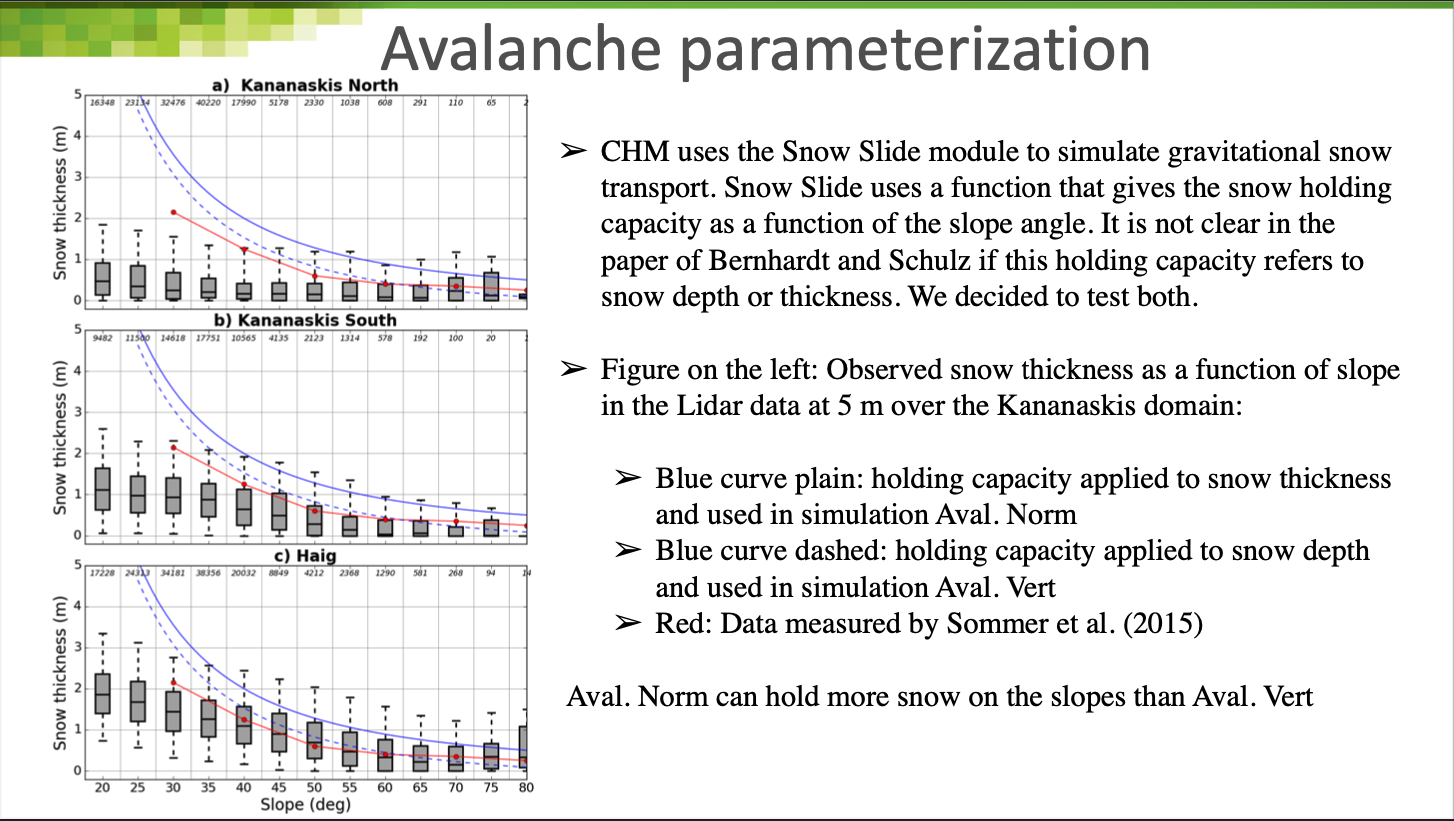
SnowSlide is a simple topographically-driven model that simulates the effects of gravitational snow transport. It uses a snow holding depth that decreases exponentially with increasing slope angle, limiting snow accumulation in steep terrain. The algorithm moves mass from the highest triangle of the mesh to the lowest one. If the snow depth exceeds the snow holding capacity for a given triangle, excess snow is redistributed to the lower adjacent triangles, proportionally to the elevation difference between the neighboring triangles and the original one. SnowSlide uses the total elevation (snow depth plus surface elevation) to operate. In this study, the default formulation of the snow holding depth proposed by Bernhardt and Schulz (2010) is used which leads to a maximal snow thickness (taken perpendicular to the slope) of 3.08 m, 1.11 m, 0.45 m, and 0.15 m for slopes of 30° 45°, 60°, and 75°, respectively.
In the manuscript it is unclear if the holding capacity (max depth) is parameterized for a snow thickness normal to the slope (i.e., how the snowmodels treat snow) or if it is in the vertical direction (i.e., how LiDAR would measure it, a.k.a cosine corrected snow depth). An analysis versus observed LiDAR derived snowdepths over the Kananaskis, Canada domain as well as data observed by Sommer et al. (2015) showed a better evaluation with snowdepths if it is assumed the parameterization is defined for snowdepths in the vertical.
Depends:
Snow depth “snowdepthavg” [m]
Snow depth “snowdepthavg_vert” [m]
Snow Water Equivalent “swe” [mm]
Provides:
Change in snow mass due to avalanching “delta_avalanche_mass” [mm]
Change in snow depth due to avalanching “delta_avalanche_snowdepth” [mm]
Maximum snowdepth holding capacity of a triangle “maxDepth” [m]
Configuration:
 {
    "avalache_mult": 3178.4,
    "avalache_pow": -1.998
}
- avalache_mult#
- avalache_pow#
References:
Bernhardt, M., Schulz, K. (2010). SnowSlide: A simple routine for calculating gravitational snow transport Geophysical Research Letters 37(11), 1-6. https://dx.doi.org/10.1029/2010gl043086
- Default:
3178.4
- Default:
-1.998
Lehning_snowpack#
-
class Lehning_snowpack : public module_base
SNOWPACK (Bartelt and Lehning, 2002) is a multilayer finite-element energy balance snow model originally developed for avalanche hazard forecasting. It has the greatest computational burden of all snowpack models in CHM. This version of SNOWPACK has been modified to allow unlimited removal of snow layers by the blowing snow and avalanche routines.
Depends:
Incoming shortwave radiation, all beams “iswr” [ \( W \cdot m^{-2} \) ]
Incomging longwave radiation “ilwr” [ \( W \cdot m^{-2} \) ]
Relative humidity “rh” [%]
Air temperature “t” [ \( {}^\circ C \)]
Windspeed at 2m “U_2m_above_srf” [ \( m \cdot s^{-1} \)]
Precipitation “p” [ \( mm \cdot dt^{-1} \)]
Precipitation rain fraction “frac_precip_rain” [-]
Snow albedo “snow_albedo” [-]
Optional:
Optionally, depend on the
_subcanopyvariants of the aboveBlowing snow erosion/deposition mass “drift_mass” [mm]
Ground temperature “T_g” [ \( {}^\circ C \)]
Provides:
Change in internal energy “dQ” [ \( W \cdot m^{-2} \) ]
Snow water equivalent “swe” [mm]
Bulk snow temperature “T_s” [ \( {}^\circ C \)]
Surface exchange layer temperature “T_s_0”
Number of discretization nodes “n_nodes”
Number of discretization layers “n_elem”
Snowdepth “snowdepthavg” [m]
Sensible heat flux “H” [ \( W \cdot m^{-2} \) ]
Latent heat flux “E” [ \( W \cdot m^{-2} \) ]
Ground heat flux “G” [ \( W \cdot m^{-2} \) ]
Outgoing longwave radiation “ilwr_out” [ \( W \cdot m^{-2} \) ]
Reflected shortwave radiation “iswr_out” [ \( W \cdot m^{-2} \) ]
Net allwave radiation “R_n” [ \( W \cdot m^{-2} \) ]
Snowpack runoff “runoff” [mm]
Snow mass removed “mass_snowpack_removed” [mm]
Total snowpack runoff “sum_runoff”
Total surface sublimation loss “sum_subl”
Sublimation loss “sublimation”
Evaporation loss “evap”
”MS_SWE”
”MS_WATER”
”MS_TOTALMASS”
”MS_SOIL_RUNOFF”
Configuration:
{
   "sno":
   {
      "SoilAlbedo": 0.09,
      "BareSoil_z0": 0.2,
      "WindScalingFactor": 1,
      "TimeCountDeltaHS": 0.0
   }
Note
Currently SNOWPACK is setup to be run an external albedo model and should be changed to default back to the SNOWPACK one.
threshold_p_phase#
-
class threshold_p_phase : public module_base
Calculates phase from air temperature. Defaults to 2 \( {}^\circ C \), looks for the config parameter “threshold_temperature”. Binary snow/rain at 2 \( {}^\circ C \) threshold.
Depends:
Air temperature “t” [ \( {}^\circ C \) ]
Precipitation “p” [ \( mm \cdot dt^{-1} \) ]
Provides:
Fractional precipitation that is rain “frac_precip_rain” [0-1]
Fractional precipitation that is snow “frac_precip_snow” [0-1]
Precipitation, rain “p_rain” [ \( mm \cdot dt^{-1} \)]
Precipitation, snow “p_snow” [ \( mm \cdot dt^{-1} \)]
Configuration:
{
   "threshold_temperature": 2.0
}
- threshold_temperature#
Threshold air temperature for rain/snow delineation
- Default:
2.0 \({}^\circ C\)
Soil Infiltration#
Gray_inf#
-
class Gray_inf : public module_base
Estimates areal snowmelt infiltration into frozen soils for: a) Restricted - Water entry impeded by surface conditions b) Limited - Capiliary flow dominates and water flow influenced by soil physical properties c) Unlimited - Gravity flow dominates
Depends:
Snow water equivalent “swe” [mm]
Snow melt for interval “snowmelt_int” [ \(mm \cdot dt^{-1}\)]
Provides:
Infiltration “inf” [ \(mm \cdot dt^{-1}\)]
Total infiltration “total_inf” [mm]
Total infiltration excess “total_excess” [mm]
Total runoff “runoff” [mm]
Total soil storage “soil_storage”
Potential infiltration “potential_inf”
Opportunity time for infiltration to occur “opportunity_time”
Available storage for water of the soil “available_storage”
References:
Gray, D., Toth, B., Zhao, L., Pomeroy, J., Granger, R. (2001). Estimating areal snowmelt infiltration into frozen soils Hydrological Processes 15(16), 3095-3111. https://dx.doi.org/10.1002/hyp.320
Note
Has hardcoded soil parameters that need to be read from the mesh parameters.
Uncategorized#
module_template#
-
class module_template : public module_base
Template header file for new module implementations.
Depends:
Provides:
mpi#
-
class mpi : public module_base
MPI usage example
Depends:
None
Provides:
None
Configuration:
None
Parameters:
None
Wind#
fetchr#
-
class fetchr : public module_base
Calculates upwind fetch distances. The fetch is broken if a triangle at distance
d * I> current triangle’s elevation.Depends:
Wind direction “vw_dir” [degrees]
Provides:
Fetch distance “fetch” [m]
Configuration:
{
   "steps": 10,
   "max_distance": 1000
}
- steps#
Number of steps along the search vector to check for a higher point
- max_distance#
Maximum search distance to look for a higher point
- I#
Rise/run threshold to multiply against the distance of a test triangle.
References:
Lapen, D. R., and L. W. Martz (1993), The measurement of two simple topographic indices of wind sheltering-exposure from raster digital elevation models, Comput. Geosci., 19(6), 769–779, doi:10.1016/0098-3004(93)90049-B.
- Type:
int
- Default:
10
- Type:
double
- Default:
1000 m
- Type:
double
- Default:
0.06
Liston_wind#
-
class Liston_wind : public module_base
Calculates windspeeds using a terrain curvature following Liston and Elder 2006. Direction convention is (North = 0, clockwise from North)
Depends from met:
Wind at reference height “U_R” [ \(m \cdot s^{-1}\)]
Direction at reference height ‘vw_dir’ [degrees] (North = 0, clockwise from North)
Provides:
Wind at reference height “U_R”
Interpolated wind field at reference height prior to downscaling “U_R_orig” [ \(m \cdot s^{-1}\)]
Wind direction “vw_dir” [degrees]
Original wind direction “vw_dir_orig” [degrees]
Amount the wind vector direction has been changed “vw_dir_divergence” [degrees]
Zonal U at reference height “zonal_u” [ \( m \cdot s^{-1}\) ]
Zonal V at reference height “zonal_v” [ \( m \cdot s^{-1}\) ]
Configuration:
{
   "distance": 300,
   "Ww_coeff: 1,
   "ys": 0.5,
   "yc": 0.5
}
- distance#
Distance to “look” to compute the terrain curvature.
- Ww_coeff#
Leading coefficient in equation 16. Used for compatibility with calibration approach such as done by Pohl.
- ys#
Slope weight. Valid range [0,1]. The value of 0.5 gives equal weight to slope and curvature
- yc#
Curvature weight. Valid range [0,1]. The value of 0.5 gives equal weight to slope and curvature
References:
Liston, G. E., & Elder, K. (2006). A meteorological distribution system for high-resolution terrestrial modeling (MicroMet). Journal of Hydrometeorology, 7(2), 217–234. http://doi.org/10.1175/JHM486.1
- Type:
double
- Default:
300
- Type:
int
- Default:
1
- Type:
double
- Default:
0.5
- Type:
double
- Default:
0.5
MS_wind#
-
class MS_wind : public module_base
Calculates windspeeds using the Mason Sykes wind speed from Essery, et al (1999), using 8 lookup map from DBSM. Optionally uses Ryan, et al. for wind direction correction.
Depends from met:
Wind at reference height “U_R” [ \( m \cdot s^{-1}\) ]
Direction at reference height “vw_dir” [degrees]
Provides:
Wind speed at reference height “U_R” [ \( m \cdot s^{-1}\) ]
Wind direction ‘vw_dir’ at reference height [degrees]
Speedup magnitude “W_speedup” [-]
Zonal u speed component at 2m “2m_zonal_u” [ \( m \cdot s^{-1}\) ]
Zonal v speed component at 2m “2m_zonal_v” [ \( m \cdot s^{-1}\) ]
Original interpolated wind direction “vw_dir_orig” [degrees]
Parameters:
Requires speedup, u, and v parameters named “MS%i_U” and “MS%i_V” and “MS%i” for each of the 8 directions. These need to be generated using DBSM in
tools/MSwind.Configuration:
{
   "speedup_height": 2.0,
   "use_ryan_dir", false
}
- speedup_height#
The height at which the MS Wind tool was run for. The default is 2 m and shouldn’t be changed.
- use_ryan_dir#
Instead of using the _u and _v components to compute direction perturbation, use the algorithm of Ryan as per Liston and Elder (2006)
Reference:
Essery, R., Li, L., Pomeroy, J. (1999). A distributed model of blowing snow over complex terrain Hydrological Processes 13(), 2423-2438.
- Type:
double
- Default:
2.0
- Type:
boolean
- Default:
false
uniform_wind#
-
class uniform_wind : public module_base
Spatially interpolates wind speed and direction without any terrain speed-up modification
Depends from met:
Wind at reference height “U_R” [ \( m \cdot s^{-1}\) ]
Direction at reference height “vw_dir” [degrees]
Provides:
Wind speed at reference height “U_R” [ \( m \cdot s^{-1}\) ]
Wind direction ‘vw_dir’ at reference height [degrees]
WindNinja#
-
class WindNinja : public module_base
Calculates wind speed and direction following the downscaling stategy of Barcons et al. (2018). This is via a library of high-resolution wind field generated with the WindNinja wind flow model. Unless the reference height windspeed is provided, use the scale_wind_speed filter to log-scale the windspeed up to U_R.
Depends from met:
Wind at reference height “U_R” [ \( m \cdot s^{-1}\) ]
Direction at reference height “vw_dir” [degrees]
Provides:
Wind speed at reference height “U_R” [ \( m \cdot s^{-1}\) ]
Wind direction ‘vw_dir’ at reference height [degrees]
Zonal U at reference height “zonal_u” [ \( m \cdot s^{-1}\) ]
Zonal V at reference height “zonal_v” [ \( m \cdot s^{-1}\) ]
Diagnostics:
Downscaled windspeed “Ninja_speed” [ \( m \cdot s^{-1}\) ]
Interpolated wind field at reference height prior to downscaling “U_R_orig” [ \(m \cdot s^{-1}\)]
Interpolated zonal U at level H_Forc “interp_zonal_u” [ \( m \cdot s^{-1}\) ]
Interpolated zonal V at level H_Forc “interp_zonal_v” [ \( m \cdot s^{-1}\) ]
What lookup map was used “lookup_d” [-]
Original wind direction “vw_dir_orig” [degrees]
Amount the wind vector direction has been changed “vw_dir_divergence” [degrees]
Configuration:
{
   "ninja_average": true,
   "compute_Sx": true,
   "ninja_recirc": false,
   "Sx_crit", 30.
   "L_avg": 1000.
   "H_forc": 40,
   "Max_spdup": 3.0,
   "Min_spdup": 0.1,
}
- ninja_average#
Linear interpolation between the closest 2 wind fields from the library
- compute_Sx#
Use the Winstral Sx parameterization to idenitify and modify lee-side windfield. This will cause a runtime error (conflict) if
Winstral_parametersis also a module. This uses an angular window of 30 degrees and a step size of 10 m.
- ninja_recirc#
Enables the leeside slow down via
compute_Sx. Requires"compute_Sx":true.
- Sx_crit#
Reduce wind speed on the lee side of mountain crest identified by Sx>Sx_crit
..confval:: L_avg
The WindMapper tool uses a radius to compute a mean. This is the length over which that average is done. Normally this will be baked into the parameter name (e.g., Ninja_1000). However, there may be reasons to specifiy it directly. Cannot be used if the parameters have the _Lavg suffix. You likely don’t need to set this.
- H_forc#
- Max_spdup#
Limit speed up value to Max_spdup to avoid unrelistic values at crest top
- Min_spdup#
Limit speed up value to Max_spdup to avoid unrelistic values at crest top
Parameters:
Requires speedup, u, and v parameters named “Ninja%i_U” and “Ninja%i_V” and “Ninja%i” for each of the n directions. Should be generated with WindMapper. The number of directions will be automatically determined as will the Lavg value. These should be computed with the Windmapper tool .
References:
Barcons, J., Avila, M., Folch, A. (2018). A wind field downscaling strategy based on domain segmentation and transfer functions Wind Energy 21(6)https://dx.doi.org/10.1002/we.2169
- Type:
boolean
- Default:
true
- Type:
boolean
- Default:
true
- Type:
boolean
- Default:
false
- Type:
double
- Default:
- Type:
int
- Default:
None
- Type:
double
- Default:
40.0
Reference height for input forcing and WindNinja wind field library
- Type:
double
- Default:
3.0
- Type:
double
- Default:
3.0
scale_wind_vert#
-
class scale_wind_vert : public module_base
Scales wind speed from reference height to defined heights. Scales the wind vertically using a neutral stability log relationship. If snow depth is present, the height is taken into account. A fixed z0 of 0.01m is currently used. If a canopy is present then an exp sub-canopy scaling is used.
Depends:
Wind speed @reference height “U_R” [ \( m \cdot s^{-1} \) ]
Optional:
Snow depth to take into account for the scaling “snowdepthavg” [m]
Provides:
Wind speed @2m “U_2m_above_srf” [ \( m \cdot s^{-1} \) ]
Parameters:
If
ignore_canopy=False, then Leaf Area Index “LAI” [-]
Configuration:
{
   "ignore_canopy": false
}
- ignore_canopy#
Ignores the vegetation canopy
- Default:
false
By provides variable#
Note
- These provides are automatically produced from the module code. They do not include provides that are dynamically generated
i.e.,
provides("t_"+some_var);
2m_zonal_u#
MS_wind#
-
class MS_wind : public module_base
Calculates windspeeds using the Mason Sykes wind speed from Essery, et al (1999), using 8 lookup map from DBSM. Optionally uses Ryan, et al. for wind direction correction.
Depends from met:
Wind at reference height “U_R” [ \( m \cdot s^{-1}\) ]
Direction at reference height “vw_dir” [degrees]
Provides:
Wind speed at reference height “U_R” [ \( m \cdot s^{-1}\) ]
Wind direction ‘vw_dir’ at reference height [degrees]
Speedup magnitude “W_speedup” [-]
Zonal u speed component at 2m “2m_zonal_u” [ \( m \cdot s^{-1}\) ]
Zonal v speed component at 2m “2m_zonal_v” [ \( m \cdot s^{-1}\) ]
Original interpolated wind direction “vw_dir_orig” [degrees]
Parameters:
Requires speedup, u, and v parameters named “MS%i_U” and “MS%i_V” and “MS%i” for each of the 8 directions. These need to be generated using DBSM in
tools/MSwind.Configuration:
{
   "speedup_height": 2.0,
   "use_ryan_dir", false
}
- speedup_height#
The height at which the MS Wind tool was run for. The default is 2 m and shouldn’t be changed.
- use_ryan_dir#
Instead of using the _u and _v components to compute direction perturbation, use the algorithm of Ryan as per Liston and Elder (2006)
Reference:
Essery, R., Li, L., Pomeroy, J. (1999). A distributed model of blowing snow over complex terrain Hydrological Processes 13(), 2423-2438.
- Type:
double
- Default:
2.0
- Type:
boolean
- Default:
false
2m_zonal_v#
MS_wind#
-
class MS_wind : public module_base
Calculates windspeeds using the Mason Sykes wind speed from Essery, et al (1999), using 8 lookup map from DBSM. Optionally uses Ryan, et al. for wind direction correction.
Depends from met:
Wind at reference height “U_R” [ \( m \cdot s^{-1}\) ]
Direction at reference height “vw_dir” [degrees]
Provides:
Wind speed at reference height “U_R” [ \( m \cdot s^{-1}\) ]
Wind direction ‘vw_dir’ at reference height [degrees]
Speedup magnitude “W_speedup” [-]
Zonal u speed component at 2m “2m_zonal_u” [ \( m \cdot s^{-1}\) ]
Zonal v speed component at 2m “2m_zonal_v” [ \( m \cdot s^{-1}\) ]
Original interpolated wind direction “vw_dir_orig” [degrees]
Parameters:
Requires speedup, u, and v parameters named “MS%i_U” and “MS%i_V” and “MS%i” for each of the 8 directions. These need to be generated using DBSM in
tools/MSwind.Configuration:
{
   "speedup_height": 2.0,
   "use_ryan_dir", false
}
- speedup_height#
The height at which the MS Wind tool was run for. The default is 2 m and shouldn’t be changed.
- use_ryan_dir#
Instead of using the _u and _v components to compute direction perturbation, use the algorithm of Ryan as per Liston and Elder (2006)
Reference:
Essery, R., Li, L., Pomeroy, J. (1999). A distributed model of blowing snow over complex terrain Hydrological Processes 13(), 2423-2438.
- Type:
double
- Default:
2.0
- Type:
boolean
- Default:
false
E#
FSM#
-
class FSM : public module_base
Flexible Snow Model (FSM) 2.0
“The Flexible Snow Model (FSM2) is a multi-physics energy balance model of snow accumulation and melt,
extending the Factorial Snow Model (Essery, 2015) with additional physics, driving and output options.”
This version of FSM has been customized to have the sophisticated process parametrizations selected in every case, except atmospheric stability corrections.
Depends:
Solar elevation “solar_el” [degrees]
Incoming longwave radiation “ilwr” \([W \cdot m^{-2}\)]
Relative Humidy “rh” [%]
Air temperature “t” [ \( {}^\circ C \)]
Precipitation snow “p_snow” [ \(mm \cdot dt^{-1}\)]
Precipitation rain “p_rain” [ \(mm \cdot dt^{-1}\)]
Wind speed 2 m above surface “U_2m_above_srf” [ \( m \cdot s^{-1}\) ]
Incoming shortwave radiation, direct beam “iswr_direct” \([W \cdot m^{-2}\)]
Incoming shortwave radiation, diffuse beam “iswr_diffuse” \([W \cdot m^{-2}\)]
Provides:
Sensible heat flux “H” \([W \cdot m^{-2}]\)
Latent heat flux “E” \([W \cdot m^{-2}]\)
Outgoing longwave radiation “ilwr_out” (alias “LWout”) \([W \cdot m^{-2}]\)
Melt rate “melt_rate” \([mm \cdot dt^{-1}]\)
Surface runoff/drainage, includes rain on snow percolation “roff” \([mm \cdot dt^{-1}]\)
Mean snow depth (slope-normal) “snowdepthavg” [m]
Mean snow depth (vertical projection) “snowdepthavg_vert” [m]
Snow water equivalent “swe” [mm]
Instantaneous sublimation “subl” \([mm \cdot dt^{-1}]\)
Cumulative sublimation “sum_snowpack_subl” [mm]
Snow albedo “snow_albedo” [-]
Number of snow layers “Nsnow” [-]
Snow liquid water content layer 0 “Sliq[0]” [mm]
Snow liquid water content layer 1 “Sliq[1]” [mm]
Snow liquid water content layer 2 “Sliq[2]” [mm]
Snow temperature layer 0 “Tsnow[0]” [K]
Snow temperature layer 1 “Tsnow[1]” [K]
Snow temperature layer 2 “Tsnow[2]” [K]
Soil temperature layer 0 “Tsoil[0]” [K]
Soil temperature layer 1 “Tsoil[1]” [K]
Soil temperature layer 2 “Tsoil[2]” [K]
Soil temperature layer 3 “Tsoil[3]” [K]
Optional:
Sub-canopy forcing:
Subcanopy incoming shortwave radiation “iswr_subcanopy” \([W \cdot m^{-2}\)]
Subcanopy relative humidity “rh_subcanopy” [%]
Subcanopy air temperatue “ta_subcanopy” [ \( {}^\circ C \)]
Subcanopy incoming longwave radidation “ilwr_subcanopy” \([W \cdot m^{-2}\)]
References:
Essery, R. (2015). A factorial snowpack model (FSM 1.0) Geoscientific Model Development 8(12), 3867 3876. https://dx.doi.org/10.5194/gmd-8-3867-2015
Warning
Vegetation characteristics remain a TODO
snobal#
-
class snobal : public module_base
Snobal is a physically-based snowpack model that approximates the snowpack with two layers. The surface-active layer has a fixed thickness of 0.1 m and is used to estimate surface temperature for outgoing longwave radiation and turbulent heat fluxes. The second lower layer represents the remaining snowpack. For each layer, Snobal simulates the evolution of the snow water equivalent, temperature, density, cold content, and liquid water content. This version of Snobal includes an improved algorithm for snow compaction that accounts for bulk compaction and temperature metamorphism (Hedrick et al., 2018).
Depends:
Incoming shortwave radiation, all beams “iswr” [ \( W \cdot m^{-2} \) ]
Incomging longwave radiation “ilwr” [ \( W \cdot m^{-2} \) ]
Relative humidity “rh” [%]
Air temperature “t” [ \( {}^\circ C \)]
Windspeed at 2m “U_2m_above_srf” [ \( m \cdot s^{-1} \)]
Precipitation “p” [ \( mm \cdot dt^{-1} \)]
Precipitation snow fraction “frac_precip_snow” [-]
Snow albedo “snow_albedo” [-]
Optional:
Optionally, depend on the
_subcanopyvariants of the aboveBlowing snow erosion/deposition mass “drift_mass” [mm]
Ground temperature “T_g” [ \( {}^\circ C \)]
Change in snow mass due to avalanching “delta_avalanche_mass” [mm]
Change in snow depth due to avalanching “delta_avalanche_snowdepth” [mm]
Provides:
Snow water equivalent “swe” [mm]
Interval snowmelt “snowmelt_int” [mm]
Net allwave radiation “R_n” [ \( W \cdot m^{-2} \) ]
Sensible heat flux “H” [ \( W \cdot m^{-2} \) ]
Latent heat flux “E” [ \( W \cdot m^{-2} \) ]
Ground heat flux “G” [ \( W \cdot m^{-2} \) ]
Advected heat from precipitation “M” [ \( W \cdot m^{-2} \) ]
Change in internal energy “dQ” [ \( W \cdot m^{-2} \) ]
Cold content of entire snowpack “cc” [ \( J \cdot m^{-2} \) ]
Bulk snow temperature “T_s” [K]
Surface exchange layer temperature “T_s_0” [K]
Lower layer temperature “T_s_l” [K]
Was an iteration error hit “dead”. Diagnostic, don’t use. [-]
Net shortwave radiation at the surface. Diagnostic. “iswr_out” [ \( W \cdot m^{-2} \) ]
Binary is the snow isothermal “isothermal” [0,1]
Outgoing longwave radiation “ilwr_out” [ \( W \cdot m^{-2} \) ]
Total snowpack runoff “sum_snowpack_runoff”
Total snowpack sublimation “sum_snowpack_subl”
Total precipitation onto the snowpack. Diagnostic. “sum_snowpack_pcp” [mm]
Total snowpack melt “sum_melt” [mm]
Snowdepth “snowdepthavg” [m]
Snowdepth in the vertical direction (cosine corrected) “snowdepthavg_vert” [m]
Configuration:
{
   "drift_density": 300,
   "const_T_g": -4.0,
   "use_slope_SWE": true,
   "param_snow_compaction": 1,
   "max_h2o_vol":0.0001,
   "kt_wetsand": 0.08,
   "max_active_layer": 0.1,
   "z0":0.001,
   "z_T":2.6,
   "z_u":2.96,
   "z_g":0.1,
}
- drift_density#
Density of snow that is added from drift events
- const_T_g#
Constant ground temperature
- use_slope_SWE#
Use slope corrected snowdepth for compaction. I.e., parallel to gravity force.
- param_snow_compaction#
Set to 1 to use new Hedrick, et al parameterization for snow compaction. 0 for origianl Snobal.
- max_h2o_vol#
Maximum volumetric water content in the snow. Tends to be required to be set quite low.
- kt_wetsand#
Thermal conductivity of wet sand for G flux
- max_active_layer#
Thickness of active layer
- z0#
Rouighness length
- z_T#
Height of air temperature
- z_u#
Height of wind measurement
- z_g#
Depth of ground temperature measurement
References:
Marks, D., Domingo, J., Susong, D., Link, T., Garen, D. (1999). A spatially distributed energy balance snowmelt model for application in mountain basins Hydrological Processes 13(12-13), 1935-1959.
Hedrick, A., Marks, D., Havens, S., Robertson, M., Johnson, M., Sandusky, M., Marshall, H., Kormos, P., Bormann, K., Painter, T. (2018). Direct Insertion of NASA Airborne Snow Observatory‐Derived Snow Depth Time Series Into the iSnobal Energy Balance Snow Model Water Resources Research 54(10), 8045-8063. https://dx.doi.org/10.1029/2018wr023190
- Default:
300 \(kg \cdot m^3\)
- Default:
-4.0 \({}^\circ C\)
- Default:
true
- Default:
1
- Default:
0.0001
- Default:
\(0.08 W \cdot m^{-2}\)
- Default:
0.1 m
- Default:
0.001 m
- Default:
2.6 m
- Default:
2 m
- Default:
0.1
Lehning_snowpack#
-
class Lehning_snowpack : public module_base
SNOWPACK (Bartelt and Lehning, 2002) is a multilayer finite-element energy balance snow model originally developed for avalanche hazard forecasting. It has the greatest computational burden of all snowpack models in CHM. This version of SNOWPACK has been modified to allow unlimited removal of snow layers by the blowing snow and avalanche routines.
Depends:
Incoming shortwave radiation, all beams “iswr” [ \( W \cdot m^{-2} \) ]
Incomging longwave radiation “ilwr” [ \( W \cdot m^{-2} \) ]
Relative humidity “rh” [%]
Air temperature “t” [ \( {}^\circ C \)]
Windspeed at 2m “U_2m_above_srf” [ \( m \cdot s^{-1} \)]
Precipitation “p” [ \( mm \cdot dt^{-1} \)]
Precipitation rain fraction “frac_precip_rain” [-]
Snow albedo “snow_albedo” [-]
Optional:
Optionally, depend on the
_subcanopyvariants of the aboveBlowing snow erosion/deposition mass “drift_mass” [mm]
Ground temperature “T_g” [ \( {}^\circ C \)]
Provides:
Change in internal energy “dQ” [ \( W \cdot m^{-2} \) ]
Snow water equivalent “swe” [mm]
Bulk snow temperature “T_s” [ \( {}^\circ C \)]
Surface exchange layer temperature “T_s_0”
Number of discretization nodes “n_nodes”
Number of discretization layers “n_elem”
Snowdepth “snowdepthavg” [m]
Sensible heat flux “H” [ \( W \cdot m^{-2} \) ]
Latent heat flux “E” [ \( W \cdot m^{-2} \) ]
Ground heat flux “G” [ \( W \cdot m^{-2} \) ]
Outgoing longwave radiation “ilwr_out” [ \( W \cdot m^{-2} \) ]
Reflected shortwave radiation “iswr_out” [ \( W \cdot m^{-2} \) ]
Net allwave radiation “R_n” [ \( W \cdot m^{-2} \) ]
Snowpack runoff “runoff” [mm]
Snow mass removed “mass_snowpack_removed” [mm]
Total snowpack runoff “sum_runoff”
Total surface sublimation loss “sum_subl”
Sublimation loss “sublimation”
Evaporation loss “evap”
”MS_SWE”
”MS_WATER”
”MS_TOTALMASS”
”MS_SOIL_RUNOFF”
Configuration:
{
   "sno":
   {
      "SoilAlbedo": 0.09,
      "BareSoil_z0": 0.2,
      "WindScalingFactor": 1,
      "TimeCountDeltaHS": 0.0
   }
Note
Currently SNOWPACK is setup to be run an external albedo model and should be changed to default back to the SNOWPACK one.
ET#
PenmanMonteith_evaporation#
-
class PenmanMonteith_evaporation : public module_base
Calculates evapo-transpiration via Penman-Monteith.
Not currently maintained.
Depends:
Incoming shortwave radaition “iswr” [ \( W \cdot m^{-2} \) ]
Incoming longwave radiation “ilwr” [ \( W \cdot m^{-2} \) ]
Relative humidity “rh” [%]
Windspeed at 2m “U_2m_above_srf” [ \( m \cdot s^{-1} \) ]
Provides:
Evapotranspiration “ET” [ \( mm \cdot dt^{-1} \) ]
G#
snobal#
-
class snobal : public module_base
Snobal is a physically-based snowpack model that approximates the snowpack with two layers. The surface-active layer has a fixed thickness of 0.1 m and is used to estimate surface temperature for outgoing longwave radiation and turbulent heat fluxes. The second lower layer represents the remaining snowpack. For each layer, Snobal simulates the evolution of the snow water equivalent, temperature, density, cold content, and liquid water content. This version of Snobal includes an improved algorithm for snow compaction that accounts for bulk compaction and temperature metamorphism (Hedrick et al., 2018).
Depends:
Incoming shortwave radiation, all beams “iswr” [ \( W \cdot m^{-2} \) ]
Incomging longwave radiation “ilwr” [ \( W \cdot m^{-2} \) ]
Relative humidity “rh” [%]
Air temperature “t” [ \( {}^\circ C \)]
Windspeed at 2m “U_2m_above_srf” [ \( m \cdot s^{-1} \)]
Precipitation “p” [ \( mm \cdot dt^{-1} \)]
Precipitation snow fraction “frac_precip_snow” [-]
Snow albedo “snow_albedo” [-]
Optional:
Optionally, depend on the
_subcanopyvariants of the aboveBlowing snow erosion/deposition mass “drift_mass” [mm]
Ground temperature “T_g” [ \( {}^\circ C \)]
Change in snow mass due to avalanching “delta_avalanche_mass” [mm]
Change in snow depth due to avalanching “delta_avalanche_snowdepth” [mm]
Provides:
Snow water equivalent “swe” [mm]
Interval snowmelt “snowmelt_int” [mm]
Net allwave radiation “R_n” [ \( W \cdot m^{-2} \) ]
Sensible heat flux “H” [ \( W \cdot m^{-2} \) ]
Latent heat flux “E” [ \( W \cdot m^{-2} \) ]
Ground heat flux “G” [ \( W \cdot m^{-2} \) ]
Advected heat from precipitation “M” [ \( W \cdot m^{-2} \) ]
Change in internal energy “dQ” [ \( W \cdot m^{-2} \) ]
Cold content of entire snowpack “cc” [ \( J \cdot m^{-2} \) ]
Bulk snow temperature “T_s” [K]
Surface exchange layer temperature “T_s_0” [K]
Lower layer temperature “T_s_l” [K]
Was an iteration error hit “dead”. Diagnostic, don’t use. [-]
Net shortwave radiation at the surface. Diagnostic. “iswr_out” [ \( W \cdot m^{-2} \) ]
Binary is the snow isothermal “isothermal” [0,1]
Outgoing longwave radiation “ilwr_out” [ \( W \cdot m^{-2} \) ]
Total snowpack runoff “sum_snowpack_runoff”
Total snowpack sublimation “sum_snowpack_subl”
Total precipitation onto the snowpack. Diagnostic. “sum_snowpack_pcp” [mm]
Total snowpack melt “sum_melt” [mm]
Snowdepth “snowdepthavg” [m]
Snowdepth in the vertical direction (cosine corrected) “snowdepthavg_vert” [m]
Configuration:
{
   "drift_density": 300,
   "const_T_g": -4.0,
   "use_slope_SWE": true,
   "param_snow_compaction": 1,
   "max_h2o_vol":0.0001,
   "kt_wetsand": 0.08,
   "max_active_layer": 0.1,
   "z0":0.001,
   "z_T":2.6,
   "z_u":2.96,
   "z_g":0.1,
}
- drift_density#
Density of snow that is added from drift events
- const_T_g#
Constant ground temperature
- use_slope_SWE#
Use slope corrected snowdepth for compaction. I.e., parallel to gravity force.
- param_snow_compaction#
Set to 1 to use new Hedrick, et al parameterization for snow compaction. 0 for origianl Snobal.
- max_h2o_vol#
Maximum volumetric water content in the snow. Tends to be required to be set quite low.
- kt_wetsand#
Thermal conductivity of wet sand for G flux
- max_active_layer#
Thickness of active layer
- z0#
Rouighness length
- z_T#
Height of air temperature
- z_u#
Height of wind measurement
- z_g#
Depth of ground temperature measurement
References:
Marks, D., Domingo, J., Susong, D., Link, T., Garen, D. (1999). A spatially distributed energy balance snowmelt model for application in mountain basins Hydrological Processes 13(12-13), 1935-1959.
Hedrick, A., Marks, D., Havens, S., Robertson, M., Johnson, M., Sandusky, M., Marshall, H., Kormos, P., Bormann, K., Painter, T. (2018). Direct Insertion of NASA Airborne Snow Observatory‐Derived Snow Depth Time Series Into the iSnobal Energy Balance Snow Model Water Resources Research 54(10), 8045-8063. https://dx.doi.org/10.1029/2018wr023190
- Default:
300 \(kg \cdot m^3\)
- Default:
-4.0 \({}^\circ C\)
- Default:
true
- Default:
1
- Default:
0.0001
- Default:
\(0.08 W \cdot m^{-2}\)
- Default:
0.1 m
- Default:
0.001 m
- Default:
2.6 m
- Default:
2 m
- Default:
0.1
Lehning_snowpack#
-
class Lehning_snowpack : public module_base
SNOWPACK (Bartelt and Lehning, 2002) is a multilayer finite-element energy balance snow model originally developed for avalanche hazard forecasting. It has the greatest computational burden of all snowpack models in CHM. This version of SNOWPACK has been modified to allow unlimited removal of snow layers by the blowing snow and avalanche routines.
Depends:
Incoming shortwave radiation, all beams “iswr” [ \( W \cdot m^{-2} \) ]
Incomging longwave radiation “ilwr” [ \( W \cdot m^{-2} \) ]
Relative humidity “rh” [%]
Air temperature “t” [ \( {}^\circ C \)]
Windspeed at 2m “U_2m_above_srf” [ \( m \cdot s^{-1} \)]
Precipitation “p” [ \( mm \cdot dt^{-1} \)]
Precipitation rain fraction “frac_precip_rain” [-]
Snow albedo “snow_albedo” [-]
Optional:
Optionally, depend on the
_subcanopyvariants of the aboveBlowing snow erosion/deposition mass “drift_mass” [mm]
Ground temperature “T_g” [ \( {}^\circ C \)]
Provides:
Change in internal energy “dQ” [ \( W \cdot m^{-2} \) ]
Snow water equivalent “swe” [mm]
Bulk snow temperature “T_s” [ \( {}^\circ C \)]
Surface exchange layer temperature “T_s_0”
Number of discretization nodes “n_nodes”
Number of discretization layers “n_elem”
Snowdepth “snowdepthavg” [m]
Sensible heat flux “H” [ \( W \cdot m^{-2} \) ]
Latent heat flux “E” [ \( W \cdot m^{-2} \) ]
Ground heat flux “G” [ \( W \cdot m^{-2} \) ]
Outgoing longwave radiation “ilwr_out” [ \( W \cdot m^{-2} \) ]
Reflected shortwave radiation “iswr_out” [ \( W \cdot m^{-2} \) ]
Net allwave radiation “R_n” [ \( W \cdot m^{-2} \) ]
Snowpack runoff “runoff” [mm]
Snow mass removed “mass_snowpack_removed” [mm]
Total snowpack runoff “sum_runoff”
Total surface sublimation loss “sum_subl”
Sublimation loss “sublimation”
Evaporation loss “evap”
”MS_SWE”
”MS_WATER”
”MS_TOTALMASS”
”MS_SOIL_RUNOFF”
Configuration:
{
   "sno":
   {
      "SoilAlbedo": 0.09,
      "BareSoil_z0": 0.2,
      "WindScalingFactor": 1,
      "TimeCountDeltaHS": 0.0
   }
Note
Currently SNOWPACK is setup to be run an external albedo model and should be changed to default back to the SNOWPACK one.
H#
FSM#
-
class FSM : public module_base
Flexible Snow Model (FSM) 2.0
“The Flexible Snow Model (FSM2) is a multi-physics energy balance model of snow accumulation and melt,
extending the Factorial Snow Model (Essery, 2015) with additional physics, driving and output options.”
This version of FSM has been customized to have the sophisticated process parametrizations selected in every case, except atmospheric stability corrections.
Depends:
Solar elevation “solar_el” [degrees]
Incoming longwave radiation “ilwr” \([W \cdot m^{-2}\)]
Relative Humidy “rh” [%]
Air temperature “t” [ \( {}^\circ C \)]
Precipitation snow “p_snow” [ \(mm \cdot dt^{-1}\)]
Precipitation rain “p_rain” [ \(mm \cdot dt^{-1}\)]
Wind speed 2 m above surface “U_2m_above_srf” [ \( m \cdot s^{-1}\) ]
Incoming shortwave radiation, direct beam “iswr_direct” \([W \cdot m^{-2}\)]
Incoming shortwave radiation, diffuse beam “iswr_diffuse” \([W \cdot m^{-2}\)]
Provides:
Sensible heat flux “H” \([W \cdot m^{-2}]\)
Latent heat flux “E” \([W \cdot m^{-2}]\)
Outgoing longwave radiation “ilwr_out” (alias “LWout”) \([W \cdot m^{-2}]\)
Melt rate “melt_rate” \([mm \cdot dt^{-1}]\)
Surface runoff/drainage, includes rain on snow percolation “roff” \([mm \cdot dt^{-1}]\)
Mean snow depth (slope-normal) “snowdepthavg” [m]
Mean snow depth (vertical projection) “snowdepthavg_vert” [m]
Snow water equivalent “swe” [mm]
Instantaneous sublimation “subl” \([mm \cdot dt^{-1}]\)
Cumulative sublimation “sum_snowpack_subl” [mm]
Snow albedo “snow_albedo” [-]
Number of snow layers “Nsnow” [-]
Snow liquid water content layer 0 “Sliq[0]” [mm]
Snow liquid water content layer 1 “Sliq[1]” [mm]
Snow liquid water content layer 2 “Sliq[2]” [mm]
Snow temperature layer 0 “Tsnow[0]” [K]
Snow temperature layer 1 “Tsnow[1]” [K]
Snow temperature layer 2 “Tsnow[2]” [K]
Soil temperature layer 0 “Tsoil[0]” [K]
Soil temperature layer 1 “Tsoil[1]” [K]
Soil temperature layer 2 “Tsoil[2]” [K]
Soil temperature layer 3 “Tsoil[3]” [K]
Optional:
Sub-canopy forcing:
Subcanopy incoming shortwave radiation “iswr_subcanopy” \([W \cdot m^{-2}\)]
Subcanopy relative humidity “rh_subcanopy” [%]
Subcanopy air temperatue “ta_subcanopy” [ \( {}^\circ C \)]
Subcanopy incoming longwave radidation “ilwr_subcanopy” \([W \cdot m^{-2}\)]
References:
Essery, R. (2015). A factorial snowpack model (FSM 1.0) Geoscientific Model Development 8(12), 3867 3876. https://dx.doi.org/10.5194/gmd-8-3867-2015
Warning
Vegetation characteristics remain a TODO
snobal#
-
class snobal : public module_base
Snobal is a physically-based snowpack model that approximates the snowpack with two layers. The surface-active layer has a fixed thickness of 0.1 m and is used to estimate surface temperature for outgoing longwave radiation and turbulent heat fluxes. The second lower layer represents the remaining snowpack. For each layer, Snobal simulates the evolution of the snow water equivalent, temperature, density, cold content, and liquid water content. This version of Snobal includes an improved algorithm for snow compaction that accounts for bulk compaction and temperature metamorphism (Hedrick et al., 2018).
Depends:
Incoming shortwave radiation, all beams “iswr” [ \( W \cdot m^{-2} \) ]
Incomging longwave radiation “ilwr” [ \( W \cdot m^{-2} \) ]
Relative humidity “rh” [%]
Air temperature “t” [ \( {}^\circ C \)]
Windspeed at 2m “U_2m_above_srf” [ \( m \cdot s^{-1} \)]
Precipitation “p” [ \( mm \cdot dt^{-1} \)]
Precipitation snow fraction “frac_precip_snow” [-]
Snow albedo “snow_albedo” [-]
Optional:
Optionally, depend on the
_subcanopyvariants of the aboveBlowing snow erosion/deposition mass “drift_mass” [mm]
Ground temperature “T_g” [ \( {}^\circ C \)]
Change in snow mass due to avalanching “delta_avalanche_mass” [mm]
Change in snow depth due to avalanching “delta_avalanche_snowdepth” [mm]
Provides:
Snow water equivalent “swe” [mm]
Interval snowmelt “snowmelt_int” [mm]
Net allwave radiation “R_n” [ \( W \cdot m^{-2} \) ]
Sensible heat flux “H” [ \( W \cdot m^{-2} \) ]
Latent heat flux “E” [ \( W \cdot m^{-2} \) ]
Ground heat flux “G” [ \( W \cdot m^{-2} \) ]
Advected heat from precipitation “M” [ \( W \cdot m^{-2} \) ]
Change in internal energy “dQ” [ \( W \cdot m^{-2} \) ]
Cold content of entire snowpack “cc” [ \( J \cdot m^{-2} \) ]
Bulk snow temperature “T_s” [K]
Surface exchange layer temperature “T_s_0” [K]
Lower layer temperature “T_s_l” [K]
Was an iteration error hit “dead”. Diagnostic, don’t use. [-]
Net shortwave radiation at the surface. Diagnostic. “iswr_out” [ \( W \cdot m^{-2} \) ]
Binary is the snow isothermal “isothermal” [0,1]
Outgoing longwave radiation “ilwr_out” [ \( W \cdot m^{-2} \) ]
Total snowpack runoff “sum_snowpack_runoff”
Total snowpack sublimation “sum_snowpack_subl”
Total precipitation onto the snowpack. Diagnostic. “sum_snowpack_pcp” [mm]
Total snowpack melt “sum_melt” [mm]
Snowdepth “snowdepthavg” [m]
Snowdepth in the vertical direction (cosine corrected) “snowdepthavg_vert” [m]
Configuration:
{
   "drift_density": 300,
   "const_T_g": -4.0,
   "use_slope_SWE": true,
   "param_snow_compaction": 1,
   "max_h2o_vol":0.0001,
   "kt_wetsand": 0.08,
   "max_active_layer": 0.1,
   "z0":0.001,
   "z_T":2.6,
   "z_u":2.96,
   "z_g":0.1,
}
- drift_density#
Density of snow that is added from drift events
- const_T_g#
Constant ground temperature
- use_slope_SWE#
Use slope corrected snowdepth for compaction. I.e., parallel to gravity force.
- param_snow_compaction#
Set to 1 to use new Hedrick, et al parameterization for snow compaction. 0 for origianl Snobal.
- max_h2o_vol#
Maximum volumetric water content in the snow. Tends to be required to be set quite low.
- kt_wetsand#
Thermal conductivity of wet sand for G flux
- max_active_layer#
Thickness of active layer
- z0#
Rouighness length
- z_T#
Height of air temperature
- z_u#
Height of wind measurement
- z_g#
Depth of ground temperature measurement
References:
Marks, D., Domingo, J., Susong, D., Link, T., Garen, D. (1999). A spatially distributed energy balance snowmelt model for application in mountain basins Hydrological Processes 13(12-13), 1935-1959.
Hedrick, A., Marks, D., Havens, S., Robertson, M., Johnson, M., Sandusky, M., Marshall, H., Kormos, P., Bormann, K., Painter, T. (2018). Direct Insertion of NASA Airborne Snow Observatory‐Derived Snow Depth Time Series Into the iSnobal Energy Balance Snow Model Water Resources Research 54(10), 8045-8063. https://dx.doi.org/10.1029/2018wr023190
- Default:
300 \(kg \cdot m^3\)
- Default:
-4.0 \({}^\circ C\)
- Default:
true
- Default:
1
- Default:
0.0001
- Default:
\(0.08 W \cdot m^{-2}\)
- Default:
0.1 m
- Default:
0.001 m
- Default:
2.6 m
- Default:
2 m
- Default:
0.1
Lehning_snowpack#
-
class Lehning_snowpack : public module_base
SNOWPACK (Bartelt and Lehning, 2002) is a multilayer finite-element energy balance snow model originally developed for avalanche hazard forecasting. It has the greatest computational burden of all snowpack models in CHM. This version of SNOWPACK has been modified to allow unlimited removal of snow layers by the blowing snow and avalanche routines.
Depends:
Incoming shortwave radiation, all beams “iswr” [ \( W \cdot m^{-2} \) ]
Incomging longwave radiation “ilwr” [ \( W \cdot m^{-2} \) ]
Relative humidity “rh” [%]
Air temperature “t” [ \( {}^\circ C \)]
Windspeed at 2m “U_2m_above_srf” [ \( m \cdot s^{-1} \)]
Precipitation “p” [ \( mm \cdot dt^{-1} \)]
Precipitation rain fraction “frac_precip_rain” [-]
Snow albedo “snow_albedo” [-]
Optional:
Optionally, depend on the
_subcanopyvariants of the aboveBlowing snow erosion/deposition mass “drift_mass” [mm]
Ground temperature “T_g” [ \( {}^\circ C \)]
Provides:
Change in internal energy “dQ” [ \( W \cdot m^{-2} \) ]
Snow water equivalent “swe” [mm]
Bulk snow temperature “T_s” [ \( {}^\circ C \)]
Surface exchange layer temperature “T_s_0”
Number of discretization nodes “n_nodes”
Number of discretization layers “n_elem”
Snowdepth “snowdepthavg” [m]
Sensible heat flux “H” [ \( W \cdot m^{-2} \) ]
Latent heat flux “E” [ \( W \cdot m^{-2} \) ]
Ground heat flux “G” [ \( W \cdot m^{-2} \) ]
Outgoing longwave radiation “ilwr_out” [ \( W \cdot m^{-2} \) ]
Reflected shortwave radiation “iswr_out” [ \( W \cdot m^{-2} \) ]
Net allwave radiation “R_n” [ \( W \cdot m^{-2} \) ]
Snowpack runoff “runoff” [mm]
Snow mass removed “mass_snowpack_removed” [mm]
Total snowpack runoff “sum_runoff”
Total surface sublimation loss “sum_subl”
Sublimation loss “sublimation”
Evaporation loss “evap”
”MS_SWE”
”MS_WATER”
”MS_TOTALMASS”
”MS_SOIL_RUNOFF”
Configuration:
{
   "sno":
   {
      "SoilAlbedo": 0.09,
      "BareSoil_z0": 0.2,
      "WindScalingFactor": 1,
      "TimeCountDeltaHS": 0.0
   }
Note
Currently SNOWPACK is setup to be run an external albedo model and should be changed to default back to the SNOWPACK one.
Km_coeff#
PBSM3D#
-
class PBSM3D : public module_base
A 3D scalar-transport blowing snow model that is spatially discretized using the finite volume method. The methods are detailed in Marsh, et al (2020) but are ultimately based upon the work of Pomeroy, et al from the late 1980s and early 1990s. Due to the use of the FVM, neither simplifying assumptions about wind direction nor domain rotations into the wind direction are needed. This allows use where the wind flow is divergent and over large extents. Erosion and deposition are computed as the spatial and temporal divergence of the suspension and saltation fluxes, that is, their rate of change over space and over model time steps.
The nonsteady effects of upwind fetch are represented by a downwind increase with fetch to a fully developed saturation level in the saltation concentrations. This is used to calculate suspended concentrations and the increasing height of the suspended snow layer with fetch. The steady‐state saltation flux parameterizations (Pomeroy & Gray, 1990) are used to calculate the saltation layer mass concentration based on an observed relationship between saltation trajectory height and shear stress.
Precipitation is not currently blown simultaneously
This should be used with a wind parameterziation such as the WindNinja module.
Depends:
Air temp “t” [ \( {}^\circ C \)]
Relative humidity “rh” [%]
Snow water equivalent “swe” [mm]
Wind speed @2m “U_2m_above_srf” [ \( m \cdot s^{-1} \) ]
Wind direction @2m “vw_dir” [degrees]
Wind speed @reference height “U_R” [ \( m \cdot s^{-1} \) ]
Provides:
Blowing snow probability. Only active if
use_PomLi_probability:true“blowingsnow_probability” [0-1]Sublimation flux “Qsubl” [ \( kg \cdot (m^2 \cdot s)^{-1} \) ]
Sublimation mass “Qsubl_mass” [ \( kg \cdot m^{-2} \) ]
Total sublimation “sum_subl”
Mass eroded or deposited during blowing snow. Positive for mass deposition, negative for mass removal. [ \( kg \cdot m^{-2} \) ]
Down wind suspension flux “Qsusp” [ \( kg \cdot (m \cdot s)^{-1} \) ]
Saltation flux “Qsalt” [ \( kg \cdot (m \cdot s)^{-1} \)]
Cumulative mass erorded or desposited during model run “sum_drift” [ \( kg \cdot m^{-2} \) ]
Upwind fetch if
exp_fetchortanh_fetchare used “fetch” [m]Hours since last snowfall if only
use_PomLi_probabilityis used “p_snow_hours” [hr]
Parameters:
If
enable_veg=True, then the vegetation height “CanopyHeight” [m]If
use_R94_lambda=Truethen leaf area index “LAI” [-]
Configuration:
{
   "use_exp_fetch": false,
   "use_tanh_fetch": true,
   "use_PomLi_probability": false,
   "z0_ustar_coupling": false,
   "use_R94_lambda": true,
   "N":1,
   "dv":0.8,
   "debug_output": false,
   "nLayer": 10,
   "do_fixed_settling": false,
   "settling_velocity":0.5,
   "do_sublimation": true,
   "do_lateral_diff": true,
   "smooth_coeff":820,
   "min_sd_trans": 0.1,
   "cutoff": 0.3,
   "snow_diffusion_const":0.3,
   "rouault_diffusion_coef": false,
   "enable_veg": true,
   "iterative_subl": false,

}
- use_exp_fetch#
Use the exp fetch proposed by Liston Liston, G., & Sturm, M. (1998). A snow-transport model for complex terrain. Journal of Glaciology
- use_tanh_fetch#
Use the tanh formulation of Pomeroy & Male (1986). Has more physical basis than
use_exp_fetch.
- use_PomLi_probability#
Considers temporal non-steady effects on blowing snow occurence via the upscaled Pomeroy and Li (2000) parameterization. Requires hours since last snowfall “p_snow_hours” [hr]. This has not been extensively tested for applicability to triangles and should be used with caution.
- z0_ustar_coupling#
To test if blowing snow occurs, a friction velocity is compared to a threshold. This friction velcoity needs a z0 estimated to be computed. If there is blowing snow, the z0 value is larger than under non-blowing snow conditions. Therefore an execution order problem occurs: should the blowing snow z0 and impact on u be used to test for blowing snow? Setting this to true uses the blowing snow z0. Testing suggests this can overestiamte blowing snow occurence.
- use_subgrid_topo#
Experimental sub-grid topographic impacts. Do not use.
- use_subgrid_topo_V2#
Experimental sub-grid topographic impacts v2. Do not use.
- use_R94_lambda#
Estimate vegetation characteristics from LAI observation. This has been tested less extensively than the N, dv options below. Raupach (1994) (DOI:10.1007/BF00709229)
- N#
If
use_R94_lambda:falsethen use the vegetation number dnesity (number/m^2)
- dv#
If
use_R94_lambda:falsethen use the vegetation stalk diameter (m)
- debug_output#
Write extra run-time diangostics such as per-layer suspension concentration to the output file. Adds significant computtional overhead.
- nLayer#
Number of vertical discretization layers. 10-15 have been found to generally work well
- do_fixed_settling#
If true, instead of computing a settling velocity a fixed value given by
settling_velocityis used.
- settling_velocity#
Fixed settling velocity. Requires setting
do_fixed_settling:true
- do_sublimation#
Compute sublimation losses from the saltation and suspension layers.
- do_lateral_diff#
Add a very small amount of lateral diffusion for numerical robustness. Should be left alone.
- smooth_coeff#
Multidimensional transport equations may have spurious oscillations in the solution (Kuzmin, 2010). This term is a Laplacian smoothing (Kuzmin, 2010) term, without which oscillations between erosion and deposition may appear. This should be set to be the largest distance over which oscillations are allowed. It should be a few times the average triangle length scale (\(\alpha\)):
\[\frac{\alpha^2}{\pi^2}.\]
- min_sd_trans#
Minimum snowdepth below which blowing snow saltation is not computed for this triangle. A basic form of sub-grid variability.
- cutoff#
If (vegetation heigh - snow depth) <= cutoff, blowing snow (saltation) is inhibilited for this triangle. Used to allow some in-shrub blowing snow to occur.
- snow_diffusion_const#
Scales the eddy diffusivity. There is some physical basis for it, but this parameter has quite a bit of variability in the literature 0.3 to 1. In PBSM3D better results have been found for values ~0.3 such that these results closely match QSusp estimates from Pomeroy, et al. This accounts for lower than reported in the literature values for the settling velocity. Thus, this parameter, for larger triangles (versus point models) accounts for spatial variability in fall velocities and turbulent diffusion. The larger triangles require setting this lower than what is generally reported for a point-scale model.
- rouault_diffusion_coef#
This over rides the
snow_diffusion_constby using the Rouault diffusion coefficient estimation (e.g., used by Déry, et al (1999)). This approach tends to produce a diffusion coefficient that is a bit too high.Rouault, M., Mestayer, P., Schiestel, R. (1991). A model of evaporating spray droplet dispersion Journal of Geophysical Research: Oceans 96(C4), 7181-7200. https://dx.doi.org/10.1029/90jc02569
- enable_veg#
Set to false to ignore vegetation impacts
- iterative_subl#
Use the Pomeroy and Li (2000) iterative solution for Schimdt’s sublimation equation. This code path has not had extensive testing and should not be used at the moment.
References:
Marsh, C., Pomeroy, J., Spiteri, R., Wheater, H. (2020). A Finite Volume Blowing Snow Model for Use With Variable Resolution Meshes Water Resources Research 56(2)https://dx.doi.org/10.1029/2019wr025307
- Default:
false
- Default:
true
- Default:
false
- Default:
false
- Default:
true
- Default:
1
- Default:
0.8
- Default:
false
- Default:
10
- Default:
false
- Default:
0.5 [m/s]
- Default:
true
- Default:
true
- Default:
820
- Type:
double
- Default:
0.1
- Type:
double
- Default:
0.3
- Type:
double
- Default:
0.3
- Default:
false
- Default:
true
- Default:
false
LWout#
FSM#
-
class FSM : public module_base
Flexible Snow Model (FSM) 2.0
“The Flexible Snow Model (FSM2) is a multi-physics energy balance model of snow accumulation and melt,
extending the Factorial Snow Model (Essery, 2015) with additional physics, driving and output options.”
This version of FSM has been customized to have the sophisticated process parametrizations selected in every case, except atmospheric stability corrections.
Depends:
Solar elevation “solar_el” [degrees]
Incoming longwave radiation “ilwr” \([W \cdot m^{-2}\)]
Relative Humidy “rh” [%]
Air temperature “t” [ \( {}^\circ C \)]
Precipitation snow “p_snow” [ \(mm \cdot dt^{-1}\)]
Precipitation rain “p_rain” [ \(mm \cdot dt^{-1}\)]
Wind speed 2 m above surface “U_2m_above_srf” [ \( m \cdot s^{-1}\) ]
Incoming shortwave radiation, direct beam “iswr_direct” \([W \cdot m^{-2}\)]
Incoming shortwave radiation, diffuse beam “iswr_diffuse” \([W \cdot m^{-2}\)]
Provides:
Sensible heat flux “H” \([W \cdot m^{-2}]\)
Latent heat flux “E” \([W \cdot m^{-2}]\)
Outgoing longwave radiation “ilwr_out” (alias “LWout”) \([W \cdot m^{-2}]\)
Melt rate “melt_rate” \([mm \cdot dt^{-1}]\)
Surface runoff/drainage, includes rain on snow percolation “roff” \([mm \cdot dt^{-1}]\)
Mean snow depth (slope-normal) “snowdepthavg” [m]
Mean snow depth (vertical projection) “snowdepthavg_vert” [m]
Snow water equivalent “swe” [mm]
Instantaneous sublimation “subl” \([mm \cdot dt^{-1}]\)
Cumulative sublimation “sum_snowpack_subl” [mm]
Snow albedo “snow_albedo” [-]
Number of snow layers “Nsnow” [-]
Snow liquid water content layer 0 “Sliq[0]” [mm]
Snow liquid water content layer 1 “Sliq[1]” [mm]
Snow liquid water content layer 2 “Sliq[2]” [mm]
Snow temperature layer 0 “Tsnow[0]” [K]
Snow temperature layer 1 “Tsnow[1]” [K]
Snow temperature layer 2 “Tsnow[2]” [K]
Soil temperature layer 0 “Tsoil[0]” [K]
Soil temperature layer 1 “Tsoil[1]” [K]
Soil temperature layer 2 “Tsoil[2]” [K]
Soil temperature layer 3 “Tsoil[3]” [K]
Optional:
Sub-canopy forcing:
Subcanopy incoming shortwave radiation “iswr_subcanopy” \([W \cdot m^{-2}\)]
Subcanopy relative humidity “rh_subcanopy” [%]
Subcanopy air temperatue “ta_subcanopy” [ \( {}^\circ C \)]
Subcanopy incoming longwave radidation “ilwr_subcanopy” \([W \cdot m^{-2}\)]
References:
Essery, R. (2015). A factorial snowpack model (FSM 1.0) Geoscientific Model Development 8(12), 3867 3876. https://dx.doi.org/10.5194/gmd-8-3867-2015
Warning
Vegetation characteristics remain a TODO
M#
snobal#
-
class snobal : public module_base
Snobal is a physically-based snowpack model that approximates the snowpack with two layers. The surface-active layer has a fixed thickness of 0.1 m and is used to estimate surface temperature for outgoing longwave radiation and turbulent heat fluxes. The second lower layer represents the remaining snowpack. For each layer, Snobal simulates the evolution of the snow water equivalent, temperature, density, cold content, and liquid water content. This version of Snobal includes an improved algorithm for snow compaction that accounts for bulk compaction and temperature metamorphism (Hedrick et al., 2018).
Depends:
Incoming shortwave radiation, all beams “iswr” [ \( W \cdot m^{-2} \) ]
Incomging longwave radiation “ilwr” [ \( W \cdot m^{-2} \) ]
Relative humidity “rh” [%]
Air temperature “t” [ \( {}^\circ C \)]
Windspeed at 2m “U_2m_above_srf” [ \( m \cdot s^{-1} \)]
Precipitation “p” [ \( mm \cdot dt^{-1} \)]
Precipitation snow fraction “frac_precip_snow” [-]
Snow albedo “snow_albedo” [-]
Optional:
Optionally, depend on the
_subcanopyvariants of the aboveBlowing snow erosion/deposition mass “drift_mass” [mm]
Ground temperature “T_g” [ \( {}^\circ C \)]
Change in snow mass due to avalanching “delta_avalanche_mass” [mm]
Change in snow depth due to avalanching “delta_avalanche_snowdepth” [mm]
Provides:
Snow water equivalent “swe” [mm]
Interval snowmelt “snowmelt_int” [mm]
Net allwave radiation “R_n” [ \( W \cdot m^{-2} \) ]
Sensible heat flux “H” [ \( W \cdot m^{-2} \) ]
Latent heat flux “E” [ \( W \cdot m^{-2} \) ]
Ground heat flux “G” [ \( W \cdot m^{-2} \) ]
Advected heat from precipitation “M” [ \( W \cdot m^{-2} \) ]
Change in internal energy “dQ” [ \( W \cdot m^{-2} \) ]
Cold content of entire snowpack “cc” [ \( J \cdot m^{-2} \) ]
Bulk snow temperature “T_s” [K]
Surface exchange layer temperature “T_s_0” [K]
Lower layer temperature “T_s_l” [K]
Was an iteration error hit “dead”. Diagnostic, don’t use. [-]
Net shortwave radiation at the surface. Diagnostic. “iswr_out” [ \( W \cdot m^{-2} \) ]
Binary is the snow isothermal “isothermal” [0,1]
Outgoing longwave radiation “ilwr_out” [ \( W \cdot m^{-2} \) ]
Total snowpack runoff “sum_snowpack_runoff”
Total snowpack sublimation “sum_snowpack_subl”
Total precipitation onto the snowpack. Diagnostic. “sum_snowpack_pcp” [mm]
Total snowpack melt “sum_melt” [mm]
Snowdepth “snowdepthavg” [m]
Snowdepth in the vertical direction (cosine corrected) “snowdepthavg_vert” [m]
Configuration:
{
   "drift_density": 300,
   "const_T_g": -4.0,
   "use_slope_SWE": true,
   "param_snow_compaction": 1,
   "max_h2o_vol":0.0001,
   "kt_wetsand": 0.08,
   "max_active_layer": 0.1,
   "z0":0.001,
   "z_T":2.6,
   "z_u":2.96,
   "z_g":0.1,
}
- drift_density#
Density of snow that is added from drift events
- const_T_g#
Constant ground temperature
- use_slope_SWE#
Use slope corrected snowdepth for compaction. I.e., parallel to gravity force.
- param_snow_compaction#
Set to 1 to use new Hedrick, et al parameterization for snow compaction. 0 for origianl Snobal.
- max_h2o_vol#
Maximum volumetric water content in the snow. Tends to be required to be set quite low.
- kt_wetsand#
Thermal conductivity of wet sand for G flux
- max_active_layer#
Thickness of active layer
- z0#
Rouighness length
- z_T#
Height of air temperature
- z_u#
Height of wind measurement
- z_g#
Depth of ground temperature measurement
References:
Marks, D., Domingo, J., Susong, D., Link, T., Garen, D. (1999). A spatially distributed energy balance snowmelt model for application in mountain basins Hydrological Processes 13(12-13), 1935-1959.
Hedrick, A., Marks, D., Havens, S., Robertson, M., Johnson, M., Sandusky, M., Marshall, H., Kormos, P., Bormann, K., Painter, T. (2018). Direct Insertion of NASA Airborne Snow Observatory‐Derived Snow Depth Time Series Into the iSnobal Energy Balance Snow Model Water Resources Research 54(10), 8045-8063. https://dx.doi.org/10.1029/2018wr023190
- Default:
300 \(kg \cdot m^3\)
- Default:
-4.0 \({}^\circ C\)
- Default:
true
- Default:
1
- Default:
0.0001
- Default:
\(0.08 W \cdot m^{-2}\)
- Default:
0.1 m
- Default:
0.001 m
- Default:
2.6 m
- Default:
2 m
- Default:
0.1
MS_SOIL_RUNOFF#
Lehning_snowpack#
-
class Lehning_snowpack : public module_base
SNOWPACK (Bartelt and Lehning, 2002) is a multilayer finite-element energy balance snow model originally developed for avalanche hazard forecasting. It has the greatest computational burden of all snowpack models in CHM. This version of SNOWPACK has been modified to allow unlimited removal of snow layers by the blowing snow and avalanche routines.
Depends:
Incoming shortwave radiation, all beams “iswr” [ \( W \cdot m^{-2} \) ]
Incomging longwave radiation “ilwr” [ \( W \cdot m^{-2} \) ]
Relative humidity “rh” [%]
Air temperature “t” [ \( {}^\circ C \)]
Windspeed at 2m “U_2m_above_srf” [ \( m \cdot s^{-1} \)]
Precipitation “p” [ \( mm \cdot dt^{-1} \)]
Precipitation rain fraction “frac_precip_rain” [-]
Snow albedo “snow_albedo” [-]
Optional:
Optionally, depend on the
_subcanopyvariants of the aboveBlowing snow erosion/deposition mass “drift_mass” [mm]
Ground temperature “T_g” [ \( {}^\circ C \)]
Provides:
Change in internal energy “dQ” [ \( W \cdot m^{-2} \) ]
Snow water equivalent “swe” [mm]
Bulk snow temperature “T_s” [ \( {}^\circ C \)]
Surface exchange layer temperature “T_s_0”
Number of discretization nodes “n_nodes”
Number of discretization layers “n_elem”
Snowdepth “snowdepthavg” [m]
Sensible heat flux “H” [ \( W \cdot m^{-2} \) ]
Latent heat flux “E” [ \( W \cdot m^{-2} \) ]
Ground heat flux “G” [ \( W \cdot m^{-2} \) ]
Outgoing longwave radiation “ilwr_out” [ \( W \cdot m^{-2} \) ]
Reflected shortwave radiation “iswr_out” [ \( W \cdot m^{-2} \) ]
Net allwave radiation “R_n” [ \( W \cdot m^{-2} \) ]
Snowpack runoff “runoff” [mm]
Snow mass removed “mass_snowpack_removed” [mm]
Total snowpack runoff “sum_runoff”
Total surface sublimation loss “sum_subl”
Sublimation loss “sublimation”
Evaporation loss “evap”
”MS_SWE”
”MS_WATER”
”MS_TOTALMASS”
”MS_SOIL_RUNOFF”
Configuration:
{
   "sno":
   {
      "SoilAlbedo": 0.09,
      "BareSoil_z0": 0.2,
      "WindScalingFactor": 1,
      "TimeCountDeltaHS": 0.0
   }
Note
Currently SNOWPACK is setup to be run an external albedo model and should be changed to default back to the SNOWPACK one.
MS_SWE#
Lehning_snowpack#
-
class Lehning_snowpack : public module_base
SNOWPACK (Bartelt and Lehning, 2002) is a multilayer finite-element energy balance snow model originally developed for avalanche hazard forecasting. It has the greatest computational burden of all snowpack models in CHM. This version of SNOWPACK has been modified to allow unlimited removal of snow layers by the blowing snow and avalanche routines.
Depends:
Incoming shortwave radiation, all beams “iswr” [ \( W \cdot m^{-2} \) ]
Incomging longwave radiation “ilwr” [ \( W \cdot m^{-2} \) ]
Relative humidity “rh” [%]
Air temperature “t” [ \( {}^\circ C \)]
Windspeed at 2m “U_2m_above_srf” [ \( m \cdot s^{-1} \)]
Precipitation “p” [ \( mm \cdot dt^{-1} \)]
Precipitation rain fraction “frac_precip_rain” [-]
Snow albedo “snow_albedo” [-]
Optional:
Optionally, depend on the
_subcanopyvariants of the aboveBlowing snow erosion/deposition mass “drift_mass” [mm]
Ground temperature “T_g” [ \( {}^\circ C \)]
Provides:
Change in internal energy “dQ” [ \( W \cdot m^{-2} \) ]
Snow water equivalent “swe” [mm]
Bulk snow temperature “T_s” [ \( {}^\circ C \)]
Surface exchange layer temperature “T_s_0”
Number of discretization nodes “n_nodes”
Number of discretization layers “n_elem”
Snowdepth “snowdepthavg” [m]
Sensible heat flux “H” [ \( W \cdot m^{-2} \) ]
Latent heat flux “E” [ \( W \cdot m^{-2} \) ]
Ground heat flux “G” [ \( W \cdot m^{-2} \) ]
Outgoing longwave radiation “ilwr_out” [ \( W \cdot m^{-2} \) ]
Reflected shortwave radiation “iswr_out” [ \( W \cdot m^{-2} \) ]
Net allwave radiation “R_n” [ \( W \cdot m^{-2} \) ]
Snowpack runoff “runoff” [mm]
Snow mass removed “mass_snowpack_removed” [mm]
Total snowpack runoff “sum_runoff”
Total surface sublimation loss “sum_subl”
Sublimation loss “sublimation”
Evaporation loss “evap”
”MS_SWE”
”MS_WATER”
”MS_TOTALMASS”
”MS_SOIL_RUNOFF”
Configuration:
{
   "sno":
   {
      "SoilAlbedo": 0.09,
      "BareSoil_z0": 0.2,
      "WindScalingFactor": 1,
      "TimeCountDeltaHS": 0.0
   }
Note
Currently SNOWPACK is setup to be run an external albedo model and should be changed to default back to the SNOWPACK one.
MS_TOTALMASS#
Lehning_snowpack#
-
class Lehning_snowpack : public module_base
SNOWPACK (Bartelt and Lehning, 2002) is a multilayer finite-element energy balance snow model originally developed for avalanche hazard forecasting. It has the greatest computational burden of all snowpack models in CHM. This version of SNOWPACK has been modified to allow unlimited removal of snow layers by the blowing snow and avalanche routines.
Depends:
Incoming shortwave radiation, all beams “iswr” [ \( W \cdot m^{-2} \) ]
Incomging longwave radiation “ilwr” [ \( W \cdot m^{-2} \) ]
Relative humidity “rh” [%]
Air temperature “t” [ \( {}^\circ C \)]
Windspeed at 2m “U_2m_above_srf” [ \( m \cdot s^{-1} \)]
Precipitation “p” [ \( mm \cdot dt^{-1} \)]
Precipitation rain fraction “frac_precip_rain” [-]
Snow albedo “snow_albedo” [-]
Optional:
Optionally, depend on the
_subcanopyvariants of the aboveBlowing snow erosion/deposition mass “drift_mass” [mm]
Ground temperature “T_g” [ \( {}^\circ C \)]
Provides:
Change in internal energy “dQ” [ \( W \cdot m^{-2} \) ]
Snow water equivalent “swe” [mm]
Bulk snow temperature “T_s” [ \( {}^\circ C \)]
Surface exchange layer temperature “T_s_0”
Number of discretization nodes “n_nodes”
Number of discretization layers “n_elem”
Snowdepth “snowdepthavg” [m]
Sensible heat flux “H” [ \( W \cdot m^{-2} \) ]
Latent heat flux “E” [ \( W \cdot m^{-2} \) ]
Ground heat flux “G” [ \( W \cdot m^{-2} \) ]
Outgoing longwave radiation “ilwr_out” [ \( W \cdot m^{-2} \) ]
Reflected shortwave radiation “iswr_out” [ \( W \cdot m^{-2} \) ]
Net allwave radiation “R_n” [ \( W \cdot m^{-2} \) ]
Snowpack runoff “runoff” [mm]
Snow mass removed “mass_snowpack_removed” [mm]
Total snowpack runoff “sum_runoff”
Total surface sublimation loss “sum_subl”
Sublimation loss “sublimation”
Evaporation loss “evap”
”MS_SWE”
”MS_WATER”
”MS_TOTALMASS”
”MS_SOIL_RUNOFF”
Configuration:
{
   "sno":
   {
      "SoilAlbedo": 0.09,
      "BareSoil_z0": 0.2,
      "WindScalingFactor": 1,
      "TimeCountDeltaHS": 0.0
   }
Note
Currently SNOWPACK is setup to be run an external albedo model and should be changed to default back to the SNOWPACK one.
MS_WATER#
Lehning_snowpack#
-
class Lehning_snowpack : public module_base
SNOWPACK (Bartelt and Lehning, 2002) is a multilayer finite-element energy balance snow model originally developed for avalanche hazard forecasting. It has the greatest computational burden of all snowpack models in CHM. This version of SNOWPACK has been modified to allow unlimited removal of snow layers by the blowing snow and avalanche routines.
Depends:
Incoming shortwave radiation, all beams “iswr” [ \( W \cdot m^{-2} \) ]
Incomging longwave radiation “ilwr” [ \( W \cdot m^{-2} \) ]
Relative humidity “rh” [%]
Air temperature “t” [ \( {}^\circ C \)]
Windspeed at 2m “U_2m_above_srf” [ \( m \cdot s^{-1} \)]
Precipitation “p” [ \( mm \cdot dt^{-1} \)]
Precipitation rain fraction “frac_precip_rain” [-]
Snow albedo “snow_albedo” [-]
Optional:
Optionally, depend on the
_subcanopyvariants of the aboveBlowing snow erosion/deposition mass “drift_mass” [mm]
Ground temperature “T_g” [ \( {}^\circ C \)]
Provides:
Change in internal energy “dQ” [ \( W \cdot m^{-2} \) ]
Snow water equivalent “swe” [mm]
Bulk snow temperature “T_s” [ \( {}^\circ C \)]
Surface exchange layer temperature “T_s_0”
Number of discretization nodes “n_nodes”
Number of discretization layers “n_elem”
Snowdepth “snowdepthavg” [m]
Sensible heat flux “H” [ \( W \cdot m^{-2} \) ]
Latent heat flux “E” [ \( W \cdot m^{-2} \) ]
Ground heat flux “G” [ \( W \cdot m^{-2} \) ]
Outgoing longwave radiation “ilwr_out” [ \( W \cdot m^{-2} \) ]
Reflected shortwave radiation “iswr_out” [ \( W \cdot m^{-2} \) ]
Net allwave radiation “R_n” [ \( W \cdot m^{-2} \) ]
Snowpack runoff “runoff” [mm]
Snow mass removed “mass_snowpack_removed” [mm]
Total snowpack runoff “sum_runoff”
Total surface sublimation loss “sum_subl”
Sublimation loss “sublimation”
Evaporation loss “evap”
”MS_SWE”
”MS_WATER”
”MS_TOTALMASS”
”MS_SOIL_RUNOFF”
Configuration:
{
   "sno":
   {
      "SoilAlbedo": 0.09,
      "BareSoil_z0": 0.2,
      "WindScalingFactor": 1,
      "TimeCountDeltaHS": 0.0
   }
Note
Currently SNOWPACK is setup to be run an external albedo model and should be changed to default back to the SNOWPACK one.
Ninja_speed#
WindNinja#
-
class WindNinja : public module_base
Calculates wind speed and direction following the downscaling stategy of Barcons et al. (2018). This is via a library of high-resolution wind field generated with the WindNinja wind flow model. Unless the reference height windspeed is provided, use the scale_wind_speed filter to log-scale the windspeed up to U_R.
Depends from met:
Wind at reference height “U_R” [ \( m \cdot s^{-1}\) ]
Direction at reference height “vw_dir” [degrees]
Provides:
Wind speed at reference height “U_R” [ \( m \cdot s^{-1}\) ]
Wind direction ‘vw_dir’ at reference height [degrees]
Zonal U at reference height “zonal_u” [ \( m \cdot s^{-1}\) ]
Zonal V at reference height “zonal_v” [ \( m \cdot s^{-1}\) ]
Diagnostics:
Downscaled windspeed “Ninja_speed” [ \( m \cdot s^{-1}\) ]
Interpolated wind field at reference height prior to downscaling “U_R_orig” [ \(m \cdot s^{-1}\)]
Interpolated zonal U at level H_Forc “interp_zonal_u” [ \( m \cdot s^{-1}\) ]
Interpolated zonal V at level H_Forc “interp_zonal_v” [ \( m \cdot s^{-1}\) ]
What lookup map was used “lookup_d” [-]
Original wind direction “vw_dir_orig” [degrees]
Amount the wind vector direction has been changed “vw_dir_divergence” [degrees]
Configuration:
{
   "ninja_average": true,
   "compute_Sx": true,
   "ninja_recirc": false,
   "Sx_crit", 30.
   "L_avg": 1000.
   "H_forc": 40,
   "Max_spdup": 3.0,
   "Min_spdup": 0.1,
}
- ninja_average#
Linear interpolation between the closest 2 wind fields from the library
- compute_Sx#
Use the Winstral Sx parameterization to idenitify and modify lee-side windfield. This will cause a runtime error (conflict) if
Winstral_parametersis also a module. This uses an angular window of 30 degrees and a step size of 10 m.
- ninja_recirc#
Enables the leeside slow down via
compute_Sx. Requires"compute_Sx":true.
- Sx_crit#
Reduce wind speed on the lee side of mountain crest identified by Sx>Sx_crit
..confval:: L_avg
The WindMapper tool uses a radius to compute a mean. This is the length over which that average is done. Normally this will be baked into the parameter name (e.g., Ninja_1000). However, there may be reasons to specifiy it directly. Cannot be used if the parameters have the _Lavg suffix. You likely don’t need to set this.
- H_forc#
- Max_spdup#
Limit speed up value to Max_spdup to avoid unrelistic values at crest top
- Min_spdup#
Limit speed up value to Max_spdup to avoid unrelistic values at crest top
Parameters:
Requires speedup, u, and v parameters named “Ninja%i_U” and “Ninja%i_V” and “Ninja%i” for each of the n directions. Should be generated with WindMapper. The number of directions will be automatically determined as will the Lavg value. These should be computed with the Windmapper tool .
References:
Barcons, J., Avila, M., Folch, A. (2018). A wind field downscaling strategy based on domain segmentation and transfer functions Wind Energy 21(6)https://dx.doi.org/10.1002/we.2169
- Type:
boolean
- Default:
true
- Type:
boolean
- Default:
true
- Type:
boolean
- Default:
false
- Type:
double
- Default:
- Type:
int
- Default:
None
- Type:
double
- Default:
40.0
Reference height for input forcing and WindNinja wind field library
- Type:
double
- Default:
3.0
- Type:
double
- Default:
3.0
Nsnow#
FSM#
-
class FSM : public module_base
Flexible Snow Model (FSM) 2.0
“The Flexible Snow Model (FSM2) is a multi-physics energy balance model of snow accumulation and melt,
extending the Factorial Snow Model (Essery, 2015) with additional physics, driving and output options.”
This version of FSM has been customized to have the sophisticated process parametrizations selected in every case, except atmospheric stability corrections.
Depends:
Solar elevation “solar_el” [degrees]
Incoming longwave radiation “ilwr” \([W \cdot m^{-2}\)]
Relative Humidy “rh” [%]
Air temperature “t” [ \( {}^\circ C \)]
Precipitation snow “p_snow” [ \(mm \cdot dt^{-1}\)]
Precipitation rain “p_rain” [ \(mm \cdot dt^{-1}\)]
Wind speed 2 m above surface “U_2m_above_srf” [ \( m \cdot s^{-1}\) ]
Incoming shortwave radiation, direct beam “iswr_direct” \([W \cdot m^{-2}\)]
Incoming shortwave radiation, diffuse beam “iswr_diffuse” \([W \cdot m^{-2}\)]
Provides:
Sensible heat flux “H” \([W \cdot m^{-2}]\)
Latent heat flux “E” \([W \cdot m^{-2}]\)
Outgoing longwave radiation “ilwr_out” (alias “LWout”) \([W \cdot m^{-2}]\)
Melt rate “melt_rate” \([mm \cdot dt^{-1}]\)
Surface runoff/drainage, includes rain on snow percolation “roff” \([mm \cdot dt^{-1}]\)
Mean snow depth (slope-normal) “snowdepthavg” [m]
Mean snow depth (vertical projection) “snowdepthavg_vert” [m]
Snow water equivalent “swe” [mm]
Instantaneous sublimation “subl” \([mm \cdot dt^{-1}]\)
Cumulative sublimation “sum_snowpack_subl” [mm]
Snow albedo “snow_albedo” [-]
Number of snow layers “Nsnow” [-]
Snow liquid water content layer 0 “Sliq[0]” [mm]
Snow liquid water content layer 1 “Sliq[1]” [mm]
Snow liquid water content layer 2 “Sliq[2]” [mm]
Snow temperature layer 0 “Tsnow[0]” [K]
Snow temperature layer 1 “Tsnow[1]” [K]
Snow temperature layer 2 “Tsnow[2]” [K]
Soil temperature layer 0 “Tsoil[0]” [K]
Soil temperature layer 1 “Tsoil[1]” [K]
Soil temperature layer 2 “Tsoil[2]” [K]
Soil temperature layer 3 “Tsoil[3]” [K]
Optional:
Sub-canopy forcing:
Subcanopy incoming shortwave radiation “iswr_subcanopy” \([W \cdot m^{-2}\)]
Subcanopy relative humidity “rh_subcanopy” [%]
Subcanopy air temperatue “ta_subcanopy” [ \( {}^\circ C \)]
Subcanopy incoming longwave radidation “ilwr_subcanopy” \([W \cdot m^{-2}\)]
References:
Essery, R. (2015). A factorial snowpack model (FSM 1.0) Geoscientific Model Development 8(12), 3867 3876. https://dx.doi.org/10.5194/gmd-8-3867-2015
Warning
Vegetation characteristics remain a TODO
Qsalt#
PBSM3D#
-
class PBSM3D : public module_base
A 3D scalar-transport blowing snow model that is spatially discretized using the finite volume method. The methods are detailed in Marsh, et al (2020) but are ultimately based upon the work of Pomeroy, et al from the late 1980s and early 1990s. Due to the use of the FVM, neither simplifying assumptions about wind direction nor domain rotations into the wind direction are needed. This allows use where the wind flow is divergent and over large extents. Erosion and deposition are computed as the spatial and temporal divergence of the suspension and saltation fluxes, that is, their rate of change over space and over model time steps.
The nonsteady effects of upwind fetch are represented by a downwind increase with fetch to a fully developed saturation level in the saltation concentrations. This is used to calculate suspended concentrations and the increasing height of the suspended snow layer with fetch. The steady‐state saltation flux parameterizations (Pomeroy & Gray, 1990) are used to calculate the saltation layer mass concentration based on an observed relationship between saltation trajectory height and shear stress.
Precipitation is not currently blown simultaneously
This should be used with a wind parameterziation such as the WindNinja module.
Depends:
Air temp “t” [ \( {}^\circ C \)]
Relative humidity “rh” [%]
Snow water equivalent “swe” [mm]
Wind speed @2m “U_2m_above_srf” [ \( m \cdot s^{-1} \) ]
Wind direction @2m “vw_dir” [degrees]
Wind speed @reference height “U_R” [ \( m \cdot s^{-1} \) ]
Provides:
Blowing snow probability. Only active if
use_PomLi_probability:true“blowingsnow_probability” [0-1]Sublimation flux “Qsubl” [ \( kg \cdot (m^2 \cdot s)^{-1} \) ]
Sublimation mass “Qsubl_mass” [ \( kg \cdot m^{-2} \) ]
Total sublimation “sum_subl”
Mass eroded or deposited during blowing snow. Positive for mass deposition, negative for mass removal. [ \( kg \cdot m^{-2} \) ]
Down wind suspension flux “Qsusp” [ \( kg \cdot (m \cdot s)^{-1} \) ]
Saltation flux “Qsalt” [ \( kg \cdot (m \cdot s)^{-1} \)]
Cumulative mass erorded or desposited during model run “sum_drift” [ \( kg \cdot m^{-2} \) ]
Upwind fetch if
exp_fetchortanh_fetchare used “fetch” [m]Hours since last snowfall if only
use_PomLi_probabilityis used “p_snow_hours” [hr]
Parameters:
If
enable_veg=True, then the vegetation height “CanopyHeight” [m]If
use_R94_lambda=Truethen leaf area index “LAI” [-]
Configuration:
{
   "use_exp_fetch": false,
   "use_tanh_fetch": true,
   "use_PomLi_probability": false,
   "z0_ustar_coupling": false,
   "use_R94_lambda": true,
   "N":1,
   "dv":0.8,
   "debug_output": false,
   "nLayer": 10,
   "do_fixed_settling": false,
   "settling_velocity":0.5,
   "do_sublimation": true,
   "do_lateral_diff": true,
   "smooth_coeff":820,
   "min_sd_trans": 0.1,
   "cutoff": 0.3,
   "snow_diffusion_const":0.3,
   "rouault_diffusion_coef": false,
   "enable_veg": true,
   "iterative_subl": false,

}
- use_exp_fetch#
Use the exp fetch proposed by Liston Liston, G., & Sturm, M. (1998). A snow-transport model for complex terrain. Journal of Glaciology
- use_tanh_fetch#
Use the tanh formulation of Pomeroy & Male (1986). Has more physical basis than
use_exp_fetch.
- use_PomLi_probability#
Considers temporal non-steady effects on blowing snow occurence via the upscaled Pomeroy and Li (2000) parameterization. Requires hours since last snowfall “p_snow_hours” [hr]. This has not been extensively tested for applicability to triangles and should be used with caution.
- z0_ustar_coupling#
To test if blowing snow occurs, a friction velocity is compared to a threshold. This friction velcoity needs a z0 estimated to be computed. If there is blowing snow, the z0 value is larger than under non-blowing snow conditions. Therefore an execution order problem occurs: should the blowing snow z0 and impact on u be used to test for blowing snow? Setting this to true uses the blowing snow z0. Testing suggests this can overestiamte blowing snow occurence.
- use_subgrid_topo#
Experimental sub-grid topographic impacts. Do not use.
- use_subgrid_topo_V2#
Experimental sub-grid topographic impacts v2. Do not use.
- use_R94_lambda#
Estimate vegetation characteristics from LAI observation. This has been tested less extensively than the N, dv options below. Raupach (1994) (DOI:10.1007/BF00709229)
- N#
If
use_R94_lambda:falsethen use the vegetation number dnesity (number/m^2)
- dv#
If
use_R94_lambda:falsethen use the vegetation stalk diameter (m)
- debug_output#
Write extra run-time diangostics such as per-layer suspension concentration to the output file. Adds significant computtional overhead.
- nLayer#
Number of vertical discretization layers. 10-15 have been found to generally work well
- do_fixed_settling#
If true, instead of computing a settling velocity a fixed value given by
settling_velocityis used.
- settling_velocity#
Fixed settling velocity. Requires setting
do_fixed_settling:true
- do_sublimation#
Compute sublimation losses from the saltation and suspension layers.
- do_lateral_diff#
Add a very small amount of lateral diffusion for numerical robustness. Should be left alone.
- smooth_coeff#
Multidimensional transport equations may have spurious oscillations in the solution (Kuzmin, 2010). This term is a Laplacian smoothing (Kuzmin, 2010) term, without which oscillations between erosion and deposition may appear. This should be set to be the largest distance over which oscillations are allowed. It should be a few times the average triangle length scale (\(\alpha\)):
\[\frac{\alpha^2}{\pi^2}.\]
- min_sd_trans#
Minimum snowdepth below which blowing snow saltation is not computed for this triangle. A basic form of sub-grid variability.
- cutoff#
If (vegetation heigh - snow depth) <= cutoff, blowing snow (saltation) is inhibilited for this triangle. Used to allow some in-shrub blowing snow to occur.
- snow_diffusion_const#
Scales the eddy diffusivity. There is some physical basis for it, but this parameter has quite a bit of variability in the literature 0.3 to 1. In PBSM3D better results have been found for values ~0.3 such that these results closely match QSusp estimates from Pomeroy, et al. This accounts for lower than reported in the literature values for the settling velocity. Thus, this parameter, for larger triangles (versus point models) accounts for spatial variability in fall velocities and turbulent diffusion. The larger triangles require setting this lower than what is generally reported for a point-scale model.
- rouault_diffusion_coef#
This over rides the
snow_diffusion_constby using the Rouault diffusion coefficient estimation (e.g., used by Déry, et al (1999)). This approach tends to produce a diffusion coefficient that is a bit too high.Rouault, M., Mestayer, P., Schiestel, R. (1991). A model of evaporating spray droplet dispersion Journal of Geophysical Research: Oceans 96(C4), 7181-7200. https://dx.doi.org/10.1029/90jc02569
- enable_veg#
Set to false to ignore vegetation impacts
- iterative_subl#
Use the Pomeroy and Li (2000) iterative solution for Schimdt’s sublimation equation. This code path has not had extensive testing and should not be used at the moment.
References:
Marsh, C., Pomeroy, J., Spiteri, R., Wheater, H. (2020). A Finite Volume Blowing Snow Model for Use With Variable Resolution Meshes Water Resources Research 56(2)https://dx.doi.org/10.1029/2019wr025307
- Default:
false
- Default:
true
- Default:
false
- Default:
false
- Default:
true
- Default:
1
- Default:
0.8
- Default:
false
- Default:
10
- Default:
false
- Default:
0.5 [m/s]
- Default:
true
- Default:
true
- Default:
820
- Type:
double
- Default:
0.1
- Type:
double
- Default:
0.3
- Type:
double
- Default:
0.3
- Default:
false
- Default:
true
- Default:
false
Qsubl#
PBSM3D#
-
class PBSM3D : public module_base
A 3D scalar-transport blowing snow model that is spatially discretized using the finite volume method. The methods are detailed in Marsh, et al (2020) but are ultimately based upon the work of Pomeroy, et al from the late 1980s and early 1990s. Due to the use of the FVM, neither simplifying assumptions about wind direction nor domain rotations into the wind direction are needed. This allows use where the wind flow is divergent and over large extents. Erosion and deposition are computed as the spatial and temporal divergence of the suspension and saltation fluxes, that is, their rate of change over space and over model time steps.
The nonsteady effects of upwind fetch are represented by a downwind increase with fetch to a fully developed saturation level in the saltation concentrations. This is used to calculate suspended concentrations and the increasing height of the suspended snow layer with fetch. The steady‐state saltation flux parameterizations (Pomeroy & Gray, 1990) are used to calculate the saltation layer mass concentration based on an observed relationship between saltation trajectory height and shear stress.
Precipitation is not currently blown simultaneously
This should be used with a wind parameterziation such as the WindNinja module.
Depends:
Air temp “t” [ \( {}^\circ C \)]
Relative humidity “rh” [%]
Snow water equivalent “swe” [mm]
Wind speed @2m “U_2m_above_srf” [ \( m \cdot s^{-1} \) ]
Wind direction @2m “vw_dir” [degrees]
Wind speed @reference height “U_R” [ \( m \cdot s^{-1} \) ]
Provides:
Blowing snow probability. Only active if
use_PomLi_probability:true“blowingsnow_probability” [0-1]Sublimation flux “Qsubl” [ \( kg \cdot (m^2 \cdot s)^{-1} \) ]
Sublimation mass “Qsubl_mass” [ \( kg \cdot m^{-2} \) ]
Total sublimation “sum_subl”
Mass eroded or deposited during blowing snow. Positive for mass deposition, negative for mass removal. [ \( kg \cdot m^{-2} \) ]
Down wind suspension flux “Qsusp” [ \( kg \cdot (m \cdot s)^{-1} \) ]
Saltation flux “Qsalt” [ \( kg \cdot (m \cdot s)^{-1} \)]
Cumulative mass erorded or desposited during model run “sum_drift” [ \( kg \cdot m^{-2} \) ]
Upwind fetch if
exp_fetchortanh_fetchare used “fetch” [m]Hours since last snowfall if only
use_PomLi_probabilityis used “p_snow_hours” [hr]
Parameters:
If
enable_veg=True, then the vegetation height “CanopyHeight” [m]If
use_R94_lambda=Truethen leaf area index “LAI” [-]
Configuration:
{
   "use_exp_fetch": false,
   "use_tanh_fetch": true,
   "use_PomLi_probability": false,
   "z0_ustar_coupling": false,
   "use_R94_lambda": true,
   "N":1,
   "dv":0.8,
   "debug_output": false,
   "nLayer": 10,
   "do_fixed_settling": false,
   "settling_velocity":0.5,
   "do_sublimation": true,
   "do_lateral_diff": true,
   "smooth_coeff":820,
   "min_sd_trans": 0.1,
   "cutoff": 0.3,
   "snow_diffusion_const":0.3,
   "rouault_diffusion_coef": false,
   "enable_veg": true,
   "iterative_subl": false,

}
- use_exp_fetch#
Use the exp fetch proposed by Liston Liston, G., & Sturm, M. (1998). A snow-transport model for complex terrain. Journal of Glaciology
- use_tanh_fetch#
Use the tanh formulation of Pomeroy & Male (1986). Has more physical basis than
use_exp_fetch.
- use_PomLi_probability#
Considers temporal non-steady effects on blowing snow occurence via the upscaled Pomeroy and Li (2000) parameterization. Requires hours since last snowfall “p_snow_hours” [hr]. This has not been extensively tested for applicability to triangles and should be used with caution.
- z0_ustar_coupling#
To test if blowing snow occurs, a friction velocity is compared to a threshold. This friction velcoity needs a z0 estimated to be computed. If there is blowing snow, the z0 value is larger than under non-blowing snow conditions. Therefore an execution order problem occurs: should the blowing snow z0 and impact on u be used to test for blowing snow? Setting this to true uses the blowing snow z0. Testing suggests this can overestiamte blowing snow occurence.
- use_subgrid_topo#
Experimental sub-grid topographic impacts. Do not use.
- use_subgrid_topo_V2#
Experimental sub-grid topographic impacts v2. Do not use.
- use_R94_lambda#
Estimate vegetation characteristics from LAI observation. This has been tested less extensively than the N, dv options below. Raupach (1994) (DOI:10.1007/BF00709229)
- N#
If
use_R94_lambda:falsethen use the vegetation number dnesity (number/m^2)
- dv#
If
use_R94_lambda:falsethen use the vegetation stalk diameter (m)
- debug_output#
Write extra run-time diangostics such as per-layer suspension concentration to the output file. Adds significant computtional overhead.
- nLayer#
Number of vertical discretization layers. 10-15 have been found to generally work well
- do_fixed_settling#
If true, instead of computing a settling velocity a fixed value given by
settling_velocityis used.
- settling_velocity#
Fixed settling velocity. Requires setting
do_fixed_settling:true
- do_sublimation#
Compute sublimation losses from the saltation and suspension layers.
- do_lateral_diff#
Add a very small amount of lateral diffusion for numerical robustness. Should be left alone.
- smooth_coeff#
Multidimensional transport equations may have spurious oscillations in the solution (Kuzmin, 2010). This term is a Laplacian smoothing (Kuzmin, 2010) term, without which oscillations between erosion and deposition may appear. This should be set to be the largest distance over which oscillations are allowed. It should be a few times the average triangle length scale (\(\alpha\)):
\[\frac{\alpha^2}{\pi^2}.\]
- min_sd_trans#
Minimum snowdepth below which blowing snow saltation is not computed for this triangle. A basic form of sub-grid variability.
- cutoff#
If (vegetation heigh - snow depth) <= cutoff, blowing snow (saltation) is inhibilited for this triangle. Used to allow some in-shrub blowing snow to occur.
- snow_diffusion_const#
Scales the eddy diffusivity. There is some physical basis for it, but this parameter has quite a bit of variability in the literature 0.3 to 1. In PBSM3D better results have been found for values ~0.3 such that these results closely match QSusp estimates from Pomeroy, et al. This accounts for lower than reported in the literature values for the settling velocity. Thus, this parameter, for larger triangles (versus point models) accounts for spatial variability in fall velocities and turbulent diffusion. The larger triangles require setting this lower than what is generally reported for a point-scale model.
- rouault_diffusion_coef#
This over rides the
snow_diffusion_constby using the Rouault diffusion coefficient estimation (e.g., used by Déry, et al (1999)). This approach tends to produce a diffusion coefficient that is a bit too high.Rouault, M., Mestayer, P., Schiestel, R. (1991). A model of evaporating spray droplet dispersion Journal of Geophysical Research: Oceans 96(C4), 7181-7200. https://dx.doi.org/10.1029/90jc02569
- enable_veg#
Set to false to ignore vegetation impacts
- iterative_subl#
Use the Pomeroy and Li (2000) iterative solution for Schimdt’s sublimation equation. This code path has not had extensive testing and should not be used at the moment.
References:
Marsh, C., Pomeroy, J., Spiteri, R., Wheater, H. (2020). A Finite Volume Blowing Snow Model for Use With Variable Resolution Meshes Water Resources Research 56(2)https://dx.doi.org/10.1029/2019wr025307
- Default:
false
- Default:
true
- Default:
false
- Default:
false
- Default:
true
- Default:
1
- Default:
0.8
- Default:
false
- Default:
10
- Default:
false
- Default:
0.5 [m/s]
- Default:
true
- Default:
true
- Default:
820
- Type:
double
- Default:
0.1
- Type:
double
- Default:
0.3
- Type:
double
- Default:
0.3
- Default:
false
- Default:
true
- Default:
false
Qsubl_mass#
PBSM3D#
-
class PBSM3D : public module_base
A 3D scalar-transport blowing snow model that is spatially discretized using the finite volume method. The methods are detailed in Marsh, et al (2020) but are ultimately based upon the work of Pomeroy, et al from the late 1980s and early 1990s. Due to the use of the FVM, neither simplifying assumptions about wind direction nor domain rotations into the wind direction are needed. This allows use where the wind flow is divergent and over large extents. Erosion and deposition are computed as the spatial and temporal divergence of the suspension and saltation fluxes, that is, their rate of change over space and over model time steps.
The nonsteady effects of upwind fetch are represented by a downwind increase with fetch to a fully developed saturation level in the saltation concentrations. This is used to calculate suspended concentrations and the increasing height of the suspended snow layer with fetch. The steady‐state saltation flux parameterizations (Pomeroy & Gray, 1990) are used to calculate the saltation layer mass concentration based on an observed relationship between saltation trajectory height and shear stress.
Precipitation is not currently blown simultaneously
This should be used with a wind parameterziation such as the WindNinja module.
Depends:
Air temp “t” [ \( {}^\circ C \)]
Relative humidity “rh” [%]
Snow water equivalent “swe” [mm]
Wind speed @2m “U_2m_above_srf” [ \( m \cdot s^{-1} \) ]
Wind direction @2m “vw_dir” [degrees]
Wind speed @reference height “U_R” [ \( m \cdot s^{-1} \) ]
Provides:
Blowing snow probability. Only active if
use_PomLi_probability:true“blowingsnow_probability” [0-1]Sublimation flux “Qsubl” [ \( kg \cdot (m^2 \cdot s)^{-1} \) ]
Sublimation mass “Qsubl_mass” [ \( kg \cdot m^{-2} \) ]
Total sublimation “sum_subl”
Mass eroded or deposited during blowing snow. Positive for mass deposition, negative for mass removal. [ \( kg \cdot m^{-2} \) ]
Down wind suspension flux “Qsusp” [ \( kg \cdot (m \cdot s)^{-1} \) ]
Saltation flux “Qsalt” [ \( kg \cdot (m \cdot s)^{-1} \)]
Cumulative mass erorded or desposited during model run “sum_drift” [ \( kg \cdot m^{-2} \) ]
Upwind fetch if
exp_fetchortanh_fetchare used “fetch” [m]Hours since last snowfall if only
use_PomLi_probabilityis used “p_snow_hours” [hr]
Parameters:
If
enable_veg=True, then the vegetation height “CanopyHeight” [m]If
use_R94_lambda=Truethen leaf area index “LAI” [-]
Configuration:
{
   "use_exp_fetch": false,
   "use_tanh_fetch": true,
   "use_PomLi_probability": false,
   "z0_ustar_coupling": false,
   "use_R94_lambda": true,
   "N":1,
   "dv":0.8,
   "debug_output": false,
   "nLayer": 10,
   "do_fixed_settling": false,
   "settling_velocity":0.5,
   "do_sublimation": true,
   "do_lateral_diff": true,
   "smooth_coeff":820,
   "min_sd_trans": 0.1,
   "cutoff": 0.3,
   "snow_diffusion_const":0.3,
   "rouault_diffusion_coef": false,
   "enable_veg": true,
   "iterative_subl": false,

}
- use_exp_fetch#
Use the exp fetch proposed by Liston Liston, G., & Sturm, M. (1998). A snow-transport model for complex terrain. Journal of Glaciology
- use_tanh_fetch#
Use the tanh formulation of Pomeroy & Male (1986). Has more physical basis than
use_exp_fetch.
- use_PomLi_probability#
Considers temporal non-steady effects on blowing snow occurence via the upscaled Pomeroy and Li (2000) parameterization. Requires hours since last snowfall “p_snow_hours” [hr]. This has not been extensively tested for applicability to triangles and should be used with caution.
- z0_ustar_coupling#
To test if blowing snow occurs, a friction velocity is compared to a threshold. This friction velcoity needs a z0 estimated to be computed. If there is blowing snow, the z0 value is larger than under non-blowing snow conditions. Therefore an execution order problem occurs: should the blowing snow z0 and impact on u be used to test for blowing snow? Setting this to true uses the blowing snow z0. Testing suggests this can overestiamte blowing snow occurence.
- use_subgrid_topo#
Experimental sub-grid topographic impacts. Do not use.
- use_subgrid_topo_V2#
Experimental sub-grid topographic impacts v2. Do not use.
- use_R94_lambda#
Estimate vegetation characteristics from LAI observation. This has been tested less extensively than the N, dv options below. Raupach (1994) (DOI:10.1007/BF00709229)
- N#
If
use_R94_lambda:falsethen use the vegetation number dnesity (number/m^2)
- dv#
If
use_R94_lambda:falsethen use the vegetation stalk diameter (m)
- debug_output#
Write extra run-time diangostics such as per-layer suspension concentration to the output file. Adds significant computtional overhead.
- nLayer#
Number of vertical discretization layers. 10-15 have been found to generally work well
- do_fixed_settling#
If true, instead of computing a settling velocity a fixed value given by
settling_velocityis used.
- settling_velocity#
Fixed settling velocity. Requires setting
do_fixed_settling:true
- do_sublimation#
Compute sublimation losses from the saltation and suspension layers.
- do_lateral_diff#
Add a very small amount of lateral diffusion for numerical robustness. Should be left alone.
- smooth_coeff#
Multidimensional transport equations may have spurious oscillations in the solution (Kuzmin, 2010). This term is a Laplacian smoothing (Kuzmin, 2010) term, without which oscillations between erosion and deposition may appear. This should be set to be the largest distance over which oscillations are allowed. It should be a few times the average triangle length scale (\(\alpha\)):
\[\frac{\alpha^2}{\pi^2}.\]
- min_sd_trans#
Minimum snowdepth below which blowing snow saltation is not computed for this triangle. A basic form of sub-grid variability.
- cutoff#
If (vegetation heigh - snow depth) <= cutoff, blowing snow (saltation) is inhibilited for this triangle. Used to allow some in-shrub blowing snow to occur.
- snow_diffusion_const#
Scales the eddy diffusivity. There is some physical basis for it, but this parameter has quite a bit of variability in the literature 0.3 to 1. In PBSM3D better results have been found for values ~0.3 such that these results closely match QSusp estimates from Pomeroy, et al. This accounts for lower than reported in the literature values for the settling velocity. Thus, this parameter, for larger triangles (versus point models) accounts for spatial variability in fall velocities and turbulent diffusion. The larger triangles require setting this lower than what is generally reported for a point-scale model.
- rouault_diffusion_coef#
This over rides the
snow_diffusion_constby using the Rouault diffusion coefficient estimation (e.g., used by Déry, et al (1999)). This approach tends to produce a diffusion coefficient that is a bit too high.Rouault, M., Mestayer, P., Schiestel, R. (1991). A model of evaporating spray droplet dispersion Journal of Geophysical Research: Oceans 96(C4), 7181-7200. https://dx.doi.org/10.1029/90jc02569
- enable_veg#
Set to false to ignore vegetation impacts
- iterative_subl#
Use the Pomeroy and Li (2000) iterative solution for Schimdt’s sublimation equation. This code path has not had extensive testing and should not be used at the moment.
References:
Marsh, C., Pomeroy, J., Spiteri, R., Wheater, H. (2020). A Finite Volume Blowing Snow Model for Use With Variable Resolution Meshes Water Resources Research 56(2)https://dx.doi.org/10.1029/2019wr025307
- Default:
false
- Default:
true
- Default:
false
- Default:
false
- Default:
true
- Default:
1
- Default:
0.8
- Default:
false
- Default:
10
- Default:
false
- Default:
0.5 [m/s]
- Default:
true
- Default:
true
- Default:
820
- Type:
double
- Default:
0.1
- Type:
double
- Default:
0.3
- Type:
double
- Default:
0.3
- Default:
false
- Default:
true
- Default:
false
Qsusp#
PBSM3D#
-
class PBSM3D : public module_base
A 3D scalar-transport blowing snow model that is spatially discretized using the finite volume method. The methods are detailed in Marsh, et al (2020) but are ultimately based upon the work of Pomeroy, et al from the late 1980s and early 1990s. Due to the use of the FVM, neither simplifying assumptions about wind direction nor domain rotations into the wind direction are needed. This allows use where the wind flow is divergent and over large extents. Erosion and deposition are computed as the spatial and temporal divergence of the suspension and saltation fluxes, that is, their rate of change over space and over model time steps.
The nonsteady effects of upwind fetch are represented by a downwind increase with fetch to a fully developed saturation level in the saltation concentrations. This is used to calculate suspended concentrations and the increasing height of the suspended snow layer with fetch. The steady‐state saltation flux parameterizations (Pomeroy & Gray, 1990) are used to calculate the saltation layer mass concentration based on an observed relationship between saltation trajectory height and shear stress.
Precipitation is not currently blown simultaneously
This should be used with a wind parameterziation such as the WindNinja module.
Depends:
Air temp “t” [ \( {}^\circ C \)]
Relative humidity “rh” [%]
Snow water equivalent “swe” [mm]
Wind speed @2m “U_2m_above_srf” [ \( m \cdot s^{-1} \) ]
Wind direction @2m “vw_dir” [degrees]
Wind speed @reference height “U_R” [ \( m \cdot s^{-1} \) ]
Provides:
Blowing snow probability. Only active if
use_PomLi_probability:true“blowingsnow_probability” [0-1]Sublimation flux “Qsubl” [ \( kg \cdot (m^2 \cdot s)^{-1} \) ]
Sublimation mass “Qsubl_mass” [ \( kg \cdot m^{-2} \) ]
Total sublimation “sum_subl”
Mass eroded or deposited during blowing snow. Positive for mass deposition, negative for mass removal. [ \( kg \cdot m^{-2} \) ]
Down wind suspension flux “Qsusp” [ \( kg \cdot (m \cdot s)^{-1} \) ]
Saltation flux “Qsalt” [ \( kg \cdot (m \cdot s)^{-1} \)]
Cumulative mass erorded or desposited during model run “sum_drift” [ \( kg \cdot m^{-2} \) ]
Upwind fetch if
exp_fetchortanh_fetchare used “fetch” [m]Hours since last snowfall if only
use_PomLi_probabilityis used “p_snow_hours” [hr]
Parameters:
If
enable_veg=True, then the vegetation height “CanopyHeight” [m]If
use_R94_lambda=Truethen leaf area index “LAI” [-]
Configuration:
{
   "use_exp_fetch": false,
   "use_tanh_fetch": true,
   "use_PomLi_probability": false,
   "z0_ustar_coupling": false,
   "use_R94_lambda": true,
   "N":1,
   "dv":0.8,
   "debug_output": false,
   "nLayer": 10,
   "do_fixed_settling": false,
   "settling_velocity":0.5,
   "do_sublimation": true,
   "do_lateral_diff": true,
   "smooth_coeff":820,
   "min_sd_trans": 0.1,
   "cutoff": 0.3,
   "snow_diffusion_const":0.3,
   "rouault_diffusion_coef": false,
   "enable_veg": true,
   "iterative_subl": false,

}
- use_exp_fetch#
Use the exp fetch proposed by Liston Liston, G., & Sturm, M. (1998). A snow-transport model for complex terrain. Journal of Glaciology
- use_tanh_fetch#
Use the tanh formulation of Pomeroy & Male (1986). Has more physical basis than
use_exp_fetch.
- use_PomLi_probability#
Considers temporal non-steady effects on blowing snow occurence via the upscaled Pomeroy and Li (2000) parameterization. Requires hours since last snowfall “p_snow_hours” [hr]. This has not been extensively tested for applicability to triangles and should be used with caution.
- z0_ustar_coupling#
To test if blowing snow occurs, a friction velocity is compared to a threshold. This friction velcoity needs a z0 estimated to be computed. If there is blowing snow, the z0 value is larger than under non-blowing snow conditions. Therefore an execution order problem occurs: should the blowing snow z0 and impact on u be used to test for blowing snow? Setting this to true uses the blowing snow z0. Testing suggests this can overestiamte blowing snow occurence.
- use_subgrid_topo#
Experimental sub-grid topographic impacts. Do not use.
- use_subgrid_topo_V2#
Experimental sub-grid topographic impacts v2. Do not use.
- use_R94_lambda#
Estimate vegetation characteristics from LAI observation. This has been tested less extensively than the N, dv options below. Raupach (1994) (DOI:10.1007/BF00709229)
- N#
If
use_R94_lambda:falsethen use the vegetation number dnesity (number/m^2)
- dv#
If
use_R94_lambda:falsethen use the vegetation stalk diameter (m)
- debug_output#
Write extra run-time diangostics such as per-layer suspension concentration to the output file. Adds significant computtional overhead.
- nLayer#
Number of vertical discretization layers. 10-15 have been found to generally work well
- do_fixed_settling#
If true, instead of computing a settling velocity a fixed value given by
settling_velocityis used.
- settling_velocity#
Fixed settling velocity. Requires setting
do_fixed_settling:true
- do_sublimation#
Compute sublimation losses from the saltation and suspension layers.
- do_lateral_diff#
Add a very small amount of lateral diffusion for numerical robustness. Should be left alone.
- smooth_coeff#
Multidimensional transport equations may have spurious oscillations in the solution (Kuzmin, 2010). This term is a Laplacian smoothing (Kuzmin, 2010) term, without which oscillations between erosion and deposition may appear. This should be set to be the largest distance over which oscillations are allowed. It should be a few times the average triangle length scale (\(\alpha\)):
\[\frac{\alpha^2}{\pi^2}.\]
- min_sd_trans#
Minimum snowdepth below which blowing snow saltation is not computed for this triangle. A basic form of sub-grid variability.
- cutoff#
If (vegetation heigh - snow depth) <= cutoff, blowing snow (saltation) is inhibilited for this triangle. Used to allow some in-shrub blowing snow to occur.
- snow_diffusion_const#
Scales the eddy diffusivity. There is some physical basis for it, but this parameter has quite a bit of variability in the literature 0.3 to 1. In PBSM3D better results have been found for values ~0.3 such that these results closely match QSusp estimates from Pomeroy, et al. This accounts for lower than reported in the literature values for the settling velocity. Thus, this parameter, for larger triangles (versus point models) accounts for spatial variability in fall velocities and turbulent diffusion. The larger triangles require setting this lower than what is generally reported for a point-scale model.
- rouault_diffusion_coef#
This over rides the
snow_diffusion_constby using the Rouault diffusion coefficient estimation (e.g., used by Déry, et al (1999)). This approach tends to produce a diffusion coefficient that is a bit too high.Rouault, M., Mestayer, P., Schiestel, R. (1991). A model of evaporating spray droplet dispersion Journal of Geophysical Research: Oceans 96(C4), 7181-7200. https://dx.doi.org/10.1029/90jc02569
- enable_veg#
Set to false to ignore vegetation impacts
- iterative_subl#
Use the Pomeroy and Li (2000) iterative solution for Schimdt’s sublimation equation. This code path has not had extensive testing and should not be used at the moment.
References:
Marsh, C., Pomeroy, J., Spiteri, R., Wheater, H. (2020). A Finite Volume Blowing Snow Model for Use With Variable Resolution Meshes Water Resources Research 56(2)https://dx.doi.org/10.1029/2019wr025307
- Default:
false
- Default:
true
- Default:
false
- Default:
false
- Default:
true
- Default:
1
- Default:
0.8
- Default:
false
- Default:
10
- Default:
false
- Default:
0.5 [m/s]
- Default:
true
- Default:
true
- Default:
820
- Type:
double
- Default:
0.1
- Type:
double
- Default:
0.3
- Type:
double
- Default:
0.3
- Default:
false
- Default:
true
- Default:
false
Qsusp_pbsm#
PBSM3D#
-
class PBSM3D : public module_base
A 3D scalar-transport blowing snow model that is spatially discretized using the finite volume method. The methods are detailed in Marsh, et al (2020) but are ultimately based upon the work of Pomeroy, et al from the late 1980s and early 1990s. Due to the use of the FVM, neither simplifying assumptions about wind direction nor domain rotations into the wind direction are needed. This allows use where the wind flow is divergent and over large extents. Erosion and deposition are computed as the spatial and temporal divergence of the suspension and saltation fluxes, that is, their rate of change over space and over model time steps.
The nonsteady effects of upwind fetch are represented by a downwind increase with fetch to a fully developed saturation level in the saltation concentrations. This is used to calculate suspended concentrations and the increasing height of the suspended snow layer with fetch. The steady‐state saltation flux parameterizations (Pomeroy & Gray, 1990) are used to calculate the saltation layer mass concentration based on an observed relationship between saltation trajectory height and shear stress.
Precipitation is not currently blown simultaneously
This should be used with a wind parameterziation such as the WindNinja module.
Depends:
Air temp “t” [ \( {}^\circ C \)]
Relative humidity “rh” [%]
Snow water equivalent “swe” [mm]
Wind speed @2m “U_2m_above_srf” [ \( m \cdot s^{-1} \) ]
Wind direction @2m “vw_dir” [degrees]
Wind speed @reference height “U_R” [ \( m \cdot s^{-1} \) ]
Provides:
Blowing snow probability. Only active if
use_PomLi_probability:true“blowingsnow_probability” [0-1]Sublimation flux “Qsubl” [ \( kg \cdot (m^2 \cdot s)^{-1} \) ]
Sublimation mass “Qsubl_mass” [ \( kg \cdot m^{-2} \) ]
Total sublimation “sum_subl”
Mass eroded or deposited during blowing snow. Positive for mass deposition, negative for mass removal. [ \( kg \cdot m^{-2} \) ]
Down wind suspension flux “Qsusp” [ \( kg \cdot (m \cdot s)^{-1} \) ]
Saltation flux “Qsalt” [ \( kg \cdot (m \cdot s)^{-1} \)]
Cumulative mass erorded or desposited during model run “sum_drift” [ \( kg \cdot m^{-2} \) ]
Upwind fetch if
exp_fetchortanh_fetchare used “fetch” [m]Hours since last snowfall if only
use_PomLi_probabilityis used “p_snow_hours” [hr]
Parameters:
If
enable_veg=True, then the vegetation height “CanopyHeight” [m]If
use_R94_lambda=Truethen leaf area index “LAI” [-]
Configuration:
{
   "use_exp_fetch": false,
   "use_tanh_fetch": true,
   "use_PomLi_probability": false,
   "z0_ustar_coupling": false,
   "use_R94_lambda": true,
   "N":1,
   "dv":0.8,
   "debug_output": false,
   "nLayer": 10,
   "do_fixed_settling": false,
   "settling_velocity":0.5,
   "do_sublimation": true,
   "do_lateral_diff": true,
   "smooth_coeff":820,
   "min_sd_trans": 0.1,
   "cutoff": 0.3,
   "snow_diffusion_const":0.3,
   "rouault_diffusion_coef": false,
   "enable_veg": true,
   "iterative_subl": false,

}
- use_exp_fetch#
Use the exp fetch proposed by Liston Liston, G., & Sturm, M. (1998). A snow-transport model for complex terrain. Journal of Glaciology
- use_tanh_fetch#
Use the tanh formulation of Pomeroy & Male (1986). Has more physical basis than
use_exp_fetch.
- use_PomLi_probability#
Considers temporal non-steady effects on blowing snow occurence via the upscaled Pomeroy and Li (2000) parameterization. Requires hours since last snowfall “p_snow_hours” [hr]. This has not been extensively tested for applicability to triangles and should be used with caution.
- z0_ustar_coupling#
To test if blowing snow occurs, a friction velocity is compared to a threshold. This friction velcoity needs a z0 estimated to be computed. If there is blowing snow, the z0 value is larger than under non-blowing snow conditions. Therefore an execution order problem occurs: should the blowing snow z0 and impact on u be used to test for blowing snow? Setting this to true uses the blowing snow z0. Testing suggests this can overestiamte blowing snow occurence.
- use_subgrid_topo#
Experimental sub-grid topographic impacts. Do not use.
- use_subgrid_topo_V2#
Experimental sub-grid topographic impacts v2. Do not use.
- use_R94_lambda#
Estimate vegetation characteristics from LAI observation. This has been tested less extensively than the N, dv options below. Raupach (1994) (DOI:10.1007/BF00709229)
- N#
If
use_R94_lambda:falsethen use the vegetation number dnesity (number/m^2)
- dv#
If
use_R94_lambda:falsethen use the vegetation stalk diameter (m)
- debug_output#
Write extra run-time diangostics such as per-layer suspension concentration to the output file. Adds significant computtional overhead.
- nLayer#
Number of vertical discretization layers. 10-15 have been found to generally work well
- do_fixed_settling#
If true, instead of computing a settling velocity a fixed value given by
settling_velocityis used.
- settling_velocity#
Fixed settling velocity. Requires setting
do_fixed_settling:true
- do_sublimation#
Compute sublimation losses from the saltation and suspension layers.
- do_lateral_diff#
Add a very small amount of lateral diffusion for numerical robustness. Should be left alone.
- smooth_coeff#
Multidimensional transport equations may have spurious oscillations in the solution (Kuzmin, 2010). This term is a Laplacian smoothing (Kuzmin, 2010) term, without which oscillations between erosion and deposition may appear. This should be set to be the largest distance over which oscillations are allowed. It should be a few times the average triangle length scale (\(\alpha\)):
\[\frac{\alpha^2}{\pi^2}.\]
- min_sd_trans#
Minimum snowdepth below which blowing snow saltation is not computed for this triangle. A basic form of sub-grid variability.
- cutoff#
If (vegetation heigh - snow depth) <= cutoff, blowing snow (saltation) is inhibilited for this triangle. Used to allow some in-shrub blowing snow to occur.
- snow_diffusion_const#
Scales the eddy diffusivity. There is some physical basis for it, but this parameter has quite a bit of variability in the literature 0.3 to 1. In PBSM3D better results have been found for values ~0.3 such that these results closely match QSusp estimates from Pomeroy, et al. This accounts for lower than reported in the literature values for the settling velocity. Thus, this parameter, for larger triangles (versus point models) accounts for spatial variability in fall velocities and turbulent diffusion. The larger triangles require setting this lower than what is generally reported for a point-scale model.
- rouault_diffusion_coef#
This over rides the
snow_diffusion_constby using the Rouault diffusion coefficient estimation (e.g., used by Déry, et al (1999)). This approach tends to produce a diffusion coefficient that is a bit too high.Rouault, M., Mestayer, P., Schiestel, R. (1991). A model of evaporating spray droplet dispersion Journal of Geophysical Research: Oceans 96(C4), 7181-7200. https://dx.doi.org/10.1029/90jc02569
- enable_veg#
Set to false to ignore vegetation impacts
- iterative_subl#
Use the Pomeroy and Li (2000) iterative solution for Schimdt’s sublimation equation. This code path has not had extensive testing and should not be used at the moment.
References:
Marsh, C., Pomeroy, J., Spiteri, R., Wheater, H. (2020). A Finite Volume Blowing Snow Model for Use With Variable Resolution Meshes Water Resources Research 56(2)https://dx.doi.org/10.1029/2019wr025307
- Default:
false
- Default:
true
- Default:
false
- Default:
false
- Default:
true
- Default:
1
- Default:
0.8
- Default:
false
- Default:
10
- Default:
false
- Default:
0.5 [m/s]
- Default:
true
- Default:
true
- Default:
820
- Type:
double
- Default:
0.1
- Type:
double
- Default:
0.3
- Type:
double
- Default:
0.3
- Default:
false
- Default:
true
- Default:
false
R_n#
snobal#
-
class snobal : public module_base
Snobal is a physically-based snowpack model that approximates the snowpack with two layers. The surface-active layer has a fixed thickness of 0.1 m and is used to estimate surface temperature for outgoing longwave radiation and turbulent heat fluxes. The second lower layer represents the remaining snowpack. For each layer, Snobal simulates the evolution of the snow water equivalent, temperature, density, cold content, and liquid water content. This version of Snobal includes an improved algorithm for snow compaction that accounts for bulk compaction and temperature metamorphism (Hedrick et al., 2018).
Depends:
Incoming shortwave radiation, all beams “iswr” [ \( W \cdot m^{-2} \) ]
Incomging longwave radiation “ilwr” [ \( W \cdot m^{-2} \) ]
Relative humidity “rh” [%]
Air temperature “t” [ \( {}^\circ C \)]
Windspeed at 2m “U_2m_above_srf” [ \( m \cdot s^{-1} \)]
Precipitation “p” [ \( mm \cdot dt^{-1} \)]
Precipitation snow fraction “frac_precip_snow” [-]
Snow albedo “snow_albedo” [-]
Optional:
Optionally, depend on the
_subcanopyvariants of the aboveBlowing snow erosion/deposition mass “drift_mass” [mm]
Ground temperature “T_g” [ \( {}^\circ C \)]
Change in snow mass due to avalanching “delta_avalanche_mass” [mm]
Change in snow depth due to avalanching “delta_avalanche_snowdepth” [mm]
Provides:
Snow water equivalent “swe” [mm]
Interval snowmelt “snowmelt_int” [mm]
Net allwave radiation “R_n” [ \( W \cdot m^{-2} \) ]
Sensible heat flux “H” [ \( W \cdot m^{-2} \) ]
Latent heat flux “E” [ \( W \cdot m^{-2} \) ]
Ground heat flux “G” [ \( W \cdot m^{-2} \) ]
Advected heat from precipitation “M” [ \( W \cdot m^{-2} \) ]
Change in internal energy “dQ” [ \( W \cdot m^{-2} \) ]
Cold content of entire snowpack “cc” [ \( J \cdot m^{-2} \) ]
Bulk snow temperature “T_s” [K]
Surface exchange layer temperature “T_s_0” [K]
Lower layer temperature “T_s_l” [K]
Was an iteration error hit “dead”. Diagnostic, don’t use. [-]
Net shortwave radiation at the surface. Diagnostic. “iswr_out” [ \( W \cdot m^{-2} \) ]
Binary is the snow isothermal “isothermal” [0,1]
Outgoing longwave radiation “ilwr_out” [ \( W \cdot m^{-2} \) ]
Total snowpack runoff “sum_snowpack_runoff”
Total snowpack sublimation “sum_snowpack_subl”
Total precipitation onto the snowpack. Diagnostic. “sum_snowpack_pcp” [mm]
Total snowpack melt “sum_melt” [mm]
Snowdepth “snowdepthavg” [m]
Snowdepth in the vertical direction (cosine corrected) “snowdepthavg_vert” [m]
Configuration:
{
   "drift_density": 300,
   "const_T_g": -4.0,
   "use_slope_SWE": true,
   "param_snow_compaction": 1,
   "max_h2o_vol":0.0001,
   "kt_wetsand": 0.08,
   "max_active_layer": 0.1,
   "z0":0.001,
   "z_T":2.6,
   "z_u":2.96,
   "z_g":0.1,
}
- drift_density#
Density of snow that is added from drift events
- const_T_g#
Constant ground temperature
- use_slope_SWE#
Use slope corrected snowdepth for compaction. I.e., parallel to gravity force.
- param_snow_compaction#
Set to 1 to use new Hedrick, et al parameterization for snow compaction. 0 for origianl Snobal.
- max_h2o_vol#
Maximum volumetric water content in the snow. Tends to be required to be set quite low.
- kt_wetsand#
Thermal conductivity of wet sand for G flux
- max_active_layer#
Thickness of active layer
- z0#
Rouighness length
- z_T#
Height of air temperature
- z_u#
Height of wind measurement
- z_g#
Depth of ground temperature measurement
References:
Marks, D., Domingo, J., Susong, D., Link, T., Garen, D. (1999). A spatially distributed energy balance snowmelt model for application in mountain basins Hydrological Processes 13(12-13), 1935-1959.
Hedrick, A., Marks, D., Havens, S., Robertson, M., Johnson, M., Sandusky, M., Marshall, H., Kormos, P., Bormann, K., Painter, T. (2018). Direct Insertion of NASA Airborne Snow Observatory‐Derived Snow Depth Time Series Into the iSnobal Energy Balance Snow Model Water Resources Research 54(10), 8045-8063. https://dx.doi.org/10.1029/2018wr023190
- Default:
300 \(kg \cdot m^3\)
- Default:
-4.0 \({}^\circ C\)
- Default:
true
- Default:
1
- Default:
0.0001
- Default:
\(0.08 W \cdot m^{-2}\)
- Default:
0.1 m
- Default:
0.001 m
- Default:
2.6 m
- Default:
2 m
- Default:
0.1
Lehning_snowpack#
-
class Lehning_snowpack : public module_base
SNOWPACK (Bartelt and Lehning, 2002) is a multilayer finite-element energy balance snow model originally developed for avalanche hazard forecasting. It has the greatest computational burden of all snowpack models in CHM. This version of SNOWPACK has been modified to allow unlimited removal of snow layers by the blowing snow and avalanche routines.
Depends:
Incoming shortwave radiation, all beams “iswr” [ \( W \cdot m^{-2} \) ]
Incomging longwave radiation “ilwr” [ \( W \cdot m^{-2} \) ]
Relative humidity “rh” [%]
Air temperature “t” [ \( {}^\circ C \)]
Windspeed at 2m “U_2m_above_srf” [ \( m \cdot s^{-1} \)]
Precipitation “p” [ \( mm \cdot dt^{-1} \)]
Precipitation rain fraction “frac_precip_rain” [-]
Snow albedo “snow_albedo” [-]
Optional:
Optionally, depend on the
_subcanopyvariants of the aboveBlowing snow erosion/deposition mass “drift_mass” [mm]
Ground temperature “T_g” [ \( {}^\circ C \)]
Provides:
Change in internal energy “dQ” [ \( W \cdot m^{-2} \) ]
Snow water equivalent “swe” [mm]
Bulk snow temperature “T_s” [ \( {}^\circ C \)]
Surface exchange layer temperature “T_s_0”
Number of discretization nodes “n_nodes”
Number of discretization layers “n_elem”
Snowdepth “snowdepthavg” [m]
Sensible heat flux “H” [ \( W \cdot m^{-2} \) ]
Latent heat flux “E” [ \( W \cdot m^{-2} \) ]
Ground heat flux “G” [ \( W \cdot m^{-2} \) ]
Outgoing longwave radiation “ilwr_out” [ \( W \cdot m^{-2} \) ]
Reflected shortwave radiation “iswr_out” [ \( W \cdot m^{-2} \) ]
Net allwave radiation “R_n” [ \( W \cdot m^{-2} \) ]
Snowpack runoff “runoff” [mm]
Snow mass removed “mass_snowpack_removed” [mm]
Total snowpack runoff “sum_runoff”
Total surface sublimation loss “sum_subl”
Sublimation loss “sublimation”
Evaporation loss “evap”
”MS_SWE”
”MS_WATER”
”MS_TOTALMASS”
”MS_SOIL_RUNOFF”
Configuration:
{
   "sno":
   {
      "SoilAlbedo": 0.09,
      "BareSoil_z0": 0.2,
      "WindScalingFactor": 1,
      "TimeCountDeltaHS": 0.0
   }
Note
Currently SNOWPACK is setup to be run an external albedo model and should be changed to default back to the SNOWPACK one.
Sliq[0]#
FSM#
-
class FSM : public module_base
Flexible Snow Model (FSM) 2.0
“The Flexible Snow Model (FSM2) is a multi-physics energy balance model of snow accumulation and melt,
extending the Factorial Snow Model (Essery, 2015) with additional physics, driving and output options.”
This version of FSM has been customized to have the sophisticated process parametrizations selected in every case, except atmospheric stability corrections.
Depends:
Solar elevation “solar_el” [degrees]
Incoming longwave radiation “ilwr” \([W \cdot m^{-2}\)]
Relative Humidy “rh” [%]
Air temperature “t” [ \( {}^\circ C \)]
Precipitation snow “p_snow” [ \(mm \cdot dt^{-1}\)]
Precipitation rain “p_rain” [ \(mm \cdot dt^{-1}\)]
Wind speed 2 m above surface “U_2m_above_srf” [ \( m \cdot s^{-1}\) ]
Incoming shortwave radiation, direct beam “iswr_direct” \([W \cdot m^{-2}\)]
Incoming shortwave radiation, diffuse beam “iswr_diffuse” \([W \cdot m^{-2}\)]
Provides:
Sensible heat flux “H” \([W \cdot m^{-2}]\)
Latent heat flux “E” \([W \cdot m^{-2}]\)
Outgoing longwave radiation “ilwr_out” (alias “LWout”) \([W \cdot m^{-2}]\)
Melt rate “melt_rate” \([mm \cdot dt^{-1}]\)
Surface runoff/drainage, includes rain on snow percolation “roff” \([mm \cdot dt^{-1}]\)
Mean snow depth (slope-normal) “snowdepthavg” [m]
Mean snow depth (vertical projection) “snowdepthavg_vert” [m]
Snow water equivalent “swe” [mm]
Instantaneous sublimation “subl” \([mm \cdot dt^{-1}]\)
Cumulative sublimation “sum_snowpack_subl” [mm]
Snow albedo “snow_albedo” [-]
Number of snow layers “Nsnow” [-]
Snow liquid water content layer 0 “Sliq[0]” [mm]
Snow liquid water content layer 1 “Sliq[1]” [mm]
Snow liquid water content layer 2 “Sliq[2]” [mm]
Snow temperature layer 0 “Tsnow[0]” [K]
Snow temperature layer 1 “Tsnow[1]” [K]
Snow temperature layer 2 “Tsnow[2]” [K]
Soil temperature layer 0 “Tsoil[0]” [K]
Soil temperature layer 1 “Tsoil[1]” [K]
Soil temperature layer 2 “Tsoil[2]” [K]
Soil temperature layer 3 “Tsoil[3]” [K]
Optional:
Sub-canopy forcing:
Subcanopy incoming shortwave radiation “iswr_subcanopy” \([W \cdot m^{-2}\)]
Subcanopy relative humidity “rh_subcanopy” [%]
Subcanopy air temperatue “ta_subcanopy” [ \( {}^\circ C \)]
Subcanopy incoming longwave radidation “ilwr_subcanopy” \([W \cdot m^{-2}\)]
References:
Essery, R. (2015). A factorial snowpack model (FSM 1.0) Geoscientific Model Development 8(12), 3867 3876. https://dx.doi.org/10.5194/gmd-8-3867-2015
Warning
Vegetation characteristics remain a TODO
Sliq[1]#
FSM#
-
class FSM : public module_base
Flexible Snow Model (FSM) 2.0
“The Flexible Snow Model (FSM2) is a multi-physics energy balance model of snow accumulation and melt,
extending the Factorial Snow Model (Essery, 2015) with additional physics, driving and output options.”
This version of FSM has been customized to have the sophisticated process parametrizations selected in every case, except atmospheric stability corrections.
Depends:
Solar elevation “solar_el” [degrees]
Incoming longwave radiation “ilwr” \([W \cdot m^{-2}\)]
Relative Humidy “rh” [%]
Air temperature “t” [ \( {}^\circ C \)]
Precipitation snow “p_snow” [ \(mm \cdot dt^{-1}\)]
Precipitation rain “p_rain” [ \(mm \cdot dt^{-1}\)]
Wind speed 2 m above surface “U_2m_above_srf” [ \( m \cdot s^{-1}\) ]
Incoming shortwave radiation, direct beam “iswr_direct” \([W \cdot m^{-2}\)]
Incoming shortwave radiation, diffuse beam “iswr_diffuse” \([W \cdot m^{-2}\)]
Provides:
Sensible heat flux “H” \([W \cdot m^{-2}]\)
Latent heat flux “E” \([W \cdot m^{-2}]\)
Outgoing longwave radiation “ilwr_out” (alias “LWout”) \([W \cdot m^{-2}]\)
Melt rate “melt_rate” \([mm \cdot dt^{-1}]\)
Surface runoff/drainage, includes rain on snow percolation “roff” \([mm \cdot dt^{-1}]\)
Mean snow depth (slope-normal) “snowdepthavg” [m]
Mean snow depth (vertical projection) “snowdepthavg_vert” [m]
Snow water equivalent “swe” [mm]
Instantaneous sublimation “subl” \([mm \cdot dt^{-1}]\)
Cumulative sublimation “sum_snowpack_subl” [mm]
Snow albedo “snow_albedo” [-]
Number of snow layers “Nsnow” [-]
Snow liquid water content layer 0 “Sliq[0]” [mm]
Snow liquid water content layer 1 “Sliq[1]” [mm]
Snow liquid water content layer 2 “Sliq[2]” [mm]
Snow temperature layer 0 “Tsnow[0]” [K]
Snow temperature layer 1 “Tsnow[1]” [K]
Snow temperature layer 2 “Tsnow[2]” [K]
Soil temperature layer 0 “Tsoil[0]” [K]
Soil temperature layer 1 “Tsoil[1]” [K]
Soil temperature layer 2 “Tsoil[2]” [K]
Soil temperature layer 3 “Tsoil[3]” [K]
Optional:
Sub-canopy forcing:
Subcanopy incoming shortwave radiation “iswr_subcanopy” \([W \cdot m^{-2}\)]
Subcanopy relative humidity “rh_subcanopy” [%]
Subcanopy air temperatue “ta_subcanopy” [ \( {}^\circ C \)]
Subcanopy incoming longwave radidation “ilwr_subcanopy” \([W \cdot m^{-2}\)]
References:
Essery, R. (2015). A factorial snowpack model (FSM 1.0) Geoscientific Model Development 8(12), 3867 3876. https://dx.doi.org/10.5194/gmd-8-3867-2015
Warning
Vegetation characteristics remain a TODO
Sliq[2]#
FSM#
-
class FSM : public module_base
Flexible Snow Model (FSM) 2.0
“The Flexible Snow Model (FSM2) is a multi-physics energy balance model of snow accumulation and melt,
extending the Factorial Snow Model (Essery, 2015) with additional physics, driving and output options.”
This version of FSM has been customized to have the sophisticated process parametrizations selected in every case, except atmospheric stability corrections.
Depends:
Solar elevation “solar_el” [degrees]
Incoming longwave radiation “ilwr” \([W \cdot m^{-2}\)]
Relative Humidy “rh” [%]
Air temperature “t” [ \( {}^\circ C \)]
Precipitation snow “p_snow” [ \(mm \cdot dt^{-1}\)]
Precipitation rain “p_rain” [ \(mm \cdot dt^{-1}\)]
Wind speed 2 m above surface “U_2m_above_srf” [ \( m \cdot s^{-1}\) ]
Incoming shortwave radiation, direct beam “iswr_direct” \([W \cdot m^{-2}\)]
Incoming shortwave radiation, diffuse beam “iswr_diffuse” \([W \cdot m^{-2}\)]
Provides:
Sensible heat flux “H” \([W \cdot m^{-2}]\)
Latent heat flux “E” \([W \cdot m^{-2}]\)
Outgoing longwave radiation “ilwr_out” (alias “LWout”) \([W \cdot m^{-2}]\)
Melt rate “melt_rate” \([mm \cdot dt^{-1}]\)
Surface runoff/drainage, includes rain on snow percolation “roff” \([mm \cdot dt^{-1}]\)
Mean snow depth (slope-normal) “snowdepthavg” [m]
Mean snow depth (vertical projection) “snowdepthavg_vert” [m]
Snow water equivalent “swe” [mm]
Instantaneous sublimation “subl” \([mm \cdot dt^{-1}]\)
Cumulative sublimation “sum_snowpack_subl” [mm]
Snow albedo “snow_albedo” [-]
Number of snow layers “Nsnow” [-]
Snow liquid water content layer 0 “Sliq[0]” [mm]
Snow liquid water content layer 1 “Sliq[1]” [mm]
Snow liquid water content layer 2 “Sliq[2]” [mm]
Snow temperature layer 0 “Tsnow[0]” [K]
Snow temperature layer 1 “Tsnow[1]” [K]
Snow temperature layer 2 “Tsnow[2]” [K]
Soil temperature layer 0 “Tsoil[0]” [K]
Soil temperature layer 1 “Tsoil[1]” [K]
Soil temperature layer 2 “Tsoil[2]” [K]
Soil temperature layer 3 “Tsoil[3]” [K]
Optional:
Sub-canopy forcing:
Subcanopy incoming shortwave radiation “iswr_subcanopy” \([W \cdot m^{-2}\)]
Subcanopy relative humidity “rh_subcanopy” [%]
Subcanopy air temperatue “ta_subcanopy” [ \( {}^\circ C \)]
Subcanopy incoming longwave radidation “ilwr_subcanopy” \([W \cdot m^{-2}\)]
References:
Essery, R. (2015). A factorial snowpack model (FSM 1.0) Geoscientific Model Development 8(12), 3867 3876. https://dx.doi.org/10.5194/gmd-8-3867-2015
Warning
Vegetation characteristics remain a TODO
Sx#
WindNinja#
-
class WindNinja : public module_base
Calculates wind speed and direction following the downscaling stategy of Barcons et al. (2018). This is via a library of high-resolution wind field generated with the WindNinja wind flow model. Unless the reference height windspeed is provided, use the scale_wind_speed filter to log-scale the windspeed up to U_R.
Depends from met:
Wind at reference height “U_R” [ \( m \cdot s^{-1}\) ]
Direction at reference height “vw_dir” [degrees]
Provides:
Wind speed at reference height “U_R” [ \( m \cdot s^{-1}\) ]
Wind direction ‘vw_dir’ at reference height [degrees]
Zonal U at reference height “zonal_u” [ \( m \cdot s^{-1}\) ]
Zonal V at reference height “zonal_v” [ \( m \cdot s^{-1}\) ]
Diagnostics:
Downscaled windspeed “Ninja_speed” [ \( m \cdot s^{-1}\) ]
Interpolated wind field at reference height prior to downscaling “U_R_orig” [ \(m \cdot s^{-1}\)]
Interpolated zonal U at level H_Forc “interp_zonal_u” [ \( m \cdot s^{-1}\) ]
Interpolated zonal V at level H_Forc “interp_zonal_v” [ \( m \cdot s^{-1}\) ]
What lookup map was used “lookup_d” [-]
Original wind direction “vw_dir_orig” [degrees]
Amount the wind vector direction has been changed “vw_dir_divergence” [degrees]
Configuration:
{
   "ninja_average": true,
   "compute_Sx": true,
   "ninja_recirc": false,
   "Sx_crit", 30.
   "L_avg": 1000.
   "H_forc": 40,
   "Max_spdup": 3.0,
   "Min_spdup": 0.1,
}
- ninja_average#
Linear interpolation between the closest 2 wind fields from the library
- compute_Sx#
Use the Winstral Sx parameterization to idenitify and modify lee-side windfield. This will cause a runtime error (conflict) if
Winstral_parametersis also a module. This uses an angular window of 30 degrees and a step size of 10 m.
- ninja_recirc#
Enables the leeside slow down via
compute_Sx. Requires"compute_Sx":true.
- Sx_crit#
Reduce wind speed on the lee side of mountain crest identified by Sx>Sx_crit
..confval:: L_avg
The WindMapper tool uses a radius to compute a mean. This is the length over which that average is done. Normally this will be baked into the parameter name (e.g., Ninja_1000). However, there may be reasons to specifiy it directly. Cannot be used if the parameters have the _Lavg suffix. You likely don’t need to set this.
- H_forc#
- Max_spdup#
Limit speed up value to Max_spdup to avoid unrelistic values at crest top
- Min_spdup#
Limit speed up value to Max_spdup to avoid unrelistic values at crest top
Parameters:
Requires speedup, u, and v parameters named “Ninja%i_U” and “Ninja%i_V” and “Ninja%i” for each of the n directions. Should be generated with WindMapper. The number of directions will be automatically determined as will the Lavg value. These should be computed with the Windmapper tool .
References:
Barcons, J., Avila, M., Folch, A. (2018). A wind field downscaling strategy based on domain segmentation and transfer functions Wind Energy 21(6)https://dx.doi.org/10.1002/we.2169
- Type:
boolean
- Default:
true
- Type:
boolean
- Default:
true
- Type:
boolean
- Default:
false
- Type:
double
- Default:
- Type:
int
- Default:
None
- Type:
double
- Default:
40.0
Reference height for input forcing and WindNinja wind field library
- Type:
double
- Default:
3.0
- Type:
double
- Default:
3.0
Winstral#
-
class Winstral
Compute the Winstral parameter that can be used to redistribute wind and precipitation in complex terrain to improve simulation of snow cover variability.
Depends:
Direction at reference height ‘vw_dir’ [degrees]
Snow depth [m] (optional)
Provides:
Winstral parameter “Sx” [degrees]
Configuration:
{
   "dmax": 300,
   "size_of_step": 10.0,
   "height_param": 0.0,
   "angular_window": 30.0,
   "delta_angle" : 5.0,
   "incl_veg": false,
   "incl_snw": false
   "use_subgridz": true
}
- dmax#
Max distance to search
- size_of_step#
Size of the step to take when searching
- height_param#
Height parameter to account for instrument height or the impact of small terrain perturbation on Sx . See Winstral et al. (2013) for more details
- angular_window#
The angle for which to bin the wind directions in
- delta_angle#
- incl_veg#
Should vegetation height be added to terrain height for the calculation
- incl_snw#
Should snow height be added to terrain height for the calculation
- use_subgridz#
Use an interpolated height within the triangle instead of just the triangle cell centre. Avoids step function results.
References:
Winstral, A., Marks, D., Gurney, R. (2013). Simulating wind-affected snow accumulations at catchment to basin scales Advances in Water Resources 55(), 64-79. https://dx.doi.org/10.1016/j.advwatres.2012.08.011
- Type:
double
- Default:
300 m
- Type:
double
- Default:
10.0 m
- Type:
double
- Default:
0.0
- Type:
double
- Default:
30 deg
- Type:
double
- Default:
5.0
- Type:
boolean
- Default:
false
- Type:
boolean
- Default:
false
- Type:
boolean
- Default:
true
T_g#
point_mode#
-
class point_mode : public module_base
Use this module to enable using CHM in point mode. This module does not to any spatial interpolation. Instead, it passes input met through to the per-triangle variables storages. This is suitable for using CHM like a point scale model, such as at a research site. Specifically this sets
depends_from_met(...)inputs such thatdepends(...)in other modules can work.Depends from met::
Air temp “t” [ \( {}^\circ C \)]
Relative humidity “rh” [%]
Wind speed “u” [ \( m \cdot s^{-1} \) ]
Precipitation “p” [mm]
Incoming longwave radiation “Qli” [ \( W \cdot m^{-2}\)]
Incoming shortwave radiation “Qsi” [ \( W \cdot m^{-2}\)]
Incomging shortwave radiation, diffuse beam “iswr_diffuse” [ \( W \cdot m^{-2}\)]
Incomging shortwave radiation, direct beam “iswr_direct” [ \( W \cdot m^{-2}\)]
Wind direction @2m “vw_dir” [degrees]
Ground temperature “T_g” [ \( {}^\circ C \)]
Provides:
Air temp “t” [ \( {}^\circ C \)]
Relative humidity “rh” [%]
Wind speed @2m “U_2m_above_srf” [ \( m \cdot s^{-1} \) ]
Wind speed @reference height “U_R” [ \( m \cdot s^{-1} \) ]
Precipitation “p” [mm]
Incoming longwave radiation “ilwr” [ \( W \cdot m^{-2}\)]
Incoming shortwave radiation “iswr” [ \( W \cdot m^{-2}\)]
Incomging shortwave radiation, diffuse beam “iswr_diffuse” [ \( W \cdot m^{-2}\)]
Incomging shortwave radiation, direct beam “iswr_direct” [ \( W \cdot m^{-2}\)]
Wind direction @2m “vw_dir” [degrees]
Ground temperature “T_g” [ \( {}^\circ C \)]
Configuration:
 "provide":{
    "t": true,
    "rh": true,
    "U_R": true,
    "U_2m_above_srf": true,
    "p": true,
    "ilwr": true,
    "iswr": true,
    "vw_dir": true,
    "iswr_diffuse": false,
    "iswr_direct": false,
    "T_g": false,

    "override":
    {
       "svf":0.8
    }

}
- override.svf#
Allows for setting the sky view factor at the point to be different than what was calculated from the mesh.
Note
The configuration allows for fine-tuning what is passed through. So although
Depends from metbelow lists all of the possible depends, whatever is set in the configuration will be what is required at runtime.
T_s#
snobal#
-
class snobal : public module_base
Snobal is a physically-based snowpack model that approximates the snowpack with two layers. The surface-active layer has a fixed thickness of 0.1 m and is used to estimate surface temperature for outgoing longwave radiation and turbulent heat fluxes. The second lower layer represents the remaining snowpack. For each layer, Snobal simulates the evolution of the snow water equivalent, temperature, density, cold content, and liquid water content. This version of Snobal includes an improved algorithm for snow compaction that accounts for bulk compaction and temperature metamorphism (Hedrick et al., 2018).
Depends:
Incoming shortwave radiation, all beams “iswr” [ \( W \cdot m^{-2} \) ]
Incomging longwave radiation “ilwr” [ \( W \cdot m^{-2} \) ]
Relative humidity “rh” [%]
Air temperature “t” [ \( {}^\circ C \)]
Windspeed at 2m “U_2m_above_srf” [ \( m \cdot s^{-1} \)]
Precipitation “p” [ \( mm \cdot dt^{-1} \)]
Precipitation snow fraction “frac_precip_snow” [-]
Snow albedo “snow_albedo” [-]
Optional:
Optionally, depend on the
_subcanopyvariants of the aboveBlowing snow erosion/deposition mass “drift_mass” [mm]
Ground temperature “T_g” [ \( {}^\circ C \)]
Change in snow mass due to avalanching “delta_avalanche_mass” [mm]
Change in snow depth due to avalanching “delta_avalanche_snowdepth” [mm]
Provides:
Snow water equivalent “swe” [mm]
Interval snowmelt “snowmelt_int” [mm]
Net allwave radiation “R_n” [ \( W \cdot m^{-2} \) ]
Sensible heat flux “H” [ \( W \cdot m^{-2} \) ]
Latent heat flux “E” [ \( W \cdot m^{-2} \) ]
Ground heat flux “G” [ \( W \cdot m^{-2} \) ]
Advected heat from precipitation “M” [ \( W \cdot m^{-2} \) ]
Change in internal energy “dQ” [ \( W \cdot m^{-2} \) ]
Cold content of entire snowpack “cc” [ \( J \cdot m^{-2} \) ]
Bulk snow temperature “T_s” [K]
Surface exchange layer temperature “T_s_0” [K]
Lower layer temperature “T_s_l” [K]
Was an iteration error hit “dead”. Diagnostic, don’t use. [-]
Net shortwave radiation at the surface. Diagnostic. “iswr_out” [ \( W \cdot m^{-2} \) ]
Binary is the snow isothermal “isothermal” [0,1]
Outgoing longwave radiation “ilwr_out” [ \( W \cdot m^{-2} \) ]
Total snowpack runoff “sum_snowpack_runoff”
Total snowpack sublimation “sum_snowpack_subl”
Total precipitation onto the snowpack. Diagnostic. “sum_snowpack_pcp” [mm]
Total snowpack melt “sum_melt” [mm]
Snowdepth “snowdepthavg” [m]
Snowdepth in the vertical direction (cosine corrected) “snowdepthavg_vert” [m]
Configuration:
{
   "drift_density": 300,
   "const_T_g": -4.0,
   "use_slope_SWE": true,
   "param_snow_compaction": 1,
   "max_h2o_vol":0.0001,
   "kt_wetsand": 0.08,
   "max_active_layer": 0.1,
   "z0":0.001,
   "z_T":2.6,
   "z_u":2.96,
   "z_g":0.1,
}
- drift_density#
Density of snow that is added from drift events
- const_T_g#
Constant ground temperature
- use_slope_SWE#
Use slope corrected snowdepth for compaction. I.e., parallel to gravity force.
- param_snow_compaction#
Set to 1 to use new Hedrick, et al parameterization for snow compaction. 0 for origianl Snobal.
- max_h2o_vol#
Maximum volumetric water content in the snow. Tends to be required to be set quite low.
- kt_wetsand#
Thermal conductivity of wet sand for G flux
- max_active_layer#
Thickness of active layer
- z0#
Rouighness length
- z_T#
Height of air temperature
- z_u#
Height of wind measurement
- z_g#
Depth of ground temperature measurement
References:
Marks, D., Domingo, J., Susong, D., Link, T., Garen, D. (1999). A spatially distributed energy balance snowmelt model for application in mountain basins Hydrological Processes 13(12-13), 1935-1959.
Hedrick, A., Marks, D., Havens, S., Robertson, M., Johnson, M., Sandusky, M., Marshall, H., Kormos, P., Bormann, K., Painter, T. (2018). Direct Insertion of NASA Airborne Snow Observatory‐Derived Snow Depth Time Series Into the iSnobal Energy Balance Snow Model Water Resources Research 54(10), 8045-8063. https://dx.doi.org/10.1029/2018wr023190
- Default:
300 \(kg \cdot m^3\)
- Default:
-4.0 \({}^\circ C\)
- Default:
true
- Default:
1
- Default:
0.0001
- Default:
\(0.08 W \cdot m^{-2}\)
- Default:
0.1 m
- Default:
0.001 m
- Default:
2.6 m
- Default:
2 m
- Default:
0.1
Lehning_snowpack#
-
class Lehning_snowpack : public module_base
SNOWPACK (Bartelt and Lehning, 2002) is a multilayer finite-element energy balance snow model originally developed for avalanche hazard forecasting. It has the greatest computational burden of all snowpack models in CHM. This version of SNOWPACK has been modified to allow unlimited removal of snow layers by the blowing snow and avalanche routines.
Depends:
Incoming shortwave radiation, all beams “iswr” [ \( W \cdot m^{-2} \) ]
Incomging longwave radiation “ilwr” [ \( W \cdot m^{-2} \) ]
Relative humidity “rh” [%]
Air temperature “t” [ \( {}^\circ C \)]
Windspeed at 2m “U_2m_above_srf” [ \( m \cdot s^{-1} \)]
Precipitation “p” [ \( mm \cdot dt^{-1} \)]
Precipitation rain fraction “frac_precip_rain” [-]
Snow albedo “snow_albedo” [-]
Optional:
Optionally, depend on the
_subcanopyvariants of the aboveBlowing snow erosion/deposition mass “drift_mass” [mm]
Ground temperature “T_g” [ \( {}^\circ C \)]
Provides:
Change in internal energy “dQ” [ \( W \cdot m^{-2} \) ]
Snow water equivalent “swe” [mm]
Bulk snow temperature “T_s” [ \( {}^\circ C \)]
Surface exchange layer temperature “T_s_0”
Number of discretization nodes “n_nodes”
Number of discretization layers “n_elem”
Snowdepth “snowdepthavg” [m]
Sensible heat flux “H” [ \( W \cdot m^{-2} \) ]
Latent heat flux “E” [ \( W \cdot m^{-2} \) ]
Ground heat flux “G” [ \( W \cdot m^{-2} \) ]
Outgoing longwave radiation “ilwr_out” [ \( W \cdot m^{-2} \) ]
Reflected shortwave radiation “iswr_out” [ \( W \cdot m^{-2} \) ]
Net allwave radiation “R_n” [ \( W \cdot m^{-2} \) ]
Snowpack runoff “runoff” [mm]
Snow mass removed “mass_snowpack_removed” [mm]
Total snowpack runoff “sum_runoff”
Total surface sublimation loss “sum_subl”
Sublimation loss “sublimation”
Evaporation loss “evap”
”MS_SWE”
”MS_WATER”
”MS_TOTALMASS”
”MS_SOIL_RUNOFF”
Configuration:
{
   "sno":
   {
      "SoilAlbedo": 0.09,
      "BareSoil_z0": 0.2,
      "WindScalingFactor": 1,
      "TimeCountDeltaHS": 0.0
   }
Note
Currently SNOWPACK is setup to be run an external albedo model and should be changed to default back to the SNOWPACK one.
T_s_0#
snobal#
-
class snobal : public module_base
Snobal is a physically-based snowpack model that approximates the snowpack with two layers. The surface-active layer has a fixed thickness of 0.1 m and is used to estimate surface temperature for outgoing longwave radiation and turbulent heat fluxes. The second lower layer represents the remaining snowpack. For each layer, Snobal simulates the evolution of the snow water equivalent, temperature, density, cold content, and liquid water content. This version of Snobal includes an improved algorithm for snow compaction that accounts for bulk compaction and temperature metamorphism (Hedrick et al., 2018).
Depends:
Incoming shortwave radiation, all beams “iswr” [ \( W \cdot m^{-2} \) ]
Incomging longwave radiation “ilwr” [ \( W \cdot m^{-2} \) ]
Relative humidity “rh” [%]
Air temperature “t” [ \( {}^\circ C \)]
Windspeed at 2m “U_2m_above_srf” [ \( m \cdot s^{-1} \)]
Precipitation “p” [ \( mm \cdot dt^{-1} \)]
Precipitation snow fraction “frac_precip_snow” [-]
Snow albedo “snow_albedo” [-]
Optional:
Optionally, depend on the
_subcanopyvariants of the aboveBlowing snow erosion/deposition mass “drift_mass” [mm]
Ground temperature “T_g” [ \( {}^\circ C \)]
Change in snow mass due to avalanching “delta_avalanche_mass” [mm]
Change in snow depth due to avalanching “delta_avalanche_snowdepth” [mm]
Provides:
Snow water equivalent “swe” [mm]
Interval snowmelt “snowmelt_int” [mm]
Net allwave radiation “R_n” [ \( W \cdot m^{-2} \) ]
Sensible heat flux “H” [ \( W \cdot m^{-2} \) ]
Latent heat flux “E” [ \( W \cdot m^{-2} \) ]
Ground heat flux “G” [ \( W \cdot m^{-2} \) ]
Advected heat from precipitation “M” [ \( W \cdot m^{-2} \) ]
Change in internal energy “dQ” [ \( W \cdot m^{-2} \) ]
Cold content of entire snowpack “cc” [ \( J \cdot m^{-2} \) ]
Bulk snow temperature “T_s” [K]
Surface exchange layer temperature “T_s_0” [K]
Lower layer temperature “T_s_l” [K]
Was an iteration error hit “dead”. Diagnostic, don’t use. [-]
Net shortwave radiation at the surface. Diagnostic. “iswr_out” [ \( W \cdot m^{-2} \) ]
Binary is the snow isothermal “isothermal” [0,1]
Outgoing longwave radiation “ilwr_out” [ \( W \cdot m^{-2} \) ]
Total snowpack runoff “sum_snowpack_runoff”
Total snowpack sublimation “sum_snowpack_subl”
Total precipitation onto the snowpack. Diagnostic. “sum_snowpack_pcp” [mm]
Total snowpack melt “sum_melt” [mm]
Snowdepth “snowdepthavg” [m]
Snowdepth in the vertical direction (cosine corrected) “snowdepthavg_vert” [m]
Configuration:
{
   "drift_density": 300,
   "const_T_g": -4.0,
   "use_slope_SWE": true,
   "param_snow_compaction": 1,
   "max_h2o_vol":0.0001,
   "kt_wetsand": 0.08,
   "max_active_layer": 0.1,
   "z0":0.001,
   "z_T":2.6,
   "z_u":2.96,
   "z_g":0.1,
}
- drift_density#
Density of snow that is added from drift events
- const_T_g#
Constant ground temperature
- use_slope_SWE#
Use slope corrected snowdepth for compaction. I.e., parallel to gravity force.
- param_snow_compaction#
Set to 1 to use new Hedrick, et al parameterization for snow compaction. 0 for origianl Snobal.
- max_h2o_vol#
Maximum volumetric water content in the snow. Tends to be required to be set quite low.
- kt_wetsand#
Thermal conductivity of wet sand for G flux
- max_active_layer#
Thickness of active layer
- z0#
Rouighness length
- z_T#
Height of air temperature
- z_u#
Height of wind measurement
- z_g#
Depth of ground temperature measurement
References:
Marks, D., Domingo, J., Susong, D., Link, T., Garen, D. (1999). A spatially distributed energy balance snowmelt model for application in mountain basins Hydrological Processes 13(12-13), 1935-1959.
Hedrick, A., Marks, D., Havens, S., Robertson, M., Johnson, M., Sandusky, M., Marshall, H., Kormos, P., Bormann, K., Painter, T. (2018). Direct Insertion of NASA Airborne Snow Observatory‐Derived Snow Depth Time Series Into the iSnobal Energy Balance Snow Model Water Resources Research 54(10), 8045-8063. https://dx.doi.org/10.1029/2018wr023190
- Default:
300 \(kg \cdot m^3\)
- Default:
-4.0 \({}^\circ C\)
- Default:
true
- Default:
1
- Default:
0.0001
- Default:
\(0.08 W \cdot m^{-2}\)
- Default:
0.1 m
- Default:
0.001 m
- Default:
2.6 m
- Default:
2 m
- Default:
0.1
Lehning_snowpack#
-
class Lehning_snowpack : public module_base
SNOWPACK (Bartelt and Lehning, 2002) is a multilayer finite-element energy balance snow model originally developed for avalanche hazard forecasting. It has the greatest computational burden of all snowpack models in CHM. This version of SNOWPACK has been modified to allow unlimited removal of snow layers by the blowing snow and avalanche routines.
Depends:
Incoming shortwave radiation, all beams “iswr” [ \( W \cdot m^{-2} \) ]
Incomging longwave radiation “ilwr” [ \( W \cdot m^{-2} \) ]
Relative humidity “rh” [%]
Air temperature “t” [ \( {}^\circ C \)]
Windspeed at 2m “U_2m_above_srf” [ \( m \cdot s^{-1} \)]
Precipitation “p” [ \( mm \cdot dt^{-1} \)]
Precipitation rain fraction “frac_precip_rain” [-]
Snow albedo “snow_albedo” [-]
Optional:
Optionally, depend on the
_subcanopyvariants of the aboveBlowing snow erosion/deposition mass “drift_mass” [mm]
Ground temperature “T_g” [ \( {}^\circ C \)]
Provides:
Change in internal energy “dQ” [ \( W \cdot m^{-2} \) ]
Snow water equivalent “swe” [mm]
Bulk snow temperature “T_s” [ \( {}^\circ C \)]
Surface exchange layer temperature “T_s_0”
Number of discretization nodes “n_nodes”
Number of discretization layers “n_elem”
Snowdepth “snowdepthavg” [m]
Sensible heat flux “H” [ \( W \cdot m^{-2} \) ]
Latent heat flux “E” [ \( W \cdot m^{-2} \) ]
Ground heat flux “G” [ \( W \cdot m^{-2} \) ]
Outgoing longwave radiation “ilwr_out” [ \( W \cdot m^{-2} \) ]
Reflected shortwave radiation “iswr_out” [ \( W \cdot m^{-2} \) ]
Net allwave radiation “R_n” [ \( W \cdot m^{-2} \) ]
Snowpack runoff “runoff” [mm]
Snow mass removed “mass_snowpack_removed” [mm]
Total snowpack runoff “sum_runoff”
Total surface sublimation loss “sum_subl”
Sublimation loss “sublimation”
Evaporation loss “evap”
”MS_SWE”
”MS_WATER”
”MS_TOTALMASS”
”MS_SOIL_RUNOFF”
Configuration:
{
   "sno":
   {
      "SoilAlbedo": 0.09,
      "BareSoil_z0": 0.2,
      "WindScalingFactor": 1,
      "TimeCountDeltaHS": 0.0
   }
Note
Currently SNOWPACK is setup to be run an external albedo model and should be changed to default back to the SNOWPACK one.
T_s_l#
snobal#
-
class snobal : public module_base
Snobal is a physically-based snowpack model that approximates the snowpack with two layers. The surface-active layer has a fixed thickness of 0.1 m and is used to estimate surface temperature for outgoing longwave radiation and turbulent heat fluxes. The second lower layer represents the remaining snowpack. For each layer, Snobal simulates the evolution of the snow water equivalent, temperature, density, cold content, and liquid water content. This version of Snobal includes an improved algorithm for snow compaction that accounts for bulk compaction and temperature metamorphism (Hedrick et al., 2018).
Depends:
Incoming shortwave radiation, all beams “iswr” [ \( W \cdot m^{-2} \) ]
Incomging longwave radiation “ilwr” [ \( W \cdot m^{-2} \) ]
Relative humidity “rh” [%]
Air temperature “t” [ \( {}^\circ C \)]
Windspeed at 2m “U_2m_above_srf” [ \( m \cdot s^{-1} \)]
Precipitation “p” [ \( mm \cdot dt^{-1} \)]
Precipitation snow fraction “frac_precip_snow” [-]
Snow albedo “snow_albedo” [-]
Optional:
Optionally, depend on the
_subcanopyvariants of the aboveBlowing snow erosion/deposition mass “drift_mass” [mm]
Ground temperature “T_g” [ \( {}^\circ C \)]
Change in snow mass due to avalanching “delta_avalanche_mass” [mm]
Change in snow depth due to avalanching “delta_avalanche_snowdepth” [mm]
Provides:
Snow water equivalent “swe” [mm]
Interval snowmelt “snowmelt_int” [mm]
Net allwave radiation “R_n” [ \( W \cdot m^{-2} \) ]
Sensible heat flux “H” [ \( W \cdot m^{-2} \) ]
Latent heat flux “E” [ \( W \cdot m^{-2} \) ]
Ground heat flux “G” [ \( W \cdot m^{-2} \) ]
Advected heat from precipitation “M” [ \( W \cdot m^{-2} \) ]
Change in internal energy “dQ” [ \( W \cdot m^{-2} \) ]
Cold content of entire snowpack “cc” [ \( J \cdot m^{-2} \) ]
Bulk snow temperature “T_s” [K]
Surface exchange layer temperature “T_s_0” [K]
Lower layer temperature “T_s_l” [K]
Was an iteration error hit “dead”. Diagnostic, don’t use. [-]
Net shortwave radiation at the surface. Diagnostic. “iswr_out” [ \( W \cdot m^{-2} \) ]
Binary is the snow isothermal “isothermal” [0,1]
Outgoing longwave radiation “ilwr_out” [ \( W \cdot m^{-2} \) ]
Total snowpack runoff “sum_snowpack_runoff”
Total snowpack sublimation “sum_snowpack_subl”
Total precipitation onto the snowpack. Diagnostic. “sum_snowpack_pcp” [mm]
Total snowpack melt “sum_melt” [mm]
Snowdepth “snowdepthavg” [m]
Snowdepth in the vertical direction (cosine corrected) “snowdepthavg_vert” [m]
Configuration:
{
   "drift_density": 300,
   "const_T_g": -4.0,
   "use_slope_SWE": true,
   "param_snow_compaction": 1,
   "max_h2o_vol":0.0001,
   "kt_wetsand": 0.08,
   "max_active_layer": 0.1,
   "z0":0.001,
   "z_T":2.6,
   "z_u":2.96,
   "z_g":0.1,
}
- drift_density#
Density of snow that is added from drift events
- const_T_g#
Constant ground temperature
- use_slope_SWE#
Use slope corrected snowdepth for compaction. I.e., parallel to gravity force.
- param_snow_compaction#
Set to 1 to use new Hedrick, et al parameterization for snow compaction. 0 for origianl Snobal.
- max_h2o_vol#
Maximum volumetric water content in the snow. Tends to be required to be set quite low.
- kt_wetsand#
Thermal conductivity of wet sand for G flux
- max_active_layer#
Thickness of active layer
- z0#
Rouighness length
- z_T#
Height of air temperature
- z_u#
Height of wind measurement
- z_g#
Depth of ground temperature measurement
References:
Marks, D., Domingo, J., Susong, D., Link, T., Garen, D. (1999). A spatially distributed energy balance snowmelt model for application in mountain basins Hydrological Processes 13(12-13), 1935-1959.
Hedrick, A., Marks, D., Havens, S., Robertson, M., Johnson, M., Sandusky, M., Marshall, H., Kormos, P., Bormann, K., Painter, T. (2018). Direct Insertion of NASA Airborne Snow Observatory‐Derived Snow Depth Time Series Into the iSnobal Energy Balance Snow Model Water Resources Research 54(10), 8045-8063. https://dx.doi.org/10.1029/2018wr023190
- Default:
300 \(kg \cdot m^3\)
- Default:
-4.0 \({}^\circ C\)
- Default:
true
- Default:
1
- Default:
0.0001
- Default:
\(0.08 W \cdot m^{-2}\)
- Default:
0.1 m
- Default:
0.001 m
- Default:
2.6 m
- Default:
2 m
- Default:
0.1
Td_lapse_rate#
Kunkel_monthlyTd_rh#
-
class Kunkel_monthlyTd_rh : public module_base
Monthly-variable linear lapse rate adjustment for relative humidity based upon Kunkel (1989). RH is lapsed via dew point temperatures.
Depends:
Air temperature “t” [ \( {}^\circ C \)]
Depends from Met:
Relative Humidity “rh” [ \( % \)]
Provides:
Relative humidity “rh” [ \( % \)]
Configuration keys:
None
Reference: Kunkel, K. E. (1989). Simple procedures for extrapolation of humidity variables in the mountainous western United States. Journal of Climate, 2(7), 656–669.
Ti#
Harder_precip_phase#
-
class Harder_precip_phase : public module_base
Calculates precipitation phase via falling hydrometeor energy balance following Harder, et al (2013)
Depends:
Air temperature “t” [ \( {}^\circ C\) ]
Relative Humidity “rh” [%]
Precip “p” [ \(mm \cdot dt^{-1}\) ]
Provides:
Snow precip p_snow [ \(mm \cdot dt^{-1}\)]
Liquid precip p_rain [ \(mm \cdot dt^{-1}\)]
Fraction of rain “frac_precip_rain” [-]
Fraction of snow “frac_precip_snow” [-]
Cumulated snow precip “acc_snow” [mm]
Cumulated liquid precip “acc_rain” [mm]
References:
Harder, P., Pomeroy, J. (2013). Estimating precipitation phase using a psychrometric energy balance method Hydrological Processes 27(13), 1901-1914. https://dx.doi.org/10.1002/hyp.9799
PBSM3D#
-
class PBSM3D : public module_base
A 3D scalar-transport blowing snow model that is spatially discretized using the finite volume method. The methods are detailed in Marsh, et al (2020) but are ultimately based upon the work of Pomeroy, et al from the late 1980s and early 1990s. Due to the use of the FVM, neither simplifying assumptions about wind direction nor domain rotations into the wind direction are needed. This allows use where the wind flow is divergent and over large extents. Erosion and deposition are computed as the spatial and temporal divergence of the suspension and saltation fluxes, that is, their rate of change over space and over model time steps.
The nonsteady effects of upwind fetch are represented by a downwind increase with fetch to a fully developed saturation level in the saltation concentrations. This is used to calculate suspended concentrations and the increasing height of the suspended snow layer with fetch. The steady‐state saltation flux parameterizations (Pomeroy & Gray, 1990) are used to calculate the saltation layer mass concentration based on an observed relationship between saltation trajectory height and shear stress.
Precipitation is not currently blown simultaneously
This should be used with a wind parameterziation such as the WindNinja module.
Depends:
Air temp “t” [ \( {}^\circ C \)]
Relative humidity “rh” [%]
Snow water equivalent “swe” [mm]
Wind speed @2m “U_2m_above_srf” [ \( m \cdot s^{-1} \) ]
Wind direction @2m “vw_dir” [degrees]
Wind speed @reference height “U_R” [ \( m \cdot s^{-1} \) ]
Provides:
Blowing snow probability. Only active if
use_PomLi_probability:true“blowingsnow_probability” [0-1]Sublimation flux “Qsubl” [ \( kg \cdot (m^2 \cdot s)^{-1} \) ]
Sublimation mass “Qsubl_mass” [ \( kg \cdot m^{-2} \) ]
Total sublimation “sum_subl”
Mass eroded or deposited during blowing snow. Positive for mass deposition, negative for mass removal. [ \( kg \cdot m^{-2} \) ]
Down wind suspension flux “Qsusp” [ \( kg \cdot (m \cdot s)^{-1} \) ]
Saltation flux “Qsalt” [ \( kg \cdot (m \cdot s)^{-1} \)]
Cumulative mass erorded or desposited during model run “sum_drift” [ \( kg \cdot m^{-2} \) ]
Upwind fetch if
exp_fetchortanh_fetchare used “fetch” [m]Hours since last snowfall if only
use_PomLi_probabilityis used “p_snow_hours” [hr]
Parameters:
If
enable_veg=True, then the vegetation height “CanopyHeight” [m]If
use_R94_lambda=Truethen leaf area index “LAI” [-]
Configuration:
{
   "use_exp_fetch": false,
   "use_tanh_fetch": true,
   "use_PomLi_probability": false,
   "z0_ustar_coupling": false,
   "use_R94_lambda": true,
   "N":1,
   "dv":0.8,
   "debug_output": false,
   "nLayer": 10,
   "do_fixed_settling": false,
   "settling_velocity":0.5,
   "do_sublimation": true,
   "do_lateral_diff": true,
   "smooth_coeff":820,
   "min_sd_trans": 0.1,
   "cutoff": 0.3,
   "snow_diffusion_const":0.3,
   "rouault_diffusion_coef": false,
   "enable_veg": true,
   "iterative_subl": false,

}
- use_exp_fetch#
Use the exp fetch proposed by Liston Liston, G., & Sturm, M. (1998). A snow-transport model for complex terrain. Journal of Glaciology
- use_tanh_fetch#
Use the tanh formulation of Pomeroy & Male (1986). Has more physical basis than
use_exp_fetch.
- use_PomLi_probability#
Considers temporal non-steady effects on blowing snow occurence via the upscaled Pomeroy and Li (2000) parameterization. Requires hours since last snowfall “p_snow_hours” [hr]. This has not been extensively tested for applicability to triangles and should be used with caution.
- z0_ustar_coupling#
To test if blowing snow occurs, a friction velocity is compared to a threshold. This friction velcoity needs a z0 estimated to be computed. If there is blowing snow, the z0 value is larger than under non-blowing snow conditions. Therefore an execution order problem occurs: should the blowing snow z0 and impact on u be used to test for blowing snow? Setting this to true uses the blowing snow z0. Testing suggests this can overestiamte blowing snow occurence.
- use_subgrid_topo#
Experimental sub-grid topographic impacts. Do not use.
- use_subgrid_topo_V2#
Experimental sub-grid topographic impacts v2. Do not use.
- use_R94_lambda#
Estimate vegetation characteristics from LAI observation. This has been tested less extensively than the N, dv options below. Raupach (1994) (DOI:10.1007/BF00709229)
- N#
If
use_R94_lambda:falsethen use the vegetation number dnesity (number/m^2)
- dv#
If
use_R94_lambda:falsethen use the vegetation stalk diameter (m)
- debug_output#
Write extra run-time diangostics such as per-layer suspension concentration to the output file. Adds significant computtional overhead.
- nLayer#
Number of vertical discretization layers. 10-15 have been found to generally work well
- do_fixed_settling#
If true, instead of computing a settling velocity a fixed value given by
settling_velocityis used.
- settling_velocity#
Fixed settling velocity. Requires setting
do_fixed_settling:true
- do_sublimation#
Compute sublimation losses from the saltation and suspension layers.
- do_lateral_diff#
Add a very small amount of lateral diffusion for numerical robustness. Should be left alone.
- smooth_coeff#
Multidimensional transport equations may have spurious oscillations in the solution (Kuzmin, 2010). This term is a Laplacian smoothing (Kuzmin, 2010) term, without which oscillations between erosion and deposition may appear. This should be set to be the largest distance over which oscillations are allowed. It should be a few times the average triangle length scale (\(\alpha\)):
\[\frac{\alpha^2}{\pi^2}.\]
- min_sd_trans#
Minimum snowdepth below which blowing snow saltation is not computed for this triangle. A basic form of sub-grid variability.
- cutoff#
If (vegetation heigh - snow depth) <= cutoff, blowing snow (saltation) is inhibilited for this triangle. Used to allow some in-shrub blowing snow to occur.
- snow_diffusion_const#
Scales the eddy diffusivity. There is some physical basis for it, but this parameter has quite a bit of variability in the literature 0.3 to 1. In PBSM3D better results have been found for values ~0.3 such that these results closely match QSusp estimates from Pomeroy, et al. This accounts for lower than reported in the literature values for the settling velocity. Thus, this parameter, for larger triangles (versus point models) accounts for spatial variability in fall velocities and turbulent diffusion. The larger triangles require setting this lower than what is generally reported for a point-scale model.
- rouault_diffusion_coef#
This over rides the
snow_diffusion_constby using the Rouault diffusion coefficient estimation (e.g., used by Déry, et al (1999)). This approach tends to produce a diffusion coefficient that is a bit too high.Rouault, M., Mestayer, P., Schiestel, R. (1991). A model of evaporating spray droplet dispersion Journal of Geophysical Research: Oceans 96(C4), 7181-7200. https://dx.doi.org/10.1029/90jc02569
- enable_veg#
Set to false to ignore vegetation impacts
- iterative_subl#
Use the Pomeroy and Li (2000) iterative solution for Schimdt’s sublimation equation. This code path has not had extensive testing and should not be used at the moment.
References:
Marsh, C., Pomeroy, J., Spiteri, R., Wheater, H. (2020). A Finite Volume Blowing Snow Model for Use With Variable Resolution Meshes Water Resources Research 56(2)https://dx.doi.org/10.1029/2019wr025307
- Default:
false
- Default:
true
- Default:
false
- Default:
false
- Default:
true
- Default:
1
- Default:
0.8
- Default:
false
- Default:
10
- Default:
false
- Default:
0.5 [m/s]
- Default:
true
- Default:
true
- Default:
820
- Type:
double
- Default:
0.1
- Type:
double
- Default:
0.3
- Type:
double
- Default:
0.3
- Default:
false
- Default:
true
- Default:
false
Tsnow[0]#
FSM#
-
class FSM : public module_base
Flexible Snow Model (FSM) 2.0
“The Flexible Snow Model (FSM2) is a multi-physics energy balance model of snow accumulation and melt,
extending the Factorial Snow Model (Essery, 2015) with additional physics, driving and output options.”
This version of FSM has been customized to have the sophisticated process parametrizations selected in every case, except atmospheric stability corrections.
Depends:
Solar elevation “solar_el” [degrees]
Incoming longwave radiation “ilwr” \([W \cdot m^{-2}\)]
Relative Humidy “rh” [%]
Air temperature “t” [ \( {}^\circ C \)]
Precipitation snow “p_snow” [ \(mm \cdot dt^{-1}\)]
Precipitation rain “p_rain” [ \(mm \cdot dt^{-1}\)]
Wind speed 2 m above surface “U_2m_above_srf” [ \( m \cdot s^{-1}\) ]
Incoming shortwave radiation, direct beam “iswr_direct” \([W \cdot m^{-2}\)]
Incoming shortwave radiation, diffuse beam “iswr_diffuse” \([W \cdot m^{-2}\)]
Provides:
Sensible heat flux “H” \([W \cdot m^{-2}]\)
Latent heat flux “E” \([W \cdot m^{-2}]\)
Outgoing longwave radiation “ilwr_out” (alias “LWout”) \([W \cdot m^{-2}]\)
Melt rate “melt_rate” \([mm \cdot dt^{-1}]\)
Surface runoff/drainage, includes rain on snow percolation “roff” \([mm \cdot dt^{-1}]\)
Mean snow depth (slope-normal) “snowdepthavg” [m]
Mean snow depth (vertical projection) “snowdepthavg_vert” [m]
Snow water equivalent “swe” [mm]
Instantaneous sublimation “subl” \([mm \cdot dt^{-1}]\)
Cumulative sublimation “sum_snowpack_subl” [mm]
Snow albedo “snow_albedo” [-]
Number of snow layers “Nsnow” [-]
Snow liquid water content layer 0 “Sliq[0]” [mm]
Snow liquid water content layer 1 “Sliq[1]” [mm]
Snow liquid water content layer 2 “Sliq[2]” [mm]
Snow temperature layer 0 “Tsnow[0]” [K]
Snow temperature layer 1 “Tsnow[1]” [K]
Snow temperature layer 2 “Tsnow[2]” [K]
Soil temperature layer 0 “Tsoil[0]” [K]
Soil temperature layer 1 “Tsoil[1]” [K]
Soil temperature layer 2 “Tsoil[2]” [K]
Soil temperature layer 3 “Tsoil[3]” [K]
Optional:
Sub-canopy forcing:
Subcanopy incoming shortwave radiation “iswr_subcanopy” \([W \cdot m^{-2}\)]
Subcanopy relative humidity “rh_subcanopy” [%]
Subcanopy air temperatue “ta_subcanopy” [ \( {}^\circ C \)]
Subcanopy incoming longwave radidation “ilwr_subcanopy” \([W \cdot m^{-2}\)]
References:
Essery, R. (2015). A factorial snowpack model (FSM 1.0) Geoscientific Model Development 8(12), 3867 3876. https://dx.doi.org/10.5194/gmd-8-3867-2015
Warning
Vegetation characteristics remain a TODO
Tsnow[1]#
FSM#
-
class FSM : public module_base
Flexible Snow Model (FSM) 2.0
“The Flexible Snow Model (FSM2) is a multi-physics energy balance model of snow accumulation and melt,
extending the Factorial Snow Model (Essery, 2015) with additional physics, driving and output options.”
This version of FSM has been customized to have the sophisticated process parametrizations selected in every case, except atmospheric stability corrections.
Depends:
Solar elevation “solar_el” [degrees]
Incoming longwave radiation “ilwr” \([W \cdot m^{-2}\)]
Relative Humidy “rh” [%]
Air temperature “t” [ \( {}^\circ C \)]
Precipitation snow “p_snow” [ \(mm \cdot dt^{-1}\)]
Precipitation rain “p_rain” [ \(mm \cdot dt^{-1}\)]
Wind speed 2 m above surface “U_2m_above_srf” [ \( m \cdot s^{-1}\) ]
Incoming shortwave radiation, direct beam “iswr_direct” \([W \cdot m^{-2}\)]
Incoming shortwave radiation, diffuse beam “iswr_diffuse” \([W \cdot m^{-2}\)]
Provides:
Sensible heat flux “H” \([W \cdot m^{-2}]\)
Latent heat flux “E” \([W \cdot m^{-2}]\)
Outgoing longwave radiation “ilwr_out” (alias “LWout”) \([W \cdot m^{-2}]\)
Melt rate “melt_rate” \([mm \cdot dt^{-1}]\)
Surface runoff/drainage, includes rain on snow percolation “roff” \([mm \cdot dt^{-1}]\)
Mean snow depth (slope-normal) “snowdepthavg” [m]
Mean snow depth (vertical projection) “snowdepthavg_vert” [m]
Snow water equivalent “swe” [mm]
Instantaneous sublimation “subl” \([mm \cdot dt^{-1}]\)
Cumulative sublimation “sum_snowpack_subl” [mm]
Snow albedo “snow_albedo” [-]
Number of snow layers “Nsnow” [-]
Snow liquid water content layer 0 “Sliq[0]” [mm]
Snow liquid water content layer 1 “Sliq[1]” [mm]
Snow liquid water content layer 2 “Sliq[2]” [mm]
Snow temperature layer 0 “Tsnow[0]” [K]
Snow temperature layer 1 “Tsnow[1]” [K]
Snow temperature layer 2 “Tsnow[2]” [K]
Soil temperature layer 0 “Tsoil[0]” [K]
Soil temperature layer 1 “Tsoil[1]” [K]
Soil temperature layer 2 “Tsoil[2]” [K]
Soil temperature layer 3 “Tsoil[3]” [K]
Optional:
Sub-canopy forcing:
Subcanopy incoming shortwave radiation “iswr_subcanopy” \([W \cdot m^{-2}\)]
Subcanopy relative humidity “rh_subcanopy” [%]
Subcanopy air temperatue “ta_subcanopy” [ \( {}^\circ C \)]
Subcanopy incoming longwave radidation “ilwr_subcanopy” \([W \cdot m^{-2}\)]
References:
Essery, R. (2015). A factorial snowpack model (FSM 1.0) Geoscientific Model Development 8(12), 3867 3876. https://dx.doi.org/10.5194/gmd-8-3867-2015
Warning
Vegetation characteristics remain a TODO
Tsnow[2]#
FSM#
-
class FSM : public module_base
Flexible Snow Model (FSM) 2.0
“The Flexible Snow Model (FSM2) is a multi-physics energy balance model of snow accumulation and melt,
extending the Factorial Snow Model (Essery, 2015) with additional physics, driving and output options.”
This version of FSM has been customized to have the sophisticated process parametrizations selected in every case, except atmospheric stability corrections.
Depends:
Solar elevation “solar_el” [degrees]
Incoming longwave radiation “ilwr” \([W \cdot m^{-2}\)]
Relative Humidy “rh” [%]
Air temperature “t” [ \( {}^\circ C \)]
Precipitation snow “p_snow” [ \(mm \cdot dt^{-1}\)]
Precipitation rain “p_rain” [ \(mm \cdot dt^{-1}\)]
Wind speed 2 m above surface “U_2m_above_srf” [ \( m \cdot s^{-1}\) ]
Incoming shortwave radiation, direct beam “iswr_direct” \([W \cdot m^{-2}\)]
Incoming shortwave radiation, diffuse beam “iswr_diffuse” \([W \cdot m^{-2}\)]
Provides:
Sensible heat flux “H” \([W \cdot m^{-2}]\)
Latent heat flux “E” \([W \cdot m^{-2}]\)
Outgoing longwave radiation “ilwr_out” (alias “LWout”) \([W \cdot m^{-2}]\)
Melt rate “melt_rate” \([mm \cdot dt^{-1}]\)
Surface runoff/drainage, includes rain on snow percolation “roff” \([mm \cdot dt^{-1}]\)
Mean snow depth (slope-normal) “snowdepthavg” [m]
Mean snow depth (vertical projection) “snowdepthavg_vert” [m]
Snow water equivalent “swe” [mm]
Instantaneous sublimation “subl” \([mm \cdot dt^{-1}]\)
Cumulative sublimation “sum_snowpack_subl” [mm]
Snow albedo “snow_albedo” [-]
Number of snow layers “Nsnow” [-]
Snow liquid water content layer 0 “Sliq[0]” [mm]
Snow liquid water content layer 1 “Sliq[1]” [mm]
Snow liquid water content layer 2 “Sliq[2]” [mm]
Snow temperature layer 0 “Tsnow[0]” [K]
Snow temperature layer 1 “Tsnow[1]” [K]
Snow temperature layer 2 “Tsnow[2]” [K]
Soil temperature layer 0 “Tsoil[0]” [K]
Soil temperature layer 1 “Tsoil[1]” [K]
Soil temperature layer 2 “Tsoil[2]” [K]
Soil temperature layer 3 “Tsoil[3]” [K]
Optional:
Sub-canopy forcing:
Subcanopy incoming shortwave radiation “iswr_subcanopy” \([W \cdot m^{-2}\)]
Subcanopy relative humidity “rh_subcanopy” [%]
Subcanopy air temperatue “ta_subcanopy” [ \( {}^\circ C \)]
Subcanopy incoming longwave radidation “ilwr_subcanopy” \([W \cdot m^{-2}\)]
References:
Essery, R. (2015). A factorial snowpack model (FSM 1.0) Geoscientific Model Development 8(12), 3867 3876. https://dx.doi.org/10.5194/gmd-8-3867-2015
Warning
Vegetation characteristics remain a TODO
Tsoil[0]#
FSM#
-
class FSM : public module_base
Flexible Snow Model (FSM) 2.0
“The Flexible Snow Model (FSM2) is a multi-physics energy balance model of snow accumulation and melt,
extending the Factorial Snow Model (Essery, 2015) with additional physics, driving and output options.”
This version of FSM has been customized to have the sophisticated process parametrizations selected in every case, except atmospheric stability corrections.
Depends:
Solar elevation “solar_el” [degrees]
Incoming longwave radiation “ilwr” \([W \cdot m^{-2}\)]
Relative Humidy “rh” [%]
Air temperature “t” [ \( {}^\circ C \)]
Precipitation snow “p_snow” [ \(mm \cdot dt^{-1}\)]
Precipitation rain “p_rain” [ \(mm \cdot dt^{-1}\)]
Wind speed 2 m above surface “U_2m_above_srf” [ \( m \cdot s^{-1}\) ]
Incoming shortwave radiation, direct beam “iswr_direct” \([W \cdot m^{-2}\)]
Incoming shortwave radiation, diffuse beam “iswr_diffuse” \([W \cdot m^{-2}\)]
Provides:
Sensible heat flux “H” \([W \cdot m^{-2}]\)
Latent heat flux “E” \([W \cdot m^{-2}]\)
Outgoing longwave radiation “ilwr_out” (alias “LWout”) \([W \cdot m^{-2}]\)
Melt rate “melt_rate” \([mm \cdot dt^{-1}]\)
Surface runoff/drainage, includes rain on snow percolation “roff” \([mm \cdot dt^{-1}]\)
Mean snow depth (slope-normal) “snowdepthavg” [m]
Mean snow depth (vertical projection) “snowdepthavg_vert” [m]
Snow water equivalent “swe” [mm]
Instantaneous sublimation “subl” \([mm \cdot dt^{-1}]\)
Cumulative sublimation “sum_snowpack_subl” [mm]
Snow albedo “snow_albedo” [-]
Number of snow layers “Nsnow” [-]
Snow liquid water content layer 0 “Sliq[0]” [mm]
Snow liquid water content layer 1 “Sliq[1]” [mm]
Snow liquid water content layer 2 “Sliq[2]” [mm]
Snow temperature layer 0 “Tsnow[0]” [K]
Snow temperature layer 1 “Tsnow[1]” [K]
Snow temperature layer 2 “Tsnow[2]” [K]
Soil temperature layer 0 “Tsoil[0]” [K]
Soil temperature layer 1 “Tsoil[1]” [K]
Soil temperature layer 2 “Tsoil[2]” [K]
Soil temperature layer 3 “Tsoil[3]” [K]
Optional:
Sub-canopy forcing:
Subcanopy incoming shortwave radiation “iswr_subcanopy” \([W \cdot m^{-2}\)]
Subcanopy relative humidity “rh_subcanopy” [%]
Subcanopy air temperatue “ta_subcanopy” [ \( {}^\circ C \)]
Subcanopy incoming longwave radidation “ilwr_subcanopy” \([W \cdot m^{-2}\)]
References:
Essery, R. (2015). A factorial snowpack model (FSM 1.0) Geoscientific Model Development 8(12), 3867 3876. https://dx.doi.org/10.5194/gmd-8-3867-2015
Warning
Vegetation characteristics remain a TODO
Tsoil[1]#
FSM#
-
class FSM : public module_base
Flexible Snow Model (FSM) 2.0
“The Flexible Snow Model (FSM2) is a multi-physics energy balance model of snow accumulation and melt,
extending the Factorial Snow Model (Essery, 2015) with additional physics, driving and output options.”
This version of FSM has been customized to have the sophisticated process parametrizations selected in every case, except atmospheric stability corrections.
Depends:
Solar elevation “solar_el” [degrees]
Incoming longwave radiation “ilwr” \([W \cdot m^{-2}\)]
Relative Humidy “rh” [%]
Air temperature “t” [ \( {}^\circ C \)]
Precipitation snow “p_snow” [ \(mm \cdot dt^{-1}\)]
Precipitation rain “p_rain” [ \(mm \cdot dt^{-1}\)]
Wind speed 2 m above surface “U_2m_above_srf” [ \( m \cdot s^{-1}\) ]
Incoming shortwave radiation, direct beam “iswr_direct” \([W \cdot m^{-2}\)]
Incoming shortwave radiation, diffuse beam “iswr_diffuse” \([W \cdot m^{-2}\)]
Provides:
Sensible heat flux “H” \([W \cdot m^{-2}]\)
Latent heat flux “E” \([W \cdot m^{-2}]\)
Outgoing longwave radiation “ilwr_out” (alias “LWout”) \([W \cdot m^{-2}]\)
Melt rate “melt_rate” \([mm \cdot dt^{-1}]\)
Surface runoff/drainage, includes rain on snow percolation “roff” \([mm \cdot dt^{-1}]\)
Mean snow depth (slope-normal) “snowdepthavg” [m]
Mean snow depth (vertical projection) “snowdepthavg_vert” [m]
Snow water equivalent “swe” [mm]
Instantaneous sublimation “subl” \([mm \cdot dt^{-1}]\)
Cumulative sublimation “sum_snowpack_subl” [mm]
Snow albedo “snow_albedo” [-]
Number of snow layers “Nsnow” [-]
Snow liquid water content layer 0 “Sliq[0]” [mm]
Snow liquid water content layer 1 “Sliq[1]” [mm]
Snow liquid water content layer 2 “Sliq[2]” [mm]
Snow temperature layer 0 “Tsnow[0]” [K]
Snow temperature layer 1 “Tsnow[1]” [K]
Snow temperature layer 2 “Tsnow[2]” [K]
Soil temperature layer 0 “Tsoil[0]” [K]
Soil temperature layer 1 “Tsoil[1]” [K]
Soil temperature layer 2 “Tsoil[2]” [K]
Soil temperature layer 3 “Tsoil[3]” [K]
Optional:
Sub-canopy forcing:
Subcanopy incoming shortwave radiation “iswr_subcanopy” \([W \cdot m^{-2}\)]
Subcanopy relative humidity “rh_subcanopy” [%]
Subcanopy air temperatue “ta_subcanopy” [ \( {}^\circ C \)]
Subcanopy incoming longwave radidation “ilwr_subcanopy” \([W \cdot m^{-2}\)]
References:
Essery, R. (2015). A factorial snowpack model (FSM 1.0) Geoscientific Model Development 8(12), 3867 3876. https://dx.doi.org/10.5194/gmd-8-3867-2015
Warning
Vegetation characteristics remain a TODO
Tsoil[2]#
FSM#
-
class FSM : public module_base
Flexible Snow Model (FSM) 2.0
“The Flexible Snow Model (FSM2) is a multi-physics energy balance model of snow accumulation and melt,
extending the Factorial Snow Model (Essery, 2015) with additional physics, driving and output options.”
This version of FSM has been customized to have the sophisticated process parametrizations selected in every case, except atmospheric stability corrections.
Depends:
Solar elevation “solar_el” [degrees]
Incoming longwave radiation “ilwr” \([W \cdot m^{-2}\)]
Relative Humidy “rh” [%]
Air temperature “t” [ \( {}^\circ C \)]
Precipitation snow “p_snow” [ \(mm \cdot dt^{-1}\)]
Precipitation rain “p_rain” [ \(mm \cdot dt^{-1}\)]
Wind speed 2 m above surface “U_2m_above_srf” [ \( m \cdot s^{-1}\) ]
Incoming shortwave radiation, direct beam “iswr_direct” \([W \cdot m^{-2}\)]
Incoming shortwave radiation, diffuse beam “iswr_diffuse” \([W \cdot m^{-2}\)]
Provides:
Sensible heat flux “H” \([W \cdot m^{-2}]\)
Latent heat flux “E” \([W \cdot m^{-2}]\)
Outgoing longwave radiation “ilwr_out” (alias “LWout”) \([W \cdot m^{-2}]\)
Melt rate “melt_rate” \([mm \cdot dt^{-1}]\)
Surface runoff/drainage, includes rain on snow percolation “roff” \([mm \cdot dt^{-1}]\)
Mean snow depth (slope-normal) “snowdepthavg” [m]
Mean snow depth (vertical projection) “snowdepthavg_vert” [m]
Snow water equivalent “swe” [mm]
Instantaneous sublimation “subl” \([mm \cdot dt^{-1}]\)
Cumulative sublimation “sum_snowpack_subl” [mm]
Snow albedo “snow_albedo” [-]
Number of snow layers “Nsnow” [-]
Snow liquid water content layer 0 “Sliq[0]” [mm]
Snow liquid water content layer 1 “Sliq[1]” [mm]
Snow liquid water content layer 2 “Sliq[2]” [mm]
Snow temperature layer 0 “Tsnow[0]” [K]
Snow temperature layer 1 “Tsnow[1]” [K]
Snow temperature layer 2 “Tsnow[2]” [K]
Soil temperature layer 0 “Tsoil[0]” [K]
Soil temperature layer 1 “Tsoil[1]” [K]
Soil temperature layer 2 “Tsoil[2]” [K]
Soil temperature layer 3 “Tsoil[3]” [K]
Optional:
Sub-canopy forcing:
Subcanopy incoming shortwave radiation “iswr_subcanopy” \([W \cdot m^{-2}\)]
Subcanopy relative humidity “rh_subcanopy” [%]
Subcanopy air temperatue “ta_subcanopy” [ \( {}^\circ C \)]
Subcanopy incoming longwave radidation “ilwr_subcanopy” \([W \cdot m^{-2}\)]
References:
Essery, R. (2015). A factorial snowpack model (FSM 1.0) Geoscientific Model Development 8(12), 3867 3876. https://dx.doi.org/10.5194/gmd-8-3867-2015
Warning
Vegetation characteristics remain a TODO
Tsoil[3]#
FSM#
-
class FSM : public module_base
Flexible Snow Model (FSM) 2.0
“The Flexible Snow Model (FSM2) is a multi-physics energy balance model of snow accumulation and melt,
extending the Factorial Snow Model (Essery, 2015) with additional physics, driving and output options.”
This version of FSM has been customized to have the sophisticated process parametrizations selected in every case, except atmospheric stability corrections.
Depends:
Solar elevation “solar_el” [degrees]
Incoming longwave radiation “ilwr” \([W \cdot m^{-2}\)]
Relative Humidy “rh” [%]
Air temperature “t” [ \( {}^\circ C \)]
Precipitation snow “p_snow” [ \(mm \cdot dt^{-1}\)]
Precipitation rain “p_rain” [ \(mm \cdot dt^{-1}\)]
Wind speed 2 m above surface “U_2m_above_srf” [ \( m \cdot s^{-1}\) ]
Incoming shortwave radiation, direct beam “iswr_direct” \([W \cdot m^{-2}\)]
Incoming shortwave radiation, diffuse beam “iswr_diffuse” \([W \cdot m^{-2}\)]
Provides:
Sensible heat flux “H” \([W \cdot m^{-2}]\)
Latent heat flux “E” \([W \cdot m^{-2}]\)
Outgoing longwave radiation “ilwr_out” (alias “LWout”) \([W \cdot m^{-2}]\)
Melt rate “melt_rate” \([mm \cdot dt^{-1}]\)
Surface runoff/drainage, includes rain on snow percolation “roff” \([mm \cdot dt^{-1}]\)
Mean snow depth (slope-normal) “snowdepthavg” [m]
Mean snow depth (vertical projection) “snowdepthavg_vert” [m]
Snow water equivalent “swe” [mm]
Instantaneous sublimation “subl” \([mm \cdot dt^{-1}]\)
Cumulative sublimation “sum_snowpack_subl” [mm]
Snow albedo “snow_albedo” [-]
Number of snow layers “Nsnow” [-]
Snow liquid water content layer 0 “Sliq[0]” [mm]
Snow liquid water content layer 1 “Sliq[1]” [mm]
Snow liquid water content layer 2 “Sliq[2]” [mm]
Snow temperature layer 0 “Tsnow[0]” [K]
Snow temperature layer 1 “Tsnow[1]” [K]
Snow temperature layer 2 “Tsnow[2]” [K]
Soil temperature layer 0 “Tsoil[0]” [K]
Soil temperature layer 1 “Tsoil[1]” [K]
Soil temperature layer 2 “Tsoil[2]” [K]
Soil temperature layer 3 “Tsoil[3]” [K]
Optional:
Sub-canopy forcing:
Subcanopy incoming shortwave radiation “iswr_subcanopy” \([W \cdot m^{-2}\)]
Subcanopy relative humidity “rh_subcanopy” [%]
Subcanopy air temperatue “ta_subcanopy” [ \( {}^\circ C \)]
Subcanopy incoming longwave radidation “ilwr_subcanopy” \([W \cdot m^{-2}\)]
References:
Essery, R. (2015). A factorial snowpack model (FSM 1.0) Geoscientific Model Development 8(12), 3867 3876. https://dx.doi.org/10.5194/gmd-8-3867-2015
Warning
Vegetation characteristics remain a TODO
U_10m#
PBSM3D#
-
class PBSM3D : public module_base
A 3D scalar-transport blowing snow model that is spatially discretized using the finite volume method. The methods are detailed in Marsh, et al (2020) but are ultimately based upon the work of Pomeroy, et al from the late 1980s and early 1990s. Due to the use of the FVM, neither simplifying assumptions about wind direction nor domain rotations into the wind direction are needed. This allows use where the wind flow is divergent and over large extents. Erosion and deposition are computed as the spatial and temporal divergence of the suspension and saltation fluxes, that is, their rate of change over space and over model time steps.
The nonsteady effects of upwind fetch are represented by a downwind increase with fetch to a fully developed saturation level in the saltation concentrations. This is used to calculate suspended concentrations and the increasing height of the suspended snow layer with fetch. The steady‐state saltation flux parameterizations (Pomeroy & Gray, 1990) are used to calculate the saltation layer mass concentration based on an observed relationship between saltation trajectory height and shear stress.
Precipitation is not currently blown simultaneously
This should be used with a wind parameterziation such as the WindNinja module.
Depends:
Air temp “t” [ \( {}^\circ C \)]
Relative humidity “rh” [%]
Snow water equivalent “swe” [mm]
Wind speed @2m “U_2m_above_srf” [ \( m \cdot s^{-1} \) ]
Wind direction @2m “vw_dir” [degrees]
Wind speed @reference height “U_R” [ \( m \cdot s^{-1} \) ]
Provides:
Blowing snow probability. Only active if
use_PomLi_probability:true“blowingsnow_probability” [0-1]Sublimation flux “Qsubl” [ \( kg \cdot (m^2 \cdot s)^{-1} \) ]
Sublimation mass “Qsubl_mass” [ \( kg \cdot m^{-2} \) ]
Total sublimation “sum_subl”
Mass eroded or deposited during blowing snow. Positive for mass deposition, negative for mass removal. [ \( kg \cdot m^{-2} \) ]
Down wind suspension flux “Qsusp” [ \( kg \cdot (m \cdot s)^{-1} \) ]
Saltation flux “Qsalt” [ \( kg \cdot (m \cdot s)^{-1} \)]
Cumulative mass erorded or desposited during model run “sum_drift” [ \( kg \cdot m^{-2} \) ]
Upwind fetch if
exp_fetchortanh_fetchare used “fetch” [m]Hours since last snowfall if only
use_PomLi_probabilityis used “p_snow_hours” [hr]
Parameters:
If
enable_veg=True, then the vegetation height “CanopyHeight” [m]If
use_R94_lambda=Truethen leaf area index “LAI” [-]
Configuration:
{
   "use_exp_fetch": false,
   "use_tanh_fetch": true,
   "use_PomLi_probability": false,
   "z0_ustar_coupling": false,
   "use_R94_lambda": true,
   "N":1,
   "dv":0.8,
   "debug_output": false,
   "nLayer": 10,
   "do_fixed_settling": false,
   "settling_velocity":0.5,
   "do_sublimation": true,
   "do_lateral_diff": true,
   "smooth_coeff":820,
   "min_sd_trans": 0.1,
   "cutoff": 0.3,
   "snow_diffusion_const":0.3,
   "rouault_diffusion_coef": false,
   "enable_veg": true,
   "iterative_subl": false,

}
- use_exp_fetch#
Use the exp fetch proposed by Liston Liston, G., & Sturm, M. (1998). A snow-transport model for complex terrain. Journal of Glaciology
- use_tanh_fetch#
Use the tanh formulation of Pomeroy & Male (1986). Has more physical basis than
use_exp_fetch.
- use_PomLi_probability#
Considers temporal non-steady effects on blowing snow occurence via the upscaled Pomeroy and Li (2000) parameterization. Requires hours since last snowfall “p_snow_hours” [hr]. This has not been extensively tested for applicability to triangles and should be used with caution.
- z0_ustar_coupling#
To test if blowing snow occurs, a friction velocity is compared to a threshold. This friction velcoity needs a z0 estimated to be computed. If there is blowing snow, the z0 value is larger than under non-blowing snow conditions. Therefore an execution order problem occurs: should the blowing snow z0 and impact on u be used to test for blowing snow? Setting this to true uses the blowing snow z0. Testing suggests this can overestiamte blowing snow occurence.
- use_subgrid_topo#
Experimental sub-grid topographic impacts. Do not use.
- use_subgrid_topo_V2#
Experimental sub-grid topographic impacts v2. Do not use.
- use_R94_lambda#
Estimate vegetation characteristics from LAI observation. This has been tested less extensively than the N, dv options below. Raupach (1994) (DOI:10.1007/BF00709229)
- N#
If
use_R94_lambda:falsethen use the vegetation number dnesity (number/m^2)
- dv#
If
use_R94_lambda:falsethen use the vegetation stalk diameter (m)
- debug_output#
Write extra run-time diangostics such as per-layer suspension concentration to the output file. Adds significant computtional overhead.
- nLayer#
Number of vertical discretization layers. 10-15 have been found to generally work well
- do_fixed_settling#
If true, instead of computing a settling velocity a fixed value given by
settling_velocityis used.
- settling_velocity#
Fixed settling velocity. Requires setting
do_fixed_settling:true
- do_sublimation#
Compute sublimation losses from the saltation and suspension layers.
- do_lateral_diff#
Add a very small amount of lateral diffusion for numerical robustness. Should be left alone.
- smooth_coeff#
Multidimensional transport equations may have spurious oscillations in the solution (Kuzmin, 2010). This term is a Laplacian smoothing (Kuzmin, 2010) term, without which oscillations between erosion and deposition may appear. This should be set to be the largest distance over which oscillations are allowed. It should be a few times the average triangle length scale (\(\alpha\)):
\[\frac{\alpha^2}{\pi^2}.\]
- min_sd_trans#
Minimum snowdepth below which blowing snow saltation is not computed for this triangle. A basic form of sub-grid variability.
- cutoff#
If (vegetation heigh - snow depth) <= cutoff, blowing snow (saltation) is inhibilited for this triangle. Used to allow some in-shrub blowing snow to occur.
- snow_diffusion_const#
Scales the eddy diffusivity. There is some physical basis for it, but this parameter has quite a bit of variability in the literature 0.3 to 1. In PBSM3D better results have been found for values ~0.3 such that these results closely match QSusp estimates from Pomeroy, et al. This accounts for lower than reported in the literature values for the settling velocity. Thus, this parameter, for larger triangles (versus point models) accounts for spatial variability in fall velocities and turbulent diffusion. The larger triangles require setting this lower than what is generally reported for a point-scale model.
- rouault_diffusion_coef#
This over rides the
snow_diffusion_constby using the Rouault diffusion coefficient estimation (e.g., used by Déry, et al (1999)). This approach tends to produce a diffusion coefficient that is a bit too high.Rouault, M., Mestayer, P., Schiestel, R. (1991). A model of evaporating spray droplet dispersion Journal of Geophysical Research: Oceans 96(C4), 7181-7200. https://dx.doi.org/10.1029/90jc02569
- enable_veg#
Set to false to ignore vegetation impacts
- iterative_subl#
Use the Pomeroy and Li (2000) iterative solution for Schimdt’s sublimation equation. This code path has not had extensive testing and should not be used at the moment.
References:
Marsh, C., Pomeroy, J., Spiteri, R., Wheater, H. (2020). A Finite Volume Blowing Snow Model for Use With Variable Resolution Meshes Water Resources Research 56(2)https://dx.doi.org/10.1029/2019wr025307
- Default:
false
- Default:
true
- Default:
false
- Default:
false
- Default:
true
- Default:
1
- Default:
0.8
- Default:
false
- Default:
10
- Default:
false
- Default:
0.5 [m/s]
- Default:
true
- Default:
true
- Default:
820
- Type:
double
- Default:
0.1
- Type:
double
- Default:
0.3
- Type:
double
- Default:
0.3
- Default:
false
- Default:
true
- Default:
false
U_2m_above_srf#
point_mode#
-
class point_mode : public module_base
Use this module to enable using CHM in point mode. This module does not to any spatial interpolation. Instead, it passes input met through to the per-triangle variables storages. This is suitable for using CHM like a point scale model, such as at a research site. Specifically this sets
depends_from_met(...)inputs such thatdepends(...)in other modules can work.Depends from met::
Air temp “t” [ \( {}^\circ C \)]
Relative humidity “rh” [%]
Wind speed “u” [ \( m \cdot s^{-1} \) ]
Precipitation “p” [mm]
Incoming longwave radiation “Qli” [ \( W \cdot m^{-2}\)]
Incoming shortwave radiation “Qsi” [ \( W \cdot m^{-2}\)]
Incomging shortwave radiation, diffuse beam “iswr_diffuse” [ \( W \cdot m^{-2}\)]
Incomging shortwave radiation, direct beam “iswr_direct” [ \( W \cdot m^{-2}\)]
Wind direction @2m “vw_dir” [degrees]
Ground temperature “T_g” [ \( {}^\circ C \)]
Provides:
Air temp “t” [ \( {}^\circ C \)]
Relative humidity “rh” [%]
Wind speed @2m “U_2m_above_srf” [ \( m \cdot s^{-1} \) ]
Wind speed @reference height “U_R” [ \( m \cdot s^{-1} \) ]
Precipitation “p” [mm]
Incoming longwave radiation “ilwr” [ \( W \cdot m^{-2}\)]
Incoming shortwave radiation “iswr” [ \( W \cdot m^{-2}\)]
Incomging shortwave radiation, diffuse beam “iswr_diffuse” [ \( W \cdot m^{-2}\)]
Incomging shortwave radiation, direct beam “iswr_direct” [ \( W \cdot m^{-2}\)]
Wind direction @2m “vw_dir” [degrees]
Ground temperature “T_g” [ \( {}^\circ C \)]
Configuration:
 "provide":{
    "t": true,
    "rh": true,
    "U_R": true,
    "U_2m_above_srf": true,
    "p": true,
    "ilwr": true,
    "iswr": true,
    "vw_dir": true,
    "iswr_diffuse": false,
    "iswr_direct": false,
    "T_g": false,

    "override":
    {
       "svf":0.8
    }

}
- override.svf#
Allows for setting the sky view factor at the point to be different than what was calculated from the mesh.
Note
The configuration allows for fine-tuning what is passed through. So although
Depends from metbelow lists all of the possible depends, whatever is set in the configuration will be what is required at runtime.
scale_wind_vert#
-
class scale_wind_vert : public module_base
Scales wind speed from reference height to defined heights. Scales the wind vertically using a neutral stability log relationship. If snow depth is present, the height is taken into account. A fixed z0 of 0.01m is currently used. If a canopy is present then an exp sub-canopy scaling is used.
Depends:
Wind speed @reference height “U_R” [ \( m \cdot s^{-1} \) ]
Optional:
Snow depth to take into account for the scaling “snowdepthavg” [m]
Provides:
Wind speed @2m “U_2m_above_srf” [ \( m \cdot s^{-1} \) ]
Parameters:
If
ignore_canopy=False, then Leaf Area Index “LAI” [-]
Configuration:
{
   "ignore_canopy": false
}
- ignore_canopy#
Ignores the vegetation canopy
- Default:
false
U_CanMid#
scale_wind_vert#
-
class scale_wind_vert : public module_base
Scales wind speed from reference height to defined heights. Scales the wind vertically using a neutral stability log relationship. If snow depth is present, the height is taken into account. A fixed z0 of 0.01m is currently used. If a canopy is present then an exp sub-canopy scaling is used.
Depends:
Wind speed @reference height “U_R” [ \( m \cdot s^{-1} \) ]
Optional:
Snow depth to take into account for the scaling “snowdepthavg” [m]
Provides:
Wind speed @2m “U_2m_above_srf” [ \( m \cdot s^{-1} \) ]
Parameters:
If
ignore_canopy=False, then Leaf Area Index “LAI” [-]
Configuration:
{
   "ignore_canopy": false
}
- ignore_canopy#
Ignores the vegetation canopy
- Default:
false
U_CanTop#
scale_wind_vert#
-
class scale_wind_vert : public module_base
Scales wind speed from reference height to defined heights. Scales the wind vertically using a neutral stability log relationship. If snow depth is present, the height is taken into account. A fixed z0 of 0.01m is currently used. If a canopy is present then an exp sub-canopy scaling is used.
Depends:
Wind speed @reference height “U_R” [ \( m \cdot s^{-1} \) ]
Optional:
Snow depth to take into account for the scaling “snowdepthavg” [m]
Provides:
Wind speed @2m “U_2m_above_srf” [ \( m \cdot s^{-1} \) ]
Parameters:
If
ignore_canopy=False, then Leaf Area Index “LAI” [-]
Configuration:
{
   "ignore_canopy": false
}
- ignore_canopy#
Ignores the vegetation canopy
- Default:
false
U_R#
Liston_wind#
-
class Liston_wind : public module_base
Calculates windspeeds using a terrain curvature following Liston and Elder 2006. Direction convention is (North = 0, clockwise from North)
Depends from met:
Wind at reference height “U_R” [ \(m \cdot s^{-1}\)]
Direction at reference height ‘vw_dir’ [degrees] (North = 0, clockwise from North)
Provides:
Wind at reference height “U_R”
Interpolated wind field at reference height prior to downscaling “U_R_orig” [ \(m \cdot s^{-1}\)]
Wind direction “vw_dir” [degrees]
Original wind direction “vw_dir_orig” [degrees]
Amount the wind vector direction has been changed “vw_dir_divergence” [degrees]
Zonal U at reference height “zonal_u” [ \( m \cdot s^{-1}\) ]
Zonal V at reference height “zonal_v” [ \( m \cdot s^{-1}\) ]
Configuration:
{
   "distance": 300,
   "Ww_coeff: 1,
   "ys": 0.5,
   "yc": 0.5
}
- distance#
Distance to “look” to compute the terrain curvature.
- Ww_coeff#
Leading coefficient in equation 16. Used for compatibility with calibration approach such as done by Pohl.
- ys#
Slope weight. Valid range [0,1]. The value of 0.5 gives equal weight to slope and curvature
- yc#
Curvature weight. Valid range [0,1]. The value of 0.5 gives equal weight to slope and curvature
References:
Liston, G. E., & Elder, K. (2006). A meteorological distribution system for high-resolution terrestrial modeling (MicroMet). Journal of Hydrometeorology, 7(2), 217–234. http://doi.org/10.1175/JHM486.1
- Type:
double
- Default:
300
- Type:
int
- Default:
1
- Type:
double
- Default:
0.5
- Type:
double
- Default:
0.5
MS_wind#
-
class MS_wind : public module_base
Calculates windspeeds using the Mason Sykes wind speed from Essery, et al (1999), using 8 lookup map from DBSM. Optionally uses Ryan, et al. for wind direction correction.
Depends from met:
Wind at reference height “U_R” [ \( m \cdot s^{-1}\) ]
Direction at reference height “vw_dir” [degrees]
Provides:
Wind speed at reference height “U_R” [ \( m \cdot s^{-1}\) ]
Wind direction ‘vw_dir’ at reference height [degrees]
Speedup magnitude “W_speedup” [-]
Zonal u speed component at 2m “2m_zonal_u” [ \( m \cdot s^{-1}\) ]
Zonal v speed component at 2m “2m_zonal_v” [ \( m \cdot s^{-1}\) ]
Original interpolated wind direction “vw_dir_orig” [degrees]
Parameters:
Requires speedup, u, and v parameters named “MS%i_U” and “MS%i_V” and “MS%i” for each of the 8 directions. These need to be generated using DBSM in
tools/MSwind.Configuration:
{
   "speedup_height": 2.0,
   "use_ryan_dir", false
}
- speedup_height#
The height at which the MS Wind tool was run for. The default is 2 m and shouldn’t be changed.
- use_ryan_dir#
Instead of using the _u and _v components to compute direction perturbation, use the algorithm of Ryan as per Liston and Elder (2006)
Reference:
Essery, R., Li, L., Pomeroy, J. (1999). A distributed model of blowing snow over complex terrain Hydrological Processes 13(), 2423-2438.
- Type:
double
- Default:
2.0
- Type:
boolean
- Default:
false
uniform_wind#
-
class uniform_wind : public module_base
Spatially interpolates wind speed and direction without any terrain speed-up modification
Depends from met:
Wind at reference height “U_R” [ \( m \cdot s^{-1}\) ]
Direction at reference height “vw_dir” [degrees]
Provides:
Wind speed at reference height “U_R” [ \( m \cdot s^{-1}\) ]
Wind direction ‘vw_dir’ at reference height [degrees]
WindNinja#
-
class WindNinja : public module_base
Calculates wind speed and direction following the downscaling stategy of Barcons et al. (2018). This is via a library of high-resolution wind field generated with the WindNinja wind flow model. Unless the reference height windspeed is provided, use the scale_wind_speed filter to log-scale the windspeed up to U_R.
Depends from met:
Wind at reference height “U_R” [ \( m \cdot s^{-1}\) ]
Direction at reference height “vw_dir” [degrees]
Provides:
Wind speed at reference height “U_R” [ \( m \cdot s^{-1}\) ]
Wind direction ‘vw_dir’ at reference height [degrees]
Zonal U at reference height “zonal_u” [ \( m \cdot s^{-1}\) ]
Zonal V at reference height “zonal_v” [ \( m \cdot s^{-1}\) ]
Diagnostics:
Downscaled windspeed “Ninja_speed” [ \( m \cdot s^{-1}\) ]
Interpolated wind field at reference height prior to downscaling “U_R_orig” [ \(m \cdot s^{-1}\)]
Interpolated zonal U at level H_Forc “interp_zonal_u” [ \( m \cdot s^{-1}\) ]
Interpolated zonal V at level H_Forc “interp_zonal_v” [ \( m \cdot s^{-1}\) ]
What lookup map was used “lookup_d” [-]
Original wind direction “vw_dir_orig” [degrees]
Amount the wind vector direction has been changed “vw_dir_divergence” [degrees]
Configuration:
{
   "ninja_average": true,
   "compute_Sx": true,
   "ninja_recirc": false,
   "Sx_crit", 30.
   "L_avg": 1000.
   "H_forc": 40,
   "Max_spdup": 3.0,
   "Min_spdup": 0.1,
}
- ninja_average#
Linear interpolation between the closest 2 wind fields from the library
- compute_Sx#
Use the Winstral Sx parameterization to idenitify and modify lee-side windfield. This will cause a runtime error (conflict) if
Winstral_parametersis also a module. This uses an angular window of 30 degrees and a step size of 10 m.
- ninja_recirc#
Enables the leeside slow down via
compute_Sx. Requires"compute_Sx":true.
- Sx_crit#
Reduce wind speed on the lee side of mountain crest identified by Sx>Sx_crit
..confval:: L_avg
The WindMapper tool uses a radius to compute a mean. This is the length over which that average is done. Normally this will be baked into the parameter name (e.g., Ninja_1000). However, there may be reasons to specifiy it directly. Cannot be used if the parameters have the _Lavg suffix. You likely don’t need to set this.
- H_forc#
- Max_spdup#
Limit speed up value to Max_spdup to avoid unrelistic values at crest top
- Min_spdup#
Limit speed up value to Max_spdup to avoid unrelistic values at crest top
Parameters:
Requires speedup, u, and v parameters named “Ninja%i_U” and “Ninja%i_V” and “Ninja%i” for each of the n directions. Should be generated with WindMapper. The number of directions will be automatically determined as will the Lavg value. These should be computed with the Windmapper tool .
References:
Barcons, J., Avila, M., Folch, A. (2018). A wind field downscaling strategy based on domain segmentation and transfer functions Wind Energy 21(6)https://dx.doi.org/10.1002/we.2169
- Type:
boolean
- Default:
true
- Type:
boolean
- Default:
true
- Type:
boolean
- Default:
false
- Type:
double
- Default:
- Type:
int
- Default:
None
- Type:
double
- Default:
40.0
Reference height for input forcing and WindNinja wind field library
- Type:
double
- Default:
3.0
- Type:
double
- Default:
3.0
point_mode#
-
class point_mode : public module_base
Use this module to enable using CHM in point mode. This module does not to any spatial interpolation. Instead, it passes input met through to the per-triangle variables storages. This is suitable for using CHM like a point scale model, such as at a research site. Specifically this sets
depends_from_met(...)inputs such thatdepends(...)in other modules can work.Depends from met::
Air temp “t” [ \( {}^\circ C \)]
Relative humidity “rh” [%]
Wind speed “u” [ \( m \cdot s^{-1} \) ]
Precipitation “p” [mm]
Incoming longwave radiation “Qli” [ \( W \cdot m^{-2}\)]
Incoming shortwave radiation “Qsi” [ \( W \cdot m^{-2}\)]
Incomging shortwave radiation, diffuse beam “iswr_diffuse” [ \( W \cdot m^{-2}\)]
Incomging shortwave radiation, direct beam “iswr_direct” [ \( W \cdot m^{-2}\)]
Wind direction @2m “vw_dir” [degrees]
Ground temperature “T_g” [ \( {}^\circ C \)]
Provides:
Air temp “t” [ \( {}^\circ C \)]
Relative humidity “rh” [%]
Wind speed @2m “U_2m_above_srf” [ \( m \cdot s^{-1} \) ]
Wind speed @reference height “U_R” [ \( m \cdot s^{-1} \) ]
Precipitation “p” [mm]
Incoming longwave radiation “ilwr” [ \( W \cdot m^{-2}\)]
Incoming shortwave radiation “iswr” [ \( W \cdot m^{-2}\)]
Incomging shortwave radiation, diffuse beam “iswr_diffuse” [ \( W \cdot m^{-2}\)]
Incomging shortwave radiation, direct beam “iswr_direct” [ \( W \cdot m^{-2}\)]
Wind direction @2m “vw_dir” [degrees]
Ground temperature “T_g” [ \( {}^\circ C \)]
Configuration:
 "provide":{
    "t": true,
    "rh": true,
    "U_R": true,
    "U_2m_above_srf": true,
    "p": true,
    "ilwr": true,
    "iswr": true,
    "vw_dir": true,
    "iswr_diffuse": false,
    "iswr_direct": false,
    "T_g": false,

    "override":
    {
       "svf":0.8
    }

}
- override.svf#
Allows for setting the sky view factor at the point to be different than what was calculated from the mesh.
Note
The configuration allows for fine-tuning what is passed through. So although
Depends from metbelow lists all of the possible depends, whatever is set in the configuration will be what is required at runtime.
U_R_orig#
Liston_wind#
-
class Liston_wind : public module_base
Calculates windspeeds using a terrain curvature following Liston and Elder 2006. Direction convention is (North = 0, clockwise from North)
Depends from met:
Wind at reference height “U_R” [ \(m \cdot s^{-1}\)]
Direction at reference height ‘vw_dir’ [degrees] (North = 0, clockwise from North)
Provides:
Wind at reference height “U_R”
Interpolated wind field at reference height prior to downscaling “U_R_orig” [ \(m \cdot s^{-1}\)]
Wind direction “vw_dir” [degrees]
Original wind direction “vw_dir_orig” [degrees]
Amount the wind vector direction has been changed “vw_dir_divergence” [degrees]
Zonal U at reference height “zonal_u” [ \( m \cdot s^{-1}\) ]
Zonal V at reference height “zonal_v” [ \( m \cdot s^{-1}\) ]
Configuration:
{
   "distance": 300,
   "Ww_coeff: 1,
   "ys": 0.5,
   "yc": 0.5
}
- distance#
Distance to “look” to compute the terrain curvature.
- Ww_coeff#
Leading coefficient in equation 16. Used for compatibility with calibration approach such as done by Pohl.
- ys#
Slope weight. Valid range [0,1]. The value of 0.5 gives equal weight to slope and curvature
- yc#
Curvature weight. Valid range [0,1]. The value of 0.5 gives equal weight to slope and curvature
References:
Liston, G. E., & Elder, K. (2006). A meteorological distribution system for high-resolution terrestrial modeling (MicroMet). Journal of Hydrometeorology, 7(2), 217–234. http://doi.org/10.1175/JHM486.1
- Type:
double
- Default:
300
- Type:
int
- Default:
1
- Type:
double
- Default:
0.5
- Type:
double
- Default:
0.5
WindNinja#
-
class WindNinja : public module_base
Calculates wind speed and direction following the downscaling stategy of Barcons et al. (2018). This is via a library of high-resolution wind field generated with the WindNinja wind flow model. Unless the reference height windspeed is provided, use the scale_wind_speed filter to log-scale the windspeed up to U_R.
Depends from met:
Wind at reference height “U_R” [ \( m \cdot s^{-1}\) ]
Direction at reference height “vw_dir” [degrees]
Provides:
Wind speed at reference height “U_R” [ \( m \cdot s^{-1}\) ]
Wind direction ‘vw_dir’ at reference height [degrees]
Zonal U at reference height “zonal_u” [ \( m \cdot s^{-1}\) ]
Zonal V at reference height “zonal_v” [ \( m \cdot s^{-1}\) ]
Diagnostics:
Downscaled windspeed “Ninja_speed” [ \( m \cdot s^{-1}\) ]
Interpolated wind field at reference height prior to downscaling “U_R_orig” [ \(m \cdot s^{-1}\)]
Interpolated zonal U at level H_Forc “interp_zonal_u” [ \( m \cdot s^{-1}\) ]
Interpolated zonal V at level H_Forc “interp_zonal_v” [ \( m \cdot s^{-1}\) ]
What lookup map was used “lookup_d” [-]
Original wind direction “vw_dir_orig” [degrees]
Amount the wind vector direction has been changed “vw_dir_divergence” [degrees]
Configuration:
{
   "ninja_average": true,
   "compute_Sx": true,
   "ninja_recirc": false,
   "Sx_crit", 30.
   "L_avg": 1000.
   "H_forc": 40,
   "Max_spdup": 3.0,
   "Min_spdup": 0.1,
}
- ninja_average#
Linear interpolation between the closest 2 wind fields from the library
- compute_Sx#
Use the Winstral Sx parameterization to idenitify and modify lee-side windfield. This will cause a runtime error (conflict) if
Winstral_parametersis also a module. This uses an angular window of 30 degrees and a step size of 10 m.
- ninja_recirc#
Enables the leeside slow down via
compute_Sx. Requires"compute_Sx":true.
- Sx_crit#
Reduce wind speed on the lee side of mountain crest identified by Sx>Sx_crit
..confval:: L_avg
The WindMapper tool uses a radius to compute a mean. This is the length over which that average is done. Normally this will be baked into the parameter name (e.g., Ninja_1000). However, there may be reasons to specifiy it directly. Cannot be used if the parameters have the _Lavg suffix. You likely don’t need to set this.
- H_forc#
- Max_spdup#
Limit speed up value to Max_spdup to avoid unrelistic values at crest top
- Min_spdup#
Limit speed up value to Max_spdup to avoid unrelistic values at crest top
Parameters:
Requires speedup, u, and v parameters named “Ninja%i_U” and “Ninja%i_V” and “Ninja%i” for each of the n directions. Should be generated with WindMapper. The number of directions will be automatically determined as will the Lavg value. These should be computed with the Windmapper tool .
References:
Barcons, J., Avila, M., Folch, A. (2018). A wind field downscaling strategy based on domain segmentation and transfer functions Wind Energy 21(6)https://dx.doi.org/10.1002/we.2169
- Type:
boolean
- Default:
true
- Type:
boolean
- Default:
true
- Type:
boolean
- Default:
false
- Type:
double
- Default:
- Type:
int
- Default:
None
- Type:
double
- Default:
40.0
Reference height for input forcing and WindNinja wind field library
- Type:
double
- Default:
3.0
- Type:
double
- Default:
3.0
W_speedup#
MS_wind#
-
class MS_wind : public module_base
Calculates windspeeds using the Mason Sykes wind speed from Essery, et al (1999), using 8 lookup map from DBSM. Optionally uses Ryan, et al. for wind direction correction.
Depends from met:
Wind at reference height “U_R” [ \( m \cdot s^{-1}\) ]
Direction at reference height “vw_dir” [degrees]
Provides:
Wind speed at reference height “U_R” [ \( m \cdot s^{-1}\) ]
Wind direction ‘vw_dir’ at reference height [degrees]
Speedup magnitude “W_speedup” [-]
Zonal u speed component at 2m “2m_zonal_u” [ \( m \cdot s^{-1}\) ]
Zonal v speed component at 2m “2m_zonal_v” [ \( m \cdot s^{-1}\) ]
Original interpolated wind direction “vw_dir_orig” [degrees]
Parameters:
Requires speedup, u, and v parameters named “MS%i_U” and “MS%i_V” and “MS%i” for each of the 8 directions. These need to be generated using DBSM in
tools/MSwind.Configuration:
{
   "speedup_height": 2.0,
   "use_ryan_dir", false
}
- speedup_height#
The height at which the MS Wind tool was run for. The default is 2 m and shouldn’t be changed.
- use_ryan_dir#
Instead of using the _u and _v components to compute direction perturbation, use the algorithm of Ryan as per Liston and Elder (2006)
Reference:
Essery, R., Li, L., Pomeroy, J. (1999). A distributed model of blowing snow over complex terrain Hydrological Processes 13(), 2423-2438.
- Type:
double
- Default:
2.0
- Type:
boolean
- Default:
false
W_transf#
WindNinja#
-
class WindNinja : public module_base
Calculates wind speed and direction following the downscaling stategy of Barcons et al. (2018). This is via a library of high-resolution wind field generated with the WindNinja wind flow model. Unless the reference height windspeed is provided, use the scale_wind_speed filter to log-scale the windspeed up to U_R.
Depends from met:
Wind at reference height “U_R” [ \( m \cdot s^{-1}\) ]
Direction at reference height “vw_dir” [degrees]
Provides:
Wind speed at reference height “U_R” [ \( m \cdot s^{-1}\) ]
Wind direction ‘vw_dir’ at reference height [degrees]
Zonal U at reference height “zonal_u” [ \( m \cdot s^{-1}\) ]
Zonal V at reference height “zonal_v” [ \( m \cdot s^{-1}\) ]
Diagnostics:
Downscaled windspeed “Ninja_speed” [ \( m \cdot s^{-1}\) ]
Interpolated wind field at reference height prior to downscaling “U_R_orig” [ \(m \cdot s^{-1}\)]
Interpolated zonal U at level H_Forc “interp_zonal_u” [ \( m \cdot s^{-1}\) ]
Interpolated zonal V at level H_Forc “interp_zonal_v” [ \( m \cdot s^{-1}\) ]
What lookup map was used “lookup_d” [-]
Original wind direction “vw_dir_orig” [degrees]
Amount the wind vector direction has been changed “vw_dir_divergence” [degrees]
Configuration:
{
   "ninja_average": true,
   "compute_Sx": true,
   "ninja_recirc": false,
   "Sx_crit", 30.
   "L_avg": 1000.
   "H_forc": 40,
   "Max_spdup": 3.0,
   "Min_spdup": 0.1,
}
- ninja_average#
Linear interpolation between the closest 2 wind fields from the library
- compute_Sx#
Use the Winstral Sx parameterization to idenitify and modify lee-side windfield. This will cause a runtime error (conflict) if
Winstral_parametersis also a module. This uses an angular window of 30 degrees and a step size of 10 m.
- ninja_recirc#
Enables the leeside slow down via
compute_Sx. Requires"compute_Sx":true.
- Sx_crit#
Reduce wind speed on the lee side of mountain crest identified by Sx>Sx_crit
..confval:: L_avg
The WindMapper tool uses a radius to compute a mean. This is the length over which that average is done. Normally this will be baked into the parameter name (e.g., Ninja_1000). However, there may be reasons to specifiy it directly. Cannot be used if the parameters have the _Lavg suffix. You likely don’t need to set this.
- H_forc#
- Max_spdup#
Limit speed up value to Max_spdup to avoid unrelistic values at crest top
- Min_spdup#
Limit speed up value to Max_spdup to avoid unrelistic values at crest top
Parameters:
Requires speedup, u, and v parameters named “Ninja%i_U” and “Ninja%i_V” and “Ninja%i” for each of the n directions. Should be generated with WindMapper. The number of directions will be automatically determined as will the Lavg value. These should be computed with the Windmapper tool .
References:
Barcons, J., Avila, M., Folch, A. (2018). A wind field downscaling strategy based on domain segmentation and transfer functions Wind Energy 21(6)https://dx.doi.org/10.1002/we.2169
- Type:
boolean
- Default:
true
- Type:
boolean
- Default:
true
- Type:
boolean
- Default:
false
- Type:
double
- Default:
- Type:
int
- Default:
None
- Type:
double
- Default:
40.0
Reference height for input forcing and WindNinja wind field library
- Type:
double
- Default:
3.0
- Type:
double
- Default:
3.0
acc_rain#
Harder_precip_phase#
-
class Harder_precip_phase : public module_base
Calculates precipitation phase via falling hydrometeor energy balance following Harder, et al (2013)
Depends:
Air temperature “t” [ \( {}^\circ C\) ]
Relative Humidity “rh” [%]
Precip “p” [ \(mm \cdot dt^{-1}\) ]
Provides:
Snow precip p_snow [ \(mm \cdot dt^{-1}\)]
Liquid precip p_rain [ \(mm \cdot dt^{-1}\)]
Fraction of rain “frac_precip_rain” [-]
Fraction of snow “frac_precip_snow” [-]
Cumulated snow precip “acc_snow” [mm]
Cumulated liquid precip “acc_rain” [mm]
References:
Harder, P., Pomeroy, J. (2013). Estimating precipitation phase using a psychrometric energy balance method Hydrological Processes 27(13), 1901-1914. https://dx.doi.org/10.1002/hyp.9799
acc_snow#
Harder_precip_phase#
-
class Harder_precip_phase : public module_base
Calculates precipitation phase via falling hydrometeor energy balance following Harder, et al (2013)
Depends:
Air temperature “t” [ \( {}^\circ C\) ]
Relative Humidity “rh” [%]
Precip “p” [ \(mm \cdot dt^{-1}\) ]
Provides:
Snow precip p_snow [ \(mm \cdot dt^{-1}\)]
Liquid precip p_rain [ \(mm \cdot dt^{-1}\)]
Fraction of rain “frac_precip_rain” [-]
Fraction of snow “frac_precip_snow” [-]
Cumulated snow precip “acc_snow” [mm]
Cumulated liquid precip “acc_rain” [mm]
References:
Harder, P., Pomeroy, J. (2013). Estimating precipitation phase using a psychrometric energy balance method Hydrological Processes 27(13), 1901-1914. https://dx.doi.org/10.1002/hyp.9799
atm_trans#
Burridge_iswr#
-
class Burridge_iswr : public module_base
Computes incoming shortwave direct and diffuse beam radiation using a cloud fraction.
Depends:
Cloud fraction “cloud_frac” (-)
Solar elevation “solar_el” (degrees)
Provides:
Shortwave direct beam without slope correction “iswr_direct_no_slope” \([W \cdot m^{-2}\)]
Shortwave diffuse beam without slope correction “iswr_diffuse_no_slope” \([W \cdot m^{-2}\)]
Atmospheric transmittance, [0,1] “atm_trans” [-]
Configuration:
None
References:
Burridge, D. M., and A. J. Gadd, 1974: The Meteorological Office operational 10 level numerical weather prediction model (December 1974). U.K. Met. Office Tech. Notes 12 and 48, 57 pp.
Described in Liston, G. E., & Elder, K. (2006). A meteorological distribution system for high-resolution terrestrial modeling (MicroMet). Journal of Hydrometeorology, 7(2), 217–234. http://doi.org/10.1175/JHM486.1
iswr_from_obs#
-
class iswr_from_obs : public module_base
Spatially interpolates observed shortwave measurements and estimates direct and diffuse beam components using Nijssen and Lettenmaier (1999).
Depends from met:
Shortwave radiation - “Qsi” [ \( W \cdot m^2 \)]
Provides:
Shortwave all beam “iswr” [ \( W \cdot m^2 \)]
Shortwave direct “iswr_direct” [ \( W \cdot m^2 \)]
Shortwave diffuse “iswr_diffuse” [ \( W \cdot m^2 \)]
Atmospheric transmittance, [0,1] “atm_trans” [-]
Configuration keys:
None
References: Nijssen, B., Lettenmaier, D. (1999). A simplified approach for predicting shortwave radiation transfer through boreal forest canopies Journal of Geophysical Research 104(D22), 27859. https://dx.doi.org/10.1029/1999jd900377
Iqbal_iswr#
-
class Iqbal_iswr : public module_base
Estimates incoming shortwave direct and diffuse beams without slope correction.
Depends:
Air temperature “t” [ \({}^\circ C \)]
Relative humidity “rh” [%]
Cloud fraction “cloud_frac” [-]
Solar elevation “solar_el” [degrees]
Provides:
Incoming solar shortwave radiation, direct beam, no slope adjustment “iswr_direct_no_slope” [ \( W \cdot m^{-2}\)]
Incoming solar shortwave radiation, diffuse beam, no slope adjustment “iswr_diffuse_no_slope” [ \( W \cdot m^{-2}\)]
Atmospheric transmittance “atm_trans” [-]
References:
Code ported from SUMMA
Iqbal, M. (1983). An Introduction to Solar Radiation https://dx.doi.org/10.1016/b978-0-12-373750-2.50015-x
available_storage#
Gray_inf#
-
class Gray_inf : public module_base
Estimates areal snowmelt infiltration into frozen soils for: a) Restricted - Water entry impeded by surface conditions b) Limited - Capiliary flow dominates and water flow influenced by soil physical properties c) Unlimited - Gravity flow dominates
Depends:
Snow water equivalent “swe” [mm]
Snow melt for interval “snowmelt_int” [ \(mm \cdot dt^{-1}\)]
Provides:
Infiltration “inf” [ \(mm \cdot dt^{-1}\)]
Total infiltration “total_inf” [mm]
Total infiltration excess “total_excess” [mm]
Total runoff “runoff” [mm]
Total soil storage “soil_storage”
Potential infiltration “potential_inf”
Opportunity time for infiltration to occur “opportunity_time”
Available storage for water of the soil “available_storage”
References:
Gray, D., Toth, B., Zhao, L., Pomeroy, J., Granger, R. (2001). Estimating areal snowmelt infiltration into frozen soils Hydrological Processes 15(16), 3095-3111. https://dx.doi.org/10.1002/hyp.320
Note
Has hardcoded soil parameters that need to be read from the mesh parameters.
blowingsnow_probability#
PBSM3D#
-
class PBSM3D : public module_base
A 3D scalar-transport blowing snow model that is spatially discretized using the finite volume method. The methods are detailed in Marsh, et al (2020) but are ultimately based upon the work of Pomeroy, et al from the late 1980s and early 1990s. Due to the use of the FVM, neither simplifying assumptions about wind direction nor domain rotations into the wind direction are needed. This allows use where the wind flow is divergent and over large extents. Erosion and deposition are computed as the spatial and temporal divergence of the suspension and saltation fluxes, that is, their rate of change over space and over model time steps.
The nonsteady effects of upwind fetch are represented by a downwind increase with fetch to a fully developed saturation level in the saltation concentrations. This is used to calculate suspended concentrations and the increasing height of the suspended snow layer with fetch. The steady‐state saltation flux parameterizations (Pomeroy & Gray, 1990) are used to calculate the saltation layer mass concentration based on an observed relationship between saltation trajectory height and shear stress.
Precipitation is not currently blown simultaneously
This should be used with a wind parameterziation such as the WindNinja module.
Depends:
Air temp “t” [ \( {}^\circ C \)]
Relative humidity “rh” [%]
Snow water equivalent “swe” [mm]
Wind speed @2m “U_2m_above_srf” [ \( m \cdot s^{-1} \) ]
Wind direction @2m “vw_dir” [degrees]
Wind speed @reference height “U_R” [ \( m \cdot s^{-1} \) ]
Provides:
Blowing snow probability. Only active if
use_PomLi_probability:true“blowingsnow_probability” [0-1]Sublimation flux “Qsubl” [ \( kg \cdot (m^2 \cdot s)^{-1} \) ]
Sublimation mass “Qsubl_mass” [ \( kg \cdot m^{-2} \) ]
Total sublimation “sum_subl”
Mass eroded or deposited during blowing snow. Positive for mass deposition, negative for mass removal. [ \( kg \cdot m^{-2} \) ]
Down wind suspension flux “Qsusp” [ \( kg \cdot (m \cdot s)^{-1} \) ]
Saltation flux “Qsalt” [ \( kg \cdot (m \cdot s)^{-1} \)]
Cumulative mass erorded or desposited during model run “sum_drift” [ \( kg \cdot m^{-2} \) ]
Upwind fetch if
exp_fetchortanh_fetchare used “fetch” [m]Hours since last snowfall if only
use_PomLi_probabilityis used “p_snow_hours” [hr]
Parameters:
If
enable_veg=True, then the vegetation height “CanopyHeight” [m]If
use_R94_lambda=Truethen leaf area index “LAI” [-]
Configuration:
{
   "use_exp_fetch": false,
   "use_tanh_fetch": true,
   "use_PomLi_probability": false,
   "z0_ustar_coupling": false,
   "use_R94_lambda": true,
   "N":1,
   "dv":0.8,
   "debug_output": false,
   "nLayer": 10,
   "do_fixed_settling": false,
   "settling_velocity":0.5,
   "do_sublimation": true,
   "do_lateral_diff": true,
   "smooth_coeff":820,
   "min_sd_trans": 0.1,
   "cutoff": 0.3,
   "snow_diffusion_const":0.3,
   "rouault_diffusion_coef": false,
   "enable_veg": true,
   "iterative_subl": false,

}
- use_exp_fetch#
Use the exp fetch proposed by Liston Liston, G., & Sturm, M. (1998). A snow-transport model for complex terrain. Journal of Glaciology
- use_tanh_fetch#
Use the tanh formulation of Pomeroy & Male (1986). Has more physical basis than
use_exp_fetch.
- use_PomLi_probability#
Considers temporal non-steady effects on blowing snow occurence via the upscaled Pomeroy and Li (2000) parameterization. Requires hours since last snowfall “p_snow_hours” [hr]. This has not been extensively tested for applicability to triangles and should be used with caution.
- z0_ustar_coupling#
To test if blowing snow occurs, a friction velocity is compared to a threshold. This friction velcoity needs a z0 estimated to be computed. If there is blowing snow, the z0 value is larger than under non-blowing snow conditions. Therefore an execution order problem occurs: should the blowing snow z0 and impact on u be used to test for blowing snow? Setting this to true uses the blowing snow z0. Testing suggests this can overestiamte blowing snow occurence.
- use_subgrid_topo#
Experimental sub-grid topographic impacts. Do not use.
- use_subgrid_topo_V2#
Experimental sub-grid topographic impacts v2. Do not use.
- use_R94_lambda#
Estimate vegetation characteristics from LAI observation. This has been tested less extensively than the N, dv options below. Raupach (1994) (DOI:10.1007/BF00709229)
- N#
If
use_R94_lambda:falsethen use the vegetation number dnesity (number/m^2)
- dv#
If
use_R94_lambda:falsethen use the vegetation stalk diameter (m)
- debug_output#
Write extra run-time diangostics such as per-layer suspension concentration to the output file. Adds significant computtional overhead.
- nLayer#
Number of vertical discretization layers. 10-15 have been found to generally work well
- do_fixed_settling#
If true, instead of computing a settling velocity a fixed value given by
settling_velocityis used.
- settling_velocity#
Fixed settling velocity. Requires setting
do_fixed_settling:true
- do_sublimation#
Compute sublimation losses from the saltation and suspension layers.
- do_lateral_diff#
Add a very small amount of lateral diffusion for numerical robustness. Should be left alone.
- smooth_coeff#
Multidimensional transport equations may have spurious oscillations in the solution (Kuzmin, 2010). This term is a Laplacian smoothing (Kuzmin, 2010) term, without which oscillations between erosion and deposition may appear. This should be set to be the largest distance over which oscillations are allowed. It should be a few times the average triangle length scale (\(\alpha\)):
\[\frac{\alpha^2}{\pi^2}.\]
- min_sd_trans#
Minimum snowdepth below which blowing snow saltation is not computed for this triangle. A basic form of sub-grid variability.
- cutoff#
If (vegetation heigh - snow depth) <= cutoff, blowing snow (saltation) is inhibilited for this triangle. Used to allow some in-shrub blowing snow to occur.
- snow_diffusion_const#
Scales the eddy diffusivity. There is some physical basis for it, but this parameter has quite a bit of variability in the literature 0.3 to 1. In PBSM3D better results have been found for values ~0.3 such that these results closely match QSusp estimates from Pomeroy, et al. This accounts for lower than reported in the literature values for the settling velocity. Thus, this parameter, for larger triangles (versus point models) accounts for spatial variability in fall velocities and turbulent diffusion. The larger triangles require setting this lower than what is generally reported for a point-scale model.
- rouault_diffusion_coef#
This over rides the
snow_diffusion_constby using the Rouault diffusion coefficient estimation (e.g., used by Déry, et al (1999)). This approach tends to produce a diffusion coefficient that is a bit too high.Rouault, M., Mestayer, P., Schiestel, R. (1991). A model of evaporating spray droplet dispersion Journal of Geophysical Research: Oceans 96(C4), 7181-7200. https://dx.doi.org/10.1029/90jc02569
- enable_veg#
Set to false to ignore vegetation impacts
- iterative_subl#
Use the Pomeroy and Li (2000) iterative solution for Schimdt’s sublimation equation. This code path has not had extensive testing and should not be used at the moment.
References:
Marsh, C., Pomeroy, J., Spiteri, R., Wheater, H. (2020). A Finite Volume Blowing Snow Model for Use With Variable Resolution Meshes Water Resources Research 56(2)https://dx.doi.org/10.1029/2019wr025307
- Default:
false
- Default:
true
- Default:
false
- Default:
false
- Default:
true
- Default:
1
- Default:
0.8
- Default:
false
- Default:
10
- Default:
false
- Default:
0.5 [m/s]
- Default:
true
- Default:
true
- Default:
820
- Type:
double
- Default:
0.1
- Type:
double
- Default:
0.3
- Type:
double
- Default:
0.3
- Default:
false
- Default:
true
- Default:
false
c_salt_fetch_big#
PBSM3D#
-
class PBSM3D : public module_base
A 3D scalar-transport blowing snow model that is spatially discretized using the finite volume method. The methods are detailed in Marsh, et al (2020) but are ultimately based upon the work of Pomeroy, et al from the late 1980s and early 1990s. Due to the use of the FVM, neither simplifying assumptions about wind direction nor domain rotations into the wind direction are needed. This allows use where the wind flow is divergent and over large extents. Erosion and deposition are computed as the spatial and temporal divergence of the suspension and saltation fluxes, that is, their rate of change over space and over model time steps.
The nonsteady effects of upwind fetch are represented by a downwind increase with fetch to a fully developed saturation level in the saltation concentrations. This is used to calculate suspended concentrations and the increasing height of the suspended snow layer with fetch. The steady‐state saltation flux parameterizations (Pomeroy & Gray, 1990) are used to calculate the saltation layer mass concentration based on an observed relationship between saltation trajectory height and shear stress.
Precipitation is not currently blown simultaneously
This should be used with a wind parameterziation such as the WindNinja module.
Depends:
Air temp “t” [ \( {}^\circ C \)]
Relative humidity “rh” [%]
Snow water equivalent “swe” [mm]
Wind speed @2m “U_2m_above_srf” [ \( m \cdot s^{-1} \) ]
Wind direction @2m “vw_dir” [degrees]
Wind speed @reference height “U_R” [ \( m \cdot s^{-1} \) ]
Provides:
Blowing snow probability. Only active if
use_PomLi_probability:true“blowingsnow_probability” [0-1]Sublimation flux “Qsubl” [ \( kg \cdot (m^2 \cdot s)^{-1} \) ]
Sublimation mass “Qsubl_mass” [ \( kg \cdot m^{-2} \) ]
Total sublimation “sum_subl”
Mass eroded or deposited during blowing snow. Positive for mass deposition, negative for mass removal. [ \( kg \cdot m^{-2} \) ]
Down wind suspension flux “Qsusp” [ \( kg \cdot (m \cdot s)^{-1} \) ]
Saltation flux “Qsalt” [ \( kg \cdot (m \cdot s)^{-1} \)]
Cumulative mass erorded or desposited during model run “sum_drift” [ \( kg \cdot m^{-2} \) ]
Upwind fetch if
exp_fetchortanh_fetchare used “fetch” [m]Hours since last snowfall if only
use_PomLi_probabilityis used “p_snow_hours” [hr]
Parameters:
If
enable_veg=True, then the vegetation height “CanopyHeight” [m]If
use_R94_lambda=Truethen leaf area index “LAI” [-]
Configuration:
{
   "use_exp_fetch": false,
   "use_tanh_fetch": true,
   "use_PomLi_probability": false,
   "z0_ustar_coupling": false,
   "use_R94_lambda": true,
   "N":1,
   "dv":0.8,
   "debug_output": false,
   "nLayer": 10,
   "do_fixed_settling": false,
   "settling_velocity":0.5,
   "do_sublimation": true,
   "do_lateral_diff": true,
   "smooth_coeff":820,
   "min_sd_trans": 0.1,
   "cutoff": 0.3,
   "snow_diffusion_const":0.3,
   "rouault_diffusion_coef": false,
   "enable_veg": true,
   "iterative_subl": false,

}
- use_exp_fetch#
Use the exp fetch proposed by Liston Liston, G., & Sturm, M. (1998). A snow-transport model for complex terrain. Journal of Glaciology
- use_tanh_fetch#
Use the tanh formulation of Pomeroy & Male (1986). Has more physical basis than
use_exp_fetch.
- use_PomLi_probability#
Considers temporal non-steady effects on blowing snow occurence via the upscaled Pomeroy and Li (2000) parameterization. Requires hours since last snowfall “p_snow_hours” [hr]. This has not been extensively tested for applicability to triangles and should be used with caution.
- z0_ustar_coupling#
To test if blowing snow occurs, a friction velocity is compared to a threshold. This friction velcoity needs a z0 estimated to be computed. If there is blowing snow, the z0 value is larger than under non-blowing snow conditions. Therefore an execution order problem occurs: should the blowing snow z0 and impact on u be used to test for blowing snow? Setting this to true uses the blowing snow z0. Testing suggests this can overestiamte blowing snow occurence.
- use_subgrid_topo#
Experimental sub-grid topographic impacts. Do not use.
- use_subgrid_topo_V2#
Experimental sub-grid topographic impacts v2. Do not use.
- use_R94_lambda#
Estimate vegetation characteristics from LAI observation. This has been tested less extensively than the N, dv options below. Raupach (1994) (DOI:10.1007/BF00709229)
- N#
If
use_R94_lambda:falsethen use the vegetation number dnesity (number/m^2)
- dv#
If
use_R94_lambda:falsethen use the vegetation stalk diameter (m)
- debug_output#
Write extra run-time diangostics such as per-layer suspension concentration to the output file. Adds significant computtional overhead.
- nLayer#
Number of vertical discretization layers. 10-15 have been found to generally work well
- do_fixed_settling#
If true, instead of computing a settling velocity a fixed value given by
settling_velocityis used.
- settling_velocity#
Fixed settling velocity. Requires setting
do_fixed_settling:true
- do_sublimation#
Compute sublimation losses from the saltation and suspension layers.
- do_lateral_diff#
Add a very small amount of lateral diffusion for numerical robustness. Should be left alone.
- smooth_coeff#
Multidimensional transport equations may have spurious oscillations in the solution (Kuzmin, 2010). This term is a Laplacian smoothing (Kuzmin, 2010) term, without which oscillations between erosion and deposition may appear. This should be set to be the largest distance over which oscillations are allowed. It should be a few times the average triangle length scale (\(\alpha\)):
\[\frac{\alpha^2}{\pi^2}.\]
- min_sd_trans#
Minimum snowdepth below which blowing snow saltation is not computed for this triangle. A basic form of sub-grid variability.
- cutoff#
If (vegetation heigh - snow depth) <= cutoff, blowing snow (saltation) is inhibilited for this triangle. Used to allow some in-shrub blowing snow to occur.
- snow_diffusion_const#
Scales the eddy diffusivity. There is some physical basis for it, but this parameter has quite a bit of variability in the literature 0.3 to 1. In PBSM3D better results have been found for values ~0.3 such that these results closely match QSusp estimates from Pomeroy, et al. This accounts for lower than reported in the literature values for the settling velocity. Thus, this parameter, for larger triangles (versus point models) accounts for spatial variability in fall velocities and turbulent diffusion. The larger triangles require setting this lower than what is generally reported for a point-scale model.
- rouault_diffusion_coef#
This over rides the
snow_diffusion_constby using the Rouault diffusion coefficient estimation (e.g., used by Déry, et al (1999)). This approach tends to produce a diffusion coefficient that is a bit too high.Rouault, M., Mestayer, P., Schiestel, R. (1991). A model of evaporating spray droplet dispersion Journal of Geophysical Research: Oceans 96(C4), 7181-7200. https://dx.doi.org/10.1029/90jc02569
- enable_veg#
Set to false to ignore vegetation impacts
- iterative_subl#
Use the Pomeroy and Li (2000) iterative solution for Schimdt’s sublimation equation. This code path has not had extensive testing and should not be used at the moment.
References:
Marsh, C., Pomeroy, J., Spiteri, R., Wheater, H. (2020). A Finite Volume Blowing Snow Model for Use With Variable Resolution Meshes Water Resources Research 56(2)https://dx.doi.org/10.1029/2019wr025307
- Default:
false
- Default:
true
- Default:
false
- Default:
false
- Default:
true
- Default:
1
- Default:
0.8
- Default:
false
- Default:
10
- Default:
false
- Default:
0.5 [m/s]
- Default:
true
- Default:
true
- Default:
820
- Type:
double
- Default:
0.1
- Type:
double
- Default:
0.3
- Type:
double
- Default:
0.3
- Default:
false
- Default:
true
- Default:
false
cc#
snobal#
-
class snobal : public module_base
Snobal is a physically-based snowpack model that approximates the snowpack with two layers. The surface-active layer has a fixed thickness of 0.1 m and is used to estimate surface temperature for outgoing longwave radiation and turbulent heat fluxes. The second lower layer represents the remaining snowpack. For each layer, Snobal simulates the evolution of the snow water equivalent, temperature, density, cold content, and liquid water content. This version of Snobal includes an improved algorithm for snow compaction that accounts for bulk compaction and temperature metamorphism (Hedrick et al., 2018).
Depends:
Incoming shortwave radiation, all beams “iswr” [ \( W \cdot m^{-2} \) ]
Incomging longwave radiation “ilwr” [ \( W \cdot m^{-2} \) ]
Relative humidity “rh” [%]
Air temperature “t” [ \( {}^\circ C \)]
Windspeed at 2m “U_2m_above_srf” [ \( m \cdot s^{-1} \)]
Precipitation “p” [ \( mm \cdot dt^{-1} \)]
Precipitation snow fraction “frac_precip_snow” [-]
Snow albedo “snow_albedo” [-]
Optional:
Optionally, depend on the
_subcanopyvariants of the aboveBlowing snow erosion/deposition mass “drift_mass” [mm]
Ground temperature “T_g” [ \( {}^\circ C \)]
Change in snow mass due to avalanching “delta_avalanche_mass” [mm]
Change in snow depth due to avalanching “delta_avalanche_snowdepth” [mm]
Provides:
Snow water equivalent “swe” [mm]
Interval snowmelt “snowmelt_int” [mm]
Net allwave radiation “R_n” [ \( W \cdot m^{-2} \) ]
Sensible heat flux “H” [ \( W \cdot m^{-2} \) ]
Latent heat flux “E” [ \( W \cdot m^{-2} \) ]
Ground heat flux “G” [ \( W \cdot m^{-2} \) ]
Advected heat from precipitation “M” [ \( W \cdot m^{-2} \) ]
Change in internal energy “dQ” [ \( W \cdot m^{-2} \) ]
Cold content of entire snowpack “cc” [ \( J \cdot m^{-2} \) ]
Bulk snow temperature “T_s” [K]
Surface exchange layer temperature “T_s_0” [K]
Lower layer temperature “T_s_l” [K]
Was an iteration error hit “dead”. Diagnostic, don’t use. [-]
Net shortwave radiation at the surface. Diagnostic. “iswr_out” [ \( W \cdot m^{-2} \) ]
Binary is the snow isothermal “isothermal” [0,1]
Outgoing longwave radiation “ilwr_out” [ \( W \cdot m^{-2} \) ]
Total snowpack runoff “sum_snowpack_runoff”
Total snowpack sublimation “sum_snowpack_subl”
Total precipitation onto the snowpack. Diagnostic. “sum_snowpack_pcp” [mm]
Total snowpack melt “sum_melt” [mm]
Snowdepth “snowdepthavg” [m]
Snowdepth in the vertical direction (cosine corrected) “snowdepthavg_vert” [m]
Configuration:
{
   "drift_density": 300,
   "const_T_g": -4.0,
   "use_slope_SWE": true,
   "param_snow_compaction": 1,
   "max_h2o_vol":0.0001,
   "kt_wetsand": 0.08,
   "max_active_layer": 0.1,
   "z0":0.001,
   "z_T":2.6,
   "z_u":2.96,
   "z_g":0.1,
}
- drift_density#
Density of snow that is added from drift events
- const_T_g#
Constant ground temperature
- use_slope_SWE#
Use slope corrected snowdepth for compaction. I.e., parallel to gravity force.
- param_snow_compaction#
Set to 1 to use new Hedrick, et al parameterization for snow compaction. 0 for origianl Snobal.
- max_h2o_vol#
Maximum volumetric water content in the snow. Tends to be required to be set quite low.
- kt_wetsand#
Thermal conductivity of wet sand for G flux
- max_active_layer#
Thickness of active layer
- z0#
Rouighness length
- z_T#
Height of air temperature
- z_u#
Height of wind measurement
- z_g#
Depth of ground temperature measurement
References:
Marks, D., Domingo, J., Susong, D., Link, T., Garen, D. (1999). A spatially distributed energy balance snowmelt model for application in mountain basins Hydrological Processes 13(12-13), 1935-1959.
Hedrick, A., Marks, D., Havens, S., Robertson, M., Johnson, M., Sandusky, M., Marshall, H., Kormos, P., Bormann, K., Painter, T. (2018). Direct Insertion of NASA Airborne Snow Observatory‐Derived Snow Depth Time Series Into the iSnobal Energy Balance Snow Model Water Resources Research 54(10), 8045-8063. https://dx.doi.org/10.1029/2018wr023190
- Default:
300 \(kg \cdot m^3\)
- Default:
-4.0 \({}^\circ C\)
- Default:
true
- Default:
1
- Default:
0.0001
- Default:
\(0.08 W \cdot m^{-2}\)
- Default:
0.1 m
- Default:
0.001 m
- Default:
2.6 m
- Default:
2 m
- Default:
0.1
cloud_frac#
Walcek_cloud#
-
class Walcek_cloud : public module_base
Calculates a cloud fraction using 700mvb RH. Extrapolates RH@700mb via Kunkel (1989).
Depends:
Air temperature “t” [ \( {}^\circ C \) ]
Relative humidity “rh” [%]
Provides:
Atmospheric transmittance “cloud_frac” [0,1]
References:
Walcek, C. J. (1994). Cloud cover and its relationship to relative humidity during a springtime midlatitude cyclone. Monthly Weather Review, 122(6), 1021–1035.
Kunkel, K. E. (1989). Simple procedures for extrapolation of humidity variables in the mountainous western United States. Journal of Climate, 2(7), 656–669.
csalt#
PBSM3D#
-
class PBSM3D : public module_base
A 3D scalar-transport blowing snow model that is spatially discretized using the finite volume method. The methods are detailed in Marsh, et al (2020) but are ultimately based upon the work of Pomeroy, et al from the late 1980s and early 1990s. Due to the use of the FVM, neither simplifying assumptions about wind direction nor domain rotations into the wind direction are needed. This allows use where the wind flow is divergent and over large extents. Erosion and deposition are computed as the spatial and temporal divergence of the suspension and saltation fluxes, that is, their rate of change over space and over model time steps.
The nonsteady effects of upwind fetch are represented by a downwind increase with fetch to a fully developed saturation level in the saltation concentrations. This is used to calculate suspended concentrations and the increasing height of the suspended snow layer with fetch. The steady‐state saltation flux parameterizations (Pomeroy & Gray, 1990) are used to calculate the saltation layer mass concentration based on an observed relationship between saltation trajectory height and shear stress.
Precipitation is not currently blown simultaneously
This should be used with a wind parameterziation such as the WindNinja module.
Depends:
Air temp “t” [ \( {}^\circ C \)]
Relative humidity “rh” [%]
Snow water equivalent “swe” [mm]
Wind speed @2m “U_2m_above_srf” [ \( m \cdot s^{-1} \) ]
Wind direction @2m “vw_dir” [degrees]
Wind speed @reference height “U_R” [ \( m \cdot s^{-1} \) ]
Provides:
Blowing snow probability. Only active if
use_PomLi_probability:true“blowingsnow_probability” [0-1]Sublimation flux “Qsubl” [ \( kg \cdot (m^2 \cdot s)^{-1} \) ]
Sublimation mass “Qsubl_mass” [ \( kg \cdot m^{-2} \) ]
Total sublimation “sum_subl”
Mass eroded or deposited during blowing snow. Positive for mass deposition, negative for mass removal. [ \( kg \cdot m^{-2} \) ]
Down wind suspension flux “Qsusp” [ \( kg \cdot (m \cdot s)^{-1} \) ]
Saltation flux “Qsalt” [ \( kg \cdot (m \cdot s)^{-1} \)]
Cumulative mass erorded or desposited during model run “sum_drift” [ \( kg \cdot m^{-2} \) ]
Upwind fetch if
exp_fetchortanh_fetchare used “fetch” [m]Hours since last snowfall if only
use_PomLi_probabilityis used “p_snow_hours” [hr]
Parameters:
If
enable_veg=True, then the vegetation height “CanopyHeight” [m]If
use_R94_lambda=Truethen leaf area index “LAI” [-]
Configuration:
{
   "use_exp_fetch": false,
   "use_tanh_fetch": true,
   "use_PomLi_probability": false,
   "z0_ustar_coupling": false,
   "use_R94_lambda": true,
   "N":1,
   "dv":0.8,
   "debug_output": false,
   "nLayer": 10,
   "do_fixed_settling": false,
   "settling_velocity":0.5,
   "do_sublimation": true,
   "do_lateral_diff": true,
   "smooth_coeff":820,
   "min_sd_trans": 0.1,
   "cutoff": 0.3,
   "snow_diffusion_const":0.3,
   "rouault_diffusion_coef": false,
   "enable_veg": true,
   "iterative_subl": false,

}
- use_exp_fetch#
Use the exp fetch proposed by Liston Liston, G., & Sturm, M. (1998). A snow-transport model for complex terrain. Journal of Glaciology
- use_tanh_fetch#
Use the tanh formulation of Pomeroy & Male (1986). Has more physical basis than
use_exp_fetch.
- use_PomLi_probability#
Considers temporal non-steady effects on blowing snow occurence via the upscaled Pomeroy and Li (2000) parameterization. Requires hours since last snowfall “p_snow_hours” [hr]. This has not been extensively tested for applicability to triangles and should be used with caution.
- z0_ustar_coupling#
To test if blowing snow occurs, a friction velocity is compared to a threshold. This friction velcoity needs a z0 estimated to be computed. If there is blowing snow, the z0 value is larger than under non-blowing snow conditions. Therefore an execution order problem occurs: should the blowing snow z0 and impact on u be used to test for blowing snow? Setting this to true uses the blowing snow z0. Testing suggests this can overestiamte blowing snow occurence.
- use_subgrid_topo#
Experimental sub-grid topographic impacts. Do not use.
- use_subgrid_topo_V2#
Experimental sub-grid topographic impacts v2. Do not use.
- use_R94_lambda#
Estimate vegetation characteristics from LAI observation. This has been tested less extensively than the N, dv options below. Raupach (1994) (DOI:10.1007/BF00709229)
- N#
If
use_R94_lambda:falsethen use the vegetation number dnesity (number/m^2)
- dv#
If
use_R94_lambda:falsethen use the vegetation stalk diameter (m)
- debug_output#
Write extra run-time diangostics such as per-layer suspension concentration to the output file. Adds significant computtional overhead.
- nLayer#
Number of vertical discretization layers. 10-15 have been found to generally work well
- do_fixed_settling#
If true, instead of computing a settling velocity a fixed value given by
settling_velocityis used.
- settling_velocity#
Fixed settling velocity. Requires setting
do_fixed_settling:true
- do_sublimation#
Compute sublimation losses from the saltation and suspension layers.
- do_lateral_diff#
Add a very small amount of lateral diffusion for numerical robustness. Should be left alone.
- smooth_coeff#
Multidimensional transport equations may have spurious oscillations in the solution (Kuzmin, 2010). This term is a Laplacian smoothing (Kuzmin, 2010) term, without which oscillations between erosion and deposition may appear. This should be set to be the largest distance over which oscillations are allowed. It should be a few times the average triangle length scale (\(\alpha\)):
\[\frac{\alpha^2}{\pi^2}.\]
- min_sd_trans#
Minimum snowdepth below which blowing snow saltation is not computed for this triangle. A basic form of sub-grid variability.
- cutoff#
If (vegetation heigh - snow depth) <= cutoff, blowing snow (saltation) is inhibilited for this triangle. Used to allow some in-shrub blowing snow to occur.
- snow_diffusion_const#
Scales the eddy diffusivity. There is some physical basis for it, but this parameter has quite a bit of variability in the literature 0.3 to 1. In PBSM3D better results have been found for values ~0.3 such that these results closely match QSusp estimates from Pomeroy, et al. This accounts for lower than reported in the literature values for the settling velocity. Thus, this parameter, for larger triangles (versus point models) accounts for spatial variability in fall velocities and turbulent diffusion. The larger triangles require setting this lower than what is generally reported for a point-scale model.
- rouault_diffusion_coef#
This over rides the
snow_diffusion_constby using the Rouault diffusion coefficient estimation (e.g., used by Déry, et al (1999)). This approach tends to produce a diffusion coefficient that is a bit too high.Rouault, M., Mestayer, P., Schiestel, R. (1991). A model of evaporating spray droplet dispersion Journal of Geophysical Research: Oceans 96(C4), 7181-7200. https://dx.doi.org/10.1029/90jc02569
- enable_veg#
Set to false to ignore vegetation impacts
- iterative_subl#
Use the Pomeroy and Li (2000) iterative solution for Schimdt’s sublimation equation. This code path has not had extensive testing and should not be used at the moment.
References:
Marsh, C., Pomeroy, J., Spiteri, R., Wheater, H. (2020). A Finite Volume Blowing Snow Model for Use With Variable Resolution Meshes Water Resources Research 56(2)https://dx.doi.org/10.1029/2019wr025307
- Default:
false
- Default:
true
- Default:
false
- Default:
false
- Default:
true
- Default:
1
- Default:
0.8
- Default:
false
- Default:
10
- Default:
false
- Default:
0.5 [m/s]
- Default:
true
- Default:
true
- Default:
820
- Type:
double
- Default:
0.1
- Type:
double
- Default:
0.3
- Type:
double
- Default:
0.3
- Default:
false
- Default:
true
- Default:
false
csalt_orig#
PBSM3D#
-
class PBSM3D : public module_base
A 3D scalar-transport blowing snow model that is spatially discretized using the finite volume method. The methods are detailed in Marsh, et al (2020) but are ultimately based upon the work of Pomeroy, et al from the late 1980s and early 1990s. Due to the use of the FVM, neither simplifying assumptions about wind direction nor domain rotations into the wind direction are needed. This allows use where the wind flow is divergent and over large extents. Erosion and deposition are computed as the spatial and temporal divergence of the suspension and saltation fluxes, that is, their rate of change over space and over model time steps.
The nonsteady effects of upwind fetch are represented by a downwind increase with fetch to a fully developed saturation level in the saltation concentrations. This is used to calculate suspended concentrations and the increasing height of the suspended snow layer with fetch. The steady‐state saltation flux parameterizations (Pomeroy & Gray, 1990) are used to calculate the saltation layer mass concentration based on an observed relationship between saltation trajectory height and shear stress.
Precipitation is not currently blown simultaneously
This should be used with a wind parameterziation such as the WindNinja module.
Depends:
Air temp “t” [ \( {}^\circ C \)]
Relative humidity “rh” [%]
Snow water equivalent “swe” [mm]
Wind speed @2m “U_2m_above_srf” [ \( m \cdot s^{-1} \) ]
Wind direction @2m “vw_dir” [degrees]
Wind speed @reference height “U_R” [ \( m \cdot s^{-1} \) ]
Provides:
Blowing snow probability. Only active if
use_PomLi_probability:true“blowingsnow_probability” [0-1]Sublimation flux “Qsubl” [ \( kg \cdot (m^2 \cdot s)^{-1} \) ]
Sublimation mass “Qsubl_mass” [ \( kg \cdot m^{-2} \) ]
Total sublimation “sum_subl”
Mass eroded or deposited during blowing snow. Positive for mass deposition, negative for mass removal. [ \( kg \cdot m^{-2} \) ]
Down wind suspension flux “Qsusp” [ \( kg \cdot (m \cdot s)^{-1} \) ]
Saltation flux “Qsalt” [ \( kg \cdot (m \cdot s)^{-1} \)]
Cumulative mass erorded or desposited during model run “sum_drift” [ \( kg \cdot m^{-2} \) ]
Upwind fetch if
exp_fetchortanh_fetchare used “fetch” [m]Hours since last snowfall if only
use_PomLi_probabilityis used “p_snow_hours” [hr]
Parameters:
If
enable_veg=True, then the vegetation height “CanopyHeight” [m]If
use_R94_lambda=Truethen leaf area index “LAI” [-]
Configuration:
{
   "use_exp_fetch": false,
   "use_tanh_fetch": true,
   "use_PomLi_probability": false,
   "z0_ustar_coupling": false,
   "use_R94_lambda": true,
   "N":1,
   "dv":0.8,
   "debug_output": false,
   "nLayer": 10,
   "do_fixed_settling": false,
   "settling_velocity":0.5,
   "do_sublimation": true,
   "do_lateral_diff": true,
   "smooth_coeff":820,
   "min_sd_trans": 0.1,
   "cutoff": 0.3,
   "snow_diffusion_const":0.3,
   "rouault_diffusion_coef": false,
   "enable_veg": true,
   "iterative_subl": false,

}
- use_exp_fetch#
Use the exp fetch proposed by Liston Liston, G., & Sturm, M. (1998). A snow-transport model for complex terrain. Journal of Glaciology
- use_tanh_fetch#
Use the tanh formulation of Pomeroy & Male (1986). Has more physical basis than
use_exp_fetch.
- use_PomLi_probability#
Considers temporal non-steady effects on blowing snow occurence via the upscaled Pomeroy and Li (2000) parameterization. Requires hours since last snowfall “p_snow_hours” [hr]. This has not been extensively tested for applicability to triangles and should be used with caution.
- z0_ustar_coupling#
To test if blowing snow occurs, a friction velocity is compared to a threshold. This friction velcoity needs a z0 estimated to be computed. If there is blowing snow, the z0 value is larger than under non-blowing snow conditions. Therefore an execution order problem occurs: should the blowing snow z0 and impact on u be used to test for blowing snow? Setting this to true uses the blowing snow z0. Testing suggests this can overestiamte blowing snow occurence.
- use_subgrid_topo#
Experimental sub-grid topographic impacts. Do not use.
- use_subgrid_topo_V2#
Experimental sub-grid topographic impacts v2. Do not use.
- use_R94_lambda#
Estimate vegetation characteristics from LAI observation. This has been tested less extensively than the N, dv options below. Raupach (1994) (DOI:10.1007/BF00709229)
- N#
If
use_R94_lambda:falsethen use the vegetation number dnesity (number/m^2)
- dv#
If
use_R94_lambda:falsethen use the vegetation stalk diameter (m)
- debug_output#
Write extra run-time diangostics such as per-layer suspension concentration to the output file. Adds significant computtional overhead.
- nLayer#
Number of vertical discretization layers. 10-15 have been found to generally work well
- do_fixed_settling#
If true, instead of computing a settling velocity a fixed value given by
settling_velocityis used.
- settling_velocity#
Fixed settling velocity. Requires setting
do_fixed_settling:true
- do_sublimation#
Compute sublimation losses from the saltation and suspension layers.
- do_lateral_diff#
Add a very small amount of lateral diffusion for numerical robustness. Should be left alone.
- smooth_coeff#
Multidimensional transport equations may have spurious oscillations in the solution (Kuzmin, 2010). This term is a Laplacian smoothing (Kuzmin, 2010) term, without which oscillations between erosion and deposition may appear. This should be set to be the largest distance over which oscillations are allowed. It should be a few times the average triangle length scale (\(\alpha\)):
\[\frac{\alpha^2}{\pi^2}.\]
- min_sd_trans#
Minimum snowdepth below which blowing snow saltation is not computed for this triangle. A basic form of sub-grid variability.
- cutoff#
If (vegetation heigh - snow depth) <= cutoff, blowing snow (saltation) is inhibilited for this triangle. Used to allow some in-shrub blowing snow to occur.
- snow_diffusion_const#
Scales the eddy diffusivity. There is some physical basis for it, but this parameter has quite a bit of variability in the literature 0.3 to 1. In PBSM3D better results have been found for values ~0.3 such that these results closely match QSusp estimates from Pomeroy, et al. This accounts for lower than reported in the literature values for the settling velocity. Thus, this parameter, for larger triangles (versus point models) accounts for spatial variability in fall velocities and turbulent diffusion. The larger triangles require setting this lower than what is generally reported for a point-scale model.
- rouault_diffusion_coef#
This over rides the
snow_diffusion_constby using the Rouault diffusion coefficient estimation (e.g., used by Déry, et al (1999)). This approach tends to produce a diffusion coefficient that is a bit too high.Rouault, M., Mestayer, P., Schiestel, R. (1991). A model of evaporating spray droplet dispersion Journal of Geophysical Research: Oceans 96(C4), 7181-7200. https://dx.doi.org/10.1029/90jc02569
- enable_veg#
Set to false to ignore vegetation impacts
- iterative_subl#
Use the Pomeroy and Li (2000) iterative solution for Schimdt’s sublimation equation. This code path has not had extensive testing and should not be used at the moment.
References:
Marsh, C., Pomeroy, J., Spiteri, R., Wheater, H. (2020). A Finite Volume Blowing Snow Model for Use With Variable Resolution Meshes Water Resources Research 56(2)https://dx.doi.org/10.1029/2019wr025307
- Default:
false
- Default:
true
- Default:
false
- Default:
false
- Default:
true
- Default:
1
- Default:
0.8
- Default:
false
- Default:
10
- Default:
false
- Default:
0.5 [m/s]
- Default:
true
- Default:
true
- Default:
820
- Type:
double
- Default:
0.1
- Type:
double
- Default:
0.3
- Type:
double
- Default:
0.3
- Default:
false
- Default:
true
- Default:
false
csalt_reset#
PBSM3D#
-
class PBSM3D : public module_base
A 3D scalar-transport blowing snow model that is spatially discretized using the finite volume method. The methods are detailed in Marsh, et al (2020) but are ultimately based upon the work of Pomeroy, et al from the late 1980s and early 1990s. Due to the use of the FVM, neither simplifying assumptions about wind direction nor domain rotations into the wind direction are needed. This allows use where the wind flow is divergent and over large extents. Erosion and deposition are computed as the spatial and temporal divergence of the suspension and saltation fluxes, that is, their rate of change over space and over model time steps.
The nonsteady effects of upwind fetch are represented by a downwind increase with fetch to a fully developed saturation level in the saltation concentrations. This is used to calculate suspended concentrations and the increasing height of the suspended snow layer with fetch. The steady‐state saltation flux parameterizations (Pomeroy & Gray, 1990) are used to calculate the saltation layer mass concentration based on an observed relationship between saltation trajectory height and shear stress.
Precipitation is not currently blown simultaneously
This should be used with a wind parameterziation such as the WindNinja module.
Depends:
Air temp “t” [ \( {}^\circ C \)]
Relative humidity “rh” [%]
Snow water equivalent “swe” [mm]
Wind speed @2m “U_2m_above_srf” [ \( m \cdot s^{-1} \) ]
Wind direction @2m “vw_dir” [degrees]
Wind speed @reference height “U_R” [ \( m \cdot s^{-1} \) ]
Provides:
Blowing snow probability. Only active if
use_PomLi_probability:true“blowingsnow_probability” [0-1]Sublimation flux “Qsubl” [ \( kg \cdot (m^2 \cdot s)^{-1} \) ]
Sublimation mass “Qsubl_mass” [ \( kg \cdot m^{-2} \) ]
Total sublimation “sum_subl”
Mass eroded or deposited during blowing snow. Positive for mass deposition, negative for mass removal. [ \( kg \cdot m^{-2} \) ]
Down wind suspension flux “Qsusp” [ \( kg \cdot (m \cdot s)^{-1} \) ]
Saltation flux “Qsalt” [ \( kg \cdot (m \cdot s)^{-1} \)]
Cumulative mass erorded or desposited during model run “sum_drift” [ \( kg \cdot m^{-2} \) ]
Upwind fetch if
exp_fetchortanh_fetchare used “fetch” [m]Hours since last snowfall if only
use_PomLi_probabilityis used “p_snow_hours” [hr]
Parameters:
If
enable_veg=True, then the vegetation height “CanopyHeight” [m]If
use_R94_lambda=Truethen leaf area index “LAI” [-]
Configuration:
{
   "use_exp_fetch": false,
   "use_tanh_fetch": true,
   "use_PomLi_probability": false,
   "z0_ustar_coupling": false,
   "use_R94_lambda": true,
   "N":1,
   "dv":0.8,
   "debug_output": false,
   "nLayer": 10,
   "do_fixed_settling": false,
   "settling_velocity":0.5,
   "do_sublimation": true,
   "do_lateral_diff": true,
   "smooth_coeff":820,
   "min_sd_trans": 0.1,
   "cutoff": 0.3,
   "snow_diffusion_const":0.3,
   "rouault_diffusion_coef": false,
   "enable_veg": true,
   "iterative_subl": false,

}
- use_exp_fetch#
Use the exp fetch proposed by Liston Liston, G., & Sturm, M. (1998). A snow-transport model for complex terrain. Journal of Glaciology
- use_tanh_fetch#
Use the tanh formulation of Pomeroy & Male (1986). Has more physical basis than
use_exp_fetch.
- use_PomLi_probability#
Considers temporal non-steady effects on blowing snow occurence via the upscaled Pomeroy and Li (2000) parameterization. Requires hours since last snowfall “p_snow_hours” [hr]. This has not been extensively tested for applicability to triangles and should be used with caution.
- z0_ustar_coupling#
To test if blowing snow occurs, a friction velocity is compared to a threshold. This friction velcoity needs a z0 estimated to be computed. If there is blowing snow, the z0 value is larger than under non-blowing snow conditions. Therefore an execution order problem occurs: should the blowing snow z0 and impact on u be used to test for blowing snow? Setting this to true uses the blowing snow z0. Testing suggests this can overestiamte blowing snow occurence.
- use_subgrid_topo#
Experimental sub-grid topographic impacts. Do not use.
- use_subgrid_topo_V2#
Experimental sub-grid topographic impacts v2. Do not use.
- use_R94_lambda#
Estimate vegetation characteristics from LAI observation. This has been tested less extensively than the N, dv options below. Raupach (1994) (DOI:10.1007/BF00709229)
- N#
If
use_R94_lambda:falsethen use the vegetation number dnesity (number/m^2)
- dv#
If
use_R94_lambda:falsethen use the vegetation stalk diameter (m)
- debug_output#
Write extra run-time diangostics such as per-layer suspension concentration to the output file. Adds significant computtional overhead.
- nLayer#
Number of vertical discretization layers. 10-15 have been found to generally work well
- do_fixed_settling#
If true, instead of computing a settling velocity a fixed value given by
settling_velocityis used.
- settling_velocity#
Fixed settling velocity. Requires setting
do_fixed_settling:true
- do_sublimation#
Compute sublimation losses from the saltation and suspension layers.
- do_lateral_diff#
Add a very small amount of lateral diffusion for numerical robustness. Should be left alone.
- smooth_coeff#
Multidimensional transport equations may have spurious oscillations in the solution (Kuzmin, 2010). This term is a Laplacian smoothing (Kuzmin, 2010) term, without which oscillations between erosion and deposition may appear. This should be set to be the largest distance over which oscillations are allowed. It should be a few times the average triangle length scale (\(\alpha\)):
\[\frac{\alpha^2}{\pi^2}.\]
- min_sd_trans#
Minimum snowdepth below which blowing snow saltation is not computed for this triangle. A basic form of sub-grid variability.
- cutoff#
If (vegetation heigh - snow depth) <= cutoff, blowing snow (saltation) is inhibilited for this triangle. Used to allow some in-shrub blowing snow to occur.
- snow_diffusion_const#
Scales the eddy diffusivity. There is some physical basis for it, but this parameter has quite a bit of variability in the literature 0.3 to 1. In PBSM3D better results have been found for values ~0.3 such that these results closely match QSusp estimates from Pomeroy, et al. This accounts for lower than reported in the literature values for the settling velocity. Thus, this parameter, for larger triangles (versus point models) accounts for spatial variability in fall velocities and turbulent diffusion. The larger triangles require setting this lower than what is generally reported for a point-scale model.
- rouault_diffusion_coef#
This over rides the
snow_diffusion_constby using the Rouault diffusion coefficient estimation (e.g., used by Déry, et al (1999)). This approach tends to produce a diffusion coefficient that is a bit too high.Rouault, M., Mestayer, P., Schiestel, R. (1991). A model of evaporating spray droplet dispersion Journal of Geophysical Research: Oceans 96(C4), 7181-7200. https://dx.doi.org/10.1029/90jc02569
- enable_veg#
Set to false to ignore vegetation impacts
- iterative_subl#
Use the Pomeroy and Li (2000) iterative solution for Schimdt’s sublimation equation. This code path has not had extensive testing and should not be used at the moment.
References:
Marsh, C., Pomeroy, J., Spiteri, R., Wheater, H. (2020). A Finite Volume Blowing Snow Model for Use With Variable Resolution Meshes Water Resources Research 56(2)https://dx.doi.org/10.1029/2019wr025307
- Default:
false
- Default:
true
- Default:
false
- Default:
false
- Default:
true
- Default:
1
- Default:
0.8
- Default:
false
- Default:
10
- Default:
false
- Default:
0.5 [m/s]
- Default:
true
- Default:
true
- Default:
820
- Type:
double
- Default:
0.1
- Type:
double
- Default:
0.3
- Type:
double
- Default:
0.3
- Default:
false
- Default:
true
- Default:
false
dQ#
snobal#
-
class snobal : public module_base
Snobal is a physically-based snowpack model that approximates the snowpack with two layers. The surface-active layer has a fixed thickness of 0.1 m and is used to estimate surface temperature for outgoing longwave radiation and turbulent heat fluxes. The second lower layer represents the remaining snowpack. For each layer, Snobal simulates the evolution of the snow water equivalent, temperature, density, cold content, and liquid water content. This version of Snobal includes an improved algorithm for snow compaction that accounts for bulk compaction and temperature metamorphism (Hedrick et al., 2018).
Depends:
Incoming shortwave radiation, all beams “iswr” [ \( W \cdot m^{-2} \) ]
Incomging longwave radiation “ilwr” [ \( W \cdot m^{-2} \) ]
Relative humidity “rh” [%]
Air temperature “t” [ \( {}^\circ C \)]
Windspeed at 2m “U_2m_above_srf” [ \( m \cdot s^{-1} \)]
Precipitation “p” [ \( mm \cdot dt^{-1} \)]
Precipitation snow fraction “frac_precip_snow” [-]
Snow albedo “snow_albedo” [-]
Optional:
Optionally, depend on the
_subcanopyvariants of the aboveBlowing snow erosion/deposition mass “drift_mass” [mm]
Ground temperature “T_g” [ \( {}^\circ C \)]
Change in snow mass due to avalanching “delta_avalanche_mass” [mm]
Change in snow depth due to avalanching “delta_avalanche_snowdepth” [mm]
Provides:
Snow water equivalent “swe” [mm]
Interval snowmelt “snowmelt_int” [mm]
Net allwave radiation “R_n” [ \( W \cdot m^{-2} \) ]
Sensible heat flux “H” [ \( W \cdot m^{-2} \) ]
Latent heat flux “E” [ \( W \cdot m^{-2} \) ]
Ground heat flux “G” [ \( W \cdot m^{-2} \) ]
Advected heat from precipitation “M” [ \( W \cdot m^{-2} \) ]
Change in internal energy “dQ” [ \( W \cdot m^{-2} \) ]
Cold content of entire snowpack “cc” [ \( J \cdot m^{-2} \) ]
Bulk snow temperature “T_s” [K]
Surface exchange layer temperature “T_s_0” [K]
Lower layer temperature “T_s_l” [K]
Was an iteration error hit “dead”. Diagnostic, don’t use. [-]
Net shortwave radiation at the surface. Diagnostic. “iswr_out” [ \( W \cdot m^{-2} \) ]
Binary is the snow isothermal “isothermal” [0,1]
Outgoing longwave radiation “ilwr_out” [ \( W \cdot m^{-2} \) ]
Total snowpack runoff “sum_snowpack_runoff”
Total snowpack sublimation “sum_snowpack_subl”
Total precipitation onto the snowpack. Diagnostic. “sum_snowpack_pcp” [mm]
Total snowpack melt “sum_melt” [mm]
Snowdepth “snowdepthavg” [m]
Snowdepth in the vertical direction (cosine corrected) “snowdepthavg_vert” [m]
Configuration:
{
   "drift_density": 300,
   "const_T_g": -4.0,
   "use_slope_SWE": true,
   "param_snow_compaction": 1,
   "max_h2o_vol":0.0001,
   "kt_wetsand": 0.08,
   "max_active_layer": 0.1,
   "z0":0.001,
   "z_T":2.6,
   "z_u":2.96,
   "z_g":0.1,
}
- drift_density#
Density of snow that is added from drift events
- const_T_g#
Constant ground temperature
- use_slope_SWE#
Use slope corrected snowdepth for compaction. I.e., parallel to gravity force.
- param_snow_compaction#
Set to 1 to use new Hedrick, et al parameterization for snow compaction. 0 for origianl Snobal.
- max_h2o_vol#
Maximum volumetric water content in the snow. Tends to be required to be set quite low.
- kt_wetsand#
Thermal conductivity of wet sand for G flux
- max_active_layer#
Thickness of active layer
- z0#
Rouighness length
- z_T#
Height of air temperature
- z_u#
Height of wind measurement
- z_g#
Depth of ground temperature measurement
References:
Marks, D., Domingo, J., Susong, D., Link, T., Garen, D. (1999). A spatially distributed energy balance snowmelt model for application in mountain basins Hydrological Processes 13(12-13), 1935-1959.
Hedrick, A., Marks, D., Havens, S., Robertson, M., Johnson, M., Sandusky, M., Marshall, H., Kormos, P., Bormann, K., Painter, T. (2018). Direct Insertion of NASA Airborne Snow Observatory‐Derived Snow Depth Time Series Into the iSnobal Energy Balance Snow Model Water Resources Research 54(10), 8045-8063. https://dx.doi.org/10.1029/2018wr023190
- Default:
300 \(kg \cdot m^3\)
- Default:
-4.0 \({}^\circ C\)
- Default:
true
- Default:
1
- Default:
0.0001
- Default:
\(0.08 W \cdot m^{-2}\)
- Default:
0.1 m
- Default:
0.001 m
- Default:
2.6 m
- Default:
2 m
- Default:
0.1
Lehning_snowpack#
-
class Lehning_snowpack : public module_base
SNOWPACK (Bartelt and Lehning, 2002) is a multilayer finite-element energy balance snow model originally developed for avalanche hazard forecasting. It has the greatest computational burden of all snowpack models in CHM. This version of SNOWPACK has been modified to allow unlimited removal of snow layers by the blowing snow and avalanche routines.
Depends:
Incoming shortwave radiation, all beams “iswr” [ \( W \cdot m^{-2} \) ]
Incomging longwave radiation “ilwr” [ \( W \cdot m^{-2} \) ]
Relative humidity “rh” [%]
Air temperature “t” [ \( {}^\circ C \)]
Windspeed at 2m “U_2m_above_srf” [ \( m \cdot s^{-1} \)]
Precipitation “p” [ \( mm \cdot dt^{-1} \)]
Precipitation rain fraction “frac_precip_rain” [-]
Snow albedo “snow_albedo” [-]
Optional:
Optionally, depend on the
_subcanopyvariants of the aboveBlowing snow erosion/deposition mass “drift_mass” [mm]
Ground temperature “T_g” [ \( {}^\circ C \)]
Provides:
Change in internal energy “dQ” [ \( W \cdot m^{-2} \) ]
Snow water equivalent “swe” [mm]
Bulk snow temperature “T_s” [ \( {}^\circ C \)]
Surface exchange layer temperature “T_s_0”
Number of discretization nodes “n_nodes”
Number of discretization layers “n_elem”
Snowdepth “snowdepthavg” [m]
Sensible heat flux “H” [ \( W \cdot m^{-2} \) ]
Latent heat flux “E” [ \( W \cdot m^{-2} \) ]
Ground heat flux “G” [ \( W \cdot m^{-2} \) ]
Outgoing longwave radiation “ilwr_out” [ \( W \cdot m^{-2} \) ]
Reflected shortwave radiation “iswr_out” [ \( W \cdot m^{-2} \) ]
Net allwave radiation “R_n” [ \( W \cdot m^{-2} \) ]
Snowpack runoff “runoff” [mm]
Snow mass removed “mass_snowpack_removed” [mm]
Total snowpack runoff “sum_runoff”
Total surface sublimation loss “sum_subl”
Sublimation loss “sublimation”
Evaporation loss “evap”
”MS_SWE”
”MS_WATER”
”MS_TOTALMASS”
”MS_SOIL_RUNOFF”
Configuration:
{
   "sno":
   {
      "SoilAlbedo": 0.09,
      "BareSoil_z0": 0.2,
      "WindScalingFactor": 1,
      "TimeCountDeltaHS": 0.0
   }
Note
Currently SNOWPACK is setup to be run an external albedo model and should be changed to default back to the SNOWPACK one.
dead#
snobal#
-
class snobal : public module_base
Snobal is a physically-based snowpack model that approximates the snowpack with two layers. The surface-active layer has a fixed thickness of 0.1 m and is used to estimate surface temperature for outgoing longwave radiation and turbulent heat fluxes. The second lower layer represents the remaining snowpack. For each layer, Snobal simulates the evolution of the snow water equivalent, temperature, density, cold content, and liquid water content. This version of Snobal includes an improved algorithm for snow compaction that accounts for bulk compaction and temperature metamorphism (Hedrick et al., 2018).
Depends:
Incoming shortwave radiation, all beams “iswr” [ \( W \cdot m^{-2} \) ]
Incomging longwave radiation “ilwr” [ \( W \cdot m^{-2} \) ]
Relative humidity “rh” [%]
Air temperature “t” [ \( {}^\circ C \)]
Windspeed at 2m “U_2m_above_srf” [ \( m \cdot s^{-1} \)]
Precipitation “p” [ \( mm \cdot dt^{-1} \)]
Precipitation snow fraction “frac_precip_snow” [-]
Snow albedo “snow_albedo” [-]
Optional:
Optionally, depend on the
_subcanopyvariants of the aboveBlowing snow erosion/deposition mass “drift_mass” [mm]
Ground temperature “T_g” [ \( {}^\circ C \)]
Change in snow mass due to avalanching “delta_avalanche_mass” [mm]
Change in snow depth due to avalanching “delta_avalanche_snowdepth” [mm]
Provides:
Snow water equivalent “swe” [mm]
Interval snowmelt “snowmelt_int” [mm]
Net allwave radiation “R_n” [ \( W \cdot m^{-2} \) ]
Sensible heat flux “H” [ \( W \cdot m^{-2} \) ]
Latent heat flux “E” [ \( W \cdot m^{-2} \) ]
Ground heat flux “G” [ \( W \cdot m^{-2} \) ]
Advected heat from precipitation “M” [ \( W \cdot m^{-2} \) ]
Change in internal energy “dQ” [ \( W \cdot m^{-2} \) ]
Cold content of entire snowpack “cc” [ \( J \cdot m^{-2} \) ]
Bulk snow temperature “T_s” [K]
Surface exchange layer temperature “T_s_0” [K]
Lower layer temperature “T_s_l” [K]
Was an iteration error hit “dead”. Diagnostic, don’t use. [-]
Net shortwave radiation at the surface. Diagnostic. “iswr_out” [ \( W \cdot m^{-2} \) ]
Binary is the snow isothermal “isothermal” [0,1]
Outgoing longwave radiation “ilwr_out” [ \( W \cdot m^{-2} \) ]
Total snowpack runoff “sum_snowpack_runoff”
Total snowpack sublimation “sum_snowpack_subl”
Total precipitation onto the snowpack. Diagnostic. “sum_snowpack_pcp” [mm]
Total snowpack melt “sum_melt” [mm]
Snowdepth “snowdepthavg” [m]
Snowdepth in the vertical direction (cosine corrected) “snowdepthavg_vert” [m]
Configuration:
{
   "drift_density": 300,
   "const_T_g": -4.0,
   "use_slope_SWE": true,
   "param_snow_compaction": 1,
   "max_h2o_vol":0.0001,
   "kt_wetsand": 0.08,
   "max_active_layer": 0.1,
   "z0":0.001,
   "z_T":2.6,
   "z_u":2.96,
   "z_g":0.1,
}
- drift_density#
Density of snow that is added from drift events
- const_T_g#
Constant ground temperature
- use_slope_SWE#
Use slope corrected snowdepth for compaction. I.e., parallel to gravity force.
- param_snow_compaction#
Set to 1 to use new Hedrick, et al parameterization for snow compaction. 0 for origianl Snobal.
- max_h2o_vol#
Maximum volumetric water content in the snow. Tends to be required to be set quite low.
- kt_wetsand#
Thermal conductivity of wet sand for G flux
- max_active_layer#
Thickness of active layer
- z0#
Rouighness length
- z_T#
Height of air temperature
- z_u#
Height of wind measurement
- z_g#
Depth of ground temperature measurement
References:
Marks, D., Domingo, J., Susong, D., Link, T., Garen, D. (1999). A spatially distributed energy balance snowmelt model for application in mountain basins Hydrological Processes 13(12-13), 1935-1959.
Hedrick, A., Marks, D., Havens, S., Robertson, M., Johnson, M., Sandusky, M., Marshall, H., Kormos, P., Bormann, K., Painter, T. (2018). Direct Insertion of NASA Airborne Snow Observatory‐Derived Snow Depth Time Series Into the iSnobal Energy Balance Snow Model Water Resources Research 54(10), 8045-8063. https://dx.doi.org/10.1029/2018wr023190
- Default:
300 \(kg \cdot m^3\)
- Default:
-4.0 \({}^\circ C\)
- Default:
true
- Default:
1
- Default:
0.0001
- Default:
\(0.08 W \cdot m^{-2}\)
- Default:
0.1 m
- Default:
0.001 m
- Default:
2.6 m
- Default:
2 m
- Default:
0.1
delta_avalanche_mass#
snow_slide#
-
class snow_slide : public module_base
SnowSlide is a simple topographically-driven model that simulates the effects of gravitational snow transport. It uses a snow holding depth that decreases exponentially with increasing slope angle, limiting snow accumulation in steep terrain. The algorithm moves mass from the highest triangle of the mesh to the lowest one. If the snow depth exceeds the snow holding capacity for a given triangle, excess snow is redistributed to the lower adjacent triangles, proportionally to the elevation difference between the neighboring triangles and the original one. SnowSlide uses the total elevation (snow depth plus surface elevation) to operate. In this study, the default formulation of the snow holding depth proposed by Bernhardt and Schulz (2010) is used which leads to a maximal snow thickness (taken perpendicular to the slope) of 3.08 m, 1.11 m, 0.45 m, and 0.15 m for slopes of 30° 45°, 60°, and 75°, respectively.
In the manuscript it is unclear if the holding capacity (max depth) is parameterized for a snow thickness normal to the slope (i.e., how the snowmodels treat snow) or if it is in the vertical direction (i.e., how LiDAR would measure it, a.k.a cosine corrected snow depth). An analysis versus observed LiDAR derived snowdepths over the Kananaskis, Canada domain as well as data observed by Sommer et al. (2015) showed a better evaluation with snowdepths if it is assumed the parameterization is defined for snowdepths in the vertical.
Depends:
Snow depth “snowdepthavg” [m]
Snow depth “snowdepthavg_vert” [m]
Snow Water Equivalent “swe” [mm]
Provides:
Change in snow mass due to avalanching “delta_avalanche_mass” [mm]
Change in snow depth due to avalanching “delta_avalanche_snowdepth” [mm]
Maximum snowdepth holding capacity of a triangle “maxDepth” [m]
Configuration:
 {
    "avalache_mult": 3178.4,
    "avalache_pow": -1.998
}
- avalache_mult#
- avalache_pow#
References:
Bernhardt, M., Schulz, K. (2010). SnowSlide: A simple routine for calculating gravitational snow transport Geophysical Research Letters 37(11), 1-6. https://dx.doi.org/10.1029/2010gl043086
- Default:
3178.4
- Default:
-1.998
delta_avalanche_mass_sum#
snow_slide#
-
class snow_slide : public module_base
SnowSlide is a simple topographically-driven model that simulates the effects of gravitational snow transport. It uses a snow holding depth that decreases exponentially with increasing slope angle, limiting snow accumulation in steep terrain. The algorithm moves mass from the highest triangle of the mesh to the lowest one. If the snow depth exceeds the snow holding capacity for a given triangle, excess snow is redistributed to the lower adjacent triangles, proportionally to the elevation difference between the neighboring triangles and the original one. SnowSlide uses the total elevation (snow depth plus surface elevation) to operate. In this study, the default formulation of the snow holding depth proposed by Bernhardt and Schulz (2010) is used which leads to a maximal snow thickness (taken perpendicular to the slope) of 3.08 m, 1.11 m, 0.45 m, and 0.15 m for slopes of 30° 45°, 60°, and 75°, respectively.
In the manuscript it is unclear if the holding capacity (max depth) is parameterized for a snow thickness normal to the slope (i.e., how the snowmodels treat snow) or if it is in the vertical direction (i.e., how LiDAR would measure it, a.k.a cosine corrected snow depth). An analysis versus observed LiDAR derived snowdepths over the Kananaskis, Canada domain as well as data observed by Sommer et al. (2015) showed a better evaluation with snowdepths if it is assumed the parameterization is defined for snowdepths in the vertical.
Depends:
Snow depth “snowdepthavg” [m]
Snow depth “snowdepthavg_vert” [m]
Snow Water Equivalent “swe” [mm]
Provides:
Change in snow mass due to avalanching “delta_avalanche_mass” [mm]
Change in snow depth due to avalanching “delta_avalanche_snowdepth” [mm]
Maximum snowdepth holding capacity of a triangle “maxDepth” [m]
Configuration:
 {
    "avalache_mult": 3178.4,
    "avalache_pow": -1.998
}
- avalache_mult#
- avalache_pow#
References:
Bernhardt, M., Schulz, K. (2010). SnowSlide: A simple routine for calculating gravitational snow transport Geophysical Research Letters 37(11), 1-6. https://dx.doi.org/10.1029/2010gl043086
- Default:
3178.4
- Default:
-1.998
delta_avalanche_snowdepth#
snow_slide#
-
class snow_slide : public module_base
SnowSlide is a simple topographically-driven model that simulates the effects of gravitational snow transport. It uses a snow holding depth that decreases exponentially with increasing slope angle, limiting snow accumulation in steep terrain. The algorithm moves mass from the highest triangle of the mesh to the lowest one. If the snow depth exceeds the snow holding capacity for a given triangle, excess snow is redistributed to the lower adjacent triangles, proportionally to the elevation difference between the neighboring triangles and the original one. SnowSlide uses the total elevation (snow depth plus surface elevation) to operate. In this study, the default formulation of the snow holding depth proposed by Bernhardt and Schulz (2010) is used which leads to a maximal snow thickness (taken perpendicular to the slope) of 3.08 m, 1.11 m, 0.45 m, and 0.15 m for slopes of 30° 45°, 60°, and 75°, respectively.
In the manuscript it is unclear if the holding capacity (max depth) is parameterized for a snow thickness normal to the slope (i.e., how the snowmodels treat snow) or if it is in the vertical direction (i.e., how LiDAR would measure it, a.k.a cosine corrected snow depth). An analysis versus observed LiDAR derived snowdepths over the Kananaskis, Canada domain as well as data observed by Sommer et al. (2015) showed a better evaluation with snowdepths if it is assumed the parameterization is defined for snowdepths in the vertical.
Depends:
Snow depth “snowdepthavg” [m]
Snow depth “snowdepthavg_vert” [m]
Snow Water Equivalent “swe” [mm]
Provides:
Change in snow mass due to avalanching “delta_avalanche_mass” [mm]
Change in snow depth due to avalanching “delta_avalanche_snowdepth” [mm]
Maximum snowdepth holding capacity of a triangle “maxDepth” [m]
Configuration:
 {
    "avalache_mult": 3178.4,
    "avalache_pow": -1.998
}
- avalache_mult#
- avalache_pow#
References:
Bernhardt, M., Schulz, K. (2010). SnowSlide: A simple routine for calculating gravitational snow transport Geophysical Research Letters 37(11), 1-6. https://dx.doi.org/10.1029/2010gl043086
- Default:
3178.4
- Default:
-1.998
delta_avalanche_snowdepth_sum#
snow_slide#
-
class snow_slide : public module_base
SnowSlide is a simple topographically-driven model that simulates the effects of gravitational snow transport. It uses a snow holding depth that decreases exponentially with increasing slope angle, limiting snow accumulation in steep terrain. The algorithm moves mass from the highest triangle of the mesh to the lowest one. If the snow depth exceeds the snow holding capacity for a given triangle, excess snow is redistributed to the lower adjacent triangles, proportionally to the elevation difference between the neighboring triangles and the original one. SnowSlide uses the total elevation (snow depth plus surface elevation) to operate. In this study, the default formulation of the snow holding depth proposed by Bernhardt and Schulz (2010) is used which leads to a maximal snow thickness (taken perpendicular to the slope) of 3.08 m, 1.11 m, 0.45 m, and 0.15 m for slopes of 30° 45°, 60°, and 75°, respectively.
In the manuscript it is unclear if the holding capacity (max depth) is parameterized for a snow thickness normal to the slope (i.e., how the snowmodels treat snow) or if it is in the vertical direction (i.e., how LiDAR would measure it, a.k.a cosine corrected snow depth). An analysis versus observed LiDAR derived snowdepths over the Kananaskis, Canada domain as well as data observed by Sommer et al. (2015) showed a better evaluation with snowdepths if it is assumed the parameterization is defined for snowdepths in the vertical.
Depends:
Snow depth “snowdepthavg” [m]
Snow depth “snowdepthavg_vert” [m]
Snow Water Equivalent “swe” [mm]
Provides:
Change in snow mass due to avalanching “delta_avalanche_mass” [mm]
Change in snow depth due to avalanching “delta_avalanche_snowdepth” [mm]
Maximum snowdepth holding capacity of a triangle “maxDepth” [m]
Configuration:
 {
    "avalache_mult": 3178.4,
    "avalache_pow": -1.998
}
- avalache_mult#
- avalache_pow#
References:
Bernhardt, M., Schulz, K. (2010). SnowSlide: A simple routine for calculating gravitational snow transport Geophysical Research Letters 37(11), 1-6. https://dx.doi.org/10.1029/2010gl043086
- Default:
3178.4
- Default:
-1.998
dm/dt#
PBSM3D#
-
class PBSM3D : public module_base
A 3D scalar-transport blowing snow model that is spatially discretized using the finite volume method. The methods are detailed in Marsh, et al (2020) but are ultimately based upon the work of Pomeroy, et al from the late 1980s and early 1990s. Due to the use of the FVM, neither simplifying assumptions about wind direction nor domain rotations into the wind direction are needed. This allows use where the wind flow is divergent and over large extents. Erosion and deposition are computed as the spatial and temporal divergence of the suspension and saltation fluxes, that is, their rate of change over space and over model time steps.
The nonsteady effects of upwind fetch are represented by a downwind increase with fetch to a fully developed saturation level in the saltation concentrations. This is used to calculate suspended concentrations and the increasing height of the suspended snow layer with fetch. The steady‐state saltation flux parameterizations (Pomeroy & Gray, 1990) are used to calculate the saltation layer mass concentration based on an observed relationship between saltation trajectory height and shear stress.
Precipitation is not currently blown simultaneously
This should be used with a wind parameterziation such as the WindNinja module.
Depends:
Air temp “t” [ \( {}^\circ C \)]
Relative humidity “rh” [%]
Snow water equivalent “swe” [mm]
Wind speed @2m “U_2m_above_srf” [ \( m \cdot s^{-1} \) ]
Wind direction @2m “vw_dir” [degrees]
Wind speed @reference height “U_R” [ \( m \cdot s^{-1} \) ]
Provides:
Blowing snow probability. Only active if
use_PomLi_probability:true“blowingsnow_probability” [0-1]Sublimation flux “Qsubl” [ \( kg \cdot (m^2 \cdot s)^{-1} \) ]
Sublimation mass “Qsubl_mass” [ \( kg \cdot m^{-2} \) ]
Total sublimation “sum_subl”
Mass eroded or deposited during blowing snow. Positive for mass deposition, negative for mass removal. [ \( kg \cdot m^{-2} \) ]
Down wind suspension flux “Qsusp” [ \( kg \cdot (m \cdot s)^{-1} \) ]
Saltation flux “Qsalt” [ \( kg \cdot (m \cdot s)^{-1} \)]
Cumulative mass erorded or desposited during model run “sum_drift” [ \( kg \cdot m^{-2} \) ]
Upwind fetch if
exp_fetchortanh_fetchare used “fetch” [m]Hours since last snowfall if only
use_PomLi_probabilityis used “p_snow_hours” [hr]
Parameters:
If
enable_veg=True, then the vegetation height “CanopyHeight” [m]If
use_R94_lambda=Truethen leaf area index “LAI” [-]
Configuration:
{
   "use_exp_fetch": false,
   "use_tanh_fetch": true,
   "use_PomLi_probability": false,
   "z0_ustar_coupling": false,
   "use_R94_lambda": true,
   "N":1,
   "dv":0.8,
   "debug_output": false,
   "nLayer": 10,
   "do_fixed_settling": false,
   "settling_velocity":0.5,
   "do_sublimation": true,
   "do_lateral_diff": true,
   "smooth_coeff":820,
   "min_sd_trans": 0.1,
   "cutoff": 0.3,
   "snow_diffusion_const":0.3,
   "rouault_diffusion_coef": false,
   "enable_veg": true,
   "iterative_subl": false,

}
- use_exp_fetch#
Use the exp fetch proposed by Liston Liston, G., & Sturm, M. (1998). A snow-transport model for complex terrain. Journal of Glaciology
- use_tanh_fetch#
Use the tanh formulation of Pomeroy & Male (1986). Has more physical basis than
use_exp_fetch.
- use_PomLi_probability#
Considers temporal non-steady effects on blowing snow occurence via the upscaled Pomeroy and Li (2000) parameterization. Requires hours since last snowfall “p_snow_hours” [hr]. This has not been extensively tested for applicability to triangles and should be used with caution.
- z0_ustar_coupling#
To test if blowing snow occurs, a friction velocity is compared to a threshold. This friction velcoity needs a z0 estimated to be computed. If there is blowing snow, the z0 value is larger than under non-blowing snow conditions. Therefore an execution order problem occurs: should the blowing snow z0 and impact on u be used to test for blowing snow? Setting this to true uses the blowing snow z0. Testing suggests this can overestiamte blowing snow occurence.
- use_subgrid_topo#
Experimental sub-grid topographic impacts. Do not use.
- use_subgrid_topo_V2#
Experimental sub-grid topographic impacts v2. Do not use.
- use_R94_lambda#
Estimate vegetation characteristics from LAI observation. This has been tested less extensively than the N, dv options below. Raupach (1994) (DOI:10.1007/BF00709229)
- N#
If
use_R94_lambda:falsethen use the vegetation number dnesity (number/m^2)
- dv#
If
use_R94_lambda:falsethen use the vegetation stalk diameter (m)
- debug_output#
Write extra run-time diangostics such as per-layer suspension concentration to the output file. Adds significant computtional overhead.
- nLayer#
Number of vertical discretization layers. 10-15 have been found to generally work well
- do_fixed_settling#
If true, instead of computing a settling velocity a fixed value given by
settling_velocityis used.
- settling_velocity#
Fixed settling velocity. Requires setting
do_fixed_settling:true
- do_sublimation#
Compute sublimation losses from the saltation and suspension layers.
- do_lateral_diff#
Add a very small amount of lateral diffusion for numerical robustness. Should be left alone.
- smooth_coeff#
Multidimensional transport equations may have spurious oscillations in the solution (Kuzmin, 2010). This term is a Laplacian smoothing (Kuzmin, 2010) term, without which oscillations between erosion and deposition may appear. This should be set to be the largest distance over which oscillations are allowed. It should be a few times the average triangle length scale (\(\alpha\)):
\[\frac{\alpha^2}{\pi^2}.\]
- min_sd_trans#
Minimum snowdepth below which blowing snow saltation is not computed for this triangle. A basic form of sub-grid variability.
- cutoff#
If (vegetation heigh - snow depth) <= cutoff, blowing snow (saltation) is inhibilited for this triangle. Used to allow some in-shrub blowing snow to occur.
- snow_diffusion_const#
Scales the eddy diffusivity. There is some physical basis for it, but this parameter has quite a bit of variability in the literature 0.3 to 1. In PBSM3D better results have been found for values ~0.3 such that these results closely match QSusp estimates from Pomeroy, et al. This accounts for lower than reported in the literature values for the settling velocity. Thus, this parameter, for larger triangles (versus point models) accounts for spatial variability in fall velocities and turbulent diffusion. The larger triangles require setting this lower than what is generally reported for a point-scale model.
- rouault_diffusion_coef#
This over rides the
snow_diffusion_constby using the Rouault diffusion coefficient estimation (e.g., used by Déry, et al (1999)). This approach tends to produce a diffusion coefficient that is a bit too high.Rouault, M., Mestayer, P., Schiestel, R. (1991). A model of evaporating spray droplet dispersion Journal of Geophysical Research: Oceans 96(C4), 7181-7200. https://dx.doi.org/10.1029/90jc02569
- enable_veg#
Set to false to ignore vegetation impacts
- iterative_subl#
Use the Pomeroy and Li (2000) iterative solution for Schimdt’s sublimation equation. This code path has not had extensive testing and should not be used at the moment.
References:
Marsh, C., Pomeroy, J., Spiteri, R., Wheater, H. (2020). A Finite Volume Blowing Snow Model for Use With Variable Resolution Meshes Water Resources Research 56(2)https://dx.doi.org/10.1029/2019wr025307
- Default:
false
- Default:
true
- Default:
false
- Default:
false
- Default:
true
- Default:
1
- Default:
0.8
- Default:
false
- Default:
10
- Default:
false
- Default:
0.5 [m/s]
- Default:
true
- Default:
true
- Default:
820
- Type:
double
- Default:
0.1
- Type:
double
- Default:
0.3
- Type:
double
- Default:
0.3
- Default:
false
- Default:
true
- Default:
false
drift_mass#
PBSM3D#
-
class PBSM3D : public module_base
A 3D scalar-transport blowing snow model that is spatially discretized using the finite volume method. The methods are detailed in Marsh, et al (2020) but are ultimately based upon the work of Pomeroy, et al from the late 1980s and early 1990s. Due to the use of the FVM, neither simplifying assumptions about wind direction nor domain rotations into the wind direction are needed. This allows use where the wind flow is divergent and over large extents. Erosion and deposition are computed as the spatial and temporal divergence of the suspension and saltation fluxes, that is, their rate of change over space and over model time steps.
The nonsteady effects of upwind fetch are represented by a downwind increase with fetch to a fully developed saturation level in the saltation concentrations. This is used to calculate suspended concentrations and the increasing height of the suspended snow layer with fetch. The steady‐state saltation flux parameterizations (Pomeroy & Gray, 1990) are used to calculate the saltation layer mass concentration based on an observed relationship between saltation trajectory height and shear stress.
Precipitation is not currently blown simultaneously
This should be used with a wind parameterziation such as the WindNinja module.
Depends:
Air temp “t” [ \( {}^\circ C \)]
Relative humidity “rh” [%]
Snow water equivalent “swe” [mm]
Wind speed @2m “U_2m_above_srf” [ \( m \cdot s^{-1} \) ]
Wind direction @2m “vw_dir” [degrees]
Wind speed @reference height “U_R” [ \( m \cdot s^{-1} \) ]
Provides:
Blowing snow probability. Only active if
use_PomLi_probability:true“blowingsnow_probability” [0-1]Sublimation flux “Qsubl” [ \( kg \cdot (m^2 \cdot s)^{-1} \) ]
Sublimation mass “Qsubl_mass” [ \( kg \cdot m^{-2} \) ]
Total sublimation “sum_subl”
Mass eroded or deposited during blowing snow. Positive for mass deposition, negative for mass removal. [ \( kg \cdot m^{-2} \) ]
Down wind suspension flux “Qsusp” [ \( kg \cdot (m \cdot s)^{-1} \) ]
Saltation flux “Qsalt” [ \( kg \cdot (m \cdot s)^{-1} \)]
Cumulative mass erorded or desposited during model run “sum_drift” [ \( kg \cdot m^{-2} \) ]
Upwind fetch if
exp_fetchortanh_fetchare used “fetch” [m]Hours since last snowfall if only
use_PomLi_probabilityis used “p_snow_hours” [hr]
Parameters:
If
enable_veg=True, then the vegetation height “CanopyHeight” [m]If
use_R94_lambda=Truethen leaf area index “LAI” [-]
Configuration:
{
   "use_exp_fetch": false,
   "use_tanh_fetch": true,
   "use_PomLi_probability": false,
   "z0_ustar_coupling": false,
   "use_R94_lambda": true,
   "N":1,
   "dv":0.8,
   "debug_output": false,
   "nLayer": 10,
   "do_fixed_settling": false,
   "settling_velocity":0.5,
   "do_sublimation": true,
   "do_lateral_diff": true,
   "smooth_coeff":820,
   "min_sd_trans": 0.1,
   "cutoff": 0.3,
   "snow_diffusion_const":0.3,
   "rouault_diffusion_coef": false,
   "enable_veg": true,
   "iterative_subl": false,

}
- use_exp_fetch#
Use the exp fetch proposed by Liston Liston, G., & Sturm, M. (1998). A snow-transport model for complex terrain. Journal of Glaciology
- use_tanh_fetch#
Use the tanh formulation of Pomeroy & Male (1986). Has more physical basis than
use_exp_fetch.
- use_PomLi_probability#
Considers temporal non-steady effects on blowing snow occurence via the upscaled Pomeroy and Li (2000) parameterization. Requires hours since last snowfall “p_snow_hours” [hr]. This has not been extensively tested for applicability to triangles and should be used with caution.
- z0_ustar_coupling#
To test if blowing snow occurs, a friction velocity is compared to a threshold. This friction velcoity needs a z0 estimated to be computed. If there is blowing snow, the z0 value is larger than under non-blowing snow conditions. Therefore an execution order problem occurs: should the blowing snow z0 and impact on u be used to test for blowing snow? Setting this to true uses the blowing snow z0. Testing suggests this can overestiamte blowing snow occurence.
- use_subgrid_topo#
Experimental sub-grid topographic impacts. Do not use.
- use_subgrid_topo_V2#
Experimental sub-grid topographic impacts v2. Do not use.
- use_R94_lambda#
Estimate vegetation characteristics from LAI observation. This has been tested less extensively than the N, dv options below. Raupach (1994) (DOI:10.1007/BF00709229)
- N#
If
use_R94_lambda:falsethen use the vegetation number dnesity (number/m^2)
- dv#
If
use_R94_lambda:falsethen use the vegetation stalk diameter (m)
- debug_output#
Write extra run-time diangostics such as per-layer suspension concentration to the output file. Adds significant computtional overhead.
- nLayer#
Number of vertical discretization layers. 10-15 have been found to generally work well
- do_fixed_settling#
If true, instead of computing a settling velocity a fixed value given by
settling_velocityis used.
- settling_velocity#
Fixed settling velocity. Requires setting
do_fixed_settling:true
- do_sublimation#
Compute sublimation losses from the saltation and suspension layers.
- do_lateral_diff#
Add a very small amount of lateral diffusion for numerical robustness. Should be left alone.
- smooth_coeff#
Multidimensional transport equations may have spurious oscillations in the solution (Kuzmin, 2010). This term is a Laplacian smoothing (Kuzmin, 2010) term, without which oscillations between erosion and deposition may appear. This should be set to be the largest distance over which oscillations are allowed. It should be a few times the average triangle length scale (\(\alpha\)):
\[\frac{\alpha^2}{\pi^2}.\]
- min_sd_trans#
Minimum snowdepth below which blowing snow saltation is not computed for this triangle. A basic form of sub-grid variability.
- cutoff#
If (vegetation heigh - snow depth) <= cutoff, blowing snow (saltation) is inhibilited for this triangle. Used to allow some in-shrub blowing snow to occur.
- snow_diffusion_const#
Scales the eddy diffusivity. There is some physical basis for it, but this parameter has quite a bit of variability in the literature 0.3 to 1. In PBSM3D better results have been found for values ~0.3 such that these results closely match QSusp estimates from Pomeroy, et al. This accounts for lower than reported in the literature values for the settling velocity. Thus, this parameter, for larger triangles (versus point models) accounts for spatial variability in fall velocities and turbulent diffusion. The larger triangles require setting this lower than what is generally reported for a point-scale model.
- rouault_diffusion_coef#
This over rides the
snow_diffusion_constby using the Rouault diffusion coefficient estimation (e.g., used by Déry, et al (1999)). This approach tends to produce a diffusion coefficient that is a bit too high.Rouault, M., Mestayer, P., Schiestel, R. (1991). A model of evaporating spray droplet dispersion Journal of Geophysical Research: Oceans 96(C4), 7181-7200. https://dx.doi.org/10.1029/90jc02569
- enable_veg#
Set to false to ignore vegetation impacts
- iterative_subl#
Use the Pomeroy and Li (2000) iterative solution for Schimdt’s sublimation equation. This code path has not had extensive testing and should not be used at the moment.
References:
Marsh, C., Pomeroy, J., Spiteri, R., Wheater, H. (2020). A Finite Volume Blowing Snow Model for Use With Variable Resolution Meshes Water Resources Research 56(2)https://dx.doi.org/10.1029/2019wr025307
- Default:
false
- Default:
true
- Default:
false
- Default:
false
- Default:
true
- Default:
1
- Default:
0.8
- Default:
false
- Default:
10
- Default:
false
- Default:
0.5 [m/s]
- Default:
true
- Default:
true
- Default:
820
- Type:
double
- Default:
0.1
- Type:
double
- Default:
0.3
- Type:
double
- Default:
0.3
- Default:
false
- Default:
true
- Default:
false
evap#
Lehning_snowpack#
-
class Lehning_snowpack : public module_base
SNOWPACK (Bartelt and Lehning, 2002) is a multilayer finite-element energy balance snow model originally developed for avalanche hazard forecasting. It has the greatest computational burden of all snowpack models in CHM. This version of SNOWPACK has been modified to allow unlimited removal of snow layers by the blowing snow and avalanche routines.
Depends:
Incoming shortwave radiation, all beams “iswr” [ \( W \cdot m^{-2} \) ]
Incomging longwave radiation “ilwr” [ \( W \cdot m^{-2} \) ]
Relative humidity “rh” [%]
Air temperature “t” [ \( {}^\circ C \)]
Windspeed at 2m “U_2m_above_srf” [ \( m \cdot s^{-1} \)]
Precipitation “p” [ \( mm \cdot dt^{-1} \)]
Precipitation rain fraction “frac_precip_rain” [-]
Snow albedo “snow_albedo” [-]
Optional:
Optionally, depend on the
_subcanopyvariants of the aboveBlowing snow erosion/deposition mass “drift_mass” [mm]
Ground temperature “T_g” [ \( {}^\circ C \)]
Provides:
Change in internal energy “dQ” [ \( W \cdot m^{-2} \) ]
Snow water equivalent “swe” [mm]
Bulk snow temperature “T_s” [ \( {}^\circ C \)]
Surface exchange layer temperature “T_s_0”
Number of discretization nodes “n_nodes”
Number of discretization layers “n_elem”
Snowdepth “snowdepthavg” [m]
Sensible heat flux “H” [ \( W \cdot m^{-2} \) ]
Latent heat flux “E” [ \( W \cdot m^{-2} \) ]
Ground heat flux “G” [ \( W \cdot m^{-2} \) ]
Outgoing longwave radiation “ilwr_out” [ \( W \cdot m^{-2} \) ]
Reflected shortwave radiation “iswr_out” [ \( W \cdot m^{-2} \) ]
Net allwave radiation “R_n” [ \( W \cdot m^{-2} \) ]
Snowpack runoff “runoff” [mm]
Snow mass removed “mass_snowpack_removed” [mm]
Total snowpack runoff “sum_runoff”
Total surface sublimation loss “sum_subl”
Sublimation loss “sublimation”
Evaporation loss “evap”
”MS_SWE”
”MS_WATER”
”MS_TOTALMASS”
”MS_SOIL_RUNOFF”
Configuration:
{
   "sno":
   {
      "SoilAlbedo": 0.09,
      "BareSoil_z0": 0.2,
      "WindScalingFactor": 1,
      "TimeCountDeltaHS": 0.0
   }
Note
Currently SNOWPACK is setup to be run an external albedo model and should be changed to default back to the SNOWPACK one.
fetch#
fetchr#
-
class fetchr : public module_base
Calculates upwind fetch distances. The fetch is broken if a triangle at distance
d * I> current triangle’s elevation.Depends:
Wind direction “vw_dir” [degrees]
Provides:
Fetch distance “fetch” [m]
Configuration:
{
   "steps": 10,
   "max_distance": 1000
}
- steps#
Number of steps along the search vector to check for a higher point
- max_distance#
Maximum search distance to look for a higher point
- I#
Rise/run threshold to multiply against the distance of a test triangle.
References:
Lapen, D. R., and L. W. Martz (1993), The measurement of two simple topographic indices of wind sheltering-exposure from raster digital elevation models, Comput. Geosci., 19(6), 769–779, doi:10.1016/0098-3004(93)90049-B.
- Type:
int
- Default:
10
- Type:
double
- Default:
1000 m
- Type:
double
- Default:
0.06
frac_contrib#
PBSM3D#
-
class PBSM3D : public module_base
A 3D scalar-transport blowing snow model that is spatially discretized using the finite volume method. The methods are detailed in Marsh, et al (2020) but are ultimately based upon the work of Pomeroy, et al from the late 1980s and early 1990s. Due to the use of the FVM, neither simplifying assumptions about wind direction nor domain rotations into the wind direction are needed. This allows use where the wind flow is divergent and over large extents. Erosion and deposition are computed as the spatial and temporal divergence of the suspension and saltation fluxes, that is, their rate of change over space and over model time steps.
The nonsteady effects of upwind fetch are represented by a downwind increase with fetch to a fully developed saturation level in the saltation concentrations. This is used to calculate suspended concentrations and the increasing height of the suspended snow layer with fetch. The steady‐state saltation flux parameterizations (Pomeroy & Gray, 1990) are used to calculate the saltation layer mass concentration based on an observed relationship between saltation trajectory height and shear stress.
Precipitation is not currently blown simultaneously
This should be used with a wind parameterziation such as the WindNinja module.
Depends:
Air temp “t” [ \( {}^\circ C \)]
Relative humidity “rh” [%]
Snow water equivalent “swe” [mm]
Wind speed @2m “U_2m_above_srf” [ \( m \cdot s^{-1} \) ]
Wind direction @2m “vw_dir” [degrees]
Wind speed @reference height “U_R” [ \( m \cdot s^{-1} \) ]
Provides:
Blowing snow probability. Only active if
use_PomLi_probability:true“blowingsnow_probability” [0-1]Sublimation flux “Qsubl” [ \( kg \cdot (m^2 \cdot s)^{-1} \) ]
Sublimation mass “Qsubl_mass” [ \( kg \cdot m^{-2} \) ]
Total sublimation “sum_subl”
Mass eroded or deposited during blowing snow. Positive for mass deposition, negative for mass removal. [ \( kg \cdot m^{-2} \) ]
Down wind suspension flux “Qsusp” [ \( kg \cdot (m \cdot s)^{-1} \) ]
Saltation flux “Qsalt” [ \( kg \cdot (m \cdot s)^{-1} \)]
Cumulative mass erorded or desposited during model run “sum_drift” [ \( kg \cdot m^{-2} \) ]
Upwind fetch if
exp_fetchortanh_fetchare used “fetch” [m]Hours since last snowfall if only
use_PomLi_probabilityis used “p_snow_hours” [hr]
Parameters:
If
enable_veg=True, then the vegetation height “CanopyHeight” [m]If
use_R94_lambda=Truethen leaf area index “LAI” [-]
Configuration:
{
   "use_exp_fetch": false,
   "use_tanh_fetch": true,
   "use_PomLi_probability": false,
   "z0_ustar_coupling": false,
   "use_R94_lambda": true,
   "N":1,
   "dv":0.8,
   "debug_output": false,
   "nLayer": 10,
   "do_fixed_settling": false,
   "settling_velocity":0.5,
   "do_sublimation": true,
   "do_lateral_diff": true,
   "smooth_coeff":820,
   "min_sd_trans": 0.1,
   "cutoff": 0.3,
   "snow_diffusion_const":0.3,
   "rouault_diffusion_coef": false,
   "enable_veg": true,
   "iterative_subl": false,

}
- use_exp_fetch#
Use the exp fetch proposed by Liston Liston, G., & Sturm, M. (1998). A snow-transport model for complex terrain. Journal of Glaciology
- use_tanh_fetch#
Use the tanh formulation of Pomeroy & Male (1986). Has more physical basis than
use_exp_fetch.
- use_PomLi_probability#
Considers temporal non-steady effects on blowing snow occurence via the upscaled Pomeroy and Li (2000) parameterization. Requires hours since last snowfall “p_snow_hours” [hr]. This has not been extensively tested for applicability to triangles and should be used with caution.
- z0_ustar_coupling#
To test if blowing snow occurs, a friction velocity is compared to a threshold. This friction velcoity needs a z0 estimated to be computed. If there is blowing snow, the z0 value is larger than under non-blowing snow conditions. Therefore an execution order problem occurs: should the blowing snow z0 and impact on u be used to test for blowing snow? Setting this to true uses the blowing snow z0. Testing suggests this can overestiamte blowing snow occurence.
- use_subgrid_topo#
Experimental sub-grid topographic impacts. Do not use.
- use_subgrid_topo_V2#
Experimental sub-grid topographic impacts v2. Do not use.
- use_R94_lambda#
Estimate vegetation characteristics from LAI observation. This has been tested less extensively than the N, dv options below. Raupach (1994) (DOI:10.1007/BF00709229)
- N#
If
use_R94_lambda:falsethen use the vegetation number dnesity (number/m^2)
- dv#
If
use_R94_lambda:falsethen use the vegetation stalk diameter (m)
- debug_output#
Write extra run-time diangostics such as per-layer suspension concentration to the output file. Adds significant computtional overhead.
- nLayer#
Number of vertical discretization layers. 10-15 have been found to generally work well
- do_fixed_settling#
If true, instead of computing a settling velocity a fixed value given by
settling_velocityis used.
- settling_velocity#
Fixed settling velocity. Requires setting
do_fixed_settling:true
- do_sublimation#
Compute sublimation losses from the saltation and suspension layers.
- do_lateral_diff#
Add a very small amount of lateral diffusion for numerical robustness. Should be left alone.
- smooth_coeff#
Multidimensional transport equations may have spurious oscillations in the solution (Kuzmin, 2010). This term is a Laplacian smoothing (Kuzmin, 2010) term, without which oscillations between erosion and deposition may appear. This should be set to be the largest distance over which oscillations are allowed. It should be a few times the average triangle length scale (\(\alpha\)):
\[\frac{\alpha^2}{\pi^2}.\]
- min_sd_trans#
Minimum snowdepth below which blowing snow saltation is not computed for this triangle. A basic form of sub-grid variability.
- cutoff#
If (vegetation heigh - snow depth) <= cutoff, blowing snow (saltation) is inhibilited for this triangle. Used to allow some in-shrub blowing snow to occur.
- snow_diffusion_const#
Scales the eddy diffusivity. There is some physical basis for it, but this parameter has quite a bit of variability in the literature 0.3 to 1. In PBSM3D better results have been found for values ~0.3 such that these results closely match QSusp estimates from Pomeroy, et al. This accounts for lower than reported in the literature values for the settling velocity. Thus, this parameter, for larger triangles (versus point models) accounts for spatial variability in fall velocities and turbulent diffusion. The larger triangles require setting this lower than what is generally reported for a point-scale model.
- rouault_diffusion_coef#
This over rides the
snow_diffusion_constby using the Rouault diffusion coefficient estimation (e.g., used by Déry, et al (1999)). This approach tends to produce a diffusion coefficient that is a bit too high.Rouault, M., Mestayer, P., Schiestel, R. (1991). A model of evaporating spray droplet dispersion Journal of Geophysical Research: Oceans 96(C4), 7181-7200. https://dx.doi.org/10.1029/90jc02569
- enable_veg#
Set to false to ignore vegetation impacts
- iterative_subl#
Use the Pomeroy and Li (2000) iterative solution for Schimdt’s sublimation equation. This code path has not had extensive testing and should not be used at the moment.
References:
Marsh, C., Pomeroy, J., Spiteri, R., Wheater, H. (2020). A Finite Volume Blowing Snow Model for Use With Variable Resolution Meshes Water Resources Research 56(2)https://dx.doi.org/10.1029/2019wr025307
- Default:
false
- Default:
true
- Default:
false
- Default:
false
- Default:
true
- Default:
1
- Default:
0.8
- Default:
false
- Default:
10
- Default:
false
- Default:
0.5 [m/s]
- Default:
true
- Default:
true
- Default:
820
- Type:
double
- Default:
0.1
- Type:
double
- Default:
0.3
- Type:
double
- Default:
0.3
- Default:
false
- Default:
true
- Default:
false
PBSM3D#
-
class PBSM3D : public module_base
A 3D scalar-transport blowing snow model that is spatially discretized using the finite volume method. The methods are detailed in Marsh, et al (2020) but are ultimately based upon the work of Pomeroy, et al from the late 1980s and early 1990s. Due to the use of the FVM, neither simplifying assumptions about wind direction nor domain rotations into the wind direction are needed. This allows use where the wind flow is divergent and over large extents. Erosion and deposition are computed as the spatial and temporal divergence of the suspension and saltation fluxes, that is, their rate of change over space and over model time steps.
The nonsteady effects of upwind fetch are represented by a downwind increase with fetch to a fully developed saturation level in the saltation concentrations. This is used to calculate suspended concentrations and the increasing height of the suspended snow layer with fetch. The steady‐state saltation flux parameterizations (Pomeroy & Gray, 1990) are used to calculate the saltation layer mass concentration based on an observed relationship between saltation trajectory height and shear stress.
Precipitation is not currently blown simultaneously
This should be used with a wind parameterziation such as the WindNinja module.
Depends:
Air temp “t” [ \( {}^\circ C \)]
Relative humidity “rh” [%]
Snow water equivalent “swe” [mm]
Wind speed @2m “U_2m_above_srf” [ \( m \cdot s^{-1} \) ]
Wind direction @2m “vw_dir” [degrees]
Wind speed @reference height “U_R” [ \( m \cdot s^{-1} \) ]
Provides:
Blowing snow probability. Only active if
use_PomLi_probability:true“blowingsnow_probability” [0-1]Sublimation flux “Qsubl” [ \( kg \cdot (m^2 \cdot s)^{-1} \) ]
Sublimation mass “Qsubl_mass” [ \( kg \cdot m^{-2} \) ]
Total sublimation “sum_subl”
Mass eroded or deposited during blowing snow. Positive for mass deposition, negative for mass removal. [ \( kg \cdot m^{-2} \) ]
Down wind suspension flux “Qsusp” [ \( kg \cdot (m \cdot s)^{-1} \) ]
Saltation flux “Qsalt” [ \( kg \cdot (m \cdot s)^{-1} \)]
Cumulative mass erorded or desposited during model run “sum_drift” [ \( kg \cdot m^{-2} \) ]
Upwind fetch if
exp_fetchortanh_fetchare used “fetch” [m]Hours since last snowfall if only
use_PomLi_probabilityis used “p_snow_hours” [hr]
Parameters:
If
enable_veg=True, then the vegetation height “CanopyHeight” [m]If
use_R94_lambda=Truethen leaf area index “LAI” [-]
Configuration:
{
   "use_exp_fetch": false,
   "use_tanh_fetch": true,
   "use_PomLi_probability": false,
   "z0_ustar_coupling": false,
   "use_R94_lambda": true,
   "N":1,
   "dv":0.8,
   "debug_output": false,
   "nLayer": 10,
   "do_fixed_settling": false,
   "settling_velocity":0.5,
   "do_sublimation": true,
   "do_lateral_diff": true,
   "smooth_coeff":820,
   "min_sd_trans": 0.1,
   "cutoff": 0.3,
   "snow_diffusion_const":0.3,
   "rouault_diffusion_coef": false,
   "enable_veg": true,
   "iterative_subl": false,

}
- use_exp_fetch#
Use the exp fetch proposed by Liston Liston, G., & Sturm, M. (1998). A snow-transport model for complex terrain. Journal of Glaciology
- use_tanh_fetch#
Use the tanh formulation of Pomeroy & Male (1986). Has more physical basis than
use_exp_fetch.
- use_PomLi_probability#
Considers temporal non-steady effects on blowing snow occurence via the upscaled Pomeroy and Li (2000) parameterization. Requires hours since last snowfall “p_snow_hours” [hr]. This has not been extensively tested for applicability to triangles and should be used with caution.
- z0_ustar_coupling#
To test if blowing snow occurs, a friction velocity is compared to a threshold. This friction velcoity needs a z0 estimated to be computed. If there is blowing snow, the z0 value is larger than under non-blowing snow conditions. Therefore an execution order problem occurs: should the blowing snow z0 and impact on u be used to test for blowing snow? Setting this to true uses the blowing snow z0. Testing suggests this can overestiamte blowing snow occurence.
- use_subgrid_topo#
Experimental sub-grid topographic impacts. Do not use.
- use_subgrid_topo_V2#
Experimental sub-grid topographic impacts v2. Do not use.
- use_R94_lambda#
Estimate vegetation characteristics from LAI observation. This has been tested less extensively than the N, dv options below. Raupach (1994) (DOI:10.1007/BF00709229)
- N#
If
use_R94_lambda:falsethen use the vegetation number dnesity (number/m^2)
- dv#
If
use_R94_lambda:falsethen use the vegetation stalk diameter (m)
- debug_output#
Write extra run-time diangostics such as per-layer suspension concentration to the output file. Adds significant computtional overhead.
- nLayer#
Number of vertical discretization layers. 10-15 have been found to generally work well
- do_fixed_settling#
If true, instead of computing a settling velocity a fixed value given by
settling_velocityis used.
- settling_velocity#
Fixed settling velocity. Requires setting
do_fixed_settling:true
- do_sublimation#
Compute sublimation losses from the saltation and suspension layers.
- do_lateral_diff#
Add a very small amount of lateral diffusion for numerical robustness. Should be left alone.
- smooth_coeff#
Multidimensional transport equations may have spurious oscillations in the solution (Kuzmin, 2010). This term is a Laplacian smoothing (Kuzmin, 2010) term, without which oscillations between erosion and deposition may appear. This should be set to be the largest distance over which oscillations are allowed. It should be a few times the average triangle length scale (\(\alpha\)):
\[\frac{\alpha^2}{\pi^2}.\]
- min_sd_trans#
Minimum snowdepth below which blowing snow saltation is not computed for this triangle. A basic form of sub-grid variability.
- cutoff#
If (vegetation heigh - snow depth) <= cutoff, blowing snow (saltation) is inhibilited for this triangle. Used to allow some in-shrub blowing snow to occur.
- snow_diffusion_const#
Scales the eddy diffusivity. There is some physical basis for it, but this parameter has quite a bit of variability in the literature 0.3 to 1. In PBSM3D better results have been found for values ~0.3 such that these results closely match QSusp estimates from Pomeroy, et al. This accounts for lower than reported in the literature values for the settling velocity. Thus, this parameter, for larger triangles (versus point models) accounts for spatial variability in fall velocities and turbulent diffusion. The larger triangles require setting this lower than what is generally reported for a point-scale model.
- rouault_diffusion_coef#
This over rides the
snow_diffusion_constby using the Rouault diffusion coefficient estimation (e.g., used by Déry, et al (1999)). This approach tends to produce a diffusion coefficient that is a bit too high.Rouault, M., Mestayer, P., Schiestel, R. (1991). A model of evaporating spray droplet dispersion Journal of Geophysical Research: Oceans 96(C4), 7181-7200. https://dx.doi.org/10.1029/90jc02569
- enable_veg#
Set to false to ignore vegetation impacts
- iterative_subl#
Use the Pomeroy and Li (2000) iterative solution for Schimdt’s sublimation equation. This code path has not had extensive testing and should not be used at the moment.
References:
Marsh, C., Pomeroy, J., Spiteri, R., Wheater, H. (2020). A Finite Volume Blowing Snow Model for Use With Variable Resolution Meshes Water Resources Research 56(2)https://dx.doi.org/10.1029/2019wr025307
- Default:
false
- Default:
true
- Default:
false
- Default:
false
- Default:
true
- Default:
1
- Default:
0.8
- Default:
false
- Default:
10
- Default:
false
- Default:
0.5 [m/s]
- Default:
true
- Default:
true
- Default:
820
- Type:
double
- Default:
0.1
- Type:
double
- Default:
0.3
- Type:
double
- Default:
0.3
- Default:
false
- Default:
true
- Default:
false
frac_contrib_nosnw#
PBSM3D#
-
class PBSM3D : public module_base
A 3D scalar-transport blowing snow model that is spatially discretized using the finite volume method. The methods are detailed in Marsh, et al (2020) but are ultimately based upon the work of Pomeroy, et al from the late 1980s and early 1990s. Due to the use of the FVM, neither simplifying assumptions about wind direction nor domain rotations into the wind direction are needed. This allows use where the wind flow is divergent and over large extents. Erosion and deposition are computed as the spatial and temporal divergence of the suspension and saltation fluxes, that is, their rate of change over space and over model time steps.
The nonsteady effects of upwind fetch are represented by a downwind increase with fetch to a fully developed saturation level in the saltation concentrations. This is used to calculate suspended concentrations and the increasing height of the suspended snow layer with fetch. The steady‐state saltation flux parameterizations (Pomeroy & Gray, 1990) are used to calculate the saltation layer mass concentration based on an observed relationship between saltation trajectory height and shear stress.
Precipitation is not currently blown simultaneously
This should be used with a wind parameterziation such as the WindNinja module.
Depends:
Air temp “t” [ \( {}^\circ C \)]
Relative humidity “rh” [%]
Snow water equivalent “swe” [mm]
Wind speed @2m “U_2m_above_srf” [ \( m \cdot s^{-1} \) ]
Wind direction @2m “vw_dir” [degrees]
Wind speed @reference height “U_R” [ \( m \cdot s^{-1} \) ]
Provides:
Blowing snow probability. Only active if
use_PomLi_probability:true“blowingsnow_probability” [0-1]Sublimation flux “Qsubl” [ \( kg \cdot (m^2 \cdot s)^{-1} \) ]
Sublimation mass “Qsubl_mass” [ \( kg \cdot m^{-2} \) ]
Total sublimation “sum_subl”
Mass eroded or deposited during blowing snow. Positive for mass deposition, negative for mass removal. [ \( kg \cdot m^{-2} \) ]
Down wind suspension flux “Qsusp” [ \( kg \cdot (m \cdot s)^{-1} \) ]
Saltation flux “Qsalt” [ \( kg \cdot (m \cdot s)^{-1} \)]
Cumulative mass erorded or desposited during model run “sum_drift” [ \( kg \cdot m^{-2} \) ]
Upwind fetch if
exp_fetchortanh_fetchare used “fetch” [m]Hours since last snowfall if only
use_PomLi_probabilityis used “p_snow_hours” [hr]
Parameters:
If
enable_veg=True, then the vegetation height “CanopyHeight” [m]If
use_R94_lambda=Truethen leaf area index “LAI” [-]
Configuration:
{
   "use_exp_fetch": false,
   "use_tanh_fetch": true,
   "use_PomLi_probability": false,
   "z0_ustar_coupling": false,
   "use_R94_lambda": true,
   "N":1,
   "dv":0.8,
   "debug_output": false,
   "nLayer": 10,
   "do_fixed_settling": false,
   "settling_velocity":0.5,
   "do_sublimation": true,
   "do_lateral_diff": true,
   "smooth_coeff":820,
   "min_sd_trans": 0.1,
   "cutoff": 0.3,
   "snow_diffusion_const":0.3,
   "rouault_diffusion_coef": false,
   "enable_veg": true,
   "iterative_subl": false,

}
- use_exp_fetch#
Use the exp fetch proposed by Liston Liston, G., & Sturm, M. (1998). A snow-transport model for complex terrain. Journal of Glaciology
- use_tanh_fetch#
Use the tanh formulation of Pomeroy & Male (1986). Has more physical basis than
use_exp_fetch.
- use_PomLi_probability#
Considers temporal non-steady effects on blowing snow occurence via the upscaled Pomeroy and Li (2000) parameterization. Requires hours since last snowfall “p_snow_hours” [hr]. This has not been extensively tested for applicability to triangles and should be used with caution.
- z0_ustar_coupling#
To test if blowing snow occurs, a friction velocity is compared to a threshold. This friction velcoity needs a z0 estimated to be computed. If there is blowing snow, the z0 value is larger than under non-blowing snow conditions. Therefore an execution order problem occurs: should the blowing snow z0 and impact on u be used to test for blowing snow? Setting this to true uses the blowing snow z0. Testing suggests this can overestiamte blowing snow occurence.
- use_subgrid_topo#
Experimental sub-grid topographic impacts. Do not use.
- use_subgrid_topo_V2#
Experimental sub-grid topographic impacts v2. Do not use.
- use_R94_lambda#
Estimate vegetation characteristics from LAI observation. This has been tested less extensively than the N, dv options below. Raupach (1994) (DOI:10.1007/BF00709229)
- N#
If
use_R94_lambda:falsethen use the vegetation number dnesity (number/m^2)
- dv#
If
use_R94_lambda:falsethen use the vegetation stalk diameter (m)
- debug_output#
Write extra run-time diangostics such as per-layer suspension concentration to the output file. Adds significant computtional overhead.
- nLayer#
Number of vertical discretization layers. 10-15 have been found to generally work well
- do_fixed_settling#
If true, instead of computing a settling velocity a fixed value given by
settling_velocityis used.
- settling_velocity#
Fixed settling velocity. Requires setting
do_fixed_settling:true
- do_sublimation#
Compute sublimation losses from the saltation and suspension layers.
- do_lateral_diff#
Add a very small amount of lateral diffusion for numerical robustness. Should be left alone.
- smooth_coeff#
Multidimensional transport equations may have spurious oscillations in the solution (Kuzmin, 2010). This term is a Laplacian smoothing (Kuzmin, 2010) term, without which oscillations between erosion and deposition may appear. This should be set to be the largest distance over which oscillations are allowed. It should be a few times the average triangle length scale (\(\alpha\)):
\[\frac{\alpha^2}{\pi^2}.\]
- min_sd_trans#
Minimum snowdepth below which blowing snow saltation is not computed for this triangle. A basic form of sub-grid variability.
- cutoff#
If (vegetation heigh - snow depth) <= cutoff, blowing snow (saltation) is inhibilited for this triangle. Used to allow some in-shrub blowing snow to occur.
- snow_diffusion_const#
Scales the eddy diffusivity. There is some physical basis for it, but this parameter has quite a bit of variability in the literature 0.3 to 1. In PBSM3D better results have been found for values ~0.3 such that these results closely match QSusp estimates from Pomeroy, et al. This accounts for lower than reported in the literature values for the settling velocity. Thus, this parameter, for larger triangles (versus point models) accounts for spatial variability in fall velocities and turbulent diffusion. The larger triangles require setting this lower than what is generally reported for a point-scale model.
- rouault_diffusion_coef#
This over rides the
snow_diffusion_constby using the Rouault diffusion coefficient estimation (e.g., used by Déry, et al (1999)). This approach tends to produce a diffusion coefficient that is a bit too high.Rouault, M., Mestayer, P., Schiestel, R. (1991). A model of evaporating spray droplet dispersion Journal of Geophysical Research: Oceans 96(C4), 7181-7200. https://dx.doi.org/10.1029/90jc02569
- enable_veg#
Set to false to ignore vegetation impacts
- iterative_subl#
Use the Pomeroy and Li (2000) iterative solution for Schimdt’s sublimation equation. This code path has not had extensive testing and should not be used at the moment.
References:
Marsh, C., Pomeroy, J., Spiteri, R., Wheater, H. (2020). A Finite Volume Blowing Snow Model for Use With Variable Resolution Meshes Water Resources Research 56(2)https://dx.doi.org/10.1029/2019wr025307
- Default:
false
- Default:
true
- Default:
false
- Default:
false
- Default:
true
- Default:
1
- Default:
0.8
- Default:
false
- Default:
10
- Default:
false
- Default:
0.5 [m/s]
- Default:
true
- Default:
true
- Default:
820
- Type:
double
- Default:
0.1
- Type:
double
- Default:
0.3
- Type:
double
- Default:
0.3
- Default:
false
- Default:
true
- Default:
false
frac_precip_rain#
Harder_precip_phase#
-
class Harder_precip_phase : public module_base
Calculates precipitation phase via falling hydrometeor energy balance following Harder, et al (2013)
Depends:
Air temperature “t” [ \( {}^\circ C\) ]
Relative Humidity “rh” [%]
Precip “p” [ \(mm \cdot dt^{-1}\) ]
Provides:
Snow precip p_snow [ \(mm \cdot dt^{-1}\)]
Liquid precip p_rain [ \(mm \cdot dt^{-1}\)]
Fraction of rain “frac_precip_rain” [-]
Fraction of snow “frac_precip_snow” [-]
Cumulated snow precip “acc_snow” [mm]
Cumulated liquid precip “acc_rain” [mm]
References:
Harder, P., Pomeroy, J. (2013). Estimating precipitation phase using a psychrometric energy balance method Hydrological Processes 27(13), 1901-1914. https://dx.doi.org/10.1002/hyp.9799
threshold_p_phase#
-
class threshold_p_phase : public module_base
Calculates phase from air temperature. Defaults to 2 \( {}^\circ C \), looks for the config parameter “threshold_temperature”. Binary snow/rain at 2 \( {}^\circ C \) threshold.
Depends:
Air temperature “t” [ \( {}^\circ C \) ]
Precipitation “p” [ \( mm \cdot dt^{-1} \) ]
Provides:
Fractional precipitation that is rain “frac_precip_rain” [0-1]
Fractional precipitation that is snow “frac_precip_snow” [0-1]
Precipitation, rain “p_rain” [ \( mm \cdot dt^{-1} \)]
Precipitation, snow “p_snow” [ \( mm \cdot dt^{-1} \)]
Configuration:
{
   "threshold_temperature": 2.0
}
- threshold_temperature#
Threshold air temperature for rain/snow delineation
- Default:
2.0 \({}^\circ C\)
frac_precip_snow#
Harder_precip_phase#
-
class Harder_precip_phase : public module_base
Calculates precipitation phase via falling hydrometeor energy balance following Harder, et al (2013)
Depends:
Air temperature “t” [ \( {}^\circ C\) ]
Relative Humidity “rh” [%]
Precip “p” [ \(mm \cdot dt^{-1}\) ]
Provides:
Snow precip p_snow [ \(mm \cdot dt^{-1}\)]
Liquid precip p_rain [ \(mm \cdot dt^{-1}\)]
Fraction of rain “frac_precip_rain” [-]
Fraction of snow “frac_precip_snow” [-]
Cumulated snow precip “acc_snow” [mm]
Cumulated liquid precip “acc_rain” [mm]
References:
Harder, P., Pomeroy, J. (2013). Estimating precipitation phase using a psychrometric energy balance method Hydrological Processes 27(13), 1901-1914. https://dx.doi.org/10.1002/hyp.9799
threshold_p_phase#
-
class threshold_p_phase : public module_base
Calculates phase from air temperature. Defaults to 2 \( {}^\circ C \), looks for the config parameter “threshold_temperature”. Binary snow/rain at 2 \( {}^\circ C \) threshold.
Depends:
Air temperature “t” [ \( {}^\circ C \) ]
Precipitation “p” [ \( mm \cdot dt^{-1} \) ]
Provides:
Fractional precipitation that is rain “frac_precip_rain” [0-1]
Fractional precipitation that is snow “frac_precip_snow” [0-1]
Precipitation, rain “p_rain” [ \( mm \cdot dt^{-1} \)]
Precipitation, snow “p_snow” [ \( mm \cdot dt^{-1} \)]
Configuration:
{
   "threshold_temperature": 2.0
}
- threshold_temperature#
Threshold air temperature for rain/snow delineation
- Default:
2.0 \({}^\circ C\)
ghost_ss_delta_avalanche_snowdepth#
snow_slide#
-
class snow_slide : public module_base
SnowSlide is a simple topographically-driven model that simulates the effects of gravitational snow transport. It uses a snow holding depth that decreases exponentially with increasing slope angle, limiting snow accumulation in steep terrain. The algorithm moves mass from the highest triangle of the mesh to the lowest one. If the snow depth exceeds the snow holding capacity for a given triangle, excess snow is redistributed to the lower adjacent triangles, proportionally to the elevation difference between the neighboring triangles and the original one. SnowSlide uses the total elevation (snow depth plus surface elevation) to operate. In this study, the default formulation of the snow holding depth proposed by Bernhardt and Schulz (2010) is used which leads to a maximal snow thickness (taken perpendicular to the slope) of 3.08 m, 1.11 m, 0.45 m, and 0.15 m for slopes of 30° 45°, 60°, and 75°, respectively.
In the manuscript it is unclear if the holding capacity (max depth) is parameterized for a snow thickness normal to the slope (i.e., how the snowmodels treat snow) or if it is in the vertical direction (i.e., how LiDAR would measure it, a.k.a cosine corrected snow depth). An analysis versus observed LiDAR derived snowdepths over the Kananaskis, Canada domain as well as data observed by Sommer et al. (2015) showed a better evaluation with snowdepths if it is assumed the parameterization is defined for snowdepths in the vertical.
Depends:
Snow depth “snowdepthavg” [m]
Snow depth “snowdepthavg_vert” [m]
Snow Water Equivalent “swe” [mm]
Provides:
Change in snow mass due to avalanching “delta_avalanche_mass” [mm]
Change in snow depth due to avalanching “delta_avalanche_snowdepth” [mm]
Maximum snowdepth holding capacity of a triangle “maxDepth” [m]
Configuration:
 {
    "avalache_mult": 3178.4,
    "avalache_pow": -1.998
}
- avalache_mult#
- avalache_pow#
References:
Bernhardt, M., Schulz, K. (2010). SnowSlide: A simple routine for calculating gravitational snow transport Geophysical Research Letters 37(11), 1-6. https://dx.doi.org/10.1029/2010gl043086
- Default:
3178.4
- Default:
-1.998
ghost_ss_delta_avalanche_swe#
snow_slide#
-
class snow_slide : public module_base
SnowSlide is a simple topographically-driven model that simulates the effects of gravitational snow transport. It uses a snow holding depth that decreases exponentially with increasing slope angle, limiting snow accumulation in steep terrain. The algorithm moves mass from the highest triangle of the mesh to the lowest one. If the snow depth exceeds the snow holding capacity for a given triangle, excess snow is redistributed to the lower adjacent triangles, proportionally to the elevation difference between the neighboring triangles and the original one. SnowSlide uses the total elevation (snow depth plus surface elevation) to operate. In this study, the default formulation of the snow holding depth proposed by Bernhardt and Schulz (2010) is used which leads to a maximal snow thickness (taken perpendicular to the slope) of 3.08 m, 1.11 m, 0.45 m, and 0.15 m for slopes of 30° 45°, 60°, and 75°, respectively.
In the manuscript it is unclear if the holding capacity (max depth) is parameterized for a snow thickness normal to the slope (i.e., how the snowmodels treat snow) or if it is in the vertical direction (i.e., how LiDAR would measure it, a.k.a cosine corrected snow depth). An analysis versus observed LiDAR derived snowdepths over the Kananaskis, Canada domain as well as data observed by Sommer et al. (2015) showed a better evaluation with snowdepths if it is assumed the parameterization is defined for snowdepths in the vertical.
Depends:
Snow depth “snowdepthavg” [m]
Snow depth “snowdepthavg_vert” [m]
Snow Water Equivalent “swe” [mm]
Provides:
Change in snow mass due to avalanching “delta_avalanche_mass” [mm]
Change in snow depth due to avalanching “delta_avalanche_snowdepth” [mm]
Maximum snowdepth holding capacity of a triangle “maxDepth” [m]
Configuration:
 {
    "avalache_mult": 3178.4,
    "avalache_pow": -1.998
}
- avalache_mult#
- avalache_pow#
References:
Bernhardt, M., Schulz, K. (2010). SnowSlide: A simple routine for calculating gravitational snow transport Geophysical Research Letters 37(11), 1-6. https://dx.doi.org/10.1029/2010gl043086
- Default:
3178.4
- Default:
-1.998
ghost_ss_snowdepthavg_to_xfer#
snow_slide#
-
class snow_slide : public module_base
SnowSlide is a simple topographically-driven model that simulates the effects of gravitational snow transport. It uses a snow holding depth that decreases exponentially with increasing slope angle, limiting snow accumulation in steep terrain. The algorithm moves mass from the highest triangle of the mesh to the lowest one. If the snow depth exceeds the snow holding capacity for a given triangle, excess snow is redistributed to the lower adjacent triangles, proportionally to the elevation difference between the neighboring triangles and the original one. SnowSlide uses the total elevation (snow depth plus surface elevation) to operate. In this study, the default formulation of the snow holding depth proposed by Bernhardt and Schulz (2010) is used which leads to a maximal snow thickness (taken perpendicular to the slope) of 3.08 m, 1.11 m, 0.45 m, and 0.15 m for slopes of 30° 45°, 60°, and 75°, respectively.
In the manuscript it is unclear if the holding capacity (max depth) is parameterized for a snow thickness normal to the slope (i.e., how the snowmodels treat snow) or if it is in the vertical direction (i.e., how LiDAR would measure it, a.k.a cosine corrected snow depth). An analysis versus observed LiDAR derived snowdepths over the Kananaskis, Canada domain as well as data observed by Sommer et al. (2015) showed a better evaluation with snowdepths if it is assumed the parameterization is defined for snowdepths in the vertical.
Depends:
Snow depth “snowdepthavg” [m]
Snow depth “snowdepthavg_vert” [m]
Snow Water Equivalent “swe” [mm]
Provides:
Change in snow mass due to avalanching “delta_avalanche_mass” [mm]
Change in snow depth due to avalanching “delta_avalanche_snowdepth” [mm]
Maximum snowdepth holding capacity of a triangle “maxDepth” [m]
Configuration:
 {
    "avalache_mult": 3178.4,
    "avalache_pow": -1.998
}
- avalache_mult#
- avalache_pow#
References:
Bernhardt, M., Schulz, K. (2010). SnowSlide: A simple routine for calculating gravitational snow transport Geophysical Research Letters 37(11), 1-6. https://dx.doi.org/10.1029/2010gl043086
- Default:
3178.4
- Default:
-1.998
ghost_ss_snowdepthavg_vert_copy#
snow_slide#
-
class snow_slide : public module_base
SnowSlide is a simple topographically-driven model that simulates the effects of gravitational snow transport. It uses a snow holding depth that decreases exponentially with increasing slope angle, limiting snow accumulation in steep terrain. The algorithm moves mass from the highest triangle of the mesh to the lowest one. If the snow depth exceeds the snow holding capacity for a given triangle, excess snow is redistributed to the lower adjacent triangles, proportionally to the elevation difference between the neighboring triangles and the original one. SnowSlide uses the total elevation (snow depth plus surface elevation) to operate. In this study, the default formulation of the snow holding depth proposed by Bernhardt and Schulz (2010) is used which leads to a maximal snow thickness (taken perpendicular to the slope) of 3.08 m, 1.11 m, 0.45 m, and 0.15 m for slopes of 30° 45°, 60°, and 75°, respectively.
In the manuscript it is unclear if the holding capacity (max depth) is parameterized for a snow thickness normal to the slope (i.e., how the snowmodels treat snow) or if it is in the vertical direction (i.e., how LiDAR would measure it, a.k.a cosine corrected snow depth). An analysis versus observed LiDAR derived snowdepths over the Kananaskis, Canada domain as well as data observed by Sommer et al. (2015) showed a better evaluation with snowdepths if it is assumed the parameterization is defined for snowdepths in the vertical.
Depends:
Snow depth “snowdepthavg” [m]
Snow depth “snowdepthavg_vert” [m]
Snow Water Equivalent “swe” [mm]
Provides:
Change in snow mass due to avalanching “delta_avalanche_mass” [mm]
Change in snow depth due to avalanching “delta_avalanche_snowdepth” [mm]
Maximum snowdepth holding capacity of a triangle “maxDepth” [m]
Configuration:
 {
    "avalache_mult": 3178.4,
    "avalache_pow": -1.998
}
- avalache_mult#
- avalache_pow#
References:
Bernhardt, M., Schulz, K. (2010). SnowSlide: A simple routine for calculating gravitational snow transport Geophysical Research Letters 37(11), 1-6. https://dx.doi.org/10.1029/2010gl043086
- Default:
3178.4
- Default:
-1.998
ghost_ss_swe_to_xfer#
snow_slide#
-
class snow_slide : public module_base
SnowSlide is a simple topographically-driven model that simulates the effects of gravitational snow transport. It uses a snow holding depth that decreases exponentially with increasing slope angle, limiting snow accumulation in steep terrain. The algorithm moves mass from the highest triangle of the mesh to the lowest one. If the snow depth exceeds the snow holding capacity for a given triangle, excess snow is redistributed to the lower adjacent triangles, proportionally to the elevation difference between the neighboring triangles and the original one. SnowSlide uses the total elevation (snow depth plus surface elevation) to operate. In this study, the default formulation of the snow holding depth proposed by Bernhardt and Schulz (2010) is used which leads to a maximal snow thickness (taken perpendicular to the slope) of 3.08 m, 1.11 m, 0.45 m, and 0.15 m for slopes of 30° 45°, 60°, and 75°, respectively.
In the manuscript it is unclear if the holding capacity (max depth) is parameterized for a snow thickness normal to the slope (i.e., how the snowmodels treat snow) or if it is in the vertical direction (i.e., how LiDAR would measure it, a.k.a cosine corrected snow depth). An analysis versus observed LiDAR derived snowdepths over the Kananaskis, Canada domain as well as data observed by Sommer et al. (2015) showed a better evaluation with snowdepths if it is assumed the parameterization is defined for snowdepths in the vertical.
Depends:
Snow depth “snowdepthavg” [m]
Snow depth “snowdepthavg_vert” [m]
Snow Water Equivalent “swe” [mm]
Provides:
Change in snow mass due to avalanching “delta_avalanche_mass” [mm]
Change in snow depth due to avalanching “delta_avalanche_snowdepth” [mm]
Maximum snowdepth holding capacity of a triangle “maxDepth” [m]
Configuration:
 {
    "avalache_mult": 3178.4,
    "avalache_pow": -1.998
}
- avalache_mult#
- avalache_pow#
References:
Bernhardt, M., Schulz, K. (2010). SnowSlide: A simple routine for calculating gravitational snow transport Geophysical Research Letters 37(11), 1-6. https://dx.doi.org/10.1029/2010gl043086
- Default:
3178.4
- Default:
-1.998
global_cell_id#
PBSM3D#
-
class PBSM3D : public module_base
A 3D scalar-transport blowing snow model that is spatially discretized using the finite volume method. The methods are detailed in Marsh, et al (2020) but are ultimately based upon the work of Pomeroy, et al from the late 1980s and early 1990s. Due to the use of the FVM, neither simplifying assumptions about wind direction nor domain rotations into the wind direction are needed. This allows use where the wind flow is divergent and over large extents. Erosion and deposition are computed as the spatial and temporal divergence of the suspension and saltation fluxes, that is, their rate of change over space and over model time steps.
The nonsteady effects of upwind fetch are represented by a downwind increase with fetch to a fully developed saturation level in the saltation concentrations. This is used to calculate suspended concentrations and the increasing height of the suspended snow layer with fetch. The steady‐state saltation flux parameterizations (Pomeroy & Gray, 1990) are used to calculate the saltation layer mass concentration based on an observed relationship between saltation trajectory height and shear stress.
Precipitation is not currently blown simultaneously
This should be used with a wind parameterziation such as the WindNinja module.
Depends:
Air temp “t” [ \( {}^\circ C \)]
Relative humidity “rh” [%]
Snow water equivalent “swe” [mm]
Wind speed @2m “U_2m_above_srf” [ \( m \cdot s^{-1} \) ]
Wind direction @2m “vw_dir” [degrees]
Wind speed @reference height “U_R” [ \( m \cdot s^{-1} \) ]
Provides:
Blowing snow probability. Only active if
use_PomLi_probability:true“blowingsnow_probability” [0-1]Sublimation flux “Qsubl” [ \( kg \cdot (m^2 \cdot s)^{-1} \) ]
Sublimation mass “Qsubl_mass” [ \( kg \cdot m^{-2} \) ]
Total sublimation “sum_subl”
Mass eroded or deposited during blowing snow. Positive for mass deposition, negative for mass removal. [ \( kg \cdot m^{-2} \) ]
Down wind suspension flux “Qsusp” [ \( kg \cdot (m \cdot s)^{-1} \) ]
Saltation flux “Qsalt” [ \( kg \cdot (m \cdot s)^{-1} \)]
Cumulative mass erorded or desposited during model run “sum_drift” [ \( kg \cdot m^{-2} \) ]
Upwind fetch if
exp_fetchortanh_fetchare used “fetch” [m]Hours since last snowfall if only
use_PomLi_probabilityis used “p_snow_hours” [hr]
Parameters:
If
enable_veg=True, then the vegetation height “CanopyHeight” [m]If
use_R94_lambda=Truethen leaf area index “LAI” [-]
Configuration:
{
   "use_exp_fetch": false,
   "use_tanh_fetch": true,
   "use_PomLi_probability": false,
   "z0_ustar_coupling": false,
   "use_R94_lambda": true,
   "N":1,
   "dv":0.8,
   "debug_output": false,
   "nLayer": 10,
   "do_fixed_settling": false,
   "settling_velocity":0.5,
   "do_sublimation": true,
   "do_lateral_diff": true,
   "smooth_coeff":820,
   "min_sd_trans": 0.1,
   "cutoff": 0.3,
   "snow_diffusion_const":0.3,
   "rouault_diffusion_coef": false,
   "enable_veg": true,
   "iterative_subl": false,

}
- use_exp_fetch#
Use the exp fetch proposed by Liston Liston, G., & Sturm, M. (1998). A snow-transport model for complex terrain. Journal of Glaciology
- use_tanh_fetch#
Use the tanh formulation of Pomeroy & Male (1986). Has more physical basis than
use_exp_fetch.
- use_PomLi_probability#
Considers temporal non-steady effects on blowing snow occurence via the upscaled Pomeroy and Li (2000) parameterization. Requires hours since last snowfall “p_snow_hours” [hr]. This has not been extensively tested for applicability to triangles and should be used with caution.
- z0_ustar_coupling#
To test if blowing snow occurs, a friction velocity is compared to a threshold. This friction velcoity needs a z0 estimated to be computed. If there is blowing snow, the z0 value is larger than under non-blowing snow conditions. Therefore an execution order problem occurs: should the blowing snow z0 and impact on u be used to test for blowing snow? Setting this to true uses the blowing snow z0. Testing suggests this can overestiamte blowing snow occurence.
- use_subgrid_topo#
Experimental sub-grid topographic impacts. Do not use.
- use_subgrid_topo_V2#
Experimental sub-grid topographic impacts v2. Do not use.
- use_R94_lambda#
Estimate vegetation characteristics from LAI observation. This has been tested less extensively than the N, dv options below. Raupach (1994) (DOI:10.1007/BF00709229)
- N#
If
use_R94_lambda:falsethen use the vegetation number dnesity (number/m^2)
- dv#
If
use_R94_lambda:falsethen use the vegetation stalk diameter (m)
- debug_output#
Write extra run-time diangostics such as per-layer suspension concentration to the output file. Adds significant computtional overhead.
- nLayer#
Number of vertical discretization layers. 10-15 have been found to generally work well
- do_fixed_settling#
If true, instead of computing a settling velocity a fixed value given by
settling_velocityis used.
- settling_velocity#
Fixed settling velocity. Requires setting
do_fixed_settling:true
- do_sublimation#
Compute sublimation losses from the saltation and suspension layers.
- do_lateral_diff#
Add a very small amount of lateral diffusion for numerical robustness. Should be left alone.
- smooth_coeff#
Multidimensional transport equations may have spurious oscillations in the solution (Kuzmin, 2010). This term is a Laplacian smoothing (Kuzmin, 2010) term, without which oscillations between erosion and deposition may appear. This should be set to be the largest distance over which oscillations are allowed. It should be a few times the average triangle length scale (\(\alpha\)):
\[\frac{\alpha^2}{\pi^2}.\]
- min_sd_trans#
Minimum snowdepth below which blowing snow saltation is not computed for this triangle. A basic form of sub-grid variability.
- cutoff#
If (vegetation heigh - snow depth) <= cutoff, blowing snow (saltation) is inhibilited for this triangle. Used to allow some in-shrub blowing snow to occur.
- snow_diffusion_const#
Scales the eddy diffusivity. There is some physical basis for it, but this parameter has quite a bit of variability in the literature 0.3 to 1. In PBSM3D better results have been found for values ~0.3 such that these results closely match QSusp estimates from Pomeroy, et al. This accounts for lower than reported in the literature values for the settling velocity. Thus, this parameter, for larger triangles (versus point models) accounts for spatial variability in fall velocities and turbulent diffusion. The larger triangles require setting this lower than what is generally reported for a point-scale model.
- rouault_diffusion_coef#
This over rides the
snow_diffusion_constby using the Rouault diffusion coefficient estimation (e.g., used by Déry, et al (1999)). This approach tends to produce a diffusion coefficient that is a bit too high.Rouault, M., Mestayer, P., Schiestel, R. (1991). A model of evaporating spray droplet dispersion Journal of Geophysical Research: Oceans 96(C4), 7181-7200. https://dx.doi.org/10.1029/90jc02569
- enable_veg#
Set to false to ignore vegetation impacts
- iterative_subl#
Use the Pomeroy and Li (2000) iterative solution for Schimdt’s sublimation equation. This code path has not had extensive testing and should not be used at the moment.
References:
Marsh, C., Pomeroy, J., Spiteri, R., Wheater, H. (2020). A Finite Volume Blowing Snow Model for Use With Variable Resolution Meshes Water Resources Research 56(2)https://dx.doi.org/10.1029/2019wr025307
- Default:
false
- Default:
true
- Default:
false
- Default:
false
- Default:
true
- Default:
1
- Default:
0.8
- Default:
false
- Default:
10
- Default:
false
- Default:
0.5 [m/s]
- Default:
true
- Default:
true
- Default:
820
- Type:
double
- Default:
0.1
- Type:
double
- Default:
0.3
- Type:
double
- Default:
0.3
- Default:
false
- Default:
true
- Default:
false
height_diff#
PBSM3D#
-
class PBSM3D : public module_base
A 3D scalar-transport blowing snow model that is spatially discretized using the finite volume method. The methods are detailed in Marsh, et al (2020) but are ultimately based upon the work of Pomeroy, et al from the late 1980s and early 1990s. Due to the use of the FVM, neither simplifying assumptions about wind direction nor domain rotations into the wind direction are needed. This allows use where the wind flow is divergent and over large extents. Erosion and deposition are computed as the spatial and temporal divergence of the suspension and saltation fluxes, that is, their rate of change over space and over model time steps.
The nonsteady effects of upwind fetch are represented by a downwind increase with fetch to a fully developed saturation level in the saltation concentrations. This is used to calculate suspended concentrations and the increasing height of the suspended snow layer with fetch. The steady‐state saltation flux parameterizations (Pomeroy & Gray, 1990) are used to calculate the saltation layer mass concentration based on an observed relationship between saltation trajectory height and shear stress.
Precipitation is not currently blown simultaneously
This should be used with a wind parameterziation such as the WindNinja module.
Depends:
Air temp “t” [ \( {}^\circ C \)]
Relative humidity “rh” [%]
Snow water equivalent “swe” [mm]
Wind speed @2m “U_2m_above_srf” [ \( m \cdot s^{-1} \) ]
Wind direction @2m “vw_dir” [degrees]
Wind speed @reference height “U_R” [ \( m \cdot s^{-1} \) ]
Provides:
Blowing snow probability. Only active if
use_PomLi_probability:true“blowingsnow_probability” [0-1]Sublimation flux “Qsubl” [ \( kg \cdot (m^2 \cdot s)^{-1} \) ]
Sublimation mass “Qsubl_mass” [ \( kg \cdot m^{-2} \) ]
Total sublimation “sum_subl”
Mass eroded or deposited during blowing snow. Positive for mass deposition, negative for mass removal. [ \( kg \cdot m^{-2} \) ]
Down wind suspension flux “Qsusp” [ \( kg \cdot (m \cdot s)^{-1} \) ]
Saltation flux “Qsalt” [ \( kg \cdot (m \cdot s)^{-1} \)]
Cumulative mass erorded or desposited during model run “sum_drift” [ \( kg \cdot m^{-2} \) ]
Upwind fetch if
exp_fetchortanh_fetchare used “fetch” [m]Hours since last snowfall if only
use_PomLi_probabilityis used “p_snow_hours” [hr]
Parameters:
If
enable_veg=True, then the vegetation height “CanopyHeight” [m]If
use_R94_lambda=Truethen leaf area index “LAI” [-]
Configuration:
{
   "use_exp_fetch": false,
   "use_tanh_fetch": true,
   "use_PomLi_probability": false,
   "z0_ustar_coupling": false,
   "use_R94_lambda": true,
   "N":1,
   "dv":0.8,
   "debug_output": false,
   "nLayer": 10,
   "do_fixed_settling": false,
   "settling_velocity":0.5,
   "do_sublimation": true,
   "do_lateral_diff": true,
   "smooth_coeff":820,
   "min_sd_trans": 0.1,
   "cutoff": 0.3,
   "snow_diffusion_const":0.3,
   "rouault_diffusion_coef": false,
   "enable_veg": true,
   "iterative_subl": false,

}
- use_exp_fetch#
Use the exp fetch proposed by Liston Liston, G., & Sturm, M. (1998). A snow-transport model for complex terrain. Journal of Glaciology
- use_tanh_fetch#
Use the tanh formulation of Pomeroy & Male (1986). Has more physical basis than
use_exp_fetch.
- use_PomLi_probability#
Considers temporal non-steady effects on blowing snow occurence via the upscaled Pomeroy and Li (2000) parameterization. Requires hours since last snowfall “p_snow_hours” [hr]. This has not been extensively tested for applicability to triangles and should be used with caution.
- z0_ustar_coupling#
To test if blowing snow occurs, a friction velocity is compared to a threshold. This friction velcoity needs a z0 estimated to be computed. If there is blowing snow, the z0 value is larger than under non-blowing snow conditions. Therefore an execution order problem occurs: should the blowing snow z0 and impact on u be used to test for blowing snow? Setting this to true uses the blowing snow z0. Testing suggests this can overestiamte blowing snow occurence.
- use_subgrid_topo#
Experimental sub-grid topographic impacts. Do not use.
- use_subgrid_topo_V2#
Experimental sub-grid topographic impacts v2. Do not use.
- use_R94_lambda#
Estimate vegetation characteristics from LAI observation. This has been tested less extensively than the N, dv options below. Raupach (1994) (DOI:10.1007/BF00709229)
- N#
If
use_R94_lambda:falsethen use the vegetation number dnesity (number/m^2)
- dv#
If
use_R94_lambda:falsethen use the vegetation stalk diameter (m)
- debug_output#
Write extra run-time diangostics such as per-layer suspension concentration to the output file. Adds significant computtional overhead.
- nLayer#
Number of vertical discretization layers. 10-15 have been found to generally work well
- do_fixed_settling#
If true, instead of computing a settling velocity a fixed value given by
settling_velocityis used.
- settling_velocity#
Fixed settling velocity. Requires setting
do_fixed_settling:true
- do_sublimation#
Compute sublimation losses from the saltation and suspension layers.
- do_lateral_diff#
Add a very small amount of lateral diffusion for numerical robustness. Should be left alone.
- smooth_coeff#
Multidimensional transport equations may have spurious oscillations in the solution (Kuzmin, 2010). This term is a Laplacian smoothing (Kuzmin, 2010) term, without which oscillations between erosion and deposition may appear. This should be set to be the largest distance over which oscillations are allowed. It should be a few times the average triangle length scale (\(\alpha\)):
\[\frac{\alpha^2}{\pi^2}.\]
- min_sd_trans#
Minimum snowdepth below which blowing snow saltation is not computed for this triangle. A basic form of sub-grid variability.
- cutoff#
If (vegetation heigh - snow depth) <= cutoff, blowing snow (saltation) is inhibilited for this triangle. Used to allow some in-shrub blowing snow to occur.
- snow_diffusion_const#
Scales the eddy diffusivity. There is some physical basis for it, but this parameter has quite a bit of variability in the literature 0.3 to 1. In PBSM3D better results have been found for values ~0.3 such that these results closely match QSusp estimates from Pomeroy, et al. This accounts for lower than reported in the literature values for the settling velocity. Thus, this parameter, for larger triangles (versus point models) accounts for spatial variability in fall velocities and turbulent diffusion. The larger triangles require setting this lower than what is generally reported for a point-scale model.
- rouault_diffusion_coef#
This over rides the
snow_diffusion_constby using the Rouault diffusion coefficient estimation (e.g., used by Déry, et al (1999)). This approach tends to produce a diffusion coefficient that is a bit too high.Rouault, M., Mestayer, P., Schiestel, R. (1991). A model of evaporating spray droplet dispersion Journal of Geophysical Research: Oceans 96(C4), 7181-7200. https://dx.doi.org/10.1029/90jc02569
- enable_veg#
Set to false to ignore vegetation impacts
- iterative_subl#
Use the Pomeroy and Li (2000) iterative solution for Schimdt’s sublimation equation. This code path has not had extensive testing and should not be used at the moment.
References:
Marsh, C., Pomeroy, J., Spiteri, R., Wheater, H. (2020). A Finite Volume Blowing Snow Model for Use With Variable Resolution Meshes Water Resources Research 56(2)https://dx.doi.org/10.1029/2019wr025307
- Default:
false
- Default:
true
- Default:
false
- Default:
false
- Default:
true
- Default:
1
- Default:
0.8
- Default:
false
- Default:
10
- Default:
false
- Default:
0.5 [m/s]
- Default:
true
- Default:
true
- Default:
820
- Type:
double
- Default:
0.1
- Type:
double
- Default:
0.3
- Type:
double
- Default:
0.3
- Default:
false
- Default:
true
- Default:
false
hold_topo#
PBSM3D#
-
class PBSM3D : public module_base
A 3D scalar-transport blowing snow model that is spatially discretized using the finite volume method. The methods are detailed in Marsh, et al (2020) but are ultimately based upon the work of Pomeroy, et al from the late 1980s and early 1990s. Due to the use of the FVM, neither simplifying assumptions about wind direction nor domain rotations into the wind direction are needed. This allows use where the wind flow is divergent and over large extents. Erosion and deposition are computed as the spatial and temporal divergence of the suspension and saltation fluxes, that is, their rate of change over space and over model time steps.
The nonsteady effects of upwind fetch are represented by a downwind increase with fetch to a fully developed saturation level in the saltation concentrations. This is used to calculate suspended concentrations and the increasing height of the suspended snow layer with fetch. The steady‐state saltation flux parameterizations (Pomeroy & Gray, 1990) are used to calculate the saltation layer mass concentration based on an observed relationship between saltation trajectory height and shear stress.
Precipitation is not currently blown simultaneously
This should be used with a wind parameterziation such as the WindNinja module.
Depends:
Air temp “t” [ \( {}^\circ C \)]
Relative humidity “rh” [%]
Snow water equivalent “swe” [mm]
Wind speed @2m “U_2m_above_srf” [ \( m \cdot s^{-1} \) ]
Wind direction @2m “vw_dir” [degrees]
Wind speed @reference height “U_R” [ \( m \cdot s^{-1} \) ]
Provides:
Blowing snow probability. Only active if
use_PomLi_probability:true“blowingsnow_probability” [0-1]Sublimation flux “Qsubl” [ \( kg \cdot (m^2 \cdot s)^{-1} \) ]
Sublimation mass “Qsubl_mass” [ \( kg \cdot m^{-2} \) ]
Total sublimation “sum_subl”
Mass eroded or deposited during blowing snow. Positive for mass deposition, negative for mass removal. [ \( kg \cdot m^{-2} \) ]
Down wind suspension flux “Qsusp” [ \( kg \cdot (m \cdot s)^{-1} \) ]
Saltation flux “Qsalt” [ \( kg \cdot (m \cdot s)^{-1} \)]
Cumulative mass erorded or desposited during model run “sum_drift” [ \( kg \cdot m^{-2} \) ]
Upwind fetch if
exp_fetchortanh_fetchare used “fetch” [m]Hours since last snowfall if only
use_PomLi_probabilityis used “p_snow_hours” [hr]
Parameters:
If
enable_veg=True, then the vegetation height “CanopyHeight” [m]If
use_R94_lambda=Truethen leaf area index “LAI” [-]
Configuration:
{
   "use_exp_fetch": false,
   "use_tanh_fetch": true,
   "use_PomLi_probability": false,
   "z0_ustar_coupling": false,
   "use_R94_lambda": true,
   "N":1,
   "dv":0.8,
   "debug_output": false,
   "nLayer": 10,
   "do_fixed_settling": false,
   "settling_velocity":0.5,
   "do_sublimation": true,
   "do_lateral_diff": true,
   "smooth_coeff":820,
   "min_sd_trans": 0.1,
   "cutoff": 0.3,
   "snow_diffusion_const":0.3,
   "rouault_diffusion_coef": false,
   "enable_veg": true,
   "iterative_subl": false,

}
- use_exp_fetch#
Use the exp fetch proposed by Liston Liston, G., & Sturm, M. (1998). A snow-transport model for complex terrain. Journal of Glaciology
- use_tanh_fetch#
Use the tanh formulation of Pomeroy & Male (1986). Has more physical basis than
use_exp_fetch.
- use_PomLi_probability#
Considers temporal non-steady effects on blowing snow occurence via the upscaled Pomeroy and Li (2000) parameterization. Requires hours since last snowfall “p_snow_hours” [hr]. This has not been extensively tested for applicability to triangles and should be used with caution.
- z0_ustar_coupling#
To test if blowing snow occurs, a friction velocity is compared to a threshold. This friction velcoity needs a z0 estimated to be computed. If there is blowing snow, the z0 value is larger than under non-blowing snow conditions. Therefore an execution order problem occurs: should the blowing snow z0 and impact on u be used to test for blowing snow? Setting this to true uses the blowing snow z0. Testing suggests this can overestiamte blowing snow occurence.
- use_subgrid_topo#
Experimental sub-grid topographic impacts. Do not use.
- use_subgrid_topo_V2#
Experimental sub-grid topographic impacts v2. Do not use.
- use_R94_lambda#
Estimate vegetation characteristics from LAI observation. This has been tested less extensively than the N, dv options below. Raupach (1994) (DOI:10.1007/BF00709229)
- N#
If
use_R94_lambda:falsethen use the vegetation number dnesity (number/m^2)
- dv#
If
use_R94_lambda:falsethen use the vegetation stalk diameter (m)
- debug_output#
Write extra run-time diangostics such as per-layer suspension concentration to the output file. Adds significant computtional overhead.
- nLayer#
Number of vertical discretization layers. 10-15 have been found to generally work well
- do_fixed_settling#
If true, instead of computing a settling velocity a fixed value given by
settling_velocityis used.
- settling_velocity#
Fixed settling velocity. Requires setting
do_fixed_settling:true
- do_sublimation#
Compute sublimation losses from the saltation and suspension layers.
- do_lateral_diff#
Add a very small amount of lateral diffusion for numerical robustness. Should be left alone.
- smooth_coeff#
Multidimensional transport equations may have spurious oscillations in the solution (Kuzmin, 2010). This term is a Laplacian smoothing (Kuzmin, 2010) term, without which oscillations between erosion and deposition may appear. This should be set to be the largest distance over which oscillations are allowed. It should be a few times the average triangle length scale (\(\alpha\)):
\[\frac{\alpha^2}{\pi^2}.\]
- min_sd_trans#
Minimum snowdepth below which blowing snow saltation is not computed for this triangle. A basic form of sub-grid variability.
- cutoff#
If (vegetation heigh - snow depth) <= cutoff, blowing snow (saltation) is inhibilited for this triangle. Used to allow some in-shrub blowing snow to occur.
- snow_diffusion_const#
Scales the eddy diffusivity. There is some physical basis for it, but this parameter has quite a bit of variability in the literature 0.3 to 1. In PBSM3D better results have been found for values ~0.3 such that these results closely match QSusp estimates from Pomeroy, et al. This accounts for lower than reported in the literature values for the settling velocity. Thus, this parameter, for larger triangles (versus point models) accounts for spatial variability in fall velocities and turbulent diffusion. The larger triangles require setting this lower than what is generally reported for a point-scale model.
- rouault_diffusion_coef#
This over rides the
snow_diffusion_constby using the Rouault diffusion coefficient estimation (e.g., used by Déry, et al (1999)). This approach tends to produce a diffusion coefficient that is a bit too high.Rouault, M., Mestayer, P., Schiestel, R. (1991). A model of evaporating spray droplet dispersion Journal of Geophysical Research: Oceans 96(C4), 7181-7200. https://dx.doi.org/10.1029/90jc02569
- enable_veg#
Set to false to ignore vegetation impacts
- iterative_subl#
Use the Pomeroy and Li (2000) iterative solution for Schimdt’s sublimation equation. This code path has not had extensive testing and should not be used at the moment.
References:
Marsh, C., Pomeroy, J., Spiteri, R., Wheater, H. (2020). A Finite Volume Blowing Snow Model for Use With Variable Resolution Meshes Water Resources Research 56(2)https://dx.doi.org/10.1029/2019wr025307
- Default:
false
- Default:
true
- Default:
false
- Default:
false
- Default:
true
- Default:
1
- Default:
0.8
- Default:
false
- Default:
10
- Default:
false
- Default:
0.5 [m/s]
- Default:
true
- Default:
true
- Default:
820
- Type:
double
- Default:
0.1
- Type:
double
- Default:
0.3
- Type:
double
- Default:
0.3
- Default:
false
- Default:
true
- Default:
false
PBSM3D#
-
class PBSM3D : public module_base
A 3D scalar-transport blowing snow model that is spatially discretized using the finite volume method. The methods are detailed in Marsh, et al (2020) but are ultimately based upon the work of Pomeroy, et al from the late 1980s and early 1990s. Due to the use of the FVM, neither simplifying assumptions about wind direction nor domain rotations into the wind direction are needed. This allows use where the wind flow is divergent and over large extents. Erosion and deposition are computed as the spatial and temporal divergence of the suspension and saltation fluxes, that is, their rate of change over space and over model time steps.
The nonsteady effects of upwind fetch are represented by a downwind increase with fetch to a fully developed saturation level in the saltation concentrations. This is used to calculate suspended concentrations and the increasing height of the suspended snow layer with fetch. The steady‐state saltation flux parameterizations (Pomeroy & Gray, 1990) are used to calculate the saltation layer mass concentration based on an observed relationship between saltation trajectory height and shear stress.
Precipitation is not currently blown simultaneously
This should be used with a wind parameterziation such as the WindNinja module.
Depends:
Air temp “t” [ \( {}^\circ C \)]
Relative humidity “rh” [%]
Snow water equivalent “swe” [mm]
Wind speed @2m “U_2m_above_srf” [ \( m \cdot s^{-1} \) ]
Wind direction @2m “vw_dir” [degrees]
Wind speed @reference height “U_R” [ \( m \cdot s^{-1} \) ]
Provides:
Blowing snow probability. Only active if
use_PomLi_probability:true“blowingsnow_probability” [0-1]Sublimation flux “Qsubl” [ \( kg \cdot (m^2 \cdot s)^{-1} \) ]
Sublimation mass “Qsubl_mass” [ \( kg \cdot m^{-2} \) ]
Total sublimation “sum_subl”
Mass eroded or deposited during blowing snow. Positive for mass deposition, negative for mass removal. [ \( kg \cdot m^{-2} \) ]
Down wind suspension flux “Qsusp” [ \( kg \cdot (m \cdot s)^{-1} \) ]
Saltation flux “Qsalt” [ \( kg \cdot (m \cdot s)^{-1} \)]
Cumulative mass erorded or desposited during model run “sum_drift” [ \( kg \cdot m^{-2} \) ]
Upwind fetch if
exp_fetchortanh_fetchare used “fetch” [m]Hours since last snowfall if only
use_PomLi_probabilityis used “p_snow_hours” [hr]
Parameters:
If
enable_veg=True, then the vegetation height “CanopyHeight” [m]If
use_R94_lambda=Truethen leaf area index “LAI” [-]
Configuration:
{
   "use_exp_fetch": false,
   "use_tanh_fetch": true,
   "use_PomLi_probability": false,
   "z0_ustar_coupling": false,
   "use_R94_lambda": true,
   "N":1,
   "dv":0.8,
   "debug_output": false,
   "nLayer": 10,
   "do_fixed_settling": false,
   "settling_velocity":0.5,
   "do_sublimation": true,
   "do_lateral_diff": true,
   "smooth_coeff":820,
   "min_sd_trans": 0.1,
   "cutoff": 0.3,
   "snow_diffusion_const":0.3,
   "rouault_diffusion_coef": false,
   "enable_veg": true,
   "iterative_subl": false,

}
- use_exp_fetch#
Use the exp fetch proposed by Liston Liston, G., & Sturm, M. (1998). A snow-transport model for complex terrain. Journal of Glaciology
- use_tanh_fetch#
Use the tanh formulation of Pomeroy & Male (1986). Has more physical basis than
use_exp_fetch.
- use_PomLi_probability#
Considers temporal non-steady effects on blowing snow occurence via the upscaled Pomeroy and Li (2000) parameterization. Requires hours since last snowfall “p_snow_hours” [hr]. This has not been extensively tested for applicability to triangles and should be used with caution.
- z0_ustar_coupling#
To test if blowing snow occurs, a friction velocity is compared to a threshold. This friction velcoity needs a z0 estimated to be computed. If there is blowing snow, the z0 value is larger than under non-blowing snow conditions. Therefore an execution order problem occurs: should the blowing snow z0 and impact on u be used to test for blowing snow? Setting this to true uses the blowing snow z0. Testing suggests this can overestiamte blowing snow occurence.
- use_subgrid_topo#
Experimental sub-grid topographic impacts. Do not use.
- use_subgrid_topo_V2#
Experimental sub-grid topographic impacts v2. Do not use.
- use_R94_lambda#
Estimate vegetation characteristics from LAI observation. This has been tested less extensively than the N, dv options below. Raupach (1994) (DOI:10.1007/BF00709229)
- N#
If
use_R94_lambda:falsethen use the vegetation number dnesity (number/m^2)
- dv#
If
use_R94_lambda:falsethen use the vegetation stalk diameter (m)
- debug_output#
Write extra run-time diangostics such as per-layer suspension concentration to the output file. Adds significant computtional overhead.
- nLayer#
Number of vertical discretization layers. 10-15 have been found to generally work well
- do_fixed_settling#
If true, instead of computing a settling velocity a fixed value given by
settling_velocityis used.
- settling_velocity#
Fixed settling velocity. Requires setting
do_fixed_settling:true
- do_sublimation#
Compute sublimation losses from the saltation and suspension layers.
- do_lateral_diff#
Add a very small amount of lateral diffusion for numerical robustness. Should be left alone.
- smooth_coeff#
Multidimensional transport equations may have spurious oscillations in the solution (Kuzmin, 2010). This term is a Laplacian smoothing (Kuzmin, 2010) term, without which oscillations between erosion and deposition may appear. This should be set to be the largest distance over which oscillations are allowed. It should be a few times the average triangle length scale (\(\alpha\)):
\[\frac{\alpha^2}{\pi^2}.\]
- min_sd_trans#
Minimum snowdepth below which blowing snow saltation is not computed for this triangle. A basic form of sub-grid variability.
- cutoff#
If (vegetation heigh - snow depth) <= cutoff, blowing snow (saltation) is inhibilited for this triangle. Used to allow some in-shrub blowing snow to occur.
- snow_diffusion_const#
Scales the eddy diffusivity. There is some physical basis for it, but this parameter has quite a bit of variability in the literature 0.3 to 1. In PBSM3D better results have been found for values ~0.3 such that these results closely match QSusp estimates from Pomeroy, et al. This accounts for lower than reported in the literature values for the settling velocity. Thus, this parameter, for larger triangles (versus point models) accounts for spatial variability in fall velocities and turbulent diffusion. The larger triangles require setting this lower than what is generally reported for a point-scale model.
- rouault_diffusion_coef#
This over rides the
snow_diffusion_constby using the Rouault diffusion coefficient estimation (e.g., used by Déry, et al (1999)). This approach tends to produce a diffusion coefficient that is a bit too high.Rouault, M., Mestayer, P., Schiestel, R. (1991). A model of evaporating spray droplet dispersion Journal of Geophysical Research: Oceans 96(C4), 7181-7200. https://dx.doi.org/10.1029/90jc02569
- enable_veg#
Set to false to ignore vegetation impacts
- iterative_subl#
Use the Pomeroy and Li (2000) iterative solution for Schimdt’s sublimation equation. This code path has not had extensive testing and should not be used at the moment.
References:
Marsh, C., Pomeroy, J., Spiteri, R., Wheater, H. (2020). A Finite Volume Blowing Snow Model for Use With Variable Resolution Meshes Water Resources Research 56(2)https://dx.doi.org/10.1029/2019wr025307
- Default:
false
- Default:
true
- Default:
false
- Default:
false
- Default:
true
- Default:
1
- Default:
0.8
- Default:
false
- Default:
10
- Default:
false
- Default:
0.5 [m/s]
- Default:
true
- Default:
true
- Default:
820
- Type:
double
- Default:
0.1
- Type:
double
- Default:
0.3
- Type:
double
- Default:
0.3
- Default:
false
- Default:
true
- Default:
false
hs#
PBSM3D#
-
class PBSM3D : public module_base
A 3D scalar-transport blowing snow model that is spatially discretized using the finite volume method. The methods are detailed in Marsh, et al (2020) but are ultimately based upon the work of Pomeroy, et al from the late 1980s and early 1990s. Due to the use of the FVM, neither simplifying assumptions about wind direction nor domain rotations into the wind direction are needed. This allows use where the wind flow is divergent and over large extents. Erosion and deposition are computed as the spatial and temporal divergence of the suspension and saltation fluxes, that is, their rate of change over space and over model time steps.
The nonsteady effects of upwind fetch are represented by a downwind increase with fetch to a fully developed saturation level in the saltation concentrations. This is used to calculate suspended concentrations and the increasing height of the suspended snow layer with fetch. The steady‐state saltation flux parameterizations (Pomeroy & Gray, 1990) are used to calculate the saltation layer mass concentration based on an observed relationship between saltation trajectory height and shear stress.
Precipitation is not currently blown simultaneously
This should be used with a wind parameterziation such as the WindNinja module.
Depends:
Air temp “t” [ \( {}^\circ C \)]
Relative humidity “rh” [%]
Snow water equivalent “swe” [mm]
Wind speed @2m “U_2m_above_srf” [ \( m \cdot s^{-1} \) ]
Wind direction @2m “vw_dir” [degrees]
Wind speed @reference height “U_R” [ \( m \cdot s^{-1} \) ]
Provides:
Blowing snow probability. Only active if
use_PomLi_probability:true“blowingsnow_probability” [0-1]Sublimation flux “Qsubl” [ \( kg \cdot (m^2 \cdot s)^{-1} \) ]
Sublimation mass “Qsubl_mass” [ \( kg \cdot m^{-2} \) ]
Total sublimation “sum_subl”
Mass eroded or deposited during blowing snow. Positive for mass deposition, negative for mass removal. [ \( kg \cdot m^{-2} \) ]
Down wind suspension flux “Qsusp” [ \( kg \cdot (m \cdot s)^{-1} \) ]
Saltation flux “Qsalt” [ \( kg \cdot (m \cdot s)^{-1} \)]
Cumulative mass erorded or desposited during model run “sum_drift” [ \( kg \cdot m^{-2} \) ]
Upwind fetch if
exp_fetchortanh_fetchare used “fetch” [m]Hours since last snowfall if only
use_PomLi_probabilityis used “p_snow_hours” [hr]
Parameters:
If
enable_veg=True, then the vegetation height “CanopyHeight” [m]If
use_R94_lambda=Truethen leaf area index “LAI” [-]
Configuration:
{
   "use_exp_fetch": false,
   "use_tanh_fetch": true,
   "use_PomLi_probability": false,
   "z0_ustar_coupling": false,
   "use_R94_lambda": true,
   "N":1,
   "dv":0.8,
   "debug_output": false,
   "nLayer": 10,
   "do_fixed_settling": false,
   "settling_velocity":0.5,
   "do_sublimation": true,
   "do_lateral_diff": true,
   "smooth_coeff":820,
   "min_sd_trans": 0.1,
   "cutoff": 0.3,
   "snow_diffusion_const":0.3,
   "rouault_diffusion_coef": false,
   "enable_veg": true,
   "iterative_subl": false,

}
- use_exp_fetch#
Use the exp fetch proposed by Liston Liston, G., & Sturm, M. (1998). A snow-transport model for complex terrain. Journal of Glaciology
- use_tanh_fetch#
Use the tanh formulation of Pomeroy & Male (1986). Has more physical basis than
use_exp_fetch.
- use_PomLi_probability#
Considers temporal non-steady effects on blowing snow occurence via the upscaled Pomeroy and Li (2000) parameterization. Requires hours since last snowfall “p_snow_hours” [hr]. This has not been extensively tested for applicability to triangles and should be used with caution.
- z0_ustar_coupling#
To test if blowing snow occurs, a friction velocity is compared to a threshold. This friction velcoity needs a z0 estimated to be computed. If there is blowing snow, the z0 value is larger than under non-blowing snow conditions. Therefore an execution order problem occurs: should the blowing snow z0 and impact on u be used to test for blowing snow? Setting this to true uses the blowing snow z0. Testing suggests this can overestiamte blowing snow occurence.
- use_subgrid_topo#
Experimental sub-grid topographic impacts. Do not use.
- use_subgrid_topo_V2#
Experimental sub-grid topographic impacts v2. Do not use.
- use_R94_lambda#
Estimate vegetation characteristics from LAI observation. This has been tested less extensively than the N, dv options below. Raupach (1994) (DOI:10.1007/BF00709229)
- N#
If
use_R94_lambda:falsethen use the vegetation number dnesity (number/m^2)
- dv#
If
use_R94_lambda:falsethen use the vegetation stalk diameter (m)
- debug_output#
Write extra run-time diangostics such as per-layer suspension concentration to the output file. Adds significant computtional overhead.
- nLayer#
Number of vertical discretization layers. 10-15 have been found to generally work well
- do_fixed_settling#
If true, instead of computing a settling velocity a fixed value given by
settling_velocityis used.
- settling_velocity#
Fixed settling velocity. Requires setting
do_fixed_settling:true
- do_sublimation#
Compute sublimation losses from the saltation and suspension layers.
- do_lateral_diff#
Add a very small amount of lateral diffusion for numerical robustness. Should be left alone.
- smooth_coeff#
Multidimensional transport equations may have spurious oscillations in the solution (Kuzmin, 2010). This term is a Laplacian smoothing (Kuzmin, 2010) term, without which oscillations between erosion and deposition may appear. This should be set to be the largest distance over which oscillations are allowed. It should be a few times the average triangle length scale (\(\alpha\)):
\[\frac{\alpha^2}{\pi^2}.\]
- min_sd_trans#
Minimum snowdepth below which blowing snow saltation is not computed for this triangle. A basic form of sub-grid variability.
- cutoff#
If (vegetation heigh - snow depth) <= cutoff, blowing snow (saltation) is inhibilited for this triangle. Used to allow some in-shrub blowing snow to occur.
- snow_diffusion_const#
Scales the eddy diffusivity. There is some physical basis for it, but this parameter has quite a bit of variability in the literature 0.3 to 1. In PBSM3D better results have been found for values ~0.3 such that these results closely match QSusp estimates from Pomeroy, et al. This accounts for lower than reported in the literature values for the settling velocity. Thus, this parameter, for larger triangles (versus point models) accounts for spatial variability in fall velocities and turbulent diffusion. The larger triangles require setting this lower than what is generally reported for a point-scale model.
- rouault_diffusion_coef#
This over rides the
snow_diffusion_constby using the Rouault diffusion coefficient estimation (e.g., used by Déry, et al (1999)). This approach tends to produce a diffusion coefficient that is a bit too high.Rouault, M., Mestayer, P., Schiestel, R. (1991). A model of evaporating spray droplet dispersion Journal of Geophysical Research: Oceans 96(C4), 7181-7200. https://dx.doi.org/10.1029/90jc02569
- enable_veg#
Set to false to ignore vegetation impacts
- iterative_subl#
Use the Pomeroy and Li (2000) iterative solution for Schimdt’s sublimation equation. This code path has not had extensive testing and should not be used at the moment.
References:
Marsh, C., Pomeroy, J., Spiteri, R., Wheater, H. (2020). A Finite Volume Blowing Snow Model for Use With Variable Resolution Meshes Water Resources Research 56(2)https://dx.doi.org/10.1029/2019wr025307
- Default:
false
- Default:
true
- Default:
false
- Default:
false
- Default:
true
- Default:
1
- Default:
0.8
- Default:
false
- Default:
10
- Default:
false
- Default:
0.5 [m/s]
- Default:
true
- Default:
true
- Default:
820
- Type:
double
- Default:
0.1
- Type:
double
- Default:
0.3
- Type:
double
- Default:
0.3
- Default:
false
- Default:
true
- Default:
false
ilwr#
Longwave_from_obs#
-
class Longwave_from_obs : public module_base
Annually constant longwave lapse rate adjustment to longwave from observations. Lapse rate of 2.8 W/m^2 / 100 meters
Depends from met:
Incoming longwave radiation “Qli” \([W \cdot m^{-2}\)]
Provides:
Incoming longwave “ilwr” \([W \cdot m^{-2}\)]
Configuration keys:
None
Reference: Marty, C., Philipona, R., Fröhlich, C., Ohmura, A. (2002). Altitude dependence of surface radiation fluxes and cloud forcing in the alps: results from the alpine surface radiation budget network Theoretical and Applied Climatology 72(3), 137-155. https://dx.doi.org/10.1007/s007040200019
lw_no_lapse#
-
class lw_no_lapse : public module_base
Spatially interpolates incoming longwave with no adjustment for elevation.
Depends from met:
Incoming longwave radiation “Qli” \([W \cdot m^{-2}\)]
Provides:
Incoming longwave “ilwr” \([W \cdot m^{-2}\)]
Depends:
None
Configuration keys:
None
point_mode#
-
class point_mode : public module_base
Use this module to enable using CHM in point mode. This module does not to any spatial interpolation. Instead, it passes input met through to the per-triangle variables storages. This is suitable for using CHM like a point scale model, such as at a research site. Specifically this sets
depends_from_met(...)inputs such thatdepends(...)in other modules can work.Depends from met::
Air temp “t” [ \( {}^\circ C \)]
Relative humidity “rh” [%]
Wind speed “u” [ \( m \cdot s^{-1} \) ]
Precipitation “p” [mm]
Incoming longwave radiation “Qli” [ \( W \cdot m^{-2}\)]
Incoming shortwave radiation “Qsi” [ \( W \cdot m^{-2}\)]
Incomging shortwave radiation, diffuse beam “iswr_diffuse” [ \( W \cdot m^{-2}\)]
Incomging shortwave radiation, direct beam “iswr_direct” [ \( W \cdot m^{-2}\)]
Wind direction @2m “vw_dir” [degrees]
Ground temperature “T_g” [ \( {}^\circ C \)]
Provides:
Air temp “t” [ \( {}^\circ C \)]
Relative humidity “rh” [%]
Wind speed @2m “U_2m_above_srf” [ \( m \cdot s^{-1} \) ]
Wind speed @reference height “U_R” [ \( m \cdot s^{-1} \) ]
Precipitation “p” [mm]
Incoming longwave radiation “ilwr” [ \( W \cdot m^{-2}\)]
Incoming shortwave radiation “iswr” [ \( W \cdot m^{-2}\)]
Incomging shortwave radiation, diffuse beam “iswr_diffuse” [ \( W \cdot m^{-2}\)]
Incomging shortwave radiation, direct beam “iswr_direct” [ \( W \cdot m^{-2}\)]
Wind direction @2m “vw_dir” [degrees]
Ground temperature “T_g” [ \( {}^\circ C \)]
Configuration:
 "provide":{
    "t": true,
    "rh": true,
    "U_R": true,
    "U_2m_above_srf": true,
    "p": true,
    "ilwr": true,
    "iswr": true,
    "vw_dir": true,
    "iswr_diffuse": false,
    "iswr_direct": false,
    "T_g": false,

    "override":
    {
       "svf":0.8
    }

}
- override.svf#
Allows for setting the sky view factor at the point to be different than what was calculated from the mesh.
Note
The configuration allows for fine-tuning what is passed through. So although
Depends from metbelow lists all of the possible depends, whatever is set in the configuration will be what is required at runtime.
Sicart_ilwr#
-
class Sicart_ilwr : public module_base
Calculates longwave radiation from the atmosphere (including skyview correction) for clear and cloudy days following Sicart, et al (2006)
Depends:
Air temp “t” [ \( {}^\circ C \)]
Relative humidity “rh” [%]
Incoming shortwave radiation “iswr” [ \( W \cdot m^{-2}\)]
Atmospheric transmittance “atm_trans” [-]
Cloud fraction “cloud_frac” [-]
Provides:
Incoming longwave “ilwr” [W/m^2]
Parameters:
Optionally Sky View Factor “svf” [-]
References:
Sicart, J., Pomeroy, J., Essery, R., Bewley, D. (2006). Incoming longwave radiation to melting snow: observations, sensitivity and estimation in Northern environments Hydrological Processes 20(17), 3697-3708. https://dx.doi.org/10.1002/hyp.6383
ilwr_out#
FSM#
-
class FSM : public module_base
Flexible Snow Model (FSM) 2.0
“The Flexible Snow Model (FSM2) is a multi-physics energy balance model of snow accumulation and melt,
extending the Factorial Snow Model (Essery, 2015) with additional physics, driving and output options.”
This version of FSM has been customized to have the sophisticated process parametrizations selected in every case, except atmospheric stability corrections.
Depends:
Solar elevation “solar_el” [degrees]
Incoming longwave radiation “ilwr” \([W \cdot m^{-2}\)]
Relative Humidy “rh” [%]
Air temperature “t” [ \( {}^\circ C \)]
Precipitation snow “p_snow” [ \(mm \cdot dt^{-1}\)]
Precipitation rain “p_rain” [ \(mm \cdot dt^{-1}\)]
Wind speed 2 m above surface “U_2m_above_srf” [ \( m \cdot s^{-1}\) ]
Incoming shortwave radiation, direct beam “iswr_direct” \([W \cdot m^{-2}\)]
Incoming shortwave radiation, diffuse beam “iswr_diffuse” \([W \cdot m^{-2}\)]
Provides:
Sensible heat flux “H” \([W \cdot m^{-2}]\)
Latent heat flux “E” \([W \cdot m^{-2}]\)
Outgoing longwave radiation “ilwr_out” (alias “LWout”) \([W \cdot m^{-2}]\)
Melt rate “melt_rate” \([mm \cdot dt^{-1}]\)
Surface runoff/drainage, includes rain on snow percolation “roff” \([mm \cdot dt^{-1}]\)
Mean snow depth (slope-normal) “snowdepthavg” [m]
Mean snow depth (vertical projection) “snowdepthavg_vert” [m]
Snow water equivalent “swe” [mm]
Instantaneous sublimation “subl” \([mm \cdot dt^{-1}]\)
Cumulative sublimation “sum_snowpack_subl” [mm]
Snow albedo “snow_albedo” [-]
Number of snow layers “Nsnow” [-]
Snow liquid water content layer 0 “Sliq[0]” [mm]
Snow liquid water content layer 1 “Sliq[1]” [mm]
Snow liquid water content layer 2 “Sliq[2]” [mm]
Snow temperature layer 0 “Tsnow[0]” [K]
Snow temperature layer 1 “Tsnow[1]” [K]
Snow temperature layer 2 “Tsnow[2]” [K]
Soil temperature layer 0 “Tsoil[0]” [K]
Soil temperature layer 1 “Tsoil[1]” [K]
Soil temperature layer 2 “Tsoil[2]” [K]
Soil temperature layer 3 “Tsoil[3]” [K]
Optional:
Sub-canopy forcing:
Subcanopy incoming shortwave radiation “iswr_subcanopy” \([W \cdot m^{-2}\)]
Subcanopy relative humidity “rh_subcanopy” [%]
Subcanopy air temperatue “ta_subcanopy” [ \( {}^\circ C \)]
Subcanopy incoming longwave radidation “ilwr_subcanopy” \([W \cdot m^{-2}\)]
References:
Essery, R. (2015). A factorial snowpack model (FSM 1.0) Geoscientific Model Development 8(12), 3867 3876. https://dx.doi.org/10.5194/gmd-8-3867-2015
Warning
Vegetation characteristics remain a TODO
snobal#
-
class snobal : public module_base
Snobal is a physically-based snowpack model that approximates the snowpack with two layers. The surface-active layer has a fixed thickness of 0.1 m and is used to estimate surface temperature for outgoing longwave radiation and turbulent heat fluxes. The second lower layer represents the remaining snowpack. For each layer, Snobal simulates the evolution of the snow water equivalent, temperature, density, cold content, and liquid water content. This version of Snobal includes an improved algorithm for snow compaction that accounts for bulk compaction and temperature metamorphism (Hedrick et al., 2018).
Depends:
Incoming shortwave radiation, all beams “iswr” [ \( W \cdot m^{-2} \) ]
Incomging longwave radiation “ilwr” [ \( W \cdot m^{-2} \) ]
Relative humidity “rh” [%]
Air temperature “t” [ \( {}^\circ C \)]
Windspeed at 2m “U_2m_above_srf” [ \( m \cdot s^{-1} \)]
Precipitation “p” [ \( mm \cdot dt^{-1} \)]
Precipitation snow fraction “frac_precip_snow” [-]
Snow albedo “snow_albedo” [-]
Optional:
Optionally, depend on the
_subcanopyvariants of the aboveBlowing snow erosion/deposition mass “drift_mass” [mm]
Ground temperature “T_g” [ \( {}^\circ C \)]
Change in snow mass due to avalanching “delta_avalanche_mass” [mm]
Change in snow depth due to avalanching “delta_avalanche_snowdepth” [mm]
Provides:
Snow water equivalent “swe” [mm]
Interval snowmelt “snowmelt_int” [mm]
Net allwave radiation “R_n” [ \( W \cdot m^{-2} \) ]
Sensible heat flux “H” [ \( W \cdot m^{-2} \) ]
Latent heat flux “E” [ \( W \cdot m^{-2} \) ]
Ground heat flux “G” [ \( W \cdot m^{-2} \) ]
Advected heat from precipitation “M” [ \( W \cdot m^{-2} \) ]
Change in internal energy “dQ” [ \( W \cdot m^{-2} \) ]
Cold content of entire snowpack “cc” [ \( J \cdot m^{-2} \) ]
Bulk snow temperature “T_s” [K]
Surface exchange layer temperature “T_s_0” [K]
Lower layer temperature “T_s_l” [K]
Was an iteration error hit “dead”. Diagnostic, don’t use. [-]
Net shortwave radiation at the surface. Diagnostic. “iswr_out” [ \( W \cdot m^{-2} \) ]
Binary is the snow isothermal “isothermal” [0,1]
Outgoing longwave radiation “ilwr_out” [ \( W \cdot m^{-2} \) ]
Total snowpack runoff “sum_snowpack_runoff”
Total snowpack sublimation “sum_snowpack_subl”
Total precipitation onto the snowpack. Diagnostic. “sum_snowpack_pcp” [mm]
Total snowpack melt “sum_melt” [mm]
Snowdepth “snowdepthavg” [m]
Snowdepth in the vertical direction (cosine corrected) “snowdepthavg_vert” [m]
Configuration:
{
   "drift_density": 300,
   "const_T_g": -4.0,
   "use_slope_SWE": true,
   "param_snow_compaction": 1,
   "max_h2o_vol":0.0001,
   "kt_wetsand": 0.08,
   "max_active_layer": 0.1,
   "z0":0.001,
   "z_T":2.6,
   "z_u":2.96,
   "z_g":0.1,
}
- drift_density#
Density of snow that is added from drift events
- const_T_g#
Constant ground temperature
- use_slope_SWE#
Use slope corrected snowdepth for compaction. I.e., parallel to gravity force.
- param_snow_compaction#
Set to 1 to use new Hedrick, et al parameterization for snow compaction. 0 for origianl Snobal.
- max_h2o_vol#
Maximum volumetric water content in the snow. Tends to be required to be set quite low.
- kt_wetsand#
Thermal conductivity of wet sand for G flux
- max_active_layer#
Thickness of active layer
- z0#
Rouighness length
- z_T#
Height of air temperature
- z_u#
Height of wind measurement
- z_g#
Depth of ground temperature measurement
References:
Marks, D., Domingo, J., Susong, D., Link, T., Garen, D. (1999). A spatially distributed energy balance snowmelt model for application in mountain basins Hydrological Processes 13(12-13), 1935-1959.
Hedrick, A., Marks, D., Havens, S., Robertson, M., Johnson, M., Sandusky, M., Marshall, H., Kormos, P., Bormann, K., Painter, T. (2018). Direct Insertion of NASA Airborne Snow Observatory‐Derived Snow Depth Time Series Into the iSnobal Energy Balance Snow Model Water Resources Research 54(10), 8045-8063. https://dx.doi.org/10.1029/2018wr023190
- Default:
300 \(kg \cdot m^3\)
- Default:
-4.0 \({}^\circ C\)
- Default:
true
- Default:
1
- Default:
0.0001
- Default:
\(0.08 W \cdot m^{-2}\)
- Default:
0.1 m
- Default:
0.001 m
- Default:
2.6 m
- Default:
2 m
- Default:
0.1
Lehning_snowpack#
-
class Lehning_snowpack : public module_base
SNOWPACK (Bartelt and Lehning, 2002) is a multilayer finite-element energy balance snow model originally developed for avalanche hazard forecasting. It has the greatest computational burden of all snowpack models in CHM. This version of SNOWPACK has been modified to allow unlimited removal of snow layers by the blowing snow and avalanche routines.
Depends:
Incoming shortwave radiation, all beams “iswr” [ \( W \cdot m^{-2} \) ]
Incomging longwave radiation “ilwr” [ \( W \cdot m^{-2} \) ]
Relative humidity “rh” [%]
Air temperature “t” [ \( {}^\circ C \)]
Windspeed at 2m “U_2m_above_srf” [ \( m \cdot s^{-1} \)]
Precipitation “p” [ \( mm \cdot dt^{-1} \)]
Precipitation rain fraction “frac_precip_rain” [-]
Snow albedo “snow_albedo” [-]
Optional:
Optionally, depend on the
_subcanopyvariants of the aboveBlowing snow erosion/deposition mass “drift_mass” [mm]
Ground temperature “T_g” [ \( {}^\circ C \)]
Provides:
Change in internal energy “dQ” [ \( W \cdot m^{-2} \) ]
Snow water equivalent “swe” [mm]
Bulk snow temperature “T_s” [ \( {}^\circ C \)]
Surface exchange layer temperature “T_s_0”
Number of discretization nodes “n_nodes”
Number of discretization layers “n_elem”
Snowdepth “snowdepthavg” [m]
Sensible heat flux “H” [ \( W \cdot m^{-2} \) ]
Latent heat flux “E” [ \( W \cdot m^{-2} \) ]
Ground heat flux “G” [ \( W \cdot m^{-2} \) ]
Outgoing longwave radiation “ilwr_out” [ \( W \cdot m^{-2} \) ]
Reflected shortwave radiation “iswr_out” [ \( W \cdot m^{-2} \) ]
Net allwave radiation “R_n” [ \( W \cdot m^{-2} \) ]
Snowpack runoff “runoff” [mm]
Snow mass removed “mass_snowpack_removed” [mm]
Total snowpack runoff “sum_runoff”
Total surface sublimation loss “sum_subl”
Sublimation loss “sublimation”
Evaporation loss “evap”
”MS_SWE”
”MS_WATER”
”MS_TOTALMASS”
”MS_SOIL_RUNOFF”
Configuration:
{
   "sno":
   {
      "SoilAlbedo": 0.09,
      "BareSoil_z0": 0.2,
      "WindScalingFactor": 1,
      "TimeCountDeltaHS": 0.0
   }
Note
Currently SNOWPACK is setup to be run an external albedo model and should be changed to default back to the SNOWPACK one.
inf#
Gray_inf#
-
class Gray_inf : public module_base
Estimates areal snowmelt infiltration into frozen soils for: a) Restricted - Water entry impeded by surface conditions b) Limited - Capiliary flow dominates and water flow influenced by soil physical properties c) Unlimited - Gravity flow dominates
Depends:
Snow water equivalent “swe” [mm]
Snow melt for interval “snowmelt_int” [ \(mm \cdot dt^{-1}\)]
Provides:
Infiltration “inf” [ \(mm \cdot dt^{-1}\)]
Total infiltration “total_inf” [mm]
Total infiltration excess “total_excess” [mm]
Total runoff “runoff” [mm]
Total soil storage “soil_storage”
Potential infiltration “potential_inf”
Opportunity time for infiltration to occur “opportunity_time”
Available storage for water of the soil “available_storage”
References:
Gray, D., Toth, B., Zhao, L., Pomeroy, J., Granger, R. (2001). Estimating areal snowmelt infiltration into frozen soils Hydrological Processes 15(16), 3095-3111. https://dx.doi.org/10.1002/hyp.320
Note
Has hardcoded soil parameters that need to be read from the mesh parameters.
interp_zonal_u#
MS_wind#
-
class MS_wind : public module_base
Calculates windspeeds using the Mason Sykes wind speed from Essery, et al (1999), using 8 lookup map from DBSM. Optionally uses Ryan, et al. for wind direction correction.
Depends from met:
Wind at reference height “U_R” [ \( m \cdot s^{-1}\) ]
Direction at reference height “vw_dir” [degrees]
Provides:
Wind speed at reference height “U_R” [ \( m \cdot s^{-1}\) ]
Wind direction ‘vw_dir’ at reference height [degrees]
Speedup magnitude “W_speedup” [-]
Zonal u speed component at 2m “2m_zonal_u” [ \( m \cdot s^{-1}\) ]
Zonal v speed component at 2m “2m_zonal_v” [ \( m \cdot s^{-1}\) ]
Original interpolated wind direction “vw_dir_orig” [degrees]
Parameters:
Requires speedup, u, and v parameters named “MS%i_U” and “MS%i_V” and “MS%i” for each of the 8 directions. These need to be generated using DBSM in
tools/MSwind.Configuration:
{
   "speedup_height": 2.0,
   "use_ryan_dir", false
}
- speedup_height#
The height at which the MS Wind tool was run for. The default is 2 m and shouldn’t be changed.
- use_ryan_dir#
Instead of using the _u and _v components to compute direction perturbation, use the algorithm of Ryan as per Liston and Elder (2006)
Reference:
Essery, R., Li, L., Pomeroy, J. (1999). A distributed model of blowing snow over complex terrain Hydrological Processes 13(), 2423-2438.
- Type:
double
- Default:
2.0
- Type:
boolean
- Default:
false
WindNinja#
-
class WindNinja : public module_base
Calculates wind speed and direction following the downscaling stategy of Barcons et al. (2018). This is via a library of high-resolution wind field generated with the WindNinja wind flow model. Unless the reference height windspeed is provided, use the scale_wind_speed filter to log-scale the windspeed up to U_R.
Depends from met:
Wind at reference height “U_R” [ \( m \cdot s^{-1}\) ]
Direction at reference height “vw_dir” [degrees]
Provides:
Wind speed at reference height “U_R” [ \( m \cdot s^{-1}\) ]
Wind direction ‘vw_dir’ at reference height [degrees]
Zonal U at reference height “zonal_u” [ \( m \cdot s^{-1}\) ]
Zonal V at reference height “zonal_v” [ \( m \cdot s^{-1}\) ]
Diagnostics:
Downscaled windspeed “Ninja_speed” [ \( m \cdot s^{-1}\) ]
Interpolated wind field at reference height prior to downscaling “U_R_orig” [ \(m \cdot s^{-1}\)]
Interpolated zonal U at level H_Forc “interp_zonal_u” [ \( m \cdot s^{-1}\) ]
Interpolated zonal V at level H_Forc “interp_zonal_v” [ \( m \cdot s^{-1}\) ]
What lookup map was used “lookup_d” [-]
Original wind direction “vw_dir_orig” [degrees]
Amount the wind vector direction has been changed “vw_dir_divergence” [degrees]
Configuration:
{
   "ninja_average": true,
   "compute_Sx": true,
   "ninja_recirc": false,
   "Sx_crit", 30.
   "L_avg": 1000.
   "H_forc": 40,
   "Max_spdup": 3.0,
   "Min_spdup": 0.1,
}
- ninja_average#
Linear interpolation between the closest 2 wind fields from the library
- compute_Sx#
Use the Winstral Sx parameterization to idenitify and modify lee-side windfield. This will cause a runtime error (conflict) if
Winstral_parametersis also a module. This uses an angular window of 30 degrees and a step size of 10 m.
- ninja_recirc#
Enables the leeside slow down via
compute_Sx. Requires"compute_Sx":true.
- Sx_crit#
Reduce wind speed on the lee side of mountain crest identified by Sx>Sx_crit
..confval:: L_avg
The WindMapper tool uses a radius to compute a mean. This is the length over which that average is done. Normally this will be baked into the parameter name (e.g., Ninja_1000). However, there may be reasons to specifiy it directly. Cannot be used if the parameters have the _Lavg suffix. You likely don’t need to set this.
- H_forc#
- Max_spdup#
Limit speed up value to Max_spdup to avoid unrelistic values at crest top
- Min_spdup#
Limit speed up value to Max_spdup to avoid unrelistic values at crest top
Parameters:
Requires speedup, u, and v parameters named “Ninja%i_U” and “Ninja%i_V” and “Ninja%i” for each of the n directions. Should be generated with WindMapper. The number of directions will be automatically determined as will the Lavg value. These should be computed with the Windmapper tool .
References:
Barcons, J., Avila, M., Folch, A. (2018). A wind field downscaling strategy based on domain segmentation and transfer functions Wind Energy 21(6)https://dx.doi.org/10.1002/we.2169
- Type:
boolean
- Default:
true
- Type:
boolean
- Default:
true
- Type:
boolean
- Default:
false
- Type:
double
- Default:
- Type:
int
- Default:
None
- Type:
double
- Default:
40.0
Reference height for input forcing and WindNinja wind field library
- Type:
double
- Default:
3.0
- Type:
double
- Default:
3.0
interp_zonal_v#
MS_wind#
-
class MS_wind : public module_base
Calculates windspeeds using the Mason Sykes wind speed from Essery, et al (1999), using 8 lookup map from DBSM. Optionally uses Ryan, et al. for wind direction correction.
Depends from met:
Wind at reference height “U_R” [ \( m \cdot s^{-1}\) ]
Direction at reference height “vw_dir” [degrees]
Provides:
Wind speed at reference height “U_R” [ \( m \cdot s^{-1}\) ]
Wind direction ‘vw_dir’ at reference height [degrees]
Speedup magnitude “W_speedup” [-]
Zonal u speed component at 2m “2m_zonal_u” [ \( m \cdot s^{-1}\) ]
Zonal v speed component at 2m “2m_zonal_v” [ \( m \cdot s^{-1}\) ]
Original interpolated wind direction “vw_dir_orig” [degrees]
Parameters:
Requires speedup, u, and v parameters named “MS%i_U” and “MS%i_V” and “MS%i” for each of the 8 directions. These need to be generated using DBSM in
tools/MSwind.Configuration:
{
   "speedup_height": 2.0,
   "use_ryan_dir", false
}
- speedup_height#
The height at which the MS Wind tool was run for. The default is 2 m and shouldn’t be changed.
- use_ryan_dir#
Instead of using the _u and _v components to compute direction perturbation, use the algorithm of Ryan as per Liston and Elder (2006)
Reference:
Essery, R., Li, L., Pomeroy, J. (1999). A distributed model of blowing snow over complex terrain Hydrological Processes 13(), 2423-2438.
- Type:
double
- Default:
2.0
- Type:
boolean
- Default:
false
WindNinja#
-
class WindNinja : public module_base
Calculates wind speed and direction following the downscaling stategy of Barcons et al. (2018). This is via a library of high-resolution wind field generated with the WindNinja wind flow model. Unless the reference height windspeed is provided, use the scale_wind_speed filter to log-scale the windspeed up to U_R.
Depends from met:
Wind at reference height “U_R” [ \( m \cdot s^{-1}\) ]
Direction at reference height “vw_dir” [degrees]
Provides:
Wind speed at reference height “U_R” [ \( m \cdot s^{-1}\) ]
Wind direction ‘vw_dir’ at reference height [degrees]
Zonal U at reference height “zonal_u” [ \( m \cdot s^{-1}\) ]
Zonal V at reference height “zonal_v” [ \( m \cdot s^{-1}\) ]
Diagnostics:
Downscaled windspeed “Ninja_speed” [ \( m \cdot s^{-1}\) ]
Interpolated wind field at reference height prior to downscaling “U_R_orig” [ \(m \cdot s^{-1}\)]
Interpolated zonal U at level H_Forc “interp_zonal_u” [ \( m \cdot s^{-1}\) ]
Interpolated zonal V at level H_Forc “interp_zonal_v” [ \( m \cdot s^{-1}\) ]
What lookup map was used “lookup_d” [-]
Original wind direction “vw_dir_orig” [degrees]
Amount the wind vector direction has been changed “vw_dir_divergence” [degrees]
Configuration:
{
   "ninja_average": true,
   "compute_Sx": true,
   "ninja_recirc": false,
   "Sx_crit", 30.
   "L_avg": 1000.
   "H_forc": 40,
   "Max_spdup": 3.0,
   "Min_spdup": 0.1,
}
- ninja_average#
Linear interpolation between the closest 2 wind fields from the library
- compute_Sx#
Use the Winstral Sx parameterization to idenitify and modify lee-side windfield. This will cause a runtime error (conflict) if
Winstral_parametersis also a module. This uses an angular window of 30 degrees and a step size of 10 m.
- ninja_recirc#
Enables the leeside slow down via
compute_Sx. Requires"compute_Sx":true.
- Sx_crit#
Reduce wind speed on the lee side of mountain crest identified by Sx>Sx_crit
..confval:: L_avg
The WindMapper tool uses a radius to compute a mean. This is the length over which that average is done. Normally this will be baked into the parameter name (e.g., Ninja_1000). However, there may be reasons to specifiy it directly. Cannot be used if the parameters have the _Lavg suffix. You likely don’t need to set this.
- H_forc#
- Max_spdup#
Limit speed up value to Max_spdup to avoid unrelistic values at crest top
- Min_spdup#
Limit speed up value to Max_spdup to avoid unrelistic values at crest top
Parameters:
Requires speedup, u, and v parameters named “Ninja%i_U” and “Ninja%i_V” and “Ninja%i” for each of the n directions. Should be generated with WindMapper. The number of directions will be automatically determined as will the Lavg value. These should be computed with the Windmapper tool .
References:
Barcons, J., Avila, M., Folch, A. (2018). A wind field downscaling strategy based on domain segmentation and transfer functions Wind Energy 21(6)https://dx.doi.org/10.1002/we.2169
- Type:
boolean
- Default:
true
- Type:
boolean
- Default:
true
- Type:
boolean
- Default:
false
- Type:
double
- Default:
- Type:
int
- Default:
None
- Type:
double
- Default:
40.0
Reference height for input forcing and WindNinja wind field library
- Type:
double
- Default:
3.0
- Type:
double
- Default:
3.0
is_drifting#
PBSM3D#
-
class PBSM3D : public module_base
A 3D scalar-transport blowing snow model that is spatially discretized using the finite volume method. The methods are detailed in Marsh, et al (2020) but are ultimately based upon the work of Pomeroy, et al from the late 1980s and early 1990s. Due to the use of the FVM, neither simplifying assumptions about wind direction nor domain rotations into the wind direction are needed. This allows use where the wind flow is divergent and over large extents. Erosion and deposition are computed as the spatial and temporal divergence of the suspension and saltation fluxes, that is, their rate of change over space and over model time steps.
The nonsteady effects of upwind fetch are represented by a downwind increase with fetch to a fully developed saturation level in the saltation concentrations. This is used to calculate suspended concentrations and the increasing height of the suspended snow layer with fetch. The steady‐state saltation flux parameterizations (Pomeroy & Gray, 1990) are used to calculate the saltation layer mass concentration based on an observed relationship between saltation trajectory height and shear stress.
Precipitation is not currently blown simultaneously
This should be used with a wind parameterziation such as the WindNinja module.
Depends:
Air temp “t” [ \( {}^\circ C \)]
Relative humidity “rh” [%]
Snow water equivalent “swe” [mm]
Wind speed @2m “U_2m_above_srf” [ \( m \cdot s^{-1} \) ]
Wind direction @2m “vw_dir” [degrees]
Wind speed @reference height “U_R” [ \( m \cdot s^{-1} \) ]
Provides:
Blowing snow probability. Only active if
use_PomLi_probability:true“blowingsnow_probability” [0-1]Sublimation flux “Qsubl” [ \( kg \cdot (m^2 \cdot s)^{-1} \) ]
Sublimation mass “Qsubl_mass” [ \( kg \cdot m^{-2} \) ]
Total sublimation “sum_subl”
Mass eroded or deposited during blowing snow. Positive for mass deposition, negative for mass removal. [ \( kg \cdot m^{-2} \) ]
Down wind suspension flux “Qsusp” [ \( kg \cdot (m \cdot s)^{-1} \) ]
Saltation flux “Qsalt” [ \( kg \cdot (m \cdot s)^{-1} \)]
Cumulative mass erorded or desposited during model run “sum_drift” [ \( kg \cdot m^{-2} \) ]
Upwind fetch if
exp_fetchortanh_fetchare used “fetch” [m]Hours since last snowfall if only
use_PomLi_probabilityis used “p_snow_hours” [hr]
Parameters:
If
enable_veg=True, then the vegetation height “CanopyHeight” [m]If
use_R94_lambda=Truethen leaf area index “LAI” [-]
Configuration:
{
   "use_exp_fetch": false,
   "use_tanh_fetch": true,
   "use_PomLi_probability": false,
   "z0_ustar_coupling": false,
   "use_R94_lambda": true,
   "N":1,
   "dv":0.8,
   "debug_output": false,
   "nLayer": 10,
   "do_fixed_settling": false,
   "settling_velocity":0.5,
   "do_sublimation": true,
   "do_lateral_diff": true,
   "smooth_coeff":820,
   "min_sd_trans": 0.1,
   "cutoff": 0.3,
   "snow_diffusion_const":0.3,
   "rouault_diffusion_coef": false,
   "enable_veg": true,
   "iterative_subl": false,

}
- use_exp_fetch#
Use the exp fetch proposed by Liston Liston, G., & Sturm, M. (1998). A snow-transport model for complex terrain. Journal of Glaciology
- use_tanh_fetch#
Use the tanh formulation of Pomeroy & Male (1986). Has more physical basis than
use_exp_fetch.
- use_PomLi_probability#
Considers temporal non-steady effects on blowing snow occurence via the upscaled Pomeroy and Li (2000) parameterization. Requires hours since last snowfall “p_snow_hours” [hr]. This has not been extensively tested for applicability to triangles and should be used with caution.
- z0_ustar_coupling#
To test if blowing snow occurs, a friction velocity is compared to a threshold. This friction velcoity needs a z0 estimated to be computed. If there is blowing snow, the z0 value is larger than under non-blowing snow conditions. Therefore an execution order problem occurs: should the blowing snow z0 and impact on u be used to test for blowing snow? Setting this to true uses the blowing snow z0. Testing suggests this can overestiamte blowing snow occurence.
- use_subgrid_topo#
Experimental sub-grid topographic impacts. Do not use.
- use_subgrid_topo_V2#
Experimental sub-grid topographic impacts v2. Do not use.
- use_R94_lambda#
Estimate vegetation characteristics from LAI observation. This has been tested less extensively than the N, dv options below. Raupach (1994) (DOI:10.1007/BF00709229)
- N#
If
use_R94_lambda:falsethen use the vegetation number dnesity (number/m^2)
- dv#
If
use_R94_lambda:falsethen use the vegetation stalk diameter (m)
- debug_output#
Write extra run-time diangostics such as per-layer suspension concentration to the output file. Adds significant computtional overhead.
- nLayer#
Number of vertical discretization layers. 10-15 have been found to generally work well
- do_fixed_settling#
If true, instead of computing a settling velocity a fixed value given by
settling_velocityis used.
- settling_velocity#
Fixed settling velocity. Requires setting
do_fixed_settling:true
- do_sublimation#
Compute sublimation losses from the saltation and suspension layers.
- do_lateral_diff#
Add a very small amount of lateral diffusion for numerical robustness. Should be left alone.
- smooth_coeff#
Multidimensional transport equations may have spurious oscillations in the solution (Kuzmin, 2010). This term is a Laplacian smoothing (Kuzmin, 2010) term, without which oscillations between erosion and deposition may appear. This should be set to be the largest distance over which oscillations are allowed. It should be a few times the average triangle length scale (\(\alpha\)):
\[\frac{\alpha^2}{\pi^2}.\]
- min_sd_trans#
Minimum snowdepth below which blowing snow saltation is not computed for this triangle. A basic form of sub-grid variability.
- cutoff#
If (vegetation heigh - snow depth) <= cutoff, blowing snow (saltation) is inhibilited for this triangle. Used to allow some in-shrub blowing snow to occur.
- snow_diffusion_const#
Scales the eddy diffusivity. There is some physical basis for it, but this parameter has quite a bit of variability in the literature 0.3 to 1. In PBSM3D better results have been found for values ~0.3 such that these results closely match QSusp estimates from Pomeroy, et al. This accounts for lower than reported in the literature values for the settling velocity. Thus, this parameter, for larger triangles (versus point models) accounts for spatial variability in fall velocities and turbulent diffusion. The larger triangles require setting this lower than what is generally reported for a point-scale model.
- rouault_diffusion_coef#
This over rides the
snow_diffusion_constby using the Rouault diffusion coefficient estimation (e.g., used by Déry, et al (1999)). This approach tends to produce a diffusion coefficient that is a bit too high.Rouault, M., Mestayer, P., Schiestel, R. (1991). A model of evaporating spray droplet dispersion Journal of Geophysical Research: Oceans 96(C4), 7181-7200. https://dx.doi.org/10.1029/90jc02569
- enable_veg#
Set to false to ignore vegetation impacts
- iterative_subl#
Use the Pomeroy and Li (2000) iterative solution for Schimdt’s sublimation equation. This code path has not had extensive testing and should not be used at the moment.
References:
Marsh, C., Pomeroy, J., Spiteri, R., Wheater, H. (2020). A Finite Volume Blowing Snow Model for Use With Variable Resolution Meshes Water Resources Research 56(2)https://dx.doi.org/10.1029/2019wr025307
- Default:
false
- Default:
true
- Default:
false
- Default:
false
- Default:
true
- Default:
1
- Default:
0.8
- Default:
false
- Default:
10
- Default:
false
- Default:
0.5 [m/s]
- Default:
true
- Default:
true
- Default:
820
- Type:
double
- Default:
0.1
- Type:
double
- Default:
0.3
- Type:
double
- Default:
0.3
- Default:
false
- Default:
true
- Default:
false
isothermal#
snobal#
-
class snobal : public module_base
Snobal is a physically-based snowpack model that approximates the snowpack with two layers. The surface-active layer has a fixed thickness of 0.1 m and is used to estimate surface temperature for outgoing longwave radiation and turbulent heat fluxes. The second lower layer represents the remaining snowpack. For each layer, Snobal simulates the evolution of the snow water equivalent, temperature, density, cold content, and liquid water content. This version of Snobal includes an improved algorithm for snow compaction that accounts for bulk compaction and temperature metamorphism (Hedrick et al., 2018).
Depends:
Incoming shortwave radiation, all beams “iswr” [ \( W \cdot m^{-2} \) ]
Incomging longwave radiation “ilwr” [ \( W \cdot m^{-2} \) ]
Relative humidity “rh” [%]
Air temperature “t” [ \( {}^\circ C \)]
Windspeed at 2m “U_2m_above_srf” [ \( m \cdot s^{-1} \)]
Precipitation “p” [ \( mm \cdot dt^{-1} \)]
Precipitation snow fraction “frac_precip_snow” [-]
Snow albedo “snow_albedo” [-]
Optional:
Optionally, depend on the
_subcanopyvariants of the aboveBlowing snow erosion/deposition mass “drift_mass” [mm]
Ground temperature “T_g” [ \( {}^\circ C \)]
Change in snow mass due to avalanching “delta_avalanche_mass” [mm]
Change in snow depth due to avalanching “delta_avalanche_snowdepth” [mm]
Provides:
Snow water equivalent “swe” [mm]
Interval snowmelt “snowmelt_int” [mm]
Net allwave radiation “R_n” [ \( W \cdot m^{-2} \) ]
Sensible heat flux “H” [ \( W \cdot m^{-2} \) ]
Latent heat flux “E” [ \( W \cdot m^{-2} \) ]
Ground heat flux “G” [ \( W \cdot m^{-2} \) ]
Advected heat from precipitation “M” [ \( W \cdot m^{-2} \) ]
Change in internal energy “dQ” [ \( W \cdot m^{-2} \) ]
Cold content of entire snowpack “cc” [ \( J \cdot m^{-2} \) ]
Bulk snow temperature “T_s” [K]
Surface exchange layer temperature “T_s_0” [K]
Lower layer temperature “T_s_l” [K]
Was an iteration error hit “dead”. Diagnostic, don’t use. [-]
Net shortwave radiation at the surface. Diagnostic. “iswr_out” [ \( W \cdot m^{-2} \) ]
Binary is the snow isothermal “isothermal” [0,1]
Outgoing longwave radiation “ilwr_out” [ \( W \cdot m^{-2} \) ]
Total snowpack runoff “sum_snowpack_runoff”
Total snowpack sublimation “sum_snowpack_subl”
Total precipitation onto the snowpack. Diagnostic. “sum_snowpack_pcp” [mm]
Total snowpack melt “sum_melt” [mm]
Snowdepth “snowdepthavg” [m]
Snowdepth in the vertical direction (cosine corrected) “snowdepthavg_vert” [m]
Configuration:
{
   "drift_density": 300,
   "const_T_g": -4.0,
   "use_slope_SWE": true,
   "param_snow_compaction": 1,
   "max_h2o_vol":0.0001,
   "kt_wetsand": 0.08,
   "max_active_layer": 0.1,
   "z0":0.001,
   "z_T":2.6,
   "z_u":2.96,
   "z_g":0.1,
}
- drift_density#
Density of snow that is added from drift events
- const_T_g#
Constant ground temperature
- use_slope_SWE#
Use slope corrected snowdepth for compaction. I.e., parallel to gravity force.
- param_snow_compaction#
Set to 1 to use new Hedrick, et al parameterization for snow compaction. 0 for origianl Snobal.
- max_h2o_vol#
Maximum volumetric water content in the snow. Tends to be required to be set quite low.
- kt_wetsand#
Thermal conductivity of wet sand for G flux
- max_active_layer#
Thickness of active layer
- z0#
Rouighness length
- z_T#
Height of air temperature
- z_u#
Height of wind measurement
- z_g#
Depth of ground temperature measurement
References:
Marks, D., Domingo, J., Susong, D., Link, T., Garen, D. (1999). A spatially distributed energy balance snowmelt model for application in mountain basins Hydrological Processes 13(12-13), 1935-1959.
Hedrick, A., Marks, D., Havens, S., Robertson, M., Johnson, M., Sandusky, M., Marshall, H., Kormos, P., Bormann, K., Painter, T. (2018). Direct Insertion of NASA Airborne Snow Observatory‐Derived Snow Depth Time Series Into the iSnobal Energy Balance Snow Model Water Resources Research 54(10), 8045-8063. https://dx.doi.org/10.1029/2018wr023190
- Default:
300 \(kg \cdot m^3\)
- Default:
-4.0 \({}^\circ C\)
- Default:
true
- Default:
1
- Default:
0.0001
- Default:
\(0.08 W \cdot m^{-2}\)
- Default:
0.1 m
- Default:
0.001 m
- Default:
2.6 m
- Default:
2 m
- Default:
0.1
iswr#
iswr#
-
class iswr : public module_base
This aggregates the _no_slope direct and diffuse flat plane estimates provided by other modules and calculates a unified variant that includes (if required) slope effects and applies shadow masks from shadowing modules.
Depends:
Shortwave direct on a flat plane “iswr_direct_no_slope” [ \( W \cdot m^{-2}\)]
Shortwave diffuse on a flat plane “iswr_diffuse_no_slope” [ \( W \cdot m^{-2}\)]
Provides:
Shortwave all beam “iswr” [ \( W \cdot m^{-2}\)]
Shortwave direct “iswr_direct” [ \( W \cdot m^{-2}\)]
Shortwave diffuse “iswr_diffuse” [ \( W \cdot m^{-2}\)]
Configuration:
{
   "no_slope": false,
   "already_cosine_corrected": false
}
- no_slope#
Disables slope correction.
- already_cosine_corrected#
- ”Most observations implicitly have a cosine-correction built in by virtu of the flat-plane observation.
When using observed, ground based observations, you probably want to set this to true, so that a cosine correction is not applied twice.
If the forcing input is out of a NWP, then this should be
false.
Warning
If using ground-based observations, please look at the
already_cosine_correctedconfiguration option!- Type:
boolean
- Default:
false
- Type:
boolean
- Default:
false
point_mode#
-
class point_mode : public module_base
Use this module to enable using CHM in point mode. This module does not to any spatial interpolation. Instead, it passes input met through to the per-triangle variables storages. This is suitable for using CHM like a point scale model, such as at a research site. Specifically this sets
depends_from_met(...)inputs such thatdepends(...)in other modules can work.Depends from met::
Air temp “t” [ \( {}^\circ C \)]
Relative humidity “rh” [%]
Wind speed “u” [ \( m \cdot s^{-1} \) ]
Precipitation “p” [mm]
Incoming longwave radiation “Qli” [ \( W \cdot m^{-2}\)]
Incoming shortwave radiation “Qsi” [ \( W \cdot m^{-2}\)]
Incomging shortwave radiation, diffuse beam “iswr_diffuse” [ \( W \cdot m^{-2}\)]
Incomging shortwave radiation, direct beam “iswr_direct” [ \( W \cdot m^{-2}\)]
Wind direction @2m “vw_dir” [degrees]
Ground temperature “T_g” [ \( {}^\circ C \)]
Provides:
Air temp “t” [ \( {}^\circ C \)]
Relative humidity “rh” [%]
Wind speed @2m “U_2m_above_srf” [ \( m \cdot s^{-1} \) ]
Wind speed @reference height “U_R” [ \( m \cdot s^{-1} \) ]
Precipitation “p” [mm]
Incoming longwave radiation “ilwr” [ \( W \cdot m^{-2}\)]
Incoming shortwave radiation “iswr” [ \( W \cdot m^{-2}\)]
Incomging shortwave radiation, diffuse beam “iswr_diffuse” [ \( W \cdot m^{-2}\)]
Incomging shortwave radiation, direct beam “iswr_direct” [ \( W \cdot m^{-2}\)]
Wind direction @2m “vw_dir” [degrees]
Ground temperature “T_g” [ \( {}^\circ C \)]
Configuration:
 "provide":{
    "t": true,
    "rh": true,
    "U_R": true,
    "U_2m_above_srf": true,
    "p": true,
    "ilwr": true,
    "iswr": true,
    "vw_dir": true,
    "iswr_diffuse": false,
    "iswr_direct": false,
    "T_g": false,

    "override":
    {
       "svf":0.8
    }

}
- override.svf#
Allows for setting the sky view factor at the point to be different than what was calculated from the mesh.
Note
The configuration allows for fine-tuning what is passed through. So although
Depends from metbelow lists all of the possible depends, whatever is set in the configuration will be what is required at runtime.
slope_iswr#
-
class slope_iswr : public module_base
Calculates incoming direct-beam shortwave solar radiation to slope
Depends:
Incoming solar shortwave radiation, all beam “iswr” [ \( W \cdot m^{-2} \) ]
Incoming solar shortwave radiation, direct beam “iswr_direct” [ \( W \cdot m^{-2} \) ]
Incoming solar shortwave radiation, diffuse beam “iswr_diffuse” [ \( W \cdot m^{-2} \) ]
Solar elevation “solar_el” [degrees]
Solar azimuth “solar_az” [degrees]
Optional:
Shadow map “shadow” [0,1]
Provides:
Slope corrected shortwave all beam “iswr” [W/m^2]
Slope corrected shortwave direct “iswr_direct” [W/m^2]
Solar angle “solar_angle” [degrees]
{
   "no_slope": false
}
- no_slope#
Disables slope correction calcuation when
true
- Default:
false
iswr_diffuse#
iswr#
-
class iswr : public module_base
This aggregates the _no_slope direct and diffuse flat plane estimates provided by other modules and calculates a unified variant that includes (if required) slope effects and applies shadow masks from shadowing modules.
Depends:
Shortwave direct on a flat plane “iswr_direct_no_slope” [ \( W \cdot m^{-2}\)]
Shortwave diffuse on a flat plane “iswr_diffuse_no_slope” [ \( W \cdot m^{-2}\)]
Provides:
Shortwave all beam “iswr” [ \( W \cdot m^{-2}\)]
Shortwave direct “iswr_direct” [ \( W \cdot m^{-2}\)]
Shortwave diffuse “iswr_diffuse” [ \( W \cdot m^{-2}\)]
Configuration:
{
   "no_slope": false,
   "already_cosine_corrected": false
}
- no_slope#
Disables slope correction.
- already_cosine_corrected#
- ”Most observations implicitly have a cosine-correction built in by virtu of the flat-plane observation.
When using observed, ground based observations, you probably want to set this to true, so that a cosine correction is not applied twice.
If the forcing input is out of a NWP, then this should be
false.
Warning
If using ground-based observations, please look at the
already_cosine_correctedconfiguration option!- Type:
boolean
- Default:
false
- Type:
boolean
- Default:
false
point_mode#
-
class point_mode : public module_base
Use this module to enable using CHM in point mode. This module does not to any spatial interpolation. Instead, it passes input met through to the per-triangle variables storages. This is suitable for using CHM like a point scale model, such as at a research site. Specifically this sets
depends_from_met(...)inputs such thatdepends(...)in other modules can work.Depends from met::
Air temp “t” [ \( {}^\circ C \)]
Relative humidity “rh” [%]
Wind speed “u” [ \( m \cdot s^{-1} \) ]
Precipitation “p” [mm]
Incoming longwave radiation “Qli” [ \( W \cdot m^{-2}\)]
Incoming shortwave radiation “Qsi” [ \( W \cdot m^{-2}\)]
Incomging shortwave radiation, diffuse beam “iswr_diffuse” [ \( W \cdot m^{-2}\)]
Incomging shortwave radiation, direct beam “iswr_direct” [ \( W \cdot m^{-2}\)]
Wind direction @2m “vw_dir” [degrees]
Ground temperature “T_g” [ \( {}^\circ C \)]
Provides:
Air temp “t” [ \( {}^\circ C \)]
Relative humidity “rh” [%]
Wind speed @2m “U_2m_above_srf” [ \( m \cdot s^{-1} \) ]
Wind speed @reference height “U_R” [ \( m \cdot s^{-1} \) ]
Precipitation “p” [mm]
Incoming longwave radiation “ilwr” [ \( W \cdot m^{-2}\)]
Incoming shortwave radiation “iswr” [ \( W \cdot m^{-2}\)]
Incomging shortwave radiation, diffuse beam “iswr_diffuse” [ \( W \cdot m^{-2}\)]
Incomging shortwave radiation, direct beam “iswr_direct” [ \( W \cdot m^{-2}\)]
Wind direction @2m “vw_dir” [degrees]
Ground temperature “T_g” [ \( {}^\circ C \)]
Configuration:
 "provide":{
    "t": true,
    "rh": true,
    "U_R": true,
    "U_2m_above_srf": true,
    "p": true,
    "ilwr": true,
    "iswr": true,
    "vw_dir": true,
    "iswr_diffuse": false,
    "iswr_direct": false,
    "T_g": false,

    "override":
    {
       "svf":0.8
    }

}
- override.svf#
Allows for setting the sky view factor at the point to be different than what was calculated from the mesh.
Note
The configuration allows for fine-tuning what is passed through. So although
Depends from metbelow lists all of the possible depends, whatever is set in the configuration will be what is required at runtime.
iswr_diffuse_no_slope#
Burridge_iswr#
-
class Burridge_iswr : public module_base
Computes incoming shortwave direct and diffuse beam radiation using a cloud fraction.
Depends:
Cloud fraction “cloud_frac” (-)
Solar elevation “solar_el” (degrees)
Provides:
Shortwave direct beam without slope correction “iswr_direct_no_slope” \([W \cdot m^{-2}\)]
Shortwave diffuse beam without slope correction “iswr_diffuse_no_slope” \([W \cdot m^{-2}\)]
Atmospheric transmittance, [0,1] “atm_trans” [-]
Configuration:
None
References:
Burridge, D. M., and A. J. Gadd, 1974: The Meteorological Office operational 10 level numerical weather prediction model (December 1974). U.K. Met. Office Tech. Notes 12 and 48, 57 pp.
Described in Liston, G. E., & Elder, K. (2006). A meteorological distribution system for high-resolution terrestrial modeling (MicroMet). Journal of Hydrometeorology, 7(2), 217–234. http://doi.org/10.1175/JHM486.1
iswr_from_nwp#
-
class iswr_from_nwp : public module_base
Spatially interpolates total and diffuse shortwave radiation. Computes direct beam as a residual. Best used from NWP system.
Requires from met:
Total shortwave radiation met file - “Qsi” [ \( W \cdot m^2 \)]
Total diffuse shortwave radiation met file - “Qsi_diff” [ \( W \cdot m^2 \)]
Provides:
Shortwave all beam - “iswr” [ \( W \cdot m^2 \)]
Shortwave direct - “iswr_direct” [ \( W \cdot m^2 \)]
Shortwave diffuse - “iswr_diffuse” [ \( W \cdot m^2 \)]
Configuration keys:
None
iswr_from_obs#
-
class iswr_from_obs : public module_base
Spatially interpolates observed shortwave measurements and estimates direct and diffuse beam components using Nijssen and Lettenmaier (1999).
Depends from met:
Shortwave radiation - “Qsi” [ \( W \cdot m^2 \)]
Provides:
Shortwave all beam “iswr” [ \( W \cdot m^2 \)]
Shortwave direct “iswr_direct” [ \( W \cdot m^2 \)]
Shortwave diffuse “iswr_diffuse” [ \( W \cdot m^2 \)]
Atmospheric transmittance, [0,1] “atm_trans” [-]
Configuration keys:
None
References: Nijssen, B., Lettenmaier, D. (1999). A simplified approach for predicting shortwave radiation transfer through boreal forest canopies Journal of Geophysical Research 104(D22), 27859. https://dx.doi.org/10.1029/1999jd900377
Iqbal_iswr#
-
class Iqbal_iswr : public module_base
Estimates incoming shortwave direct and diffuse beams without slope correction.
Depends:
Air temperature “t” [ \({}^\circ C \)]
Relative humidity “rh” [%]
Cloud fraction “cloud_frac” [-]
Solar elevation “solar_el” [degrees]
Provides:
Incoming solar shortwave radiation, direct beam, no slope adjustment “iswr_direct_no_slope” [ \( W \cdot m^{-2}\)]
Incoming solar shortwave radiation, diffuse beam, no slope adjustment “iswr_diffuse_no_slope” [ \( W \cdot m^{-2}\)]
Atmospheric transmittance “atm_trans” [-]
References:
Code ported from SUMMA
Iqbal, M. (1983). An Introduction to Solar Radiation https://dx.doi.org/10.1016/b978-0-12-373750-2.50015-x
iswr_direct#
iswr#
-
class iswr : public module_base
This aggregates the _no_slope direct and diffuse flat plane estimates provided by other modules and calculates a unified variant that includes (if required) slope effects and applies shadow masks from shadowing modules.
Depends:
Shortwave direct on a flat plane “iswr_direct_no_slope” [ \( W \cdot m^{-2}\)]
Shortwave diffuse on a flat plane “iswr_diffuse_no_slope” [ \( W \cdot m^{-2}\)]
Provides:
Shortwave all beam “iswr” [ \( W \cdot m^{-2}\)]
Shortwave direct “iswr_direct” [ \( W \cdot m^{-2}\)]
Shortwave diffuse “iswr_diffuse” [ \( W \cdot m^{-2}\)]
Configuration:
{
   "no_slope": false,
   "already_cosine_corrected": false
}
- no_slope#
Disables slope correction.
- already_cosine_corrected#
- ”Most observations implicitly have a cosine-correction built in by virtu of the flat-plane observation.
When using observed, ground based observations, you probably want to set this to true, so that a cosine correction is not applied twice.
If the forcing input is out of a NWP, then this should be
false.
Warning
If using ground-based observations, please look at the
already_cosine_correctedconfiguration option!- Type:
boolean
- Default:
false
- Type:
boolean
- Default:
false
point_mode#
-
class point_mode : public module_base
Use this module to enable using CHM in point mode. This module does not to any spatial interpolation. Instead, it passes input met through to the per-triangle variables storages. This is suitable for using CHM like a point scale model, such as at a research site. Specifically this sets
depends_from_met(...)inputs such thatdepends(...)in other modules can work.Depends from met::
Air temp “t” [ \( {}^\circ C \)]
Relative humidity “rh” [%]
Wind speed “u” [ \( m \cdot s^{-1} \) ]
Precipitation “p” [mm]
Incoming longwave radiation “Qli” [ \( W \cdot m^{-2}\)]
Incoming shortwave radiation “Qsi” [ \( W \cdot m^{-2}\)]
Incomging shortwave radiation, diffuse beam “iswr_diffuse” [ \( W \cdot m^{-2}\)]
Incomging shortwave radiation, direct beam “iswr_direct” [ \( W \cdot m^{-2}\)]
Wind direction @2m “vw_dir” [degrees]
Ground temperature “T_g” [ \( {}^\circ C \)]
Provides:
Air temp “t” [ \( {}^\circ C \)]
Relative humidity “rh” [%]
Wind speed @2m “U_2m_above_srf” [ \( m \cdot s^{-1} \) ]
Wind speed @reference height “U_R” [ \( m \cdot s^{-1} \) ]
Precipitation “p” [mm]
Incoming longwave radiation “ilwr” [ \( W \cdot m^{-2}\)]
Incoming shortwave radiation “iswr” [ \( W \cdot m^{-2}\)]
Incomging shortwave radiation, diffuse beam “iswr_diffuse” [ \( W \cdot m^{-2}\)]
Incomging shortwave radiation, direct beam “iswr_direct” [ \( W \cdot m^{-2}\)]
Wind direction @2m “vw_dir” [degrees]
Ground temperature “T_g” [ \( {}^\circ C \)]
Configuration:
 "provide":{
    "t": true,
    "rh": true,
    "U_R": true,
    "U_2m_above_srf": true,
    "p": true,
    "ilwr": true,
    "iswr": true,
    "vw_dir": true,
    "iswr_diffuse": false,
    "iswr_direct": false,
    "T_g": false,

    "override":
    {
       "svf":0.8
    }

}
- override.svf#
Allows for setting the sky view factor at the point to be different than what was calculated from the mesh.
Note
The configuration allows for fine-tuning what is passed through. So although
Depends from metbelow lists all of the possible depends, whatever is set in the configuration will be what is required at runtime.
slope_iswr#
-
class slope_iswr : public module_base
Calculates incoming direct-beam shortwave solar radiation to slope
Depends:
Incoming solar shortwave radiation, all beam “iswr” [ \( W \cdot m^{-2} \) ]
Incoming solar shortwave radiation, direct beam “iswr_direct” [ \( W \cdot m^{-2} \) ]
Incoming solar shortwave radiation, diffuse beam “iswr_diffuse” [ \( W \cdot m^{-2} \) ]
Solar elevation “solar_el” [degrees]
Solar azimuth “solar_az” [degrees]
Optional:
Shadow map “shadow” [0,1]
Provides:
Slope corrected shortwave all beam “iswr” [W/m^2]
Slope corrected shortwave direct “iswr_direct” [W/m^2]
Solar angle “solar_angle” [degrees]
{
   "no_slope": false
}
- no_slope#
Disables slope correction calcuation when
true
- Default:
false
iswr_direct_no_slope#
Burridge_iswr#
-
class Burridge_iswr : public module_base
Computes incoming shortwave direct and diffuse beam radiation using a cloud fraction.
Depends:
Cloud fraction “cloud_frac” (-)
Solar elevation “solar_el” (degrees)
Provides:
Shortwave direct beam without slope correction “iswr_direct_no_slope” \([W \cdot m^{-2}\)]
Shortwave diffuse beam without slope correction “iswr_diffuse_no_slope” \([W \cdot m^{-2}\)]
Atmospheric transmittance, [0,1] “atm_trans” [-]
Configuration:
None
References:
Burridge, D. M., and A. J. Gadd, 1974: The Meteorological Office operational 10 level numerical weather prediction model (December 1974). U.K. Met. Office Tech. Notes 12 and 48, 57 pp.
Described in Liston, G. E., & Elder, K. (2006). A meteorological distribution system for high-resolution terrestrial modeling (MicroMet). Journal of Hydrometeorology, 7(2), 217–234. http://doi.org/10.1175/JHM486.1
iswr_from_nwp#
-
class iswr_from_nwp : public module_base
Spatially interpolates total and diffuse shortwave radiation. Computes direct beam as a residual. Best used from NWP system.
Requires from met:
Total shortwave radiation met file - “Qsi” [ \( W \cdot m^2 \)]
Total diffuse shortwave radiation met file - “Qsi_diff” [ \( W \cdot m^2 \)]
Provides:
Shortwave all beam - “iswr” [ \( W \cdot m^2 \)]
Shortwave direct - “iswr_direct” [ \( W \cdot m^2 \)]
Shortwave diffuse - “iswr_diffuse” [ \( W \cdot m^2 \)]
Configuration keys:
None
iswr_from_obs#
-
class iswr_from_obs : public module_base
Spatially interpolates observed shortwave measurements and estimates direct and diffuse beam components using Nijssen and Lettenmaier (1999).
Depends from met:
Shortwave radiation - “Qsi” [ \( W \cdot m^2 \)]
Provides:
Shortwave all beam “iswr” [ \( W \cdot m^2 \)]
Shortwave direct “iswr_direct” [ \( W \cdot m^2 \)]
Shortwave diffuse “iswr_diffuse” [ \( W \cdot m^2 \)]
Atmospheric transmittance, [0,1] “atm_trans” [-]
Configuration keys:
None
References: Nijssen, B., Lettenmaier, D. (1999). A simplified approach for predicting shortwave radiation transfer through boreal forest canopies Journal of Geophysical Research 104(D22), 27859. https://dx.doi.org/10.1029/1999jd900377
Iqbal_iswr#
-
class Iqbal_iswr : public module_base
Estimates incoming shortwave direct and diffuse beams without slope correction.
Depends:
Air temperature “t” [ \({}^\circ C \)]
Relative humidity “rh” [%]
Cloud fraction “cloud_frac” [-]
Solar elevation “solar_el” [degrees]
Provides:
Incoming solar shortwave radiation, direct beam, no slope adjustment “iswr_direct_no_slope” [ \( W \cdot m^{-2}\)]
Incoming solar shortwave radiation, diffuse beam, no slope adjustment “iswr_diffuse_no_slope” [ \( W \cdot m^{-2}\)]
Atmospheric transmittance “atm_trans” [-]
References:
Code ported from SUMMA
Iqbal, M. (1983). An Introduction to Solar Radiation https://dx.doi.org/10.1016/b978-0-12-373750-2.50015-x
iswr_net#
snobal#
-
class snobal : public module_base
Snobal is a physically-based snowpack model that approximates the snowpack with two layers. The surface-active layer has a fixed thickness of 0.1 m and is used to estimate surface temperature for outgoing longwave radiation and turbulent heat fluxes. The second lower layer represents the remaining snowpack. For each layer, Snobal simulates the evolution of the snow water equivalent, temperature, density, cold content, and liquid water content. This version of Snobal includes an improved algorithm for snow compaction that accounts for bulk compaction and temperature metamorphism (Hedrick et al., 2018).
Depends:
Incoming shortwave radiation, all beams “iswr” [ \( W \cdot m^{-2} \) ]
Incomging longwave radiation “ilwr” [ \( W \cdot m^{-2} \) ]
Relative humidity “rh” [%]
Air temperature “t” [ \( {}^\circ C \)]
Windspeed at 2m “U_2m_above_srf” [ \( m \cdot s^{-1} \)]
Precipitation “p” [ \( mm \cdot dt^{-1} \)]
Precipitation snow fraction “frac_precip_snow” [-]
Snow albedo “snow_albedo” [-]
Optional:
Optionally, depend on the
_subcanopyvariants of the aboveBlowing snow erosion/deposition mass “drift_mass” [mm]
Ground temperature “T_g” [ \( {}^\circ C \)]
Change in snow mass due to avalanching “delta_avalanche_mass” [mm]
Change in snow depth due to avalanching “delta_avalanche_snowdepth” [mm]
Provides:
Snow water equivalent “swe” [mm]
Interval snowmelt “snowmelt_int” [mm]
Net allwave radiation “R_n” [ \( W \cdot m^{-2} \) ]
Sensible heat flux “H” [ \( W \cdot m^{-2} \) ]
Latent heat flux “E” [ \( W \cdot m^{-2} \) ]
Ground heat flux “G” [ \( W \cdot m^{-2} \) ]
Advected heat from precipitation “M” [ \( W \cdot m^{-2} \) ]
Change in internal energy “dQ” [ \( W \cdot m^{-2} \) ]
Cold content of entire snowpack “cc” [ \( J \cdot m^{-2} \) ]
Bulk snow temperature “T_s” [K]
Surface exchange layer temperature “T_s_0” [K]
Lower layer temperature “T_s_l” [K]
Was an iteration error hit “dead”. Diagnostic, don’t use. [-]
Net shortwave radiation at the surface. Diagnostic. “iswr_out” [ \( W \cdot m^{-2} \) ]
Binary is the snow isothermal “isothermal” [0,1]
Outgoing longwave radiation “ilwr_out” [ \( W \cdot m^{-2} \) ]
Total snowpack runoff “sum_snowpack_runoff”
Total snowpack sublimation “sum_snowpack_subl”
Total precipitation onto the snowpack. Diagnostic. “sum_snowpack_pcp” [mm]
Total snowpack melt “sum_melt” [mm]
Snowdepth “snowdepthavg” [m]
Snowdepth in the vertical direction (cosine corrected) “snowdepthavg_vert” [m]
Configuration:
{
   "drift_density": 300,
   "const_T_g": -4.0,
   "use_slope_SWE": true,
   "param_snow_compaction": 1,
   "max_h2o_vol":0.0001,
   "kt_wetsand": 0.08,
   "max_active_layer": 0.1,
   "z0":0.001,
   "z_T":2.6,
   "z_u":2.96,
   "z_g":0.1,
}
- drift_density#
Density of snow that is added from drift events
- const_T_g#
Constant ground temperature
- use_slope_SWE#
Use slope corrected snowdepth for compaction. I.e., parallel to gravity force.
- param_snow_compaction#
Set to 1 to use new Hedrick, et al parameterization for snow compaction. 0 for origianl Snobal.
- max_h2o_vol#
Maximum volumetric water content in the snow. Tends to be required to be set quite low.
- kt_wetsand#
Thermal conductivity of wet sand for G flux
- max_active_layer#
Thickness of active layer
- z0#
Rouighness length
- z_T#
Height of air temperature
- z_u#
Height of wind measurement
- z_g#
Depth of ground temperature measurement
References:
Marks, D., Domingo, J., Susong, D., Link, T., Garen, D. (1999). A spatially distributed energy balance snowmelt model for application in mountain basins Hydrological Processes 13(12-13), 1935-1959.
Hedrick, A., Marks, D., Havens, S., Robertson, M., Johnson, M., Sandusky, M., Marshall, H., Kormos, P., Bormann, K., Painter, T. (2018). Direct Insertion of NASA Airborne Snow Observatory‐Derived Snow Depth Time Series Into the iSnobal Energy Balance Snow Model Water Resources Research 54(10), 8045-8063. https://dx.doi.org/10.1029/2018wr023190
- Default:
300 \(kg \cdot m^3\)
- Default:
-4.0 \({}^\circ C\)
- Default:
true
- Default:
1
- Default:
0.0001
- Default:
\(0.08 W \cdot m^{-2}\)
- Default:
0.1 m
- Default:
0.001 m
- Default:
2.6 m
- Default:
2 m
- Default:
0.1
iswr_observed#
iswr_from_nwp#
-
class iswr_from_nwp : public module_base
Spatially interpolates total and diffuse shortwave radiation. Computes direct beam as a residual. Best used from NWP system.
Requires from met:
Total shortwave radiation met file - “Qsi” [ \( W \cdot m^2 \)]
Total diffuse shortwave radiation met file - “Qsi_diff” [ \( W \cdot m^2 \)]
Provides:
Shortwave all beam - “iswr” [ \( W \cdot m^2 \)]
Shortwave direct - “iswr_direct” [ \( W \cdot m^2 \)]
Shortwave diffuse - “iswr_diffuse” [ \( W \cdot m^2 \)]
Configuration keys:
None
iswr_from_obs#
-
class iswr_from_obs : public module_base
Spatially interpolates observed shortwave measurements and estimates direct and diffuse beam components using Nijssen and Lettenmaier (1999).
Depends from met:
Shortwave radiation - “Qsi” [ \( W \cdot m^2 \)]
Provides:
Shortwave all beam “iswr” [ \( W \cdot m^2 \)]
Shortwave direct “iswr_direct” [ \( W \cdot m^2 \)]
Shortwave diffuse “iswr_diffuse” [ \( W \cdot m^2 \)]
Atmospheric transmittance, [0,1] “atm_trans” [-]
Configuration keys:
None
References: Nijssen, B., Lettenmaier, D. (1999). A simplified approach for predicting shortwave radiation transfer through boreal forest canopies Journal of Geophysical Research 104(D22), 27859. https://dx.doi.org/10.1029/1999jd900377
iswr_out#
Lehning_snowpack#
-
class Lehning_snowpack : public module_base
SNOWPACK (Bartelt and Lehning, 2002) is a multilayer finite-element energy balance snow model originally developed for avalanche hazard forecasting. It has the greatest computational burden of all snowpack models in CHM. This version of SNOWPACK has been modified to allow unlimited removal of snow layers by the blowing snow and avalanche routines.
Depends:
Incoming shortwave radiation, all beams “iswr” [ \( W \cdot m^{-2} \) ]
Incomging longwave radiation “ilwr” [ \( W \cdot m^{-2} \) ]
Relative humidity “rh” [%]
Air temperature “t” [ \( {}^\circ C \)]
Windspeed at 2m “U_2m_above_srf” [ \( m \cdot s^{-1} \)]
Precipitation “p” [ \( mm \cdot dt^{-1} \)]
Precipitation rain fraction “frac_precip_rain” [-]
Snow albedo “snow_albedo” [-]
Optional:
Optionally, depend on the
_subcanopyvariants of the aboveBlowing snow erosion/deposition mass “drift_mass” [mm]
Ground temperature “T_g” [ \( {}^\circ C \)]
Provides:
Change in internal energy “dQ” [ \( W \cdot m^{-2} \) ]
Snow water equivalent “swe” [mm]
Bulk snow temperature “T_s” [ \( {}^\circ C \)]
Surface exchange layer temperature “T_s_0”
Number of discretization nodes “n_nodes”
Number of discretization layers “n_elem”
Snowdepth “snowdepthavg” [m]
Sensible heat flux “H” [ \( W \cdot m^{-2} \) ]
Latent heat flux “E” [ \( W \cdot m^{-2} \) ]
Ground heat flux “G” [ \( W \cdot m^{-2} \) ]
Outgoing longwave radiation “ilwr_out” [ \( W \cdot m^{-2} \) ]
Reflected shortwave radiation “iswr_out” [ \( W \cdot m^{-2} \) ]
Net allwave radiation “R_n” [ \( W \cdot m^{-2} \) ]
Snowpack runoff “runoff” [mm]
Snow mass removed “mass_snowpack_removed” [mm]
Total snowpack runoff “sum_runoff”
Total surface sublimation loss “sum_subl”
Sublimation loss “sublimation”
Evaporation loss “evap”
”MS_SWE”
”MS_WATER”
”MS_TOTALMASS”
”MS_SOIL_RUNOFF”
Configuration:
{
   "sno":
   {
      "SoilAlbedo": 0.09,
      "BareSoil_z0": 0.2,
      "WindScalingFactor": 1,
      "TimeCountDeltaHS": 0.0
   }
Note
Currently SNOWPACK is setup to be run an external albedo model and should be changed to default back to the SNOWPACK one.
l#
PBSM3D#
-
class PBSM3D : public module_base
A 3D scalar-transport blowing snow model that is spatially discretized using the finite volume method. The methods are detailed in Marsh, et al (2020) but are ultimately based upon the work of Pomeroy, et al from the late 1980s and early 1990s. Due to the use of the FVM, neither simplifying assumptions about wind direction nor domain rotations into the wind direction are needed. This allows use where the wind flow is divergent and over large extents. Erosion and deposition are computed as the spatial and temporal divergence of the suspension and saltation fluxes, that is, their rate of change over space and over model time steps.
The nonsteady effects of upwind fetch are represented by a downwind increase with fetch to a fully developed saturation level in the saltation concentrations. This is used to calculate suspended concentrations and the increasing height of the suspended snow layer with fetch. The steady‐state saltation flux parameterizations (Pomeroy & Gray, 1990) are used to calculate the saltation layer mass concentration based on an observed relationship between saltation trajectory height and shear stress.
Precipitation is not currently blown simultaneously
This should be used with a wind parameterziation such as the WindNinja module.
Depends:
Air temp “t” [ \( {}^\circ C \)]
Relative humidity “rh” [%]
Snow water equivalent “swe” [mm]
Wind speed @2m “U_2m_above_srf” [ \( m \cdot s^{-1} \) ]
Wind direction @2m “vw_dir” [degrees]
Wind speed @reference height “U_R” [ \( m \cdot s^{-1} \) ]
Provides:
Blowing snow probability. Only active if
use_PomLi_probability:true“blowingsnow_probability” [0-1]Sublimation flux “Qsubl” [ \( kg \cdot (m^2 \cdot s)^{-1} \) ]
Sublimation mass “Qsubl_mass” [ \( kg \cdot m^{-2} \) ]
Total sublimation “sum_subl”
Mass eroded or deposited during blowing snow. Positive for mass deposition, negative for mass removal. [ \( kg \cdot m^{-2} \) ]
Down wind suspension flux “Qsusp” [ \( kg \cdot (m \cdot s)^{-1} \) ]
Saltation flux “Qsalt” [ \( kg \cdot (m \cdot s)^{-1} \)]
Cumulative mass erorded or desposited during model run “sum_drift” [ \( kg \cdot m^{-2} \) ]
Upwind fetch if
exp_fetchortanh_fetchare used “fetch” [m]Hours since last snowfall if only
use_PomLi_probabilityis used “p_snow_hours” [hr]
Parameters:
If
enable_veg=True, then the vegetation height “CanopyHeight” [m]If
use_R94_lambda=Truethen leaf area index “LAI” [-]
Configuration:
{
   "use_exp_fetch": false,
   "use_tanh_fetch": true,
   "use_PomLi_probability": false,
   "z0_ustar_coupling": false,
   "use_R94_lambda": true,
   "N":1,
   "dv":0.8,
   "debug_output": false,
   "nLayer": 10,
   "do_fixed_settling": false,
   "settling_velocity":0.5,
   "do_sublimation": true,
   "do_lateral_diff": true,
   "smooth_coeff":820,
   "min_sd_trans": 0.1,
   "cutoff": 0.3,
   "snow_diffusion_const":0.3,
   "rouault_diffusion_coef": false,
   "enable_veg": true,
   "iterative_subl": false,

}
- use_exp_fetch#
Use the exp fetch proposed by Liston Liston, G., & Sturm, M. (1998). A snow-transport model for complex terrain. Journal of Glaciology
- use_tanh_fetch#
Use the tanh formulation of Pomeroy & Male (1986). Has more physical basis than
use_exp_fetch.
- use_PomLi_probability#
Considers temporal non-steady effects on blowing snow occurence via the upscaled Pomeroy and Li (2000) parameterization. Requires hours since last snowfall “p_snow_hours” [hr]. This has not been extensively tested for applicability to triangles and should be used with caution.
- z0_ustar_coupling#
To test if blowing snow occurs, a friction velocity is compared to a threshold. This friction velcoity needs a z0 estimated to be computed. If there is blowing snow, the z0 value is larger than under non-blowing snow conditions. Therefore an execution order problem occurs: should the blowing snow z0 and impact on u be used to test for blowing snow? Setting this to true uses the blowing snow z0. Testing suggests this can overestiamte blowing snow occurence.
- use_subgrid_topo#
Experimental sub-grid topographic impacts. Do not use.
- use_subgrid_topo_V2#
Experimental sub-grid topographic impacts v2. Do not use.
- use_R94_lambda#
Estimate vegetation characteristics from LAI observation. This has been tested less extensively than the N, dv options below. Raupach (1994) (DOI:10.1007/BF00709229)
- N#
If
use_R94_lambda:falsethen use the vegetation number dnesity (number/m^2)
- dv#
If
use_R94_lambda:falsethen use the vegetation stalk diameter (m)
- debug_output#
Write extra run-time diangostics such as per-layer suspension concentration to the output file. Adds significant computtional overhead.
- nLayer#
Number of vertical discretization layers. 10-15 have been found to generally work well
- do_fixed_settling#
If true, instead of computing a settling velocity a fixed value given by
settling_velocityis used.
- settling_velocity#
Fixed settling velocity. Requires setting
do_fixed_settling:true
- do_sublimation#
Compute sublimation losses from the saltation and suspension layers.
- do_lateral_diff#
Add a very small amount of lateral diffusion for numerical robustness. Should be left alone.
- smooth_coeff#
Multidimensional transport equations may have spurious oscillations in the solution (Kuzmin, 2010). This term is a Laplacian smoothing (Kuzmin, 2010) term, without which oscillations between erosion and deposition may appear. This should be set to be the largest distance over which oscillations are allowed. It should be a few times the average triangle length scale (\(\alpha\)):
\[\frac{\alpha^2}{\pi^2}.\]
- min_sd_trans#
Minimum snowdepth below which blowing snow saltation is not computed for this triangle. A basic form of sub-grid variability.
- cutoff#
If (vegetation heigh - snow depth) <= cutoff, blowing snow (saltation) is inhibilited for this triangle. Used to allow some in-shrub blowing snow to occur.
- snow_diffusion_const#
Scales the eddy diffusivity. There is some physical basis for it, but this parameter has quite a bit of variability in the literature 0.3 to 1. In PBSM3D better results have been found for values ~0.3 such that these results closely match QSusp estimates from Pomeroy, et al. This accounts for lower than reported in the literature values for the settling velocity. Thus, this parameter, for larger triangles (versus point models) accounts for spatial variability in fall velocities and turbulent diffusion. The larger triangles require setting this lower than what is generally reported for a point-scale model.
- rouault_diffusion_coef#
This over rides the
snow_diffusion_constby using the Rouault diffusion coefficient estimation (e.g., used by Déry, et al (1999)). This approach tends to produce a diffusion coefficient that is a bit too high.Rouault, M., Mestayer, P., Schiestel, R. (1991). A model of evaporating spray droplet dispersion Journal of Geophysical Research: Oceans 96(C4), 7181-7200. https://dx.doi.org/10.1029/90jc02569
- enable_veg#
Set to false to ignore vegetation impacts
- iterative_subl#
Use the Pomeroy and Li (2000) iterative solution for Schimdt’s sublimation equation. This code path has not had extensive testing and should not be used at the moment.
References:
Marsh, C., Pomeroy, J., Spiteri, R., Wheater, H. (2020). A Finite Volume Blowing Snow Model for Use With Variable Resolution Meshes Water Resources Research 56(2)https://dx.doi.org/10.1029/2019wr025307
- Default:
false
- Default:
true
- Default:
false
- Default:
false
- Default:
true
- Default:
1
- Default:
0.8
- Default:
false
- Default:
10
- Default:
false
- Default:
0.5 [m/s]
- Default:
true
- Default:
true
- Default:
820
- Type:
double
- Default:
0.1
- Type:
double
- Default:
0.3
- Type:
double
- Default:
0.3
- Default:
false
- Default:
true
- Default:
false
lambda#
PBSM3D#
-
class PBSM3D : public module_base
A 3D scalar-transport blowing snow model that is spatially discretized using the finite volume method. The methods are detailed in Marsh, et al (2020) but are ultimately based upon the work of Pomeroy, et al from the late 1980s and early 1990s. Due to the use of the FVM, neither simplifying assumptions about wind direction nor domain rotations into the wind direction are needed. This allows use where the wind flow is divergent and over large extents. Erosion and deposition are computed as the spatial and temporal divergence of the suspension and saltation fluxes, that is, their rate of change over space and over model time steps.
The nonsteady effects of upwind fetch are represented by a downwind increase with fetch to a fully developed saturation level in the saltation concentrations. This is used to calculate suspended concentrations and the increasing height of the suspended snow layer with fetch. The steady‐state saltation flux parameterizations (Pomeroy & Gray, 1990) are used to calculate the saltation layer mass concentration based on an observed relationship between saltation trajectory height and shear stress.
Precipitation is not currently blown simultaneously
This should be used with a wind parameterziation such as the WindNinja module.
Depends:
Air temp “t” [ \( {}^\circ C \)]
Relative humidity “rh” [%]
Snow water equivalent “swe” [mm]
Wind speed @2m “U_2m_above_srf” [ \( m \cdot s^{-1} \) ]
Wind direction @2m “vw_dir” [degrees]
Wind speed @reference height “U_R” [ \( m \cdot s^{-1} \) ]
Provides:
Blowing snow probability. Only active if
use_PomLi_probability:true“blowingsnow_probability” [0-1]Sublimation flux “Qsubl” [ \( kg \cdot (m^2 \cdot s)^{-1} \) ]
Sublimation mass “Qsubl_mass” [ \( kg \cdot m^{-2} \) ]
Total sublimation “sum_subl”
Mass eroded or deposited during blowing snow. Positive for mass deposition, negative for mass removal. [ \( kg \cdot m^{-2} \) ]
Down wind suspension flux “Qsusp” [ \( kg \cdot (m \cdot s)^{-1} \) ]
Saltation flux “Qsalt” [ \( kg \cdot (m \cdot s)^{-1} \)]
Cumulative mass erorded or desposited during model run “sum_drift” [ \( kg \cdot m^{-2} \) ]
Upwind fetch if
exp_fetchortanh_fetchare used “fetch” [m]Hours since last snowfall if only
use_PomLi_probabilityis used “p_snow_hours” [hr]
Parameters:
If
enable_veg=True, then the vegetation height “CanopyHeight” [m]If
use_R94_lambda=Truethen leaf area index “LAI” [-]
Configuration:
{
   "use_exp_fetch": false,
   "use_tanh_fetch": true,
   "use_PomLi_probability": false,
   "z0_ustar_coupling": false,
   "use_R94_lambda": true,
   "N":1,
   "dv":0.8,
   "debug_output": false,
   "nLayer": 10,
   "do_fixed_settling": false,
   "settling_velocity":0.5,
   "do_sublimation": true,
   "do_lateral_diff": true,
   "smooth_coeff":820,
   "min_sd_trans": 0.1,
   "cutoff": 0.3,
   "snow_diffusion_const":0.3,
   "rouault_diffusion_coef": false,
   "enable_veg": true,
   "iterative_subl": false,

}
- use_exp_fetch#
Use the exp fetch proposed by Liston Liston, G., & Sturm, M. (1998). A snow-transport model for complex terrain. Journal of Glaciology
- use_tanh_fetch#
Use the tanh formulation of Pomeroy & Male (1986). Has more physical basis than
use_exp_fetch.
- use_PomLi_probability#
Considers temporal non-steady effects on blowing snow occurence via the upscaled Pomeroy and Li (2000) parameterization. Requires hours since last snowfall “p_snow_hours” [hr]. This has not been extensively tested for applicability to triangles and should be used with caution.
- z0_ustar_coupling#
To test if blowing snow occurs, a friction velocity is compared to a threshold. This friction velcoity needs a z0 estimated to be computed. If there is blowing snow, the z0 value is larger than under non-blowing snow conditions. Therefore an execution order problem occurs: should the blowing snow z0 and impact on u be used to test for blowing snow? Setting this to true uses the blowing snow z0. Testing suggests this can overestiamte blowing snow occurence.
- use_subgrid_topo#
Experimental sub-grid topographic impacts. Do not use.
- use_subgrid_topo_V2#
Experimental sub-grid topographic impacts v2. Do not use.
- use_R94_lambda#
Estimate vegetation characteristics from LAI observation. This has been tested less extensively than the N, dv options below. Raupach (1994) (DOI:10.1007/BF00709229)
- N#
If
use_R94_lambda:falsethen use the vegetation number dnesity (number/m^2)
- dv#
If
use_R94_lambda:falsethen use the vegetation stalk diameter (m)
- debug_output#
Write extra run-time diangostics such as per-layer suspension concentration to the output file. Adds significant computtional overhead.
- nLayer#
Number of vertical discretization layers. 10-15 have been found to generally work well
- do_fixed_settling#
If true, instead of computing a settling velocity a fixed value given by
settling_velocityis used.
- settling_velocity#
Fixed settling velocity. Requires setting
do_fixed_settling:true
- do_sublimation#
Compute sublimation losses from the saltation and suspension layers.
- do_lateral_diff#
Add a very small amount of lateral diffusion for numerical robustness. Should be left alone.
- smooth_coeff#
Multidimensional transport equations may have spurious oscillations in the solution (Kuzmin, 2010). This term is a Laplacian smoothing (Kuzmin, 2010) term, without which oscillations between erosion and deposition may appear. This should be set to be the largest distance over which oscillations are allowed. It should be a few times the average triangle length scale (\(\alpha\)):
\[\frac{\alpha^2}{\pi^2}.\]
- min_sd_trans#
Minimum snowdepth below which blowing snow saltation is not computed for this triangle. A basic form of sub-grid variability.
- cutoff#
If (vegetation heigh - snow depth) <= cutoff, blowing snow (saltation) is inhibilited for this triangle. Used to allow some in-shrub blowing snow to occur.
- snow_diffusion_const#
Scales the eddy diffusivity. There is some physical basis for it, but this parameter has quite a bit of variability in the literature 0.3 to 1. In PBSM3D better results have been found for values ~0.3 such that these results closely match QSusp estimates from Pomeroy, et al. This accounts for lower than reported in the literature values for the settling velocity. Thus, this parameter, for larger triangles (versus point models) accounts for spatial variability in fall velocities and turbulent diffusion. The larger triangles require setting this lower than what is generally reported for a point-scale model.
- rouault_diffusion_coef#
This over rides the
snow_diffusion_constby using the Rouault diffusion coefficient estimation (e.g., used by Déry, et al (1999)). This approach tends to produce a diffusion coefficient that is a bit too high.Rouault, M., Mestayer, P., Schiestel, R. (1991). A model of evaporating spray droplet dispersion Journal of Geophysical Research: Oceans 96(C4), 7181-7200. https://dx.doi.org/10.1029/90jc02569
- enable_veg#
Set to false to ignore vegetation impacts
- iterative_subl#
Use the Pomeroy and Li (2000) iterative solution for Schimdt’s sublimation equation. This code path has not had extensive testing and should not be used at the moment.
References:
Marsh, C., Pomeroy, J., Spiteri, R., Wheater, H. (2020). A Finite Volume Blowing Snow Model for Use With Variable Resolution Meshes Water Resources Research 56(2)https://dx.doi.org/10.1029/2019wr025307
- Default:
false
- Default:
true
- Default:
false
- Default:
false
- Default:
true
- Default:
1
- Default:
0.8
- Default:
false
- Default:
10
- Default:
false
- Default:
0.5 [m/s]
- Default:
true
- Default:
true
- Default:
820
- Type:
double
- Default:
0.1
- Type:
double
- Default:
0.3
- Type:
double
- Default:
0.3
- Default:
false
- Default:
true
- Default:
false
lookup_d#
MS_wind#
-
class MS_wind : public module_base
Calculates windspeeds using the Mason Sykes wind speed from Essery, et al (1999), using 8 lookup map from DBSM. Optionally uses Ryan, et al. for wind direction correction.
Depends from met:
Wind at reference height “U_R” [ \( m \cdot s^{-1}\) ]
Direction at reference height “vw_dir” [degrees]
Provides:
Wind speed at reference height “U_R” [ \( m \cdot s^{-1}\) ]
Wind direction ‘vw_dir’ at reference height [degrees]
Speedup magnitude “W_speedup” [-]
Zonal u speed component at 2m “2m_zonal_u” [ \( m \cdot s^{-1}\) ]
Zonal v speed component at 2m “2m_zonal_v” [ \( m \cdot s^{-1}\) ]
Original interpolated wind direction “vw_dir_orig” [degrees]
Parameters:
Requires speedup, u, and v parameters named “MS%i_U” and “MS%i_V” and “MS%i” for each of the 8 directions. These need to be generated using DBSM in
tools/MSwind.Configuration:
{
   "speedup_height": 2.0,
   "use_ryan_dir", false
}
- speedup_height#
The height at which the MS Wind tool was run for. The default is 2 m and shouldn’t be changed.
- use_ryan_dir#
Instead of using the _u and _v components to compute direction perturbation, use the algorithm of Ryan as per Liston and Elder (2006)
Reference:
Essery, R., Li, L., Pomeroy, J. (1999). A distributed model of blowing snow over complex terrain Hydrological Processes 13(), 2423-2438.
- Type:
double
- Default:
2.0
- Type:
boolean
- Default:
false
WindNinja#
-
class WindNinja : public module_base
Calculates wind speed and direction following the downscaling stategy of Barcons et al. (2018). This is via a library of high-resolution wind field generated with the WindNinja wind flow model. Unless the reference height windspeed is provided, use the scale_wind_speed filter to log-scale the windspeed up to U_R.
Depends from met:
Wind at reference height “U_R” [ \( m \cdot s^{-1}\) ]
Direction at reference height “vw_dir” [degrees]
Provides:
Wind speed at reference height “U_R” [ \( m \cdot s^{-1}\) ]
Wind direction ‘vw_dir’ at reference height [degrees]
Zonal U at reference height “zonal_u” [ \( m \cdot s^{-1}\) ]
Zonal V at reference height “zonal_v” [ \( m \cdot s^{-1}\) ]
Diagnostics:
Downscaled windspeed “Ninja_speed” [ \( m \cdot s^{-1}\) ]
Interpolated wind field at reference height prior to downscaling “U_R_orig” [ \(m \cdot s^{-1}\)]
Interpolated zonal U at level H_Forc “interp_zonal_u” [ \( m \cdot s^{-1}\) ]
Interpolated zonal V at level H_Forc “interp_zonal_v” [ \( m \cdot s^{-1}\) ]
What lookup map was used “lookup_d” [-]
Original wind direction “vw_dir_orig” [degrees]
Amount the wind vector direction has been changed “vw_dir_divergence” [degrees]
Configuration:
{
   "ninja_average": true,
   "compute_Sx": true,
   "ninja_recirc": false,
   "Sx_crit", 30.
   "L_avg": 1000.
   "H_forc": 40,
   "Max_spdup": 3.0,
   "Min_spdup": 0.1,
}
- ninja_average#
Linear interpolation between the closest 2 wind fields from the library
- compute_Sx#
Use the Winstral Sx parameterization to idenitify and modify lee-side windfield. This will cause a runtime error (conflict) if
Winstral_parametersis also a module. This uses an angular window of 30 degrees and a step size of 10 m.
- ninja_recirc#
Enables the leeside slow down via
compute_Sx. Requires"compute_Sx":true.
- Sx_crit#
Reduce wind speed on the lee side of mountain crest identified by Sx>Sx_crit
..confval:: L_avg
The WindMapper tool uses a radius to compute a mean. This is the length over which that average is done. Normally this will be baked into the parameter name (e.g., Ninja_1000). However, there may be reasons to specifiy it directly. Cannot be used if the parameters have the _Lavg suffix. You likely don’t need to set this.
- H_forc#
- Max_spdup#
Limit speed up value to Max_spdup to avoid unrelistic values at crest top
- Min_spdup#
Limit speed up value to Max_spdup to avoid unrelistic values at crest top
Parameters:
Requires speedup, u, and v parameters named “Ninja%i_U” and “Ninja%i_V” and “Ninja%i” for each of the n directions. Should be generated with WindMapper. The number of directions will be automatically determined as will the Lavg value. These should be computed with the Windmapper tool .
References:
Barcons, J., Avila, M., Folch, A. (2018). A wind field downscaling strategy based on domain segmentation and transfer functions Wind Energy 21(6)https://dx.doi.org/10.1002/we.2169
- Type:
boolean
- Default:
true
- Type:
boolean
- Default:
true
- Type:
boolean
- Default:
false
- Type:
double
- Default:
- Type:
int
- Default:
None
- Type:
double
- Default:
40.0
Reference height for input forcing and WindNinja wind field library
- Type:
double
- Default:
3.0
- Type:
double
- Default:
3.0
lw_lapse_rate#
lw_no_lapse#
-
class lw_no_lapse : public module_base
Spatially interpolates incoming longwave with no adjustment for elevation.
Depends from met:
Incoming longwave radiation “Qli” \([W \cdot m^{-2}\)]
Provides:
Incoming longwave “ilwr” \([W \cdot m^{-2}\)]
Depends:
None
Configuration keys:
None
mass_qsalt#
PBSM3D#
-
class PBSM3D : public module_base
A 3D scalar-transport blowing snow model that is spatially discretized using the finite volume method. The methods are detailed in Marsh, et al (2020) but are ultimately based upon the work of Pomeroy, et al from the late 1980s and early 1990s. Due to the use of the FVM, neither simplifying assumptions about wind direction nor domain rotations into the wind direction are needed. This allows use where the wind flow is divergent and over large extents. Erosion and deposition are computed as the spatial and temporal divergence of the suspension and saltation fluxes, that is, their rate of change over space and over model time steps.
The nonsteady effects of upwind fetch are represented by a downwind increase with fetch to a fully developed saturation level in the saltation concentrations. This is used to calculate suspended concentrations and the increasing height of the suspended snow layer with fetch. The steady‐state saltation flux parameterizations (Pomeroy & Gray, 1990) are used to calculate the saltation layer mass concentration based on an observed relationship between saltation trajectory height and shear stress.
Precipitation is not currently blown simultaneously
This should be used with a wind parameterziation such as the WindNinja module.
Depends:
Air temp “t” [ \( {}^\circ C \)]
Relative humidity “rh” [%]
Snow water equivalent “swe” [mm]
Wind speed @2m “U_2m_above_srf” [ \( m \cdot s^{-1} \) ]
Wind direction @2m “vw_dir” [degrees]
Wind speed @reference height “U_R” [ \( m \cdot s^{-1} \) ]
Provides:
Blowing snow probability. Only active if
use_PomLi_probability:true“blowingsnow_probability” [0-1]Sublimation flux “Qsubl” [ \( kg \cdot (m^2 \cdot s)^{-1} \) ]
Sublimation mass “Qsubl_mass” [ \( kg \cdot m^{-2} \) ]
Total sublimation “sum_subl”
Mass eroded or deposited during blowing snow. Positive for mass deposition, negative for mass removal. [ \( kg \cdot m^{-2} \) ]
Down wind suspension flux “Qsusp” [ \( kg \cdot (m \cdot s)^{-1} \) ]
Saltation flux “Qsalt” [ \( kg \cdot (m \cdot s)^{-1} \)]
Cumulative mass erorded or desposited during model run “sum_drift” [ \( kg \cdot m^{-2} \) ]
Upwind fetch if
exp_fetchortanh_fetchare used “fetch” [m]Hours since last snowfall if only
use_PomLi_probabilityis used “p_snow_hours” [hr]
Parameters:
If
enable_veg=True, then the vegetation height “CanopyHeight” [m]If
use_R94_lambda=Truethen leaf area index “LAI” [-]
Configuration:
{
   "use_exp_fetch": false,
   "use_tanh_fetch": true,
   "use_PomLi_probability": false,
   "z0_ustar_coupling": false,
   "use_R94_lambda": true,
   "N":1,
   "dv":0.8,
   "debug_output": false,
   "nLayer": 10,
   "do_fixed_settling": false,
   "settling_velocity":0.5,
   "do_sublimation": true,
   "do_lateral_diff": true,
   "smooth_coeff":820,
   "min_sd_trans": 0.1,
   "cutoff": 0.3,
   "snow_diffusion_const":0.3,
   "rouault_diffusion_coef": false,
   "enable_veg": true,
   "iterative_subl": false,

}
- use_exp_fetch#
Use the exp fetch proposed by Liston Liston, G., & Sturm, M. (1998). A snow-transport model for complex terrain. Journal of Glaciology
- use_tanh_fetch#
Use the tanh formulation of Pomeroy & Male (1986). Has more physical basis than
use_exp_fetch.
- use_PomLi_probability#
Considers temporal non-steady effects on blowing snow occurence via the upscaled Pomeroy and Li (2000) parameterization. Requires hours since last snowfall “p_snow_hours” [hr]. This has not been extensively tested for applicability to triangles and should be used with caution.
- z0_ustar_coupling#
To test if blowing snow occurs, a friction velocity is compared to a threshold. This friction velcoity needs a z0 estimated to be computed. If there is blowing snow, the z0 value is larger than under non-blowing snow conditions. Therefore an execution order problem occurs: should the blowing snow z0 and impact on u be used to test for blowing snow? Setting this to true uses the blowing snow z0. Testing suggests this can overestiamte blowing snow occurence.
- use_subgrid_topo#
Experimental sub-grid topographic impacts. Do not use.
- use_subgrid_topo_V2#
Experimental sub-grid topographic impacts v2. Do not use.
- use_R94_lambda#
Estimate vegetation characteristics from LAI observation. This has been tested less extensively than the N, dv options below. Raupach (1994) (DOI:10.1007/BF00709229)
- N#
If
use_R94_lambda:falsethen use the vegetation number dnesity (number/m^2)
- dv#
If
use_R94_lambda:falsethen use the vegetation stalk diameter (m)
- debug_output#
Write extra run-time diangostics such as per-layer suspension concentration to the output file. Adds significant computtional overhead.
- nLayer#
Number of vertical discretization layers. 10-15 have been found to generally work well
- do_fixed_settling#
If true, instead of computing a settling velocity a fixed value given by
settling_velocityis used.
- settling_velocity#
Fixed settling velocity. Requires setting
do_fixed_settling:true
- do_sublimation#
Compute sublimation losses from the saltation and suspension layers.
- do_lateral_diff#
Add a very small amount of lateral diffusion for numerical robustness. Should be left alone.
- smooth_coeff#
Multidimensional transport equations may have spurious oscillations in the solution (Kuzmin, 2010). This term is a Laplacian smoothing (Kuzmin, 2010) term, without which oscillations between erosion and deposition may appear. This should be set to be the largest distance over which oscillations are allowed. It should be a few times the average triangle length scale (\(\alpha\)):
\[\frac{\alpha^2}{\pi^2}.\]
- min_sd_trans#
Minimum snowdepth below which blowing snow saltation is not computed for this triangle. A basic form of sub-grid variability.
- cutoff#
If (vegetation heigh - snow depth) <= cutoff, blowing snow (saltation) is inhibilited for this triangle. Used to allow some in-shrub blowing snow to occur.
- snow_diffusion_const#
Scales the eddy diffusivity. There is some physical basis for it, but this parameter has quite a bit of variability in the literature 0.3 to 1. In PBSM3D better results have been found for values ~0.3 such that these results closely match QSusp estimates from Pomeroy, et al. This accounts for lower than reported in the literature values for the settling velocity. Thus, this parameter, for larger triangles (versus point models) accounts for spatial variability in fall velocities and turbulent diffusion. The larger triangles require setting this lower than what is generally reported for a point-scale model.
- rouault_diffusion_coef#
This over rides the
snow_diffusion_constby using the Rouault diffusion coefficient estimation (e.g., used by Déry, et al (1999)). This approach tends to produce a diffusion coefficient that is a bit too high.Rouault, M., Mestayer, P., Schiestel, R. (1991). A model of evaporating spray droplet dispersion Journal of Geophysical Research: Oceans 96(C4), 7181-7200. https://dx.doi.org/10.1029/90jc02569
- enable_veg#
Set to false to ignore vegetation impacts
- iterative_subl#
Use the Pomeroy and Li (2000) iterative solution for Schimdt’s sublimation equation. This code path has not had extensive testing and should not be used at the moment.
References:
Marsh, C., Pomeroy, J., Spiteri, R., Wheater, H. (2020). A Finite Volume Blowing Snow Model for Use With Variable Resolution Meshes Water Resources Research 56(2)https://dx.doi.org/10.1029/2019wr025307
- Default:
false
- Default:
true
- Default:
false
- Default:
false
- Default:
true
- Default:
1
- Default:
0.8
- Default:
false
- Default:
10
- Default:
false
- Default:
0.5 [m/s]
- Default:
true
- Default:
true
- Default:
820
- Type:
double
- Default:
0.1
- Type:
double
- Default:
0.3
- Type:
double
- Default:
0.3
- Default:
false
- Default:
true
- Default:
false
mass_snowpack_removed#
Lehning_snowpack#
-
class Lehning_snowpack : public module_base
SNOWPACK (Bartelt and Lehning, 2002) is a multilayer finite-element energy balance snow model originally developed for avalanche hazard forecasting. It has the greatest computational burden of all snowpack models in CHM. This version of SNOWPACK has been modified to allow unlimited removal of snow layers by the blowing snow and avalanche routines.
Depends:
Incoming shortwave radiation, all beams “iswr” [ \( W \cdot m^{-2} \) ]
Incomging longwave radiation “ilwr” [ \( W \cdot m^{-2} \) ]
Relative humidity “rh” [%]
Air temperature “t” [ \( {}^\circ C \)]
Windspeed at 2m “U_2m_above_srf” [ \( m \cdot s^{-1} \)]
Precipitation “p” [ \( mm \cdot dt^{-1} \)]
Precipitation rain fraction “frac_precip_rain” [-]
Snow albedo “snow_albedo” [-]
Optional:
Optionally, depend on the
_subcanopyvariants of the aboveBlowing snow erosion/deposition mass “drift_mass” [mm]
Ground temperature “T_g” [ \( {}^\circ C \)]
Provides:
Change in internal energy “dQ” [ \( W \cdot m^{-2} \) ]
Snow water equivalent “swe” [mm]
Bulk snow temperature “T_s” [ \( {}^\circ C \)]
Surface exchange layer temperature “T_s_0”
Number of discretization nodes “n_nodes”
Number of discretization layers “n_elem”
Snowdepth “snowdepthavg” [m]
Sensible heat flux “H” [ \( W \cdot m^{-2} \) ]
Latent heat flux “E” [ \( W \cdot m^{-2} \) ]
Ground heat flux “G” [ \( W \cdot m^{-2} \) ]
Outgoing longwave radiation “ilwr_out” [ \( W \cdot m^{-2} \) ]
Reflected shortwave radiation “iswr_out” [ \( W \cdot m^{-2} \) ]
Net allwave radiation “R_n” [ \( W \cdot m^{-2} \) ]
Snowpack runoff “runoff” [mm]
Snow mass removed “mass_snowpack_removed” [mm]
Total snowpack runoff “sum_runoff”
Total surface sublimation loss “sum_subl”
Sublimation loss “sublimation”
Evaporation loss “evap”
”MS_SWE”
”MS_WATER”
”MS_TOTALMASS”
”MS_SOIL_RUNOFF”
Configuration:
{
   "sno":
   {
      "SoilAlbedo": 0.09,
      "BareSoil_z0": 0.2,
      "WindScalingFactor": 1,
      "TimeCountDeltaHS": 0.0
   }
Note
Currently SNOWPACK is setup to be run an external albedo model and should be changed to default back to the SNOWPACK one.
maxDepth#
snow_slide#
-
class snow_slide : public module_base
SnowSlide is a simple topographically-driven model that simulates the effects of gravitational snow transport. It uses a snow holding depth that decreases exponentially with increasing slope angle, limiting snow accumulation in steep terrain. The algorithm moves mass from the highest triangle of the mesh to the lowest one. If the snow depth exceeds the snow holding capacity for a given triangle, excess snow is redistributed to the lower adjacent triangles, proportionally to the elevation difference between the neighboring triangles and the original one. SnowSlide uses the total elevation (snow depth plus surface elevation) to operate. In this study, the default formulation of the snow holding depth proposed by Bernhardt and Schulz (2010) is used which leads to a maximal snow thickness (taken perpendicular to the slope) of 3.08 m, 1.11 m, 0.45 m, and 0.15 m for slopes of 30° 45°, 60°, and 75°, respectively.
In the manuscript it is unclear if the holding capacity (max depth) is parameterized for a snow thickness normal to the slope (i.e., how the snowmodels treat snow) or if it is in the vertical direction (i.e., how LiDAR would measure it, a.k.a cosine corrected snow depth). An analysis versus observed LiDAR derived snowdepths over the Kananaskis, Canada domain as well as data observed by Sommer et al. (2015) showed a better evaluation with snowdepths if it is assumed the parameterization is defined for snowdepths in the vertical.
Depends:
Snow depth “snowdepthavg” [m]
Snow depth “snowdepthavg_vert” [m]
Snow Water Equivalent “swe” [mm]
Provides:
Change in snow mass due to avalanching “delta_avalanche_mass” [mm]
Change in snow depth due to avalanching “delta_avalanche_snowdepth” [mm]
Maximum snowdepth holding capacity of a triangle “maxDepth” [m]
Configuration:
 {
    "avalache_mult": 3178.4,
    "avalache_pow": -1.998
}
- avalache_mult#
- avalache_pow#
References:
Bernhardt, M., Schulz, K. (2010). SnowSlide: A simple routine for calculating gravitational snow transport Geophysical Research Letters 37(11), 1-6. https://dx.doi.org/10.1029/2010gl043086
- Default:
3178.4
- Default:
-1.998
melt_rate#
FSM#
-
class FSM : public module_base
Flexible Snow Model (FSM) 2.0
“The Flexible Snow Model (FSM2) is a multi-physics energy balance model of snow accumulation and melt,
extending the Factorial Snow Model (Essery, 2015) with additional physics, driving and output options.”
This version of FSM has been customized to have the sophisticated process parametrizations selected in every case, except atmospheric stability corrections.
Depends:
Solar elevation “solar_el” [degrees]
Incoming longwave radiation “ilwr” \([W \cdot m^{-2}\)]
Relative Humidy “rh” [%]
Air temperature “t” [ \( {}^\circ C \)]
Precipitation snow “p_snow” [ \(mm \cdot dt^{-1}\)]
Precipitation rain “p_rain” [ \(mm \cdot dt^{-1}\)]
Wind speed 2 m above surface “U_2m_above_srf” [ \( m \cdot s^{-1}\) ]
Incoming shortwave radiation, direct beam “iswr_direct” \([W \cdot m^{-2}\)]
Incoming shortwave radiation, diffuse beam “iswr_diffuse” \([W \cdot m^{-2}\)]
Provides:
Sensible heat flux “H” \([W \cdot m^{-2}]\)
Latent heat flux “E” \([W \cdot m^{-2}]\)
Outgoing longwave radiation “ilwr_out” (alias “LWout”) \([W \cdot m^{-2}]\)
Melt rate “melt_rate” \([mm \cdot dt^{-1}]\)
Surface runoff/drainage, includes rain on snow percolation “roff” \([mm \cdot dt^{-1}]\)
Mean snow depth (slope-normal) “snowdepthavg” [m]
Mean snow depth (vertical projection) “snowdepthavg_vert” [m]
Snow water equivalent “swe” [mm]
Instantaneous sublimation “subl” \([mm \cdot dt^{-1}]\)
Cumulative sublimation “sum_snowpack_subl” [mm]
Snow albedo “snow_albedo” [-]
Number of snow layers “Nsnow” [-]
Snow liquid water content layer 0 “Sliq[0]” [mm]
Snow liquid water content layer 1 “Sliq[1]” [mm]
Snow liquid water content layer 2 “Sliq[2]” [mm]
Snow temperature layer 0 “Tsnow[0]” [K]
Snow temperature layer 1 “Tsnow[1]” [K]
Snow temperature layer 2 “Tsnow[2]” [K]
Soil temperature layer 0 “Tsoil[0]” [K]
Soil temperature layer 1 “Tsoil[1]” [K]
Soil temperature layer 2 “Tsoil[2]” [K]
Soil temperature layer 3 “Tsoil[3]” [K]
Optional:
Sub-canopy forcing:
Subcanopy incoming shortwave radiation “iswr_subcanopy” \([W \cdot m^{-2}\)]
Subcanopy relative humidity “rh_subcanopy” [%]
Subcanopy air temperatue “ta_subcanopy” [ \( {}^\circ C \)]
Subcanopy incoming longwave radidation “ilwr_subcanopy” \([W \cdot m^{-2}\)]
References:
Essery, R. (2015). A factorial snowpack model (FSM 1.0) Geoscientific Model Development 8(12), 3867 3876. https://dx.doi.org/10.5194/gmd-8-3867-2015
Warning
Vegetation characteristics remain a TODO
melting_albedo#
Richard_albedo#
-
class Richard_albedo : public module_base
Slow albedo changes for cold snow are neglected, but an exponential decay to an asymptotic minimum of 0.5 with an adjustable time constant applied to melting snow.
Somewhat mis-named as although this is detailed in Essery and Etchevers (2004), the original source is from CLASS detailed in Verseghy, et al (1991).
Depends:
Snow Water Equivalent “swe” [mm]
Snow surface temperature “T_s_0” [ \( K \) ]
Precipitation, snow phase “p_snow” [ \( mm \cdot dt^{-1} \) ]
Provides:
Snow albedo “snow_albedo” [0-1]
True if a melting snow albedo is being used “melting_albedo” [0 or 1]
Configuration:
{
   "albedo_min": 0.5,
   "albedo_max": 0.84,
   "a1": 1.08e7,
   "a2": 7.2e5,
   "min_swe_refresh": 1.0,
   "init_albedo_snow": 0.85,
   "init_albedo_bare": 0.17
}
- albedo_min#
Minimum snow albedo
- albedo_max#
Maximum snow albedo
- a1#
Cold snow decay constant
- a2#
Melting snow decay constant
- init_albedo_snow#
Initial fresh snow albedo
- init_albedo_bare#
Bare ground albedo
References:
Equation 4 and 5
Essery, R., and P. Etchevers (2004), Parameter sensitivity in simulations of snowmelt, J. Geophys. Res., 109(D20111), 1–15, doi:10.1029/2004JD005036.
Verseghy, D. L.: Class – A Canadian land surface scheme for GCMS, I. Soil model, Int. J. Climatol., 11, 111–133, https://doi.org/10.1002/joc.3370110202, 1991
- Type:
double
- Default:
0.5
- Type:
double
- Default:
0.84
- Type:
double
- Default:
1.08e7 s
- Type:
double
- Default:
7.2e5 s
- Type:
double
- Default:
0.85
- Type:
double
- Default:
0.17
mm#
PBSM3D#
-
class PBSM3D : public module_base
A 3D scalar-transport blowing snow model that is spatially discretized using the finite volume method. The methods are detailed in Marsh, et al (2020) but are ultimately based upon the work of Pomeroy, et al from the late 1980s and early 1990s. Due to the use of the FVM, neither simplifying assumptions about wind direction nor domain rotations into the wind direction are needed. This allows use where the wind flow is divergent and over large extents. Erosion and deposition are computed as the spatial and temporal divergence of the suspension and saltation fluxes, that is, their rate of change over space and over model time steps.
The nonsteady effects of upwind fetch are represented by a downwind increase with fetch to a fully developed saturation level in the saltation concentrations. This is used to calculate suspended concentrations and the increasing height of the suspended snow layer with fetch. The steady‐state saltation flux parameterizations (Pomeroy & Gray, 1990) are used to calculate the saltation layer mass concentration based on an observed relationship between saltation trajectory height and shear stress.
Precipitation is not currently blown simultaneously
This should be used with a wind parameterziation such as the WindNinja module.
Depends:
Air temp “t” [ \( {}^\circ C \)]
Relative humidity “rh” [%]
Snow water equivalent “swe” [mm]
Wind speed @2m “U_2m_above_srf” [ \( m \cdot s^{-1} \) ]
Wind direction @2m “vw_dir” [degrees]
Wind speed @reference height “U_R” [ \( m \cdot s^{-1} \) ]
Provides:
Blowing snow probability. Only active if
use_PomLi_probability:true“blowingsnow_probability” [0-1]Sublimation flux “Qsubl” [ \( kg \cdot (m^2 \cdot s)^{-1} \) ]
Sublimation mass “Qsubl_mass” [ \( kg \cdot m^{-2} \) ]
Total sublimation “sum_subl”
Mass eroded or deposited during blowing snow. Positive for mass deposition, negative for mass removal. [ \( kg \cdot m^{-2} \) ]
Down wind suspension flux “Qsusp” [ \( kg \cdot (m \cdot s)^{-1} \) ]
Saltation flux “Qsalt” [ \( kg \cdot (m \cdot s)^{-1} \)]
Cumulative mass erorded or desposited during model run “sum_drift” [ \( kg \cdot m^{-2} \) ]
Upwind fetch if
exp_fetchortanh_fetchare used “fetch” [m]Hours since last snowfall if only
use_PomLi_probabilityis used “p_snow_hours” [hr]
Parameters:
If
enable_veg=True, then the vegetation height “CanopyHeight” [m]If
use_R94_lambda=Truethen leaf area index “LAI” [-]
Configuration:
{
   "use_exp_fetch": false,
   "use_tanh_fetch": true,
   "use_PomLi_probability": false,
   "z0_ustar_coupling": false,
   "use_R94_lambda": true,
   "N":1,
   "dv":0.8,
   "debug_output": false,
   "nLayer": 10,
   "do_fixed_settling": false,
   "settling_velocity":0.5,
   "do_sublimation": true,
   "do_lateral_diff": true,
   "smooth_coeff":820,
   "min_sd_trans": 0.1,
   "cutoff": 0.3,
   "snow_diffusion_const":0.3,
   "rouault_diffusion_coef": false,
   "enable_veg": true,
   "iterative_subl": false,

}
- use_exp_fetch#
Use the exp fetch proposed by Liston Liston, G., & Sturm, M. (1998). A snow-transport model for complex terrain. Journal of Glaciology
- use_tanh_fetch#
Use the tanh formulation of Pomeroy & Male (1986). Has more physical basis than
use_exp_fetch.
- use_PomLi_probability#
Considers temporal non-steady effects on blowing snow occurence via the upscaled Pomeroy and Li (2000) parameterization. Requires hours since last snowfall “p_snow_hours” [hr]. This has not been extensively tested for applicability to triangles and should be used with caution.
- z0_ustar_coupling#
To test if blowing snow occurs, a friction velocity is compared to a threshold. This friction velcoity needs a z0 estimated to be computed. If there is blowing snow, the z0 value is larger than under non-blowing snow conditions. Therefore an execution order problem occurs: should the blowing snow z0 and impact on u be used to test for blowing snow? Setting this to true uses the blowing snow z0. Testing suggests this can overestiamte blowing snow occurence.
- use_subgrid_topo#
Experimental sub-grid topographic impacts. Do not use.
- use_subgrid_topo_V2#
Experimental sub-grid topographic impacts v2. Do not use.
- use_R94_lambda#
Estimate vegetation characteristics from LAI observation. This has been tested less extensively than the N, dv options below. Raupach (1994) (DOI:10.1007/BF00709229)
- N#
If
use_R94_lambda:falsethen use the vegetation number dnesity (number/m^2)
- dv#
If
use_R94_lambda:falsethen use the vegetation stalk diameter (m)
- debug_output#
Write extra run-time diangostics such as per-layer suspension concentration to the output file. Adds significant computtional overhead.
- nLayer#
Number of vertical discretization layers. 10-15 have been found to generally work well
- do_fixed_settling#
If true, instead of computing a settling velocity a fixed value given by
settling_velocityis used.
- settling_velocity#
Fixed settling velocity. Requires setting
do_fixed_settling:true
- do_sublimation#
Compute sublimation losses from the saltation and suspension layers.
- do_lateral_diff#
Add a very small amount of lateral diffusion for numerical robustness. Should be left alone.
- smooth_coeff#
Multidimensional transport equations may have spurious oscillations in the solution (Kuzmin, 2010). This term is a Laplacian smoothing (Kuzmin, 2010) term, without which oscillations between erosion and deposition may appear. This should be set to be the largest distance over which oscillations are allowed. It should be a few times the average triangle length scale (\(\alpha\)):
\[\frac{\alpha^2}{\pi^2}.\]
- min_sd_trans#
Minimum snowdepth below which blowing snow saltation is not computed for this triangle. A basic form of sub-grid variability.
- cutoff#
If (vegetation heigh - snow depth) <= cutoff, blowing snow (saltation) is inhibilited for this triangle. Used to allow some in-shrub blowing snow to occur.
- snow_diffusion_const#
Scales the eddy diffusivity. There is some physical basis for it, but this parameter has quite a bit of variability in the literature 0.3 to 1. In PBSM3D better results have been found for values ~0.3 such that these results closely match QSusp estimates from Pomeroy, et al. This accounts for lower than reported in the literature values for the settling velocity. Thus, this parameter, for larger triangles (versus point models) accounts for spatial variability in fall velocities and turbulent diffusion. The larger triangles require setting this lower than what is generally reported for a point-scale model.
- rouault_diffusion_coef#
This over rides the
snow_diffusion_constby using the Rouault diffusion coefficient estimation (e.g., used by Déry, et al (1999)). This approach tends to produce a diffusion coefficient that is a bit too high.Rouault, M., Mestayer, P., Schiestel, R. (1991). A model of evaporating spray droplet dispersion Journal of Geophysical Research: Oceans 96(C4), 7181-7200. https://dx.doi.org/10.1029/90jc02569
- enable_veg#
Set to false to ignore vegetation impacts
- iterative_subl#
Use the Pomeroy and Li (2000) iterative solution for Schimdt’s sublimation equation. This code path has not had extensive testing and should not be used at the moment.
References:
Marsh, C., Pomeroy, J., Spiteri, R., Wheater, H. (2020). A Finite Volume Blowing Snow Model for Use With Variable Resolution Meshes Water Resources Research 56(2)https://dx.doi.org/10.1029/2019wr025307
- Default:
false
- Default:
true
- Default:
false
- Default:
false
- Default:
true
- Default:
1
- Default:
0.8
- Default:
false
- Default:
10
- Default:
false
- Default:
0.5 [m/s]
- Default:
true
- Default:
true
- Default:
820
- Type:
double
- Default:
0.1
- Type:
double
- Default:
0.3
- Type:
double
- Default:
0.3
- Default:
false
- Default:
true
- Default:
false
mpi_ghost_test#
mpi#
-
class mpi : public module_base
MPI usage example
Depends:
None
Provides:
None
Configuration:
None
Parameters:
None
mpi_rank#
mpi#
-
class mpi : public module_base
MPI usage example
Depends:
None
Provides:
None
Configuration:
None
Parameters:
None
n_elem#
Lehning_snowpack#
-
class Lehning_snowpack : public module_base
SNOWPACK (Bartelt and Lehning, 2002) is a multilayer finite-element energy balance snow model originally developed for avalanche hazard forecasting. It has the greatest computational burden of all snowpack models in CHM. This version of SNOWPACK has been modified to allow unlimited removal of snow layers by the blowing snow and avalanche routines.
Depends:
Incoming shortwave radiation, all beams “iswr” [ \( W \cdot m^{-2} \) ]
Incomging longwave radiation “ilwr” [ \( W \cdot m^{-2} \) ]
Relative humidity “rh” [%]
Air temperature “t” [ \( {}^\circ C \)]
Windspeed at 2m “U_2m_above_srf” [ \( m \cdot s^{-1} \)]
Precipitation “p” [ \( mm \cdot dt^{-1} \)]
Precipitation rain fraction “frac_precip_rain” [-]
Snow albedo “snow_albedo” [-]
Optional:
Optionally, depend on the
_subcanopyvariants of the aboveBlowing snow erosion/deposition mass “drift_mass” [mm]
Ground temperature “T_g” [ \( {}^\circ C \)]
Provides:
Change in internal energy “dQ” [ \( W \cdot m^{-2} \) ]
Snow water equivalent “swe” [mm]
Bulk snow temperature “T_s” [ \( {}^\circ C \)]
Surface exchange layer temperature “T_s_0”
Number of discretization nodes “n_nodes”
Number of discretization layers “n_elem”
Snowdepth “snowdepthavg” [m]
Sensible heat flux “H” [ \( W \cdot m^{-2} \) ]
Latent heat flux “E” [ \( W \cdot m^{-2} \) ]
Ground heat flux “G” [ \( W \cdot m^{-2} \) ]
Outgoing longwave radiation “ilwr_out” [ \( W \cdot m^{-2} \) ]
Reflected shortwave radiation “iswr_out” [ \( W \cdot m^{-2} \) ]
Net allwave radiation “R_n” [ \( W \cdot m^{-2} \) ]
Snowpack runoff “runoff” [mm]
Snow mass removed “mass_snowpack_removed” [mm]
Total snowpack runoff “sum_runoff”
Total surface sublimation loss “sum_subl”
Sublimation loss “sublimation”
Evaporation loss “evap”
”MS_SWE”
”MS_WATER”
”MS_TOTALMASS”
”MS_SOIL_RUNOFF”
Configuration:
{
   "sno":
   {
      "SoilAlbedo": 0.09,
      "BareSoil_z0": 0.2,
      "WindScalingFactor": 1,
      "TimeCountDeltaHS": 0.0
   }
Note
Currently SNOWPACK is setup to be run an external albedo model and should be changed to default back to the SNOWPACK one.
n_nodes#
Lehning_snowpack#
-
class Lehning_snowpack : public module_base
SNOWPACK (Bartelt and Lehning, 2002) is a multilayer finite-element energy balance snow model originally developed for avalanche hazard forecasting. It has the greatest computational burden of all snowpack models in CHM. This version of SNOWPACK has been modified to allow unlimited removal of snow layers by the blowing snow and avalanche routines.
Depends:
Incoming shortwave radiation, all beams “iswr” [ \( W \cdot m^{-2} \) ]
Incomging longwave radiation “ilwr” [ \( W \cdot m^{-2} \) ]
Relative humidity “rh” [%]
Air temperature “t” [ \( {}^\circ C \)]
Windspeed at 2m “U_2m_above_srf” [ \( m \cdot s^{-1} \)]
Precipitation “p” [ \( mm \cdot dt^{-1} \)]
Precipitation rain fraction “frac_precip_rain” [-]
Snow albedo “snow_albedo” [-]
Optional:
Optionally, depend on the
_subcanopyvariants of the aboveBlowing snow erosion/deposition mass “drift_mass” [mm]
Ground temperature “T_g” [ \( {}^\circ C \)]
Provides:
Change in internal energy “dQ” [ \( W \cdot m^{-2} \) ]
Snow water equivalent “swe” [mm]
Bulk snow temperature “T_s” [ \( {}^\circ C \)]
Surface exchange layer temperature “T_s_0”
Number of discretization nodes “n_nodes”
Number of discretization layers “n_elem”
Snowdepth “snowdepthavg” [m]
Sensible heat flux “H” [ \( W \cdot m^{-2} \) ]
Latent heat flux “E” [ \( W \cdot m^{-2} \) ]
Ground heat flux “G” [ \( W \cdot m^{-2} \) ]
Outgoing longwave radiation “ilwr_out” [ \( W \cdot m^{-2} \) ]
Reflected shortwave radiation “iswr_out” [ \( W \cdot m^{-2} \) ]
Net allwave radiation “R_n” [ \( W \cdot m^{-2} \) ]
Snowpack runoff “runoff” [mm]
Snow mass removed “mass_snowpack_removed” [mm]
Total snowpack runoff “sum_runoff”
Total surface sublimation loss “sum_subl”
Sublimation loss “sublimation”
Evaporation loss “evap”
”MS_SWE”
”MS_WATER”
”MS_TOTALMASS”
”MS_SOIL_RUNOFF”
Configuration:
{
   "sno":
   {
      "SoilAlbedo": 0.09,
      "BareSoil_z0": 0.2,
      "WindScalingFactor": 1,
      "TimeCountDeltaHS": 0.0
   }
Note
Currently SNOWPACK is setup to be run an external albedo model and should be changed to default back to the SNOWPACK one.
opportunity_time#
Gray_inf#
-
class Gray_inf : public module_base
Estimates areal snowmelt infiltration into frozen soils for: a) Restricted - Water entry impeded by surface conditions b) Limited - Capiliary flow dominates and water flow influenced by soil physical properties c) Unlimited - Gravity flow dominates
Depends:
Snow water equivalent “swe” [mm]
Snow melt for interval “snowmelt_int” [ \(mm \cdot dt^{-1}\)]
Provides:
Infiltration “inf” [ \(mm \cdot dt^{-1}\)]
Total infiltration “total_inf” [mm]
Total infiltration excess “total_excess” [mm]
Total runoff “runoff” [mm]
Total soil storage “soil_storage”
Potential infiltration “potential_inf”
Opportunity time for infiltration to occur “opportunity_time”
Available storage for water of the soil “available_storage”
References:
Gray, D., Toth, B., Zhao, L., Pomeroy, J., Granger, R. (2001). Estimating areal snowmelt infiltration into frozen soils Hydrological Processes 15(16), 3095-3111. https://dx.doi.org/10.1002/hyp.320
Note
Has hardcoded soil parameters that need to be read from the mesh parameters.
p#
p_from_obs#
-
class p_from_obs : public module_base
Spatially distributes liquid water precipitation by calculating lapse rates based on observed data on a per-timestep basis
Depends from met:
Precipitation “p” [ \(mm \cdot dt^{-1}\)]
Provides:
Lapsed precipitation “p” [ \(mm \cdot dt^{-1}\)]
Precipitation corrected for triangle slope. If
"apply_cosine_correction": false, then no change. “p_no_slope” [ \(mm \cdot dt^{-1}\)]
Configuration:
None
p_lapse#
-
class p_lapse : public module_base
Spatially distributes liquid water precipitation using a precipitation lapse rate derived from stations for the Marmot Creek reserach basin or the Upper Bow River Wathershed. Monthly lapse rates are used as in the CRHM model.
Depends from met:
Precip from met file “p” [ \(mm \cdot dt^{-1}\)]
Provides:
Lapsed precipitation “p” [ \(mm \cdot dt^{-1}\)]
Lapse precipitation corrected for triangle slope. If
"apply_cosine_correction": false, then no change. “p_no_slope” [ \(mm \cdot dt^{-1}\)]
Configuration:
{
   "apply_cosine_correction": false
}
- apply_cosine_correction#
Correct precipitation input using triangle slope when input preciptation are given for the horizontally projected area.
References:
Precipitation lapse rate derived from Marmot Creek stations by Logan Fang (used in CRHM for Marmot Creek domain)
- Type:
boolean
- Default:
false
p_no_lapse#
-
class p_no_lapse : public module_base
Spatially distributes liquid water precipitation with no lapsing
Depends from met:
Precipitation “p” [ \(mm \cdot dt^{-1}\)]
Provides:
Precipitation “p” [ \(mm \cdot dt^{-1}\)]
Precipitation corrected for triangle slope. If
"apply_cosine_correction": false, then no change. “p_no_slope” [ \(mm \cdot dt^{-1}\)]
Configuration:
{
   "apply_cosine_correction": false
}
- apply_cosine_correction#
Correct precipitation input using triangle slope when input preciptation are given for the horizontally projected area.
- Type:
boolean
- Default:
false
Thornton_p#
-
class Thornton_p : public module_base
Spatially distributes liquid water precipitation using Thornton, et al. 1997 via monthly lapse rates.
Depends from met:
Precipitation “p” [ \(mm \cdot dt^{-1}\)]
Provides:
Lapsed precipitation “p” [ \(mm \cdot dt^{-1}\)]
Precipitation corrected for triangle slope. If
"apply_cosine_correction": false, then no change. “p_no_slope” [ \(mm \cdot dt^{-1}\)]
Configuration:
{
   "apply_cosine_correction": false
}
- apply_cosine_correction#
Correct precipitation input using triangle slope when input preciptation are given for the horizontally projected area.
References:
Thornton, P. E., Running, S. W., & White, M. A. (1997). Generating surfaces of daily meteorological variables over large regions of complex terrain. Journal of Hydrology, 190(3-4), 214–251. http://doi.org/10.1016/S0022-1694(96)03128-9
- Type:
boolean
- Default:
false
point_mode#
-
class point_mode : public module_base
Use this module to enable using CHM in point mode. This module does not to any spatial interpolation. Instead, it passes input met through to the per-triangle variables storages. This is suitable for using CHM like a point scale model, such as at a research site. Specifically this sets
depends_from_met(...)inputs such thatdepends(...)in other modules can work.Depends from met::
Air temp “t” [ \( {}^\circ C \)]
Relative humidity “rh” [%]
Wind speed “u” [ \( m \cdot s^{-1} \) ]
Precipitation “p” [mm]
Incoming longwave radiation “Qli” [ \( W \cdot m^{-2}\)]
Incoming shortwave radiation “Qsi” [ \( W \cdot m^{-2}\)]
Incomging shortwave radiation, diffuse beam “iswr_diffuse” [ \( W \cdot m^{-2}\)]
Incomging shortwave radiation, direct beam “iswr_direct” [ \( W \cdot m^{-2}\)]
Wind direction @2m “vw_dir” [degrees]
Ground temperature “T_g” [ \( {}^\circ C \)]
Provides:
Air temp “t” [ \( {}^\circ C \)]
Relative humidity “rh” [%]
Wind speed @2m “U_2m_above_srf” [ \( m \cdot s^{-1} \) ]
Wind speed @reference height “U_R” [ \( m \cdot s^{-1} \) ]
Precipitation “p” [mm]
Incoming longwave radiation “ilwr” [ \( W \cdot m^{-2}\)]
Incoming shortwave radiation “iswr” [ \( W \cdot m^{-2}\)]
Incomging shortwave radiation, diffuse beam “iswr_diffuse” [ \( W \cdot m^{-2}\)]
Incomging shortwave radiation, direct beam “iswr_direct” [ \( W \cdot m^{-2}\)]
Wind direction @2m “vw_dir” [degrees]
Ground temperature “T_g” [ \( {}^\circ C \)]
Configuration:
 "provide":{
    "t": true,
    "rh": true,
    "U_R": true,
    "U_2m_above_srf": true,
    "p": true,
    "ilwr": true,
    "iswr": true,
    "vw_dir": true,
    "iswr_diffuse": false,
    "iswr_direct": false,
    "T_g": false,

    "override":
    {
       "svf":0.8
    }

}
- override.svf#
Allows for setting the sky view factor at the point to be different than what was calculated from the mesh.
Note
The configuration allows for fine-tuning what is passed through. So although
Depends from metbelow lists all of the possible depends, whatever is set in the configuration will be what is required at runtime.
p_lapse#
p_from_obs#
-
class p_from_obs : public module_base
Spatially distributes liquid water precipitation by calculating lapse rates based on observed data on a per-timestep basis
Depends from met:
Precipitation “p” [ \(mm \cdot dt^{-1}\)]
Provides:
Lapsed precipitation “p” [ \(mm \cdot dt^{-1}\)]
Precipitation corrected for triangle slope. If
"apply_cosine_correction": false, then no change. “p_no_slope” [ \(mm \cdot dt^{-1}\)]
Configuration:
None
p_no_slope#
p_lapse#
-
class p_lapse : public module_base
Spatially distributes liquid water precipitation using a precipitation lapse rate derived from stations for the Marmot Creek reserach basin or the Upper Bow River Wathershed. Monthly lapse rates are used as in the CRHM model.
Depends from met:
Precip from met file “p” [ \(mm \cdot dt^{-1}\)]
Provides:
Lapsed precipitation “p” [ \(mm \cdot dt^{-1}\)]
Lapse precipitation corrected for triangle slope. If
"apply_cosine_correction": false, then no change. “p_no_slope” [ \(mm \cdot dt^{-1}\)]
Configuration:
{
   "apply_cosine_correction": false
}
- apply_cosine_correction#
Correct precipitation input using triangle slope when input preciptation are given for the horizontally projected area.
References:
Precipitation lapse rate derived from Marmot Creek stations by Logan Fang (used in CRHM for Marmot Creek domain)
- Type:
boolean
- Default:
false
p_no_lapse#
-
class p_no_lapse : public module_base
Spatially distributes liquid water precipitation with no lapsing
Depends from met:
Precipitation “p” [ \(mm \cdot dt^{-1}\)]
Provides:
Precipitation “p” [ \(mm \cdot dt^{-1}\)]
Precipitation corrected for triangle slope. If
"apply_cosine_correction": false, then no change. “p_no_slope” [ \(mm \cdot dt^{-1}\)]
Configuration:
{
   "apply_cosine_correction": false
}
- apply_cosine_correction#
Correct precipitation input using triangle slope when input preciptation are given for the horizontally projected area.
- Type:
boolean
- Default:
false
Thornton_p#
-
class Thornton_p : public module_base
Spatially distributes liquid water precipitation using Thornton, et al. 1997 via monthly lapse rates.
Depends from met:
Precipitation “p” [ \(mm \cdot dt^{-1}\)]
Provides:
Lapsed precipitation “p” [ \(mm \cdot dt^{-1}\)]
Precipitation corrected for triangle slope. If
"apply_cosine_correction": false, then no change. “p_no_slope” [ \(mm \cdot dt^{-1}\)]
Configuration:
{
   "apply_cosine_correction": false
}
- apply_cosine_correction#
Correct precipitation input using triangle slope when input preciptation are given for the horizontally projected area.
References:
Thornton, P. E., Running, S. W., & White, M. A. (1997). Generating surfaces of daily meteorological variables over large regions of complex terrain. Journal of Hydrology, 190(3-4), 214–251. http://doi.org/10.1016/S0022-1694(96)03128-9
- Type:
boolean
- Default:
false
p_rain#
Harder_precip_phase#
-
class Harder_precip_phase : public module_base
Calculates precipitation phase via falling hydrometeor energy balance following Harder, et al (2013)
Depends:
Air temperature “t” [ \( {}^\circ C\) ]
Relative Humidity “rh” [%]
Precip “p” [ \(mm \cdot dt^{-1}\) ]
Provides:
Snow precip p_snow [ \(mm \cdot dt^{-1}\)]
Liquid precip p_rain [ \(mm \cdot dt^{-1}\)]
Fraction of rain “frac_precip_rain” [-]
Fraction of snow “frac_precip_snow” [-]
Cumulated snow precip “acc_snow” [mm]
Cumulated liquid precip “acc_rain” [mm]
References:
Harder, P., Pomeroy, J. (2013). Estimating precipitation phase using a psychrometric energy balance method Hydrological Processes 27(13), 1901-1914. https://dx.doi.org/10.1002/hyp.9799
threshold_p_phase#
-
class threshold_p_phase : public module_base
Calculates phase from air temperature. Defaults to 2 \( {}^\circ C \), looks for the config parameter “threshold_temperature”. Binary snow/rain at 2 \( {}^\circ C \) threshold.
Depends:
Air temperature “t” [ \( {}^\circ C \) ]
Precipitation “p” [ \( mm \cdot dt^{-1} \) ]
Provides:
Fractional precipitation that is rain “frac_precip_rain” [0-1]
Fractional precipitation that is snow “frac_precip_snow” [0-1]
Precipitation, rain “p_rain” [ \( mm \cdot dt^{-1} \)]
Precipitation, snow “p_snow” [ \( mm \cdot dt^{-1} \)]
Configuration:
{
   "threshold_temperature": 2.0
}
- threshold_temperature#
Threshold air temperature for rain/snow delineation
- Default:
2.0 \({}^\circ C\)
p_snow#
Harder_precip_phase#
-
class Harder_precip_phase : public module_base
Calculates precipitation phase via falling hydrometeor energy balance following Harder, et al (2013)
Depends:
Air temperature “t” [ \( {}^\circ C\) ]
Relative Humidity “rh” [%]
Precip “p” [ \(mm \cdot dt^{-1}\) ]
Provides:
Snow precip p_snow [ \(mm \cdot dt^{-1}\)]
Liquid precip p_rain [ \(mm \cdot dt^{-1}\)]
Fraction of rain “frac_precip_rain” [-]
Fraction of snow “frac_precip_snow” [-]
Cumulated snow precip “acc_snow” [mm]
Cumulated liquid precip “acc_rain” [mm]
References:
Harder, P., Pomeroy, J. (2013). Estimating precipitation phase using a psychrometric energy balance method Hydrological Processes 27(13), 1901-1914. https://dx.doi.org/10.1002/hyp.9799
threshold_p_phase#
-
class threshold_p_phase : public module_base
Calculates phase from air temperature. Defaults to 2 \( {}^\circ C \), looks for the config parameter “threshold_temperature”. Binary snow/rain at 2 \( {}^\circ C \) threshold.
Depends:
Air temperature “t” [ \( {}^\circ C \) ]
Precipitation “p” [ \( mm \cdot dt^{-1} \) ]
Provides:
Fractional precipitation that is rain “frac_precip_rain” [0-1]
Fractional precipitation that is snow “frac_precip_snow” [0-1]
Precipitation, rain “p_rain” [ \( mm \cdot dt^{-1} \)]
Precipitation, snow “p_snow” [ \( mm \cdot dt^{-1} \)]
Configuration:
{
   "threshold_temperature": 2.0
}
- threshold_temperature#
Threshold air temperature for rain/snow delineation
- Default:
2.0 \({}^\circ C\)
p_snow_hours#
Harder_precip_phase#
-
class Harder_precip_phase : public module_base
Calculates precipitation phase via falling hydrometeor energy balance following Harder, et al (2013)
Depends:
Air temperature “t” [ \( {}^\circ C\) ]
Relative Humidity “rh” [%]
Precip “p” [ \(mm \cdot dt^{-1}\) ]
Provides:
Snow precip p_snow [ \(mm \cdot dt^{-1}\)]
Liquid precip p_rain [ \(mm \cdot dt^{-1}\)]
Fraction of rain “frac_precip_rain” [-]
Fraction of snow “frac_precip_snow” [-]
Cumulated snow precip “acc_snow” [mm]
Cumulated liquid precip “acc_rain” [mm]
References:
Harder, P., Pomeroy, J. (2013). Estimating precipitation phase using a psychrometric energy balance method Hydrological Processes 27(13), 1901-1914. https://dx.doi.org/10.1002/hyp.9799
pbsm_more_than_avail#
PBSM3D#
-
class PBSM3D : public module_base
A 3D scalar-transport blowing snow model that is spatially discretized using the finite volume method. The methods are detailed in Marsh, et al (2020) but are ultimately based upon the work of Pomeroy, et al from the late 1980s and early 1990s. Due to the use of the FVM, neither simplifying assumptions about wind direction nor domain rotations into the wind direction are needed. This allows use where the wind flow is divergent and over large extents. Erosion and deposition are computed as the spatial and temporal divergence of the suspension and saltation fluxes, that is, their rate of change over space and over model time steps.
The nonsteady effects of upwind fetch are represented by a downwind increase with fetch to a fully developed saturation level in the saltation concentrations. This is used to calculate suspended concentrations and the increasing height of the suspended snow layer with fetch. The steady‐state saltation flux parameterizations (Pomeroy & Gray, 1990) are used to calculate the saltation layer mass concentration based on an observed relationship between saltation trajectory height and shear stress.
Precipitation is not currently blown simultaneously
This should be used with a wind parameterziation such as the WindNinja module.
Depends:
Air temp “t” [ \( {}^\circ C \)]
Relative humidity “rh” [%]
Snow water equivalent “swe” [mm]
Wind speed @2m “U_2m_above_srf” [ \( m \cdot s^{-1} \) ]
Wind direction @2m “vw_dir” [degrees]
Wind speed @reference height “U_R” [ \( m \cdot s^{-1} \) ]
Provides:
Blowing snow probability. Only active if
use_PomLi_probability:true“blowingsnow_probability” [0-1]Sublimation flux “Qsubl” [ \( kg \cdot (m^2 \cdot s)^{-1} \) ]
Sublimation mass “Qsubl_mass” [ \( kg \cdot m^{-2} \) ]
Total sublimation “sum_subl”
Mass eroded or deposited during blowing snow. Positive for mass deposition, negative for mass removal. [ \( kg \cdot m^{-2} \) ]
Down wind suspension flux “Qsusp” [ \( kg \cdot (m \cdot s)^{-1} \) ]
Saltation flux “Qsalt” [ \( kg \cdot (m \cdot s)^{-1} \)]
Cumulative mass erorded or desposited during model run “sum_drift” [ \( kg \cdot m^{-2} \) ]
Upwind fetch if
exp_fetchortanh_fetchare used “fetch” [m]Hours since last snowfall if only
use_PomLi_probabilityis used “p_snow_hours” [hr]
Parameters:
If
enable_veg=True, then the vegetation height “CanopyHeight” [m]If
use_R94_lambda=Truethen leaf area index “LAI” [-]
Configuration:
{
   "use_exp_fetch": false,
   "use_tanh_fetch": true,
   "use_PomLi_probability": false,
   "z0_ustar_coupling": false,
   "use_R94_lambda": true,
   "N":1,
   "dv":0.8,
   "debug_output": false,
   "nLayer": 10,
   "do_fixed_settling": false,
   "settling_velocity":0.5,
   "do_sublimation": true,
   "do_lateral_diff": true,
   "smooth_coeff":820,
   "min_sd_trans": 0.1,
   "cutoff": 0.3,
   "snow_diffusion_const":0.3,
   "rouault_diffusion_coef": false,
   "enable_veg": true,
   "iterative_subl": false,

}
- use_exp_fetch#
Use the exp fetch proposed by Liston Liston, G., & Sturm, M. (1998). A snow-transport model for complex terrain. Journal of Glaciology
- use_tanh_fetch#
Use the tanh formulation of Pomeroy & Male (1986). Has more physical basis than
use_exp_fetch.
- use_PomLi_probability#
Considers temporal non-steady effects on blowing snow occurence via the upscaled Pomeroy and Li (2000) parameterization. Requires hours since last snowfall “p_snow_hours” [hr]. This has not been extensively tested for applicability to triangles and should be used with caution.
- z0_ustar_coupling#
To test if blowing snow occurs, a friction velocity is compared to a threshold. This friction velcoity needs a z0 estimated to be computed. If there is blowing snow, the z0 value is larger than under non-blowing snow conditions. Therefore an execution order problem occurs: should the blowing snow z0 and impact on u be used to test for blowing snow? Setting this to true uses the blowing snow z0. Testing suggests this can overestiamte blowing snow occurence.
- use_subgrid_topo#
Experimental sub-grid topographic impacts. Do not use.
- use_subgrid_topo_V2#
Experimental sub-grid topographic impacts v2. Do not use.
- use_R94_lambda#
Estimate vegetation characteristics from LAI observation. This has been tested less extensively than the N, dv options below. Raupach (1994) (DOI:10.1007/BF00709229)
- N#
If
use_R94_lambda:falsethen use the vegetation number dnesity (number/m^2)
- dv#
If
use_R94_lambda:falsethen use the vegetation stalk diameter (m)
- debug_output#
Write extra run-time diangostics such as per-layer suspension concentration to the output file. Adds significant computtional overhead.
- nLayer#
Number of vertical discretization layers. 10-15 have been found to generally work well
- do_fixed_settling#
If true, instead of computing a settling velocity a fixed value given by
settling_velocityis used.
- settling_velocity#
Fixed settling velocity. Requires setting
do_fixed_settling:true
- do_sublimation#
Compute sublimation losses from the saltation and suspension layers.
- do_lateral_diff#
Add a very small amount of lateral diffusion for numerical robustness. Should be left alone.
- smooth_coeff#
Multidimensional transport equations may have spurious oscillations in the solution (Kuzmin, 2010). This term is a Laplacian smoothing (Kuzmin, 2010) term, without which oscillations between erosion and deposition may appear. This should be set to be the largest distance over which oscillations are allowed. It should be a few times the average triangle length scale (\(\alpha\)):
\[\frac{\alpha^2}{\pi^2}.\]
- min_sd_trans#
Minimum snowdepth below which blowing snow saltation is not computed for this triangle. A basic form of sub-grid variability.
- cutoff#
If (vegetation heigh - snow depth) <= cutoff, blowing snow (saltation) is inhibilited for this triangle. Used to allow some in-shrub blowing snow to occur.
- snow_diffusion_const#
Scales the eddy diffusivity. There is some physical basis for it, but this parameter has quite a bit of variability in the literature 0.3 to 1. In PBSM3D better results have been found for values ~0.3 such that these results closely match QSusp estimates from Pomeroy, et al. This accounts for lower than reported in the literature values for the settling velocity. Thus, this parameter, for larger triangles (versus point models) accounts for spatial variability in fall velocities and turbulent diffusion. The larger triangles require setting this lower than what is generally reported for a point-scale model.
- rouault_diffusion_coef#
This over rides the
snow_diffusion_constby using the Rouault diffusion coefficient estimation (e.g., used by Déry, et al (1999)). This approach tends to produce a diffusion coefficient that is a bit too high.Rouault, M., Mestayer, P., Schiestel, R. (1991). A model of evaporating spray droplet dispersion Journal of Geophysical Research: Oceans 96(C4), 7181-7200. https://dx.doi.org/10.1029/90jc02569
- enable_veg#
Set to false to ignore vegetation impacts
- iterative_subl#
Use the Pomeroy and Li (2000) iterative solution for Schimdt’s sublimation equation. This code path has not had extensive testing and should not be used at the moment.
References:
Marsh, C., Pomeroy, J., Spiteri, R., Wheater, H. (2020). A Finite Volume Blowing Snow Model for Use With Variable Resolution Meshes Water Resources Research 56(2)https://dx.doi.org/10.1029/2019wr025307
- Default:
false
- Default:
true
- Default:
false
- Default:
false
- Default:
true
- Default:
1
- Default:
0.8
- Default:
false
- Default:
10
- Default:
false
- Default:
0.5 [m/s]
- Default:
true
- Default:
true
- Default:
820
- Type:
double
- Default:
0.1
- Type:
double
- Default:
0.3
- Type:
double
- Default:
0.3
- Default:
false
- Default:
true
- Default:
false
potential_inf#
Gray_inf#
-
class Gray_inf : public module_base
Estimates areal snowmelt infiltration into frozen soils for: a) Restricted - Water entry impeded by surface conditions b) Limited - Capiliary flow dominates and water flow influenced by soil physical properties c) Unlimited - Gravity flow dominates
Depends:
Snow water equivalent “swe” [mm]
Snow melt for interval “snowmelt_int” [ \(mm \cdot dt^{-1}\)]
Provides:
Infiltration “inf” [ \(mm \cdot dt^{-1}\)]
Total infiltration “total_inf” [mm]
Total infiltration excess “total_excess” [mm]
Total runoff “runoff” [mm]
Total soil storage “soil_storage”
Potential infiltration “potential_inf”
Opportunity time for infiltration to occur “opportunity_time”
Available storage for water of the soil “available_storage”
References:
Gray, D., Toth, B., Zhao, L., Pomeroy, J., Granger, R. (2001). Estimating areal snowmelt infiltration into frozen soils Hydrological Processes 15(16), 3095-3111. https://dx.doi.org/10.1002/hyp.320
Note
Has hardcoded soil parameters that need to be read from the mesh parameters.
rh#
Kunkel_monthlyTd_rh#
-
class Kunkel_monthlyTd_rh : public module_base
Monthly-variable linear lapse rate adjustment for relative humidity based upon Kunkel (1989). RH is lapsed via dew point temperatures.
Depends:
Air temperature “t” [ \( {}^\circ C \)]
Depends from Met:
Relative Humidity “rh” [ \( % \)]
Provides:
Relative humidity “rh” [ \( % \)]
Configuration keys:
None
Reference: Kunkel, K. E. (1989). Simple procedures for extrapolation of humidity variables in the mountainous western United States. Journal of Climate, 2(7), 656–669.
kunkel_rh#
-
class kunkel_rh : public module_base
Directly lapses RH values with elevation. Based on equation 15 in Kunkel (1989).
Depends from met:
Relative Humidity “rh” [ \( % \)]
Provides:
Relative Humidity “rh” [ \( % \)]
Configuration keys:
None
References: Kunkel, K. E. (1989). Simple procedures for extrapolation of humidity variables in the mountainous western United States. Journal of Climate, 2(7), 656–669.
rh_from_obs#
-
class rh_from_obs : public module_base
Creates an elevation-vapour pressure lapse rate from observed RH values. Depends on the stations to compute the vapour pressure, but it uses an already lapsed temperature from another module to recompute the RH at a triangle.
Depends from met:
Air temperature “t” [ \( {}^\circ C \)]
Relative humidity “rh” [%]
Depends:
Air temperature “t” [ \( {}^\circ C \)]
Provides:
Relative humidity “rh” [%]
Configuration keys:
None *
rh_no_lapse#
-
class rh_no_lapse : public module_base
Spatially interpolates relative humidity without any lapse adjustments. Bounds RH on [10%, 100%].
Depends from met:
Relative Humidity “rh” [%]
Provides:
Relative Humidity “rh” [%]
Configuration keys:
None
point_mode#
-
class point_mode : public module_base
Use this module to enable using CHM in point mode. This module does not to any spatial interpolation. Instead, it passes input met through to the per-triangle variables storages. This is suitable for using CHM like a point scale model, such as at a research site. Specifically this sets
depends_from_met(...)inputs such thatdepends(...)in other modules can work.Depends from met::
Air temp “t” [ \( {}^\circ C \)]
Relative humidity “rh” [%]
Wind speed “u” [ \( m \cdot s^{-1} \) ]
Precipitation “p” [mm]
Incoming longwave radiation “Qli” [ \( W \cdot m^{-2}\)]
Incoming shortwave radiation “Qsi” [ \( W \cdot m^{-2}\)]
Incomging shortwave radiation, diffuse beam “iswr_diffuse” [ \( W \cdot m^{-2}\)]
Incomging shortwave radiation, direct beam “iswr_direct” [ \( W \cdot m^{-2}\)]
Wind direction @2m “vw_dir” [degrees]
Ground temperature “T_g” [ \( {}^\circ C \)]
Provides:
Air temp “t” [ \( {}^\circ C \)]
Relative humidity “rh” [%]
Wind speed @2m “U_2m_above_srf” [ \( m \cdot s^{-1} \) ]
Wind speed @reference height “U_R” [ \( m \cdot s^{-1} \) ]
Precipitation “p” [mm]
Incoming longwave radiation “ilwr” [ \( W \cdot m^{-2}\)]
Incoming shortwave radiation “iswr” [ \( W \cdot m^{-2}\)]
Incomging shortwave radiation, diffuse beam “iswr_diffuse” [ \( W \cdot m^{-2}\)]
Incomging shortwave radiation, direct beam “iswr_direct” [ \( W \cdot m^{-2}\)]
Wind direction @2m “vw_dir” [degrees]
Ground temperature “T_g” [ \( {}^\circ C \)]
Configuration:
 "provide":{
    "t": true,
    "rh": true,
    "U_R": true,
    "U_2m_above_srf": true,
    "p": true,
    "ilwr": true,
    "iswr": true,
    "vw_dir": true,
    "iswr_diffuse": false,
    "iswr_direct": false,
    "T_g": false,

    "override":
    {
       "svf":0.8
    }

}
- override.svf#
Allows for setting the sky view factor at the point to be different than what was calculated from the mesh.
Note
The configuration allows for fine-tuning what is passed through. So although
Depends from metbelow lists all of the possible depends, whatever is set in the configuration will be what is required at runtime.
roff#
FSM#
-
class FSM : public module_base
Flexible Snow Model (FSM) 2.0
“The Flexible Snow Model (FSM2) is a multi-physics energy balance model of snow accumulation and melt,
extending the Factorial Snow Model (Essery, 2015) with additional physics, driving and output options.”
This version of FSM has been customized to have the sophisticated process parametrizations selected in every case, except atmospheric stability corrections.
Depends:
Solar elevation “solar_el” [degrees]
Incoming longwave radiation “ilwr” \([W \cdot m^{-2}\)]
Relative Humidy “rh” [%]
Air temperature “t” [ \( {}^\circ C \)]
Precipitation snow “p_snow” [ \(mm \cdot dt^{-1}\)]
Precipitation rain “p_rain” [ \(mm \cdot dt^{-1}\)]
Wind speed 2 m above surface “U_2m_above_srf” [ \( m \cdot s^{-1}\) ]
Incoming shortwave radiation, direct beam “iswr_direct” \([W \cdot m^{-2}\)]
Incoming shortwave radiation, diffuse beam “iswr_diffuse” \([W \cdot m^{-2}\)]
Provides:
Sensible heat flux “H” \([W \cdot m^{-2}]\)
Latent heat flux “E” \([W \cdot m^{-2}]\)
Outgoing longwave radiation “ilwr_out” (alias “LWout”) \([W \cdot m^{-2}]\)
Melt rate “melt_rate” \([mm \cdot dt^{-1}]\)
Surface runoff/drainage, includes rain on snow percolation “roff” \([mm \cdot dt^{-1}]\)
Mean snow depth (slope-normal) “snowdepthavg” [m]
Mean snow depth (vertical projection) “snowdepthavg_vert” [m]
Snow water equivalent “swe” [mm]
Instantaneous sublimation “subl” \([mm \cdot dt^{-1}]\)
Cumulative sublimation “sum_snowpack_subl” [mm]
Snow albedo “snow_albedo” [-]
Number of snow layers “Nsnow” [-]
Snow liquid water content layer 0 “Sliq[0]” [mm]
Snow liquid water content layer 1 “Sliq[1]” [mm]
Snow liquid water content layer 2 “Sliq[2]” [mm]
Snow temperature layer 0 “Tsnow[0]” [K]
Snow temperature layer 1 “Tsnow[1]” [K]
Snow temperature layer 2 “Tsnow[2]” [K]
Soil temperature layer 0 “Tsoil[0]” [K]
Soil temperature layer 1 “Tsoil[1]” [K]
Soil temperature layer 2 “Tsoil[2]” [K]
Soil temperature layer 3 “Tsoil[3]” [K]
Optional:
Sub-canopy forcing:
Subcanopy incoming shortwave radiation “iswr_subcanopy” \([W \cdot m^{-2}\)]
Subcanopy relative humidity “rh_subcanopy” [%]
Subcanopy air temperatue “ta_subcanopy” [ \( {}^\circ C \)]
Subcanopy incoming longwave radidation “ilwr_subcanopy” \([W \cdot m^{-2}\)]
References:
Essery, R. (2015). A factorial snowpack model (FSM 1.0) Geoscientific Model Development 8(12), 3867 3876. https://dx.doi.org/10.5194/gmd-8-3867-2015
Warning
Vegetation characteristics remain a TODO
runoff#
Gray_inf#
-
class Gray_inf : public module_base
Estimates areal snowmelt infiltration into frozen soils for: a) Restricted - Water entry impeded by surface conditions b) Limited - Capiliary flow dominates and water flow influenced by soil physical properties c) Unlimited - Gravity flow dominates
Depends:
Snow water equivalent “swe” [mm]
Snow melt for interval “snowmelt_int” [ \(mm \cdot dt^{-1}\)]
Provides:
Infiltration “inf” [ \(mm \cdot dt^{-1}\)]
Total infiltration “total_inf” [mm]
Total infiltration excess “total_excess” [mm]
Total runoff “runoff” [mm]
Total soil storage “soil_storage”
Potential infiltration “potential_inf”
Opportunity time for infiltration to occur “opportunity_time”
Available storage for water of the soil “available_storage”
References:
Gray, D., Toth, B., Zhao, L., Pomeroy, J., Granger, R. (2001). Estimating areal snowmelt infiltration into frozen soils Hydrological Processes 15(16), 3095-3111. https://dx.doi.org/10.1002/hyp.320
Note
Has hardcoded soil parameters that need to be read from the mesh parameters.
Lehning_snowpack#
-
class Lehning_snowpack : public module_base
SNOWPACK (Bartelt and Lehning, 2002) is a multilayer finite-element energy balance snow model originally developed for avalanche hazard forecasting. It has the greatest computational burden of all snowpack models in CHM. This version of SNOWPACK has been modified to allow unlimited removal of snow layers by the blowing snow and avalanche routines.
Depends:
Incoming shortwave radiation, all beams “iswr” [ \( W \cdot m^{-2} \) ]
Incomging longwave radiation “ilwr” [ \( W \cdot m^{-2} \) ]
Relative humidity “rh” [%]
Air temperature “t” [ \( {}^\circ C \)]
Windspeed at 2m “U_2m_above_srf” [ \( m \cdot s^{-1} \)]
Precipitation “p” [ \( mm \cdot dt^{-1} \)]
Precipitation rain fraction “frac_precip_rain” [-]
Snow albedo “snow_albedo” [-]
Optional:
Optionally, depend on the
_subcanopyvariants of the aboveBlowing snow erosion/deposition mass “drift_mass” [mm]
Ground temperature “T_g” [ \( {}^\circ C \)]
Provides:
Change in internal energy “dQ” [ \( W \cdot m^{-2} \) ]
Snow water equivalent “swe” [mm]
Bulk snow temperature “T_s” [ \( {}^\circ C \)]
Surface exchange layer temperature “T_s_0”
Number of discretization nodes “n_nodes”
Number of discretization layers “n_elem”
Snowdepth “snowdepthavg” [m]
Sensible heat flux “H” [ \( W \cdot m^{-2} \) ]
Latent heat flux “E” [ \( W \cdot m^{-2} \) ]
Ground heat flux “G” [ \( W \cdot m^{-2} \) ]
Outgoing longwave radiation “ilwr_out” [ \( W \cdot m^{-2} \) ]
Reflected shortwave radiation “iswr_out” [ \( W \cdot m^{-2} \) ]
Net allwave radiation “R_n” [ \( W \cdot m^{-2} \) ]
Snowpack runoff “runoff” [mm]
Snow mass removed “mass_snowpack_removed” [mm]
Total snowpack runoff “sum_runoff”
Total surface sublimation loss “sum_subl”
Sublimation loss “sublimation”
Evaporation loss “evap”
”MS_SWE”
”MS_WATER”
”MS_TOTALMASS”
”MS_SOIL_RUNOFF”
Configuration:
{
   "sno":
   {
      "SoilAlbedo": 0.09,
      "BareSoil_z0": 0.2,
      "WindScalingFactor": 1,
      "TimeCountDeltaHS": 0.0
   }
Note
Currently SNOWPACK is setup to be run an external albedo model and should be changed to default back to the SNOWPACK one.
saltation_mass#
PBSM3D#
-
class PBSM3D : public module_base
A 3D scalar-transport blowing snow model that is spatially discretized using the finite volume method. The methods are detailed in Marsh, et al (2020) but are ultimately based upon the work of Pomeroy, et al from the late 1980s and early 1990s. Due to the use of the FVM, neither simplifying assumptions about wind direction nor domain rotations into the wind direction are needed. This allows use where the wind flow is divergent and over large extents. Erosion and deposition are computed as the spatial and temporal divergence of the suspension and saltation fluxes, that is, their rate of change over space and over model time steps.
The nonsteady effects of upwind fetch are represented by a downwind increase with fetch to a fully developed saturation level in the saltation concentrations. This is used to calculate suspended concentrations and the increasing height of the suspended snow layer with fetch. The steady‐state saltation flux parameterizations (Pomeroy & Gray, 1990) are used to calculate the saltation layer mass concentration based on an observed relationship between saltation trajectory height and shear stress.
Precipitation is not currently blown simultaneously
This should be used with a wind parameterziation such as the WindNinja module.
Depends:
Air temp “t” [ \( {}^\circ C \)]
Relative humidity “rh” [%]
Snow water equivalent “swe” [mm]
Wind speed @2m “U_2m_above_srf” [ \( m \cdot s^{-1} \) ]
Wind direction @2m “vw_dir” [degrees]
Wind speed @reference height “U_R” [ \( m \cdot s^{-1} \) ]
Provides:
Blowing snow probability. Only active if
use_PomLi_probability:true“blowingsnow_probability” [0-1]Sublimation flux “Qsubl” [ \( kg \cdot (m^2 \cdot s)^{-1} \) ]
Sublimation mass “Qsubl_mass” [ \( kg \cdot m^{-2} \) ]
Total sublimation “sum_subl”
Mass eroded or deposited during blowing snow. Positive for mass deposition, negative for mass removal. [ \( kg \cdot m^{-2} \) ]
Down wind suspension flux “Qsusp” [ \( kg \cdot (m \cdot s)^{-1} \) ]
Saltation flux “Qsalt” [ \( kg \cdot (m \cdot s)^{-1} \)]
Cumulative mass erorded or desposited during model run “sum_drift” [ \( kg \cdot m^{-2} \) ]
Upwind fetch if
exp_fetchortanh_fetchare used “fetch” [m]Hours since last snowfall if only
use_PomLi_probabilityis used “p_snow_hours” [hr]
Parameters:
If
enable_veg=True, then the vegetation height “CanopyHeight” [m]If
use_R94_lambda=Truethen leaf area index “LAI” [-]
Configuration:
{
   "use_exp_fetch": false,
   "use_tanh_fetch": true,
   "use_PomLi_probability": false,
   "z0_ustar_coupling": false,
   "use_R94_lambda": true,
   "N":1,
   "dv":0.8,
   "debug_output": false,
   "nLayer": 10,
   "do_fixed_settling": false,
   "settling_velocity":0.5,
   "do_sublimation": true,
   "do_lateral_diff": true,
   "smooth_coeff":820,
   "min_sd_trans": 0.1,
   "cutoff": 0.3,
   "snow_diffusion_const":0.3,
   "rouault_diffusion_coef": false,
   "enable_veg": true,
   "iterative_subl": false,

}
- use_exp_fetch#
Use the exp fetch proposed by Liston Liston, G., & Sturm, M. (1998). A snow-transport model for complex terrain. Journal of Glaciology
- use_tanh_fetch#
Use the tanh formulation of Pomeroy & Male (1986). Has more physical basis than
use_exp_fetch.
- use_PomLi_probability#
Considers temporal non-steady effects on blowing snow occurence via the upscaled Pomeroy and Li (2000) parameterization. Requires hours since last snowfall “p_snow_hours” [hr]. This has not been extensively tested for applicability to triangles and should be used with caution.
- z0_ustar_coupling#
To test if blowing snow occurs, a friction velocity is compared to a threshold. This friction velcoity needs a z0 estimated to be computed. If there is blowing snow, the z0 value is larger than under non-blowing snow conditions. Therefore an execution order problem occurs: should the blowing snow z0 and impact on u be used to test for blowing snow? Setting this to true uses the blowing snow z0. Testing suggests this can overestiamte blowing snow occurence.
- use_subgrid_topo#
Experimental sub-grid topographic impacts. Do not use.
- use_subgrid_topo_V2#
Experimental sub-grid topographic impacts v2. Do not use.
- use_R94_lambda#
Estimate vegetation characteristics from LAI observation. This has been tested less extensively than the N, dv options below. Raupach (1994) (DOI:10.1007/BF00709229)
- N#
If
use_R94_lambda:falsethen use the vegetation number dnesity (number/m^2)
- dv#
If
use_R94_lambda:falsethen use the vegetation stalk diameter (m)
- debug_output#
Write extra run-time diangostics such as per-layer suspension concentration to the output file. Adds significant computtional overhead.
- nLayer#
Number of vertical discretization layers. 10-15 have been found to generally work well
- do_fixed_settling#
If true, instead of computing a settling velocity a fixed value given by
settling_velocityis used.
- settling_velocity#
Fixed settling velocity. Requires setting
do_fixed_settling:true
- do_sublimation#
Compute sublimation losses from the saltation and suspension layers.
- do_lateral_diff#
Add a very small amount of lateral diffusion for numerical robustness. Should be left alone.
- smooth_coeff#
Multidimensional transport equations may have spurious oscillations in the solution (Kuzmin, 2010). This term is a Laplacian smoothing (Kuzmin, 2010) term, without which oscillations between erosion and deposition may appear. This should be set to be the largest distance over which oscillations are allowed. It should be a few times the average triangle length scale (\(\alpha\)):
\[\frac{\alpha^2}{\pi^2}.\]
- min_sd_trans#
Minimum snowdepth below which blowing snow saltation is not computed for this triangle. A basic form of sub-grid variability.
- cutoff#
If (vegetation heigh - snow depth) <= cutoff, blowing snow (saltation) is inhibilited for this triangle. Used to allow some in-shrub blowing snow to occur.
- snow_diffusion_const#
Scales the eddy diffusivity. There is some physical basis for it, but this parameter has quite a bit of variability in the literature 0.3 to 1. In PBSM3D better results have been found for values ~0.3 such that these results closely match QSusp estimates from Pomeroy, et al. This accounts for lower than reported in the literature values for the settling velocity. Thus, this parameter, for larger triangles (versus point models) accounts for spatial variability in fall velocities and turbulent diffusion. The larger triangles require setting this lower than what is generally reported for a point-scale model.
- rouault_diffusion_coef#
This over rides the
snow_diffusion_constby using the Rouault diffusion coefficient estimation (e.g., used by Déry, et al (1999)). This approach tends to produce a diffusion coefficient that is a bit too high.Rouault, M., Mestayer, P., Schiestel, R. (1991). A model of evaporating spray droplet dispersion Journal of Geophysical Research: Oceans 96(C4), 7181-7200. https://dx.doi.org/10.1029/90jc02569
- enable_veg#
Set to false to ignore vegetation impacts
- iterative_subl#
Use the Pomeroy and Li (2000) iterative solution for Schimdt’s sublimation equation. This code path has not had extensive testing and should not be used at the moment.
References:
Marsh, C., Pomeroy, J., Spiteri, R., Wheater, H. (2020). A Finite Volume Blowing Snow Model for Use With Variable Resolution Meshes Water Resources Research 56(2)https://dx.doi.org/10.1029/2019wr025307
- Default:
false
- Default:
true
- Default:
false
- Default:
false
- Default:
true
- Default:
1
- Default:
0.8
- Default:
false
- Default:
10
- Default:
false
- Default:
0.5 [m/s]
- Default:
true
- Default:
true
- Default:
820
- Type:
double
- Default:
0.1
- Type:
double
- Default:
0.3
- Type:
double
- Default:
0.3
- Default:
false
- Default:
true
- Default:
false
shadow#
fast_shadow#
-
class fast_shadow : public module_base
Calculates horizon shadows using an adaptation of Dozier and Frew 1990 to an unstructured mesh. Modifies the direct beam iswr ( = 0 W/m^2). Does not impact the diffuse beam
Requires:
Solar elevation “solar_el” [degrees]
Solar azimuth “solar_az” [degrees]
Provides:
Binary no shadow/shadow “shadow” [0 or 1=shadow]
Configuration:
{
   "steps": 10,
   "max_distance": 1000
}
- steps#
Number of steps along the search vector to check for a higher point
- max_distance#
Maximum search distance to look for a higher point
References:
Dozier, J., & Frew, J. (1990). Rapid calculation of terrain parameters for radiation modeling from digital elevation data. IEEE Transactions on Geoscience and Remote, 28(5), 963–969.
Marsh, C., Pomeroy, J., Wheater, H. (2020). The Canadian Hydrological Model (CHM) v1.0: a multi-scale, multi-extent, variable-complexity hydrological model – design and overview Geoscientific Model Development 13(1), 225-247. https://dx.doi.org/10.5194/gmd-13-225-2020
- Type:
int
- Default:
10
- Type:
double
- Default:
1000 m
Marsh_shading_iswr#
-
class Marsh_shading_iswr : public module_base
Computes the horizon-shadows using the parallel point plane projection from Marsh, et al (2011). The :ref:
fast_shadowroutine provides almost as good of a result with less computational overhead.Depends:
Solar azimuth “solar_az” [degrees]
Solar elevation “solar_el” [degrees]
Provides:
Value that provides a metric for triangle ‘nearness’ to the sun “z_prime” [-]
Binary shadow value “shadowed” [1 (true) / 0 (false)]
Configuration:
{
   "x_AABB":10,
   "y_AABB":10
}


The domain is split into an x/y grid in projection space.
Triangles are only compared to triangles in their bin to compute shadows. Thus, the smaller the value the
more chance of missing a triangle intersection. It also decreases the number of comparisons and can dramatically
decrease the computational time.
- x_AABB#
This is the size number of bins in the x direction.
- y_AABB#
This is the size number of bins in the y direction.
Marsh, C.B., J.W. Pomeroy, and R.J. Spiteri. “Implications of Mountain Shading on Calculating Energy for Snowmelt Using Unstructured Triangular Meshes.” Hydrological Processes 26, no. 12 (June 15, 2012): 1767–78. doi:10.1002/hyp.9329.
- Type:
int
- Default:
10
- Type:
int
- Default:
10
snow_albedo#
FSM#
-
class FSM : public module_base
Flexible Snow Model (FSM) 2.0
“The Flexible Snow Model (FSM2) is a multi-physics energy balance model of snow accumulation and melt,
extending the Factorial Snow Model (Essery, 2015) with additional physics, driving and output options.”
This version of FSM has been customized to have the sophisticated process parametrizations selected in every case, except atmospheric stability corrections.
Depends:
Solar elevation “solar_el” [degrees]
Incoming longwave radiation “ilwr” \([W \cdot m^{-2}\)]
Relative Humidy “rh” [%]
Air temperature “t” [ \( {}^\circ C \)]
Precipitation snow “p_snow” [ \(mm \cdot dt^{-1}\)]
Precipitation rain “p_rain” [ \(mm \cdot dt^{-1}\)]
Wind speed 2 m above surface “U_2m_above_srf” [ \( m \cdot s^{-1}\) ]
Incoming shortwave radiation, direct beam “iswr_direct” \([W \cdot m^{-2}\)]
Incoming shortwave radiation, diffuse beam “iswr_diffuse” \([W \cdot m^{-2}\)]
Provides:
Sensible heat flux “H” \([W \cdot m^{-2}]\)
Latent heat flux “E” \([W \cdot m^{-2}]\)
Outgoing longwave radiation “ilwr_out” (alias “LWout”) \([W \cdot m^{-2}]\)
Melt rate “melt_rate” \([mm \cdot dt^{-1}]\)
Surface runoff/drainage, includes rain on snow percolation “roff” \([mm \cdot dt^{-1}]\)
Mean snow depth (slope-normal) “snowdepthavg” [m]
Mean snow depth (vertical projection) “snowdepthavg_vert” [m]
Snow water equivalent “swe” [mm]
Instantaneous sublimation “subl” \([mm \cdot dt^{-1}]\)
Cumulative sublimation “sum_snowpack_subl” [mm]
Snow albedo “snow_albedo” [-]
Number of snow layers “Nsnow” [-]
Snow liquid water content layer 0 “Sliq[0]” [mm]
Snow liquid water content layer 1 “Sliq[1]” [mm]
Snow liquid water content layer 2 “Sliq[2]” [mm]
Snow temperature layer 0 “Tsnow[0]” [K]
Snow temperature layer 1 “Tsnow[1]” [K]
Snow temperature layer 2 “Tsnow[2]” [K]
Soil temperature layer 0 “Tsoil[0]” [K]
Soil temperature layer 1 “Tsoil[1]” [K]
Soil temperature layer 2 “Tsoil[2]” [K]
Soil temperature layer 3 “Tsoil[3]” [K]
Optional:
Sub-canopy forcing:
Subcanopy incoming shortwave radiation “iswr_subcanopy” \([W \cdot m^{-2}\)]
Subcanopy relative humidity “rh_subcanopy” [%]
Subcanopy air temperatue “ta_subcanopy” [ \( {}^\circ C \)]
Subcanopy incoming longwave radidation “ilwr_subcanopy” \([W \cdot m^{-2}\)]
References:
Essery, R. (2015). A factorial snowpack model (FSM 1.0) Geoscientific Model Development 8(12), 3867 3876. https://dx.doi.org/10.5194/gmd-8-3867-2015
Warning
Vegetation characteristics remain a TODO
Richard_albedo#
-
class Richard_albedo : public module_base
Slow albedo changes for cold snow are neglected, but an exponential decay to an asymptotic minimum of 0.5 with an adjustable time constant applied to melting snow.
Somewhat mis-named as although this is detailed in Essery and Etchevers (2004), the original source is from CLASS detailed in Verseghy, et al (1991).
Depends:
Snow Water Equivalent “swe” [mm]
Snow surface temperature “T_s_0” [ \( K \) ]
Precipitation, snow phase “p_snow” [ \( mm \cdot dt^{-1} \) ]
Provides:
Snow albedo “snow_albedo” [0-1]
True if a melting snow albedo is being used “melting_albedo” [0 or 1]
Configuration:
{
   "albedo_min": 0.5,
   "albedo_max": 0.84,
   "a1": 1.08e7,
   "a2": 7.2e5,
   "min_swe_refresh": 1.0,
   "init_albedo_snow": 0.85,
   "init_albedo_bare": 0.17
}
- albedo_min#
Minimum snow albedo
- albedo_max#
Maximum snow albedo
- a1#
Cold snow decay constant
- a2#
Melting snow decay constant
- init_albedo_snow#
Initial fresh snow albedo
- init_albedo_bare#
Bare ground albedo
References:
Equation 4 and 5
Essery, R., and P. Etchevers (2004), Parameter sensitivity in simulations of snowmelt, J. Geophys. Res., 109(D20111), 1–15, doi:10.1029/2004JD005036.
Verseghy, D. L.: Class – A Canadian land surface scheme for GCMS, I. Soil model, Int. J. Climatol., 11, 111–133, https://doi.org/10.1002/joc.3370110202, 1991
- Type:
double
- Default:
0.5
- Type:
double
- Default:
0.84
- Type:
double
- Default:
1.08e7 s
- Type:
double
- Default:
7.2e5 s
- Type:
double
- Default:
0.85
- Type:
double
- Default:
0.17
Lehning_snowpack#
-
class Lehning_snowpack : public module_base
SNOWPACK (Bartelt and Lehning, 2002) is a multilayer finite-element energy balance snow model originally developed for avalanche hazard forecasting. It has the greatest computational burden of all snowpack models in CHM. This version of SNOWPACK has been modified to allow unlimited removal of snow layers by the blowing snow and avalanche routines.
Depends:
Incoming shortwave radiation, all beams “iswr” [ \( W \cdot m^{-2} \) ]
Incomging longwave radiation “ilwr” [ \( W \cdot m^{-2} \) ]
Relative humidity “rh” [%]
Air temperature “t” [ \( {}^\circ C \)]
Windspeed at 2m “U_2m_above_srf” [ \( m \cdot s^{-1} \)]
Precipitation “p” [ \( mm \cdot dt^{-1} \)]
Precipitation rain fraction “frac_precip_rain” [-]
Snow albedo “snow_albedo” [-]
Optional:
Optionally, depend on the
_subcanopyvariants of the aboveBlowing snow erosion/deposition mass “drift_mass” [mm]
Ground temperature “T_g” [ \( {}^\circ C \)]
Provides:
Change in internal energy “dQ” [ \( W \cdot m^{-2} \) ]
Snow water equivalent “swe” [mm]
Bulk snow temperature “T_s” [ \( {}^\circ C \)]
Surface exchange layer temperature “T_s_0”
Number of discretization nodes “n_nodes”
Number of discretization layers “n_elem”
Snowdepth “snowdepthavg” [m]
Sensible heat flux “H” [ \( W \cdot m^{-2} \) ]
Latent heat flux “E” [ \( W \cdot m^{-2} \) ]
Ground heat flux “G” [ \( W \cdot m^{-2} \) ]
Outgoing longwave radiation “ilwr_out” [ \( W \cdot m^{-2} \) ]
Reflected shortwave radiation “iswr_out” [ \( W \cdot m^{-2} \) ]
Net allwave radiation “R_n” [ \( W \cdot m^{-2} \) ]
Snowpack runoff “runoff” [mm]
Snow mass removed “mass_snowpack_removed” [mm]
Total snowpack runoff “sum_runoff”
Total surface sublimation loss “sum_subl”
Sublimation loss “sublimation”
Evaporation loss “evap”
”MS_SWE”
”MS_WATER”
”MS_TOTALMASS”
”MS_SOIL_RUNOFF”
Configuration:
{
   "sno":
   {
      "SoilAlbedo": 0.09,
      "BareSoil_z0": 0.2,
      "WindScalingFactor": 1,
      "TimeCountDeltaHS": 0.0
   }
Note
Currently SNOWPACK is setup to be run an external albedo model and should be changed to default back to the SNOWPACK one.
snowdepthavg#
FSM#
-
class FSM : public module_base
Flexible Snow Model (FSM) 2.0
“The Flexible Snow Model (FSM2) is a multi-physics energy balance model of snow accumulation and melt,
extending the Factorial Snow Model (Essery, 2015) with additional physics, driving and output options.”
This version of FSM has been customized to have the sophisticated process parametrizations selected in every case, except atmospheric stability corrections.
Depends:
Solar elevation “solar_el” [degrees]
Incoming longwave radiation “ilwr” \([W \cdot m^{-2}\)]
Relative Humidy “rh” [%]
Air temperature “t” [ \( {}^\circ C \)]
Precipitation snow “p_snow” [ \(mm \cdot dt^{-1}\)]
Precipitation rain “p_rain” [ \(mm \cdot dt^{-1}\)]
Wind speed 2 m above surface “U_2m_above_srf” [ \( m \cdot s^{-1}\) ]
Incoming shortwave radiation, direct beam “iswr_direct” \([W \cdot m^{-2}\)]
Incoming shortwave radiation, diffuse beam “iswr_diffuse” \([W \cdot m^{-2}\)]
Provides:
Sensible heat flux “H” \([W \cdot m^{-2}]\)
Latent heat flux “E” \([W \cdot m^{-2}]\)
Outgoing longwave radiation “ilwr_out” (alias “LWout”) \([W \cdot m^{-2}]\)
Melt rate “melt_rate” \([mm \cdot dt^{-1}]\)
Surface runoff/drainage, includes rain on snow percolation “roff” \([mm \cdot dt^{-1}]\)
Mean snow depth (slope-normal) “snowdepthavg” [m]
Mean snow depth (vertical projection) “snowdepthavg_vert” [m]
Snow water equivalent “swe” [mm]
Instantaneous sublimation “subl” \([mm \cdot dt^{-1}]\)
Cumulative sublimation “sum_snowpack_subl” [mm]
Snow albedo “snow_albedo” [-]
Number of snow layers “Nsnow” [-]
Snow liquid water content layer 0 “Sliq[0]” [mm]
Snow liquid water content layer 1 “Sliq[1]” [mm]
Snow liquid water content layer 2 “Sliq[2]” [mm]
Snow temperature layer 0 “Tsnow[0]” [K]
Snow temperature layer 1 “Tsnow[1]” [K]
Snow temperature layer 2 “Tsnow[2]” [K]
Soil temperature layer 0 “Tsoil[0]” [K]
Soil temperature layer 1 “Tsoil[1]” [K]
Soil temperature layer 2 “Tsoil[2]” [K]
Soil temperature layer 3 “Tsoil[3]” [K]
Optional:
Sub-canopy forcing:
Subcanopy incoming shortwave radiation “iswr_subcanopy” \([W \cdot m^{-2}\)]
Subcanopy relative humidity “rh_subcanopy” [%]
Subcanopy air temperatue “ta_subcanopy” [ \( {}^\circ C \)]
Subcanopy incoming longwave radidation “ilwr_subcanopy” \([W \cdot m^{-2}\)]
References:
Essery, R. (2015). A factorial snowpack model (FSM 1.0) Geoscientific Model Development 8(12), 3867 3876. https://dx.doi.org/10.5194/gmd-8-3867-2015
Warning
Vegetation characteristics remain a TODO
snobal#
-
class snobal : public module_base
Snobal is a physically-based snowpack model that approximates the snowpack with two layers. The surface-active layer has a fixed thickness of 0.1 m and is used to estimate surface temperature for outgoing longwave radiation and turbulent heat fluxes. The second lower layer represents the remaining snowpack. For each layer, Snobal simulates the evolution of the snow water equivalent, temperature, density, cold content, and liquid water content. This version of Snobal includes an improved algorithm for snow compaction that accounts for bulk compaction and temperature metamorphism (Hedrick et al., 2018).
Depends:
Incoming shortwave radiation, all beams “iswr” [ \( W \cdot m^{-2} \) ]
Incomging longwave radiation “ilwr” [ \( W \cdot m^{-2} \) ]
Relative humidity “rh” [%]
Air temperature “t” [ \( {}^\circ C \)]
Windspeed at 2m “U_2m_above_srf” [ \( m \cdot s^{-1} \)]
Precipitation “p” [ \( mm \cdot dt^{-1} \)]
Precipitation snow fraction “frac_precip_snow” [-]
Snow albedo “snow_albedo” [-]
Optional:
Optionally, depend on the
_subcanopyvariants of the aboveBlowing snow erosion/deposition mass “drift_mass” [mm]
Ground temperature “T_g” [ \( {}^\circ C \)]
Change in snow mass due to avalanching “delta_avalanche_mass” [mm]
Change in snow depth due to avalanching “delta_avalanche_snowdepth” [mm]
Provides:
Snow water equivalent “swe” [mm]
Interval snowmelt “snowmelt_int” [mm]
Net allwave radiation “R_n” [ \( W \cdot m^{-2} \) ]
Sensible heat flux “H” [ \( W \cdot m^{-2} \) ]
Latent heat flux “E” [ \( W \cdot m^{-2} \) ]
Ground heat flux “G” [ \( W \cdot m^{-2} \) ]
Advected heat from precipitation “M” [ \( W \cdot m^{-2} \) ]
Change in internal energy “dQ” [ \( W \cdot m^{-2} \) ]
Cold content of entire snowpack “cc” [ \( J \cdot m^{-2} \) ]
Bulk snow temperature “T_s” [K]
Surface exchange layer temperature “T_s_0” [K]
Lower layer temperature “T_s_l” [K]
Was an iteration error hit “dead”. Diagnostic, don’t use. [-]
Net shortwave radiation at the surface. Diagnostic. “iswr_out” [ \( W \cdot m^{-2} \) ]
Binary is the snow isothermal “isothermal” [0,1]
Outgoing longwave radiation “ilwr_out” [ \( W \cdot m^{-2} \) ]
Total snowpack runoff “sum_snowpack_runoff”
Total snowpack sublimation “sum_snowpack_subl”
Total precipitation onto the snowpack. Diagnostic. “sum_snowpack_pcp” [mm]
Total snowpack melt “sum_melt” [mm]
Snowdepth “snowdepthavg” [m]
Snowdepth in the vertical direction (cosine corrected) “snowdepthavg_vert” [m]
Configuration:
{
   "drift_density": 300,
   "const_T_g": -4.0,
   "use_slope_SWE": true,
   "param_snow_compaction": 1,
   "max_h2o_vol":0.0001,
   "kt_wetsand": 0.08,
   "max_active_layer": 0.1,
   "z0":0.001,
   "z_T":2.6,
   "z_u":2.96,
   "z_g":0.1,
}
- drift_density#
Density of snow that is added from drift events
- const_T_g#
Constant ground temperature
- use_slope_SWE#
Use slope corrected snowdepth for compaction. I.e., parallel to gravity force.
- param_snow_compaction#
Set to 1 to use new Hedrick, et al parameterization for snow compaction. 0 for origianl Snobal.
- max_h2o_vol#
Maximum volumetric water content in the snow. Tends to be required to be set quite low.
- kt_wetsand#
Thermal conductivity of wet sand for G flux
- max_active_layer#
Thickness of active layer
- z0#
Rouighness length
- z_T#
Height of air temperature
- z_u#
Height of wind measurement
- z_g#
Depth of ground temperature measurement
References:
Marks, D., Domingo, J., Susong, D., Link, T., Garen, D. (1999). A spatially distributed energy balance snowmelt model for application in mountain basins Hydrological Processes 13(12-13), 1935-1959.
Hedrick, A., Marks, D., Havens, S., Robertson, M., Johnson, M., Sandusky, M., Marshall, H., Kormos, P., Bormann, K., Painter, T. (2018). Direct Insertion of NASA Airborne Snow Observatory‐Derived Snow Depth Time Series Into the iSnobal Energy Balance Snow Model Water Resources Research 54(10), 8045-8063. https://dx.doi.org/10.1029/2018wr023190
- Default:
300 \(kg \cdot m^3\)
- Default:
-4.0 \({}^\circ C\)
- Default:
true
- Default:
1
- Default:
0.0001
- Default:
\(0.08 W \cdot m^{-2}\)
- Default:
0.1 m
- Default:
0.001 m
- Default:
2.6 m
- Default:
2 m
- Default:
0.1
Lehning_snowpack#
-
class Lehning_snowpack : public module_base
SNOWPACK (Bartelt and Lehning, 2002) is a multilayer finite-element energy balance snow model originally developed for avalanche hazard forecasting. It has the greatest computational burden of all snowpack models in CHM. This version of SNOWPACK has been modified to allow unlimited removal of snow layers by the blowing snow and avalanche routines.
Depends:
Incoming shortwave radiation, all beams “iswr” [ \( W \cdot m^{-2} \) ]
Incomging longwave radiation “ilwr” [ \( W \cdot m^{-2} \) ]
Relative humidity “rh” [%]
Air temperature “t” [ \( {}^\circ C \)]
Windspeed at 2m “U_2m_above_srf” [ \( m \cdot s^{-1} \)]
Precipitation “p” [ \( mm \cdot dt^{-1} \)]
Precipitation rain fraction “frac_precip_rain” [-]
Snow albedo “snow_albedo” [-]
Optional:
Optionally, depend on the
_subcanopyvariants of the aboveBlowing snow erosion/deposition mass “drift_mass” [mm]
Ground temperature “T_g” [ \( {}^\circ C \)]
Provides:
Change in internal energy “dQ” [ \( W \cdot m^{-2} \) ]
Snow water equivalent “swe” [mm]
Bulk snow temperature “T_s” [ \( {}^\circ C \)]
Surface exchange layer temperature “T_s_0”
Number of discretization nodes “n_nodes”
Number of discretization layers “n_elem”
Snowdepth “snowdepthavg” [m]
Sensible heat flux “H” [ \( W \cdot m^{-2} \) ]
Latent heat flux “E” [ \( W \cdot m^{-2} \) ]
Ground heat flux “G” [ \( W \cdot m^{-2} \) ]
Outgoing longwave radiation “ilwr_out” [ \( W \cdot m^{-2} \) ]
Reflected shortwave radiation “iswr_out” [ \( W \cdot m^{-2} \) ]
Net allwave radiation “R_n” [ \( W \cdot m^{-2} \) ]
Snowpack runoff “runoff” [mm]
Snow mass removed “mass_snowpack_removed” [mm]
Total snowpack runoff “sum_runoff”
Total surface sublimation loss “sum_subl”
Sublimation loss “sublimation”
Evaporation loss “evap”
”MS_SWE”
”MS_WATER”
”MS_TOTALMASS”
”MS_SOIL_RUNOFF”
Configuration:
{
   "sno":
   {
      "SoilAlbedo": 0.09,
      "BareSoil_z0": 0.2,
      "WindScalingFactor": 1,
      "TimeCountDeltaHS": 0.0
   }
Note
Currently SNOWPACK is setup to be run an external albedo model and should be changed to default back to the SNOWPACK one.
snowdepthavg_vert#
FSM#
-
class FSM : public module_base
Flexible Snow Model (FSM) 2.0
“The Flexible Snow Model (FSM2) is a multi-physics energy balance model of snow accumulation and melt,
extending the Factorial Snow Model (Essery, 2015) with additional physics, driving and output options.”
This version of FSM has been customized to have the sophisticated process parametrizations selected in every case, except atmospheric stability corrections.
Depends:
Solar elevation “solar_el” [degrees]
Incoming longwave radiation “ilwr” \([W \cdot m^{-2}\)]
Relative Humidy “rh” [%]
Air temperature “t” [ \( {}^\circ C \)]
Precipitation snow “p_snow” [ \(mm \cdot dt^{-1}\)]
Precipitation rain “p_rain” [ \(mm \cdot dt^{-1}\)]
Wind speed 2 m above surface “U_2m_above_srf” [ \( m \cdot s^{-1}\) ]
Incoming shortwave radiation, direct beam “iswr_direct” \([W \cdot m^{-2}\)]
Incoming shortwave radiation, diffuse beam “iswr_diffuse” \([W \cdot m^{-2}\)]
Provides:
Sensible heat flux “H” \([W \cdot m^{-2}]\)
Latent heat flux “E” \([W \cdot m^{-2}]\)
Outgoing longwave radiation “ilwr_out” (alias “LWout”) \([W \cdot m^{-2}]\)
Melt rate “melt_rate” \([mm \cdot dt^{-1}]\)
Surface runoff/drainage, includes rain on snow percolation “roff” \([mm \cdot dt^{-1}]\)
Mean snow depth (slope-normal) “snowdepthavg” [m]
Mean snow depth (vertical projection) “snowdepthavg_vert” [m]
Snow water equivalent “swe” [mm]
Instantaneous sublimation “subl” \([mm \cdot dt^{-1}]\)
Cumulative sublimation “sum_snowpack_subl” [mm]
Snow albedo “snow_albedo” [-]
Number of snow layers “Nsnow” [-]
Snow liquid water content layer 0 “Sliq[0]” [mm]
Snow liquid water content layer 1 “Sliq[1]” [mm]
Snow liquid water content layer 2 “Sliq[2]” [mm]
Snow temperature layer 0 “Tsnow[0]” [K]
Snow temperature layer 1 “Tsnow[1]” [K]
Snow temperature layer 2 “Tsnow[2]” [K]
Soil temperature layer 0 “Tsoil[0]” [K]
Soil temperature layer 1 “Tsoil[1]” [K]
Soil temperature layer 2 “Tsoil[2]” [K]
Soil temperature layer 3 “Tsoil[3]” [K]
Optional:
Sub-canopy forcing:
Subcanopy incoming shortwave radiation “iswr_subcanopy” \([W \cdot m^{-2}\)]
Subcanopy relative humidity “rh_subcanopy” [%]
Subcanopy air temperatue “ta_subcanopy” [ \( {}^\circ C \)]
Subcanopy incoming longwave radidation “ilwr_subcanopy” \([W \cdot m^{-2}\)]
References:
Essery, R. (2015). A factorial snowpack model (FSM 1.0) Geoscientific Model Development 8(12), 3867 3876. https://dx.doi.org/10.5194/gmd-8-3867-2015
Warning
Vegetation characteristics remain a TODO
snobal#
-
class snobal : public module_base
Snobal is a physically-based snowpack model that approximates the snowpack with two layers. The surface-active layer has a fixed thickness of 0.1 m and is used to estimate surface temperature for outgoing longwave radiation and turbulent heat fluxes. The second lower layer represents the remaining snowpack. For each layer, Snobal simulates the evolution of the snow water equivalent, temperature, density, cold content, and liquid water content. This version of Snobal includes an improved algorithm for snow compaction that accounts for bulk compaction and temperature metamorphism (Hedrick et al., 2018).
Depends:
Incoming shortwave radiation, all beams “iswr” [ \( W \cdot m^{-2} \) ]
Incomging longwave radiation “ilwr” [ \( W \cdot m^{-2} \) ]
Relative humidity “rh” [%]
Air temperature “t” [ \( {}^\circ C \)]
Windspeed at 2m “U_2m_above_srf” [ \( m \cdot s^{-1} \)]
Precipitation “p” [ \( mm \cdot dt^{-1} \)]
Precipitation snow fraction “frac_precip_snow” [-]
Snow albedo “snow_albedo” [-]
Optional:
Optionally, depend on the
_subcanopyvariants of the aboveBlowing snow erosion/deposition mass “drift_mass” [mm]
Ground temperature “T_g” [ \( {}^\circ C \)]
Change in snow mass due to avalanching “delta_avalanche_mass” [mm]
Change in snow depth due to avalanching “delta_avalanche_snowdepth” [mm]
Provides:
Snow water equivalent “swe” [mm]
Interval snowmelt “snowmelt_int” [mm]
Net allwave radiation “R_n” [ \( W \cdot m^{-2} \) ]
Sensible heat flux “H” [ \( W \cdot m^{-2} \) ]
Latent heat flux “E” [ \( W \cdot m^{-2} \) ]
Ground heat flux “G” [ \( W \cdot m^{-2} \) ]
Advected heat from precipitation “M” [ \( W \cdot m^{-2} \) ]
Change in internal energy “dQ” [ \( W \cdot m^{-2} \) ]
Cold content of entire snowpack “cc” [ \( J \cdot m^{-2} \) ]
Bulk snow temperature “T_s” [K]
Surface exchange layer temperature “T_s_0” [K]
Lower layer temperature “T_s_l” [K]
Was an iteration error hit “dead”. Diagnostic, don’t use. [-]
Net shortwave radiation at the surface. Diagnostic. “iswr_out” [ \( W \cdot m^{-2} \) ]
Binary is the snow isothermal “isothermal” [0,1]
Outgoing longwave radiation “ilwr_out” [ \( W \cdot m^{-2} \) ]
Total snowpack runoff “sum_snowpack_runoff”
Total snowpack sublimation “sum_snowpack_subl”
Total precipitation onto the snowpack. Diagnostic. “sum_snowpack_pcp” [mm]
Total snowpack melt “sum_melt” [mm]
Snowdepth “snowdepthavg” [m]
Snowdepth in the vertical direction (cosine corrected) “snowdepthavg_vert” [m]
Configuration:
{
   "drift_density": 300,
   "const_T_g": -4.0,
   "use_slope_SWE": true,
   "param_snow_compaction": 1,
   "max_h2o_vol":0.0001,
   "kt_wetsand": 0.08,
   "max_active_layer": 0.1,
   "z0":0.001,
   "z_T":2.6,
   "z_u":2.96,
   "z_g":0.1,
}
- drift_density#
Density of snow that is added from drift events
- const_T_g#
Constant ground temperature
- use_slope_SWE#
Use slope corrected snowdepth for compaction. I.e., parallel to gravity force.
- param_snow_compaction#
Set to 1 to use new Hedrick, et al parameterization for snow compaction. 0 for origianl Snobal.
- max_h2o_vol#
Maximum volumetric water content in the snow. Tends to be required to be set quite low.
- kt_wetsand#
Thermal conductivity of wet sand for G flux
- max_active_layer#
Thickness of active layer
- z0#
Rouighness length
- z_T#
Height of air temperature
- z_u#
Height of wind measurement
- z_g#
Depth of ground temperature measurement
References:
Marks, D., Domingo, J., Susong, D., Link, T., Garen, D. (1999). A spatially distributed energy balance snowmelt model for application in mountain basins Hydrological Processes 13(12-13), 1935-1959.
Hedrick, A., Marks, D., Havens, S., Robertson, M., Johnson, M., Sandusky, M., Marshall, H., Kormos, P., Bormann, K., Painter, T. (2018). Direct Insertion of NASA Airborne Snow Observatory‐Derived Snow Depth Time Series Into the iSnobal Energy Balance Snow Model Water Resources Research 54(10), 8045-8063. https://dx.doi.org/10.1029/2018wr023190
- Default:
300 \(kg \cdot m^3\)
- Default:
-4.0 \({}^\circ C\)
- Default:
true
- Default:
1
- Default:
0.0001
- Default:
\(0.08 W \cdot m^{-2}\)
- Default:
0.1 m
- Default:
0.001 m
- Default:
2.6 m
- Default:
2 m
- Default:
0.1
snowmelt_int#
snobal#
-
class snobal : public module_base
Snobal is a physically-based snowpack model that approximates the snowpack with two layers. The surface-active layer has a fixed thickness of 0.1 m and is used to estimate surface temperature for outgoing longwave radiation and turbulent heat fluxes. The second lower layer represents the remaining snowpack. For each layer, Snobal simulates the evolution of the snow water equivalent, temperature, density, cold content, and liquid water content. This version of Snobal includes an improved algorithm for snow compaction that accounts for bulk compaction and temperature metamorphism (Hedrick et al., 2018).
Depends:
Incoming shortwave radiation, all beams “iswr” [ \( W \cdot m^{-2} \) ]
Incomging longwave radiation “ilwr” [ \( W \cdot m^{-2} \) ]
Relative humidity “rh” [%]
Air temperature “t” [ \( {}^\circ C \)]
Windspeed at 2m “U_2m_above_srf” [ \( m \cdot s^{-1} \)]
Precipitation “p” [ \( mm \cdot dt^{-1} \)]
Precipitation snow fraction “frac_precip_snow” [-]
Snow albedo “snow_albedo” [-]
Optional:
Optionally, depend on the
_subcanopyvariants of the aboveBlowing snow erosion/deposition mass “drift_mass” [mm]
Ground temperature “T_g” [ \( {}^\circ C \)]
Change in snow mass due to avalanching “delta_avalanche_mass” [mm]
Change in snow depth due to avalanching “delta_avalanche_snowdepth” [mm]
Provides:
Snow water equivalent “swe” [mm]
Interval snowmelt “snowmelt_int” [mm]
Net allwave radiation “R_n” [ \( W \cdot m^{-2} \) ]
Sensible heat flux “H” [ \( W \cdot m^{-2} \) ]
Latent heat flux “E” [ \( W \cdot m^{-2} \) ]
Ground heat flux “G” [ \( W \cdot m^{-2} \) ]
Advected heat from precipitation “M” [ \( W \cdot m^{-2} \) ]
Change in internal energy “dQ” [ \( W \cdot m^{-2} \) ]
Cold content of entire snowpack “cc” [ \( J \cdot m^{-2} \) ]
Bulk snow temperature “T_s” [K]
Surface exchange layer temperature “T_s_0” [K]
Lower layer temperature “T_s_l” [K]
Was an iteration error hit “dead”. Diagnostic, don’t use. [-]
Net shortwave radiation at the surface. Diagnostic. “iswr_out” [ \( W \cdot m^{-2} \) ]
Binary is the snow isothermal “isothermal” [0,1]
Outgoing longwave radiation “ilwr_out” [ \( W \cdot m^{-2} \) ]
Total snowpack runoff “sum_snowpack_runoff”
Total snowpack sublimation “sum_snowpack_subl”
Total precipitation onto the snowpack. Diagnostic. “sum_snowpack_pcp” [mm]
Total snowpack melt “sum_melt” [mm]
Snowdepth “snowdepthavg” [m]
Snowdepth in the vertical direction (cosine corrected) “snowdepthavg_vert” [m]
Configuration:
{
   "drift_density": 300,
   "const_T_g": -4.0,
   "use_slope_SWE": true,
   "param_snow_compaction": 1,
   "max_h2o_vol":0.0001,
   "kt_wetsand": 0.08,
   "max_active_layer": 0.1,
   "z0":0.001,
   "z_T":2.6,
   "z_u":2.96,
   "z_g":0.1,
}
- drift_density#
Density of snow that is added from drift events
- const_T_g#
Constant ground temperature
- use_slope_SWE#
Use slope corrected snowdepth for compaction. I.e., parallel to gravity force.
- param_snow_compaction#
Set to 1 to use new Hedrick, et al parameterization for snow compaction. 0 for origianl Snobal.
- max_h2o_vol#
Maximum volumetric water content in the snow. Tends to be required to be set quite low.
- kt_wetsand#
Thermal conductivity of wet sand for G flux
- max_active_layer#
Thickness of active layer
- z0#
Rouighness length
- z_T#
Height of air temperature
- z_u#
Height of wind measurement
- z_g#
Depth of ground temperature measurement
References:
Marks, D., Domingo, J., Susong, D., Link, T., Garen, D. (1999). A spatially distributed energy balance snowmelt model for application in mountain basins Hydrological Processes 13(12-13), 1935-1959.
Hedrick, A., Marks, D., Havens, S., Robertson, M., Johnson, M., Sandusky, M., Marshall, H., Kormos, P., Bormann, K., Painter, T. (2018). Direct Insertion of NASA Airborne Snow Observatory‐Derived Snow Depth Time Series Into the iSnobal Energy Balance Snow Model Water Resources Research 54(10), 8045-8063. https://dx.doi.org/10.1029/2018wr023190
- Default:
300 \(kg \cdot m^3\)
- Default:
-4.0 \({}^\circ C\)
- Default:
true
- Default:
1
- Default:
0.0001
- Default:
\(0.08 W \cdot m^{-2}\)
- Default:
0.1 m
- Default:
0.001 m
- Default:
2.6 m
- Default:
2 m
- Default:
0.1
soil_storage#
Gray_inf#
-
class Gray_inf : public module_base
Estimates areal snowmelt infiltration into frozen soils for: a) Restricted - Water entry impeded by surface conditions b) Limited - Capiliary flow dominates and water flow influenced by soil physical properties c) Unlimited - Gravity flow dominates
Depends:
Snow water equivalent “swe” [mm]
Snow melt for interval “snowmelt_int” [ \(mm \cdot dt^{-1}\)]
Provides:
Infiltration “inf” [ \(mm \cdot dt^{-1}\)]
Total infiltration “total_inf” [mm]
Total infiltration excess “total_excess” [mm]
Total runoff “runoff” [mm]
Total soil storage “soil_storage”
Potential infiltration “potential_inf”
Opportunity time for infiltration to occur “opportunity_time”
Available storage for water of the soil “available_storage”
References:
Gray, D., Toth, B., Zhao, L., Pomeroy, J., Granger, R. (2001). Estimating areal snowmelt infiltration into frozen soils Hydrological Processes 15(16), 3095-3111. https://dx.doi.org/10.1002/hyp.320
Note
Has hardcoded soil parameters that need to be read from the mesh parameters.
solar_angle#
iswr#
-
class iswr : public module_base
This aggregates the _no_slope direct and diffuse flat plane estimates provided by other modules and calculates a unified variant that includes (if required) slope effects and applies shadow masks from shadowing modules.
Depends:
Shortwave direct on a flat plane “iswr_direct_no_slope” [ \( W \cdot m^{-2}\)]
Shortwave diffuse on a flat plane “iswr_diffuse_no_slope” [ \( W \cdot m^{-2}\)]
Provides:
Shortwave all beam “iswr” [ \( W \cdot m^{-2}\)]
Shortwave direct “iswr_direct” [ \( W \cdot m^{-2}\)]
Shortwave diffuse “iswr_diffuse” [ \( W \cdot m^{-2}\)]
Configuration:
{
   "no_slope": false,
   "already_cosine_corrected": false
}
- no_slope#
Disables slope correction.
- already_cosine_corrected#
- ”Most observations implicitly have a cosine-correction built in by virtu of the flat-plane observation.
When using observed, ground based observations, you probably want to set this to true, so that a cosine correction is not applied twice.
If the forcing input is out of a NWP, then this should be
false.
Warning
If using ground-based observations, please look at the
already_cosine_correctedconfiguration option!- Type:
boolean
- Default:
false
- Type:
boolean
- Default:
false
slope_iswr#
-
class slope_iswr : public module_base
Calculates incoming direct-beam shortwave solar radiation to slope
Depends:
Incoming solar shortwave radiation, all beam “iswr” [ \( W \cdot m^{-2} \) ]
Incoming solar shortwave radiation, direct beam “iswr_direct” [ \( W \cdot m^{-2} \) ]
Incoming solar shortwave radiation, diffuse beam “iswr_diffuse” [ \( W \cdot m^{-2} \) ]
Solar elevation “solar_el” [degrees]
Solar azimuth “solar_az” [degrees]
Optional:
Shadow map “shadow” [0,1]
Provides:
Slope corrected shortwave all beam “iswr” [W/m^2]
Slope corrected shortwave direct “iswr_direct” [W/m^2]
Solar angle “solar_angle” [degrees]
{
   "no_slope": false
}
- no_slope#
Disables slope correction calcuation when
true
- Default:
false
solar_az#
solar#
-
class solar : public module_base
Calculates solar position
Depends:
None
Provides:
Solar elevation “solar_el” [degrees]
Solar azimuth “solar_az” [degrees]
Provides:
Sky view view “svf” [-]
Configuration:
{
   "svf":
   {
      "steps": 10.
      "max_distance": 1000.0,
      "nsectors": 12,
      "compute": true
   }
}
- steps#
Number of search steps
- max_distance#
Maximum search distance
- nsectors#
Number of azimuthal search bins
- compute#
Compute the sky view factor
- Type:
int
- Default:
10
- Default:
1000.0
- Type:
int
- Default:
12
- Default:
true
solar_el#
solar#
-
class solar : public module_base
Calculates solar position
Depends:
None
Provides:
Solar elevation “solar_el” [degrees]
Solar azimuth “solar_az” [degrees]
Provides:
Sky view view “svf” [-]
Configuration:
{
   "svf":
   {
      "steps": 10.
      "max_distance": 1000.0,
      "nsectors": 12,
      "compute": true
   }
}
- steps#
Number of search steps
- max_distance#
Maximum search distance
- nsectors#
Number of azimuthal search bins
- compute#
Compute the sky view factor
- Type:
int
- Default:
10
- Default:
1000.0
- Type:
int
- Default:
12
- Default:
true
subl#
FSM#
-
class FSM : public module_base
Flexible Snow Model (FSM) 2.0
“The Flexible Snow Model (FSM2) is a multi-physics energy balance model of snow accumulation and melt,
extending the Factorial Snow Model (Essery, 2015) with additional physics, driving and output options.”
This version of FSM has been customized to have the sophisticated process parametrizations selected in every case, except atmospheric stability corrections.
Depends:
Solar elevation “solar_el” [degrees]
Incoming longwave radiation “ilwr” \([W \cdot m^{-2}\)]
Relative Humidy “rh” [%]
Air temperature “t” [ \( {}^\circ C \)]
Precipitation snow “p_snow” [ \(mm \cdot dt^{-1}\)]
Precipitation rain “p_rain” [ \(mm \cdot dt^{-1}\)]
Wind speed 2 m above surface “U_2m_above_srf” [ \( m \cdot s^{-1}\) ]
Incoming shortwave radiation, direct beam “iswr_direct” \([W \cdot m^{-2}\)]
Incoming shortwave radiation, diffuse beam “iswr_diffuse” \([W \cdot m^{-2}\)]
Provides:
Sensible heat flux “H” \([W \cdot m^{-2}]\)
Latent heat flux “E” \([W \cdot m^{-2}]\)
Outgoing longwave radiation “ilwr_out” (alias “LWout”) \([W \cdot m^{-2}]\)
Melt rate “melt_rate” \([mm \cdot dt^{-1}]\)
Surface runoff/drainage, includes rain on snow percolation “roff” \([mm \cdot dt^{-1}]\)
Mean snow depth (slope-normal) “snowdepthavg” [m]
Mean snow depth (vertical projection) “snowdepthavg_vert” [m]
Snow water equivalent “swe” [mm]
Instantaneous sublimation “subl” \([mm \cdot dt^{-1}]\)
Cumulative sublimation “sum_snowpack_subl” [mm]
Snow albedo “snow_albedo” [-]
Number of snow layers “Nsnow” [-]
Snow liquid water content layer 0 “Sliq[0]” [mm]
Snow liquid water content layer 1 “Sliq[1]” [mm]
Snow liquid water content layer 2 “Sliq[2]” [mm]
Snow temperature layer 0 “Tsnow[0]” [K]
Snow temperature layer 1 “Tsnow[1]” [K]
Snow temperature layer 2 “Tsnow[2]” [K]
Soil temperature layer 0 “Tsoil[0]” [K]
Soil temperature layer 1 “Tsoil[1]” [K]
Soil temperature layer 2 “Tsoil[2]” [K]
Soil temperature layer 3 “Tsoil[3]” [K]
Optional:
Sub-canopy forcing:
Subcanopy incoming shortwave radiation “iswr_subcanopy” \([W \cdot m^{-2}\)]
Subcanopy relative humidity “rh_subcanopy” [%]
Subcanopy air temperatue “ta_subcanopy” [ \( {}^\circ C \)]
Subcanopy incoming longwave radidation “ilwr_subcanopy” \([W \cdot m^{-2}\)]
References:
Essery, R. (2015). A factorial snowpack model (FSM 1.0) Geoscientific Model Development 8(12), 3867 3876. https://dx.doi.org/10.5194/gmd-8-3867-2015
Warning
Vegetation characteristics remain a TODO
sublimation#
Lehning_snowpack#
-
class Lehning_snowpack : public module_base
SNOWPACK (Bartelt and Lehning, 2002) is a multilayer finite-element energy balance snow model originally developed for avalanche hazard forecasting. It has the greatest computational burden of all snowpack models in CHM. This version of SNOWPACK has been modified to allow unlimited removal of snow layers by the blowing snow and avalanche routines.
Depends:
Incoming shortwave radiation, all beams “iswr” [ \( W \cdot m^{-2} \) ]
Incomging longwave radiation “ilwr” [ \( W \cdot m^{-2} \) ]
Relative humidity “rh” [%]
Air temperature “t” [ \( {}^\circ C \)]
Windspeed at 2m “U_2m_above_srf” [ \( m \cdot s^{-1} \)]
Precipitation “p” [ \( mm \cdot dt^{-1} \)]
Precipitation rain fraction “frac_precip_rain” [-]
Snow albedo “snow_albedo” [-]
Optional:
Optionally, depend on the
_subcanopyvariants of the aboveBlowing snow erosion/deposition mass “drift_mass” [mm]
Ground temperature “T_g” [ \( {}^\circ C \)]
Provides:
Change in internal energy “dQ” [ \( W \cdot m^{-2} \) ]
Snow water equivalent “swe” [mm]
Bulk snow temperature “T_s” [ \( {}^\circ C \)]
Surface exchange layer temperature “T_s_0”
Number of discretization nodes “n_nodes”
Number of discretization layers “n_elem”
Snowdepth “snowdepthavg” [m]
Sensible heat flux “H” [ \( W \cdot m^{-2} \) ]
Latent heat flux “E” [ \( W \cdot m^{-2} \) ]
Ground heat flux “G” [ \( W \cdot m^{-2} \) ]
Outgoing longwave radiation “ilwr_out” [ \( W \cdot m^{-2} \) ]
Reflected shortwave radiation “iswr_out” [ \( W \cdot m^{-2} \) ]
Net allwave radiation “R_n” [ \( W \cdot m^{-2} \) ]
Snowpack runoff “runoff” [mm]
Snow mass removed “mass_snowpack_removed” [mm]
Total snowpack runoff “sum_runoff”
Total surface sublimation loss “sum_subl”
Sublimation loss “sublimation”
Evaporation loss “evap”
”MS_SWE”
”MS_WATER”
”MS_TOTALMASS”
”MS_SOIL_RUNOFF”
Configuration:
{
   "sno":
   {
      "SoilAlbedo": 0.09,
      "BareSoil_z0": 0.2,
      "WindScalingFactor": 1,
      "TimeCountDeltaHS": 0.0
   }
Note
Currently SNOWPACK is setup to be run an external albedo model and should be changed to default back to the SNOWPACK one.
sum_drift#
PBSM3D#
-
class PBSM3D : public module_base
A 3D scalar-transport blowing snow model that is spatially discretized using the finite volume method. The methods are detailed in Marsh, et al (2020) but are ultimately based upon the work of Pomeroy, et al from the late 1980s and early 1990s. Due to the use of the FVM, neither simplifying assumptions about wind direction nor domain rotations into the wind direction are needed. This allows use where the wind flow is divergent and over large extents. Erosion and deposition are computed as the spatial and temporal divergence of the suspension and saltation fluxes, that is, their rate of change over space and over model time steps.
The nonsteady effects of upwind fetch are represented by a downwind increase with fetch to a fully developed saturation level in the saltation concentrations. This is used to calculate suspended concentrations and the increasing height of the suspended snow layer with fetch. The steady‐state saltation flux parameterizations (Pomeroy & Gray, 1990) are used to calculate the saltation layer mass concentration based on an observed relationship between saltation trajectory height and shear stress.
Precipitation is not currently blown simultaneously
This should be used with a wind parameterziation such as the WindNinja module.
Depends:
Air temp “t” [ \( {}^\circ C \)]
Relative humidity “rh” [%]
Snow water equivalent “swe” [mm]
Wind speed @2m “U_2m_above_srf” [ \( m \cdot s^{-1} \) ]
Wind direction @2m “vw_dir” [degrees]
Wind speed @reference height “U_R” [ \( m \cdot s^{-1} \) ]
Provides:
Blowing snow probability. Only active if
use_PomLi_probability:true“blowingsnow_probability” [0-1]Sublimation flux “Qsubl” [ \( kg \cdot (m^2 \cdot s)^{-1} \) ]
Sublimation mass “Qsubl_mass” [ \( kg \cdot m^{-2} \) ]
Total sublimation “sum_subl”
Mass eroded or deposited during blowing snow. Positive for mass deposition, negative for mass removal. [ \( kg \cdot m^{-2} \) ]
Down wind suspension flux “Qsusp” [ \( kg \cdot (m \cdot s)^{-1} \) ]
Saltation flux “Qsalt” [ \( kg \cdot (m \cdot s)^{-1} \)]
Cumulative mass erorded or desposited during model run “sum_drift” [ \( kg \cdot m^{-2} \) ]
Upwind fetch if
exp_fetchortanh_fetchare used “fetch” [m]Hours since last snowfall if only
use_PomLi_probabilityis used “p_snow_hours” [hr]
Parameters:
If
enable_veg=True, then the vegetation height “CanopyHeight” [m]If
use_R94_lambda=Truethen leaf area index “LAI” [-]
Configuration:
{
   "use_exp_fetch": false,
   "use_tanh_fetch": true,
   "use_PomLi_probability": false,
   "z0_ustar_coupling": false,
   "use_R94_lambda": true,
   "N":1,
   "dv":0.8,
   "debug_output": false,
   "nLayer": 10,
   "do_fixed_settling": false,
   "settling_velocity":0.5,
   "do_sublimation": true,
   "do_lateral_diff": true,
   "smooth_coeff":820,
   "min_sd_trans": 0.1,
   "cutoff": 0.3,
   "snow_diffusion_const":0.3,
   "rouault_diffusion_coef": false,
   "enable_veg": true,
   "iterative_subl": false,

}
- use_exp_fetch#
Use the exp fetch proposed by Liston Liston, G., & Sturm, M. (1998). A snow-transport model for complex terrain. Journal of Glaciology
- use_tanh_fetch#
Use the tanh formulation of Pomeroy & Male (1986). Has more physical basis than
use_exp_fetch.
- use_PomLi_probability#
Considers temporal non-steady effects on blowing snow occurence via the upscaled Pomeroy and Li (2000) parameterization. Requires hours since last snowfall “p_snow_hours” [hr]. This has not been extensively tested for applicability to triangles and should be used with caution.
- z0_ustar_coupling#
To test if blowing snow occurs, a friction velocity is compared to a threshold. This friction velcoity needs a z0 estimated to be computed. If there is blowing snow, the z0 value is larger than under non-blowing snow conditions. Therefore an execution order problem occurs: should the blowing snow z0 and impact on u be used to test for blowing snow? Setting this to true uses the blowing snow z0. Testing suggests this can overestiamte blowing snow occurence.
- use_subgrid_topo#
Experimental sub-grid topographic impacts. Do not use.
- use_subgrid_topo_V2#
Experimental sub-grid topographic impacts v2. Do not use.
- use_R94_lambda#
Estimate vegetation characteristics from LAI observation. This has been tested less extensively than the N, dv options below. Raupach (1994) (DOI:10.1007/BF00709229)
- N#
If
use_R94_lambda:falsethen use the vegetation number dnesity (number/m^2)
- dv#
If
use_R94_lambda:falsethen use the vegetation stalk diameter (m)
- debug_output#
Write extra run-time diangostics such as per-layer suspension concentration to the output file. Adds significant computtional overhead.
- nLayer#
Number of vertical discretization layers. 10-15 have been found to generally work well
- do_fixed_settling#
If true, instead of computing a settling velocity a fixed value given by
settling_velocityis used.
- settling_velocity#
Fixed settling velocity. Requires setting
do_fixed_settling:true
- do_sublimation#
Compute sublimation losses from the saltation and suspension layers.
- do_lateral_diff#
Add a very small amount of lateral diffusion for numerical robustness. Should be left alone.
- smooth_coeff#
Multidimensional transport equations may have spurious oscillations in the solution (Kuzmin, 2010). This term is a Laplacian smoothing (Kuzmin, 2010) term, without which oscillations between erosion and deposition may appear. This should be set to be the largest distance over which oscillations are allowed. It should be a few times the average triangle length scale (\(\alpha\)):
\[\frac{\alpha^2}{\pi^2}.\]
- min_sd_trans#
Minimum snowdepth below which blowing snow saltation is not computed for this triangle. A basic form of sub-grid variability.
- cutoff#
If (vegetation heigh - snow depth) <= cutoff, blowing snow (saltation) is inhibilited for this triangle. Used to allow some in-shrub blowing snow to occur.
- snow_diffusion_const#
Scales the eddy diffusivity. There is some physical basis for it, but this parameter has quite a bit of variability in the literature 0.3 to 1. In PBSM3D better results have been found for values ~0.3 such that these results closely match QSusp estimates from Pomeroy, et al. This accounts for lower than reported in the literature values for the settling velocity. Thus, this parameter, for larger triangles (versus point models) accounts for spatial variability in fall velocities and turbulent diffusion. The larger triangles require setting this lower than what is generally reported for a point-scale model.
- rouault_diffusion_coef#
This over rides the
snow_diffusion_constby using the Rouault diffusion coefficient estimation (e.g., used by Déry, et al (1999)). This approach tends to produce a diffusion coefficient that is a bit too high.Rouault, M., Mestayer, P., Schiestel, R. (1991). A model of evaporating spray droplet dispersion Journal of Geophysical Research: Oceans 96(C4), 7181-7200. https://dx.doi.org/10.1029/90jc02569
- enable_veg#
Set to false to ignore vegetation impacts
- iterative_subl#
Use the Pomeroy and Li (2000) iterative solution for Schimdt’s sublimation equation. This code path has not had extensive testing and should not be used at the moment.
References:
Marsh, C., Pomeroy, J., Spiteri, R., Wheater, H. (2020). A Finite Volume Blowing Snow Model for Use With Variable Resolution Meshes Water Resources Research 56(2)https://dx.doi.org/10.1029/2019wr025307
- Default:
false
- Default:
true
- Default:
false
- Default:
false
- Default:
true
- Default:
1
- Default:
0.8
- Default:
false
- Default:
10
- Default:
false
- Default:
0.5 [m/s]
- Default:
true
- Default:
true
- Default:
820
- Type:
double
- Default:
0.1
- Type:
double
- Default:
0.3
- Type:
double
- Default:
0.3
- Default:
false
- Default:
true
- Default:
false
sum_melt#
snobal#
-
class snobal : public module_base
Snobal is a physically-based snowpack model that approximates the snowpack with two layers. The surface-active layer has a fixed thickness of 0.1 m and is used to estimate surface temperature for outgoing longwave radiation and turbulent heat fluxes. The second lower layer represents the remaining snowpack. For each layer, Snobal simulates the evolution of the snow water equivalent, temperature, density, cold content, and liquid water content. This version of Snobal includes an improved algorithm for snow compaction that accounts for bulk compaction and temperature metamorphism (Hedrick et al., 2018).
Depends:
Incoming shortwave radiation, all beams “iswr” [ \( W \cdot m^{-2} \) ]
Incomging longwave radiation “ilwr” [ \( W \cdot m^{-2} \) ]
Relative humidity “rh” [%]
Air temperature “t” [ \( {}^\circ C \)]
Windspeed at 2m “U_2m_above_srf” [ \( m \cdot s^{-1} \)]
Precipitation “p” [ \( mm \cdot dt^{-1} \)]
Precipitation snow fraction “frac_precip_snow” [-]
Snow albedo “snow_albedo” [-]
Optional:
Optionally, depend on the
_subcanopyvariants of the aboveBlowing snow erosion/deposition mass “drift_mass” [mm]
Ground temperature “T_g” [ \( {}^\circ C \)]
Change in snow mass due to avalanching “delta_avalanche_mass” [mm]
Change in snow depth due to avalanching “delta_avalanche_snowdepth” [mm]
Provides:
Snow water equivalent “swe” [mm]
Interval snowmelt “snowmelt_int” [mm]
Net allwave radiation “R_n” [ \( W \cdot m^{-2} \) ]
Sensible heat flux “H” [ \( W \cdot m^{-2} \) ]
Latent heat flux “E” [ \( W \cdot m^{-2} \) ]
Ground heat flux “G” [ \( W \cdot m^{-2} \) ]
Advected heat from precipitation “M” [ \( W \cdot m^{-2} \) ]
Change in internal energy “dQ” [ \( W \cdot m^{-2} \) ]
Cold content of entire snowpack “cc” [ \( J \cdot m^{-2} \) ]
Bulk snow temperature “T_s” [K]
Surface exchange layer temperature “T_s_0” [K]
Lower layer temperature “T_s_l” [K]
Was an iteration error hit “dead”. Diagnostic, don’t use. [-]
Net shortwave radiation at the surface. Diagnostic. “iswr_out” [ \( W \cdot m^{-2} \) ]
Binary is the snow isothermal “isothermal” [0,1]
Outgoing longwave radiation “ilwr_out” [ \( W \cdot m^{-2} \) ]
Total snowpack runoff “sum_snowpack_runoff”
Total snowpack sublimation “sum_snowpack_subl”
Total precipitation onto the snowpack. Diagnostic. “sum_snowpack_pcp” [mm]
Total snowpack melt “sum_melt” [mm]
Snowdepth “snowdepthavg” [m]
Snowdepth in the vertical direction (cosine corrected) “snowdepthavg_vert” [m]
Configuration:
{
   "drift_density": 300,
   "const_T_g": -4.0,
   "use_slope_SWE": true,
   "param_snow_compaction": 1,
   "max_h2o_vol":0.0001,
   "kt_wetsand": 0.08,
   "max_active_layer": 0.1,
   "z0":0.001,
   "z_T":2.6,
   "z_u":2.96,
   "z_g":0.1,
}
- drift_density#
Density of snow that is added from drift events
- const_T_g#
Constant ground temperature
- use_slope_SWE#
Use slope corrected snowdepth for compaction. I.e., parallel to gravity force.
- param_snow_compaction#
Set to 1 to use new Hedrick, et al parameterization for snow compaction. 0 for origianl Snobal.
- max_h2o_vol#
Maximum volumetric water content in the snow. Tends to be required to be set quite low.
- kt_wetsand#
Thermal conductivity of wet sand for G flux
- max_active_layer#
Thickness of active layer
- z0#
Rouighness length
- z_T#
Height of air temperature
- z_u#
Height of wind measurement
- z_g#
Depth of ground temperature measurement
References:
Marks, D., Domingo, J., Susong, D., Link, T., Garen, D. (1999). A spatially distributed energy balance snowmelt model for application in mountain basins Hydrological Processes 13(12-13), 1935-1959.
Hedrick, A., Marks, D., Havens, S., Robertson, M., Johnson, M., Sandusky, M., Marshall, H., Kormos, P., Bormann, K., Painter, T. (2018). Direct Insertion of NASA Airborne Snow Observatory‐Derived Snow Depth Time Series Into the iSnobal Energy Balance Snow Model Water Resources Research 54(10), 8045-8063. https://dx.doi.org/10.1029/2018wr023190
- Default:
300 \(kg \cdot m^3\)
- Default:
-4.0 \({}^\circ C\)
- Default:
true
- Default:
1
- Default:
0.0001
- Default:
\(0.08 W \cdot m^{-2}\)
- Default:
0.1 m
- Default:
0.001 m
- Default:
2.6 m
- Default:
2 m
- Default:
0.1
sum_runoff#
Lehning_snowpack#
-
class Lehning_snowpack : public module_base
SNOWPACK (Bartelt and Lehning, 2002) is a multilayer finite-element energy balance snow model originally developed for avalanche hazard forecasting. It has the greatest computational burden of all snowpack models in CHM. This version of SNOWPACK has been modified to allow unlimited removal of snow layers by the blowing snow and avalanche routines.
Depends:
Incoming shortwave radiation, all beams “iswr” [ \( W \cdot m^{-2} \) ]
Incomging longwave radiation “ilwr” [ \( W \cdot m^{-2} \) ]
Relative humidity “rh” [%]
Air temperature “t” [ \( {}^\circ C \)]
Windspeed at 2m “U_2m_above_srf” [ \( m \cdot s^{-1} \)]
Precipitation “p” [ \( mm \cdot dt^{-1} \)]
Precipitation rain fraction “frac_precip_rain” [-]
Snow albedo “snow_albedo” [-]
Optional:
Optionally, depend on the
_subcanopyvariants of the aboveBlowing snow erosion/deposition mass “drift_mass” [mm]
Ground temperature “T_g” [ \( {}^\circ C \)]
Provides:
Change in internal energy “dQ” [ \( W \cdot m^{-2} \) ]
Snow water equivalent “swe” [mm]
Bulk snow temperature “T_s” [ \( {}^\circ C \)]
Surface exchange layer temperature “T_s_0”
Number of discretization nodes “n_nodes”
Number of discretization layers “n_elem”
Snowdepth “snowdepthavg” [m]
Sensible heat flux “H” [ \( W \cdot m^{-2} \) ]
Latent heat flux “E” [ \( W \cdot m^{-2} \) ]
Ground heat flux “G” [ \( W \cdot m^{-2} \) ]
Outgoing longwave radiation “ilwr_out” [ \( W \cdot m^{-2} \) ]
Reflected shortwave radiation “iswr_out” [ \( W \cdot m^{-2} \) ]
Net allwave radiation “R_n” [ \( W \cdot m^{-2} \) ]
Snowpack runoff “runoff” [mm]
Snow mass removed “mass_snowpack_removed” [mm]
Total snowpack runoff “sum_runoff”
Total surface sublimation loss “sum_subl”
Sublimation loss “sublimation”
Evaporation loss “evap”
”MS_SWE”
”MS_WATER”
”MS_TOTALMASS”
”MS_SOIL_RUNOFF”
Configuration:
{
   "sno":
   {
      "SoilAlbedo": 0.09,
      "BareSoil_z0": 0.2,
      "WindScalingFactor": 1,
      "TimeCountDeltaHS": 0.0
   }
Note
Currently SNOWPACK is setup to be run an external albedo model and should be changed to default back to the SNOWPACK one.
sum_snowpack_pcp#
snobal#
-
class snobal : public module_base
Snobal is a physically-based snowpack model that approximates the snowpack with two layers. The surface-active layer has a fixed thickness of 0.1 m and is used to estimate surface temperature for outgoing longwave radiation and turbulent heat fluxes. The second lower layer represents the remaining snowpack. For each layer, Snobal simulates the evolution of the snow water equivalent, temperature, density, cold content, and liquid water content. This version of Snobal includes an improved algorithm for snow compaction that accounts for bulk compaction and temperature metamorphism (Hedrick et al., 2018).
Depends:
Incoming shortwave radiation, all beams “iswr” [ \( W \cdot m^{-2} \) ]
Incomging longwave radiation “ilwr” [ \( W \cdot m^{-2} \) ]
Relative humidity “rh” [%]
Air temperature “t” [ \( {}^\circ C \)]
Windspeed at 2m “U_2m_above_srf” [ \( m \cdot s^{-1} \)]
Precipitation “p” [ \( mm \cdot dt^{-1} \)]
Precipitation snow fraction “frac_precip_snow” [-]
Snow albedo “snow_albedo” [-]
Optional:
Optionally, depend on the
_subcanopyvariants of the aboveBlowing snow erosion/deposition mass “drift_mass” [mm]
Ground temperature “T_g” [ \( {}^\circ C \)]
Change in snow mass due to avalanching “delta_avalanche_mass” [mm]
Change in snow depth due to avalanching “delta_avalanche_snowdepth” [mm]
Provides:
Snow water equivalent “swe” [mm]
Interval snowmelt “snowmelt_int” [mm]
Net allwave radiation “R_n” [ \( W \cdot m^{-2} \) ]
Sensible heat flux “H” [ \( W \cdot m^{-2} \) ]
Latent heat flux “E” [ \( W \cdot m^{-2} \) ]
Ground heat flux “G” [ \( W \cdot m^{-2} \) ]
Advected heat from precipitation “M” [ \( W \cdot m^{-2} \) ]
Change in internal energy “dQ” [ \( W \cdot m^{-2} \) ]
Cold content of entire snowpack “cc” [ \( J \cdot m^{-2} \) ]
Bulk snow temperature “T_s” [K]
Surface exchange layer temperature “T_s_0” [K]
Lower layer temperature “T_s_l” [K]
Was an iteration error hit “dead”. Diagnostic, don’t use. [-]
Net shortwave radiation at the surface. Diagnostic. “iswr_out” [ \( W \cdot m^{-2} \) ]
Binary is the snow isothermal “isothermal” [0,1]
Outgoing longwave radiation “ilwr_out” [ \( W \cdot m^{-2} \) ]
Total snowpack runoff “sum_snowpack_runoff”
Total snowpack sublimation “sum_snowpack_subl”
Total precipitation onto the snowpack. Diagnostic. “sum_snowpack_pcp” [mm]
Total snowpack melt “sum_melt” [mm]
Snowdepth “snowdepthavg” [m]
Snowdepth in the vertical direction (cosine corrected) “snowdepthavg_vert” [m]
Configuration:
{
   "drift_density": 300,
   "const_T_g": -4.0,
   "use_slope_SWE": true,
   "param_snow_compaction": 1,
   "max_h2o_vol":0.0001,
   "kt_wetsand": 0.08,
   "max_active_layer": 0.1,
   "z0":0.001,
   "z_T":2.6,
   "z_u":2.96,
   "z_g":0.1,
}
- drift_density#
Density of snow that is added from drift events
- const_T_g#
Constant ground temperature
- use_slope_SWE#
Use slope corrected snowdepth for compaction. I.e., parallel to gravity force.
- param_snow_compaction#
Set to 1 to use new Hedrick, et al parameterization for snow compaction. 0 for origianl Snobal.
- max_h2o_vol#
Maximum volumetric water content in the snow. Tends to be required to be set quite low.
- kt_wetsand#
Thermal conductivity of wet sand for G flux
- max_active_layer#
Thickness of active layer
- z0#
Rouighness length
- z_T#
Height of air temperature
- z_u#
Height of wind measurement
- z_g#
Depth of ground temperature measurement
References:
Marks, D., Domingo, J., Susong, D., Link, T., Garen, D. (1999). A spatially distributed energy balance snowmelt model for application in mountain basins Hydrological Processes 13(12-13), 1935-1959.
Hedrick, A., Marks, D., Havens, S., Robertson, M., Johnson, M., Sandusky, M., Marshall, H., Kormos, P., Bormann, K., Painter, T. (2018). Direct Insertion of NASA Airborne Snow Observatory‐Derived Snow Depth Time Series Into the iSnobal Energy Balance Snow Model Water Resources Research 54(10), 8045-8063. https://dx.doi.org/10.1029/2018wr023190
- Default:
300 \(kg \cdot m^3\)
- Default:
-4.0 \({}^\circ C\)
- Default:
true
- Default:
1
- Default:
0.0001
- Default:
\(0.08 W \cdot m^{-2}\)
- Default:
0.1 m
- Default:
0.001 m
- Default:
2.6 m
- Default:
2 m
- Default:
0.1
sum_snowpack_runoff#
snobal#
-
class snobal : public module_base
Snobal is a physically-based snowpack model that approximates the snowpack with two layers. The surface-active layer has a fixed thickness of 0.1 m and is used to estimate surface temperature for outgoing longwave radiation and turbulent heat fluxes. The second lower layer represents the remaining snowpack. For each layer, Snobal simulates the evolution of the snow water equivalent, temperature, density, cold content, and liquid water content. This version of Snobal includes an improved algorithm for snow compaction that accounts for bulk compaction and temperature metamorphism (Hedrick et al., 2018).
Depends:
Incoming shortwave radiation, all beams “iswr” [ \( W \cdot m^{-2} \) ]
Incomging longwave radiation “ilwr” [ \( W \cdot m^{-2} \) ]
Relative humidity “rh” [%]
Air temperature “t” [ \( {}^\circ C \)]
Windspeed at 2m “U_2m_above_srf” [ \( m \cdot s^{-1} \)]
Precipitation “p” [ \( mm \cdot dt^{-1} \)]
Precipitation snow fraction “frac_precip_snow” [-]
Snow albedo “snow_albedo” [-]
Optional:
Optionally, depend on the
_subcanopyvariants of the aboveBlowing snow erosion/deposition mass “drift_mass” [mm]
Ground temperature “T_g” [ \( {}^\circ C \)]
Change in snow mass due to avalanching “delta_avalanche_mass” [mm]
Change in snow depth due to avalanching “delta_avalanche_snowdepth” [mm]
Provides:
Snow water equivalent “swe” [mm]
Interval snowmelt “snowmelt_int” [mm]
Net allwave radiation “R_n” [ \( W \cdot m^{-2} \) ]
Sensible heat flux “H” [ \( W \cdot m^{-2} \) ]
Latent heat flux “E” [ \( W \cdot m^{-2} \) ]
Ground heat flux “G” [ \( W \cdot m^{-2} \) ]
Advected heat from precipitation “M” [ \( W \cdot m^{-2} \) ]
Change in internal energy “dQ” [ \( W \cdot m^{-2} \) ]
Cold content of entire snowpack “cc” [ \( J \cdot m^{-2} \) ]
Bulk snow temperature “T_s” [K]
Surface exchange layer temperature “T_s_0” [K]
Lower layer temperature “T_s_l” [K]
Was an iteration error hit “dead”. Diagnostic, don’t use. [-]
Net shortwave radiation at the surface. Diagnostic. “iswr_out” [ \( W \cdot m^{-2} \) ]
Binary is the snow isothermal “isothermal” [0,1]
Outgoing longwave radiation “ilwr_out” [ \( W \cdot m^{-2} \) ]
Total snowpack runoff “sum_snowpack_runoff”
Total snowpack sublimation “sum_snowpack_subl”
Total precipitation onto the snowpack. Diagnostic. “sum_snowpack_pcp” [mm]
Total snowpack melt “sum_melt” [mm]
Snowdepth “snowdepthavg” [m]
Snowdepth in the vertical direction (cosine corrected) “snowdepthavg_vert” [m]
Configuration:
{
   "drift_density": 300,
   "const_T_g": -4.0,
   "use_slope_SWE": true,
   "param_snow_compaction": 1,
   "max_h2o_vol":0.0001,
   "kt_wetsand": 0.08,
   "max_active_layer": 0.1,
   "z0":0.001,
   "z_T":2.6,
   "z_u":2.96,
   "z_g":0.1,
}
- drift_density#
Density of snow that is added from drift events
- const_T_g#
Constant ground temperature
- use_slope_SWE#
Use slope corrected snowdepth for compaction. I.e., parallel to gravity force.
- param_snow_compaction#
Set to 1 to use new Hedrick, et al parameterization for snow compaction. 0 for origianl Snobal.
- max_h2o_vol#
Maximum volumetric water content in the snow. Tends to be required to be set quite low.
- kt_wetsand#
Thermal conductivity of wet sand for G flux
- max_active_layer#
Thickness of active layer
- z0#
Rouighness length
- z_T#
Height of air temperature
- z_u#
Height of wind measurement
- z_g#
Depth of ground temperature measurement
References:
Marks, D., Domingo, J., Susong, D., Link, T., Garen, D. (1999). A spatially distributed energy balance snowmelt model for application in mountain basins Hydrological Processes 13(12-13), 1935-1959.
Hedrick, A., Marks, D., Havens, S., Robertson, M., Johnson, M., Sandusky, M., Marshall, H., Kormos, P., Bormann, K., Painter, T. (2018). Direct Insertion of NASA Airborne Snow Observatory‐Derived Snow Depth Time Series Into the iSnobal Energy Balance Snow Model Water Resources Research 54(10), 8045-8063. https://dx.doi.org/10.1029/2018wr023190
- Default:
300 \(kg \cdot m^3\)
- Default:
-4.0 \({}^\circ C\)
- Default:
true
- Default:
1
- Default:
0.0001
- Default:
\(0.08 W \cdot m^{-2}\)
- Default:
0.1 m
- Default:
0.001 m
- Default:
2.6 m
- Default:
2 m
- Default:
0.1
sum_snowpack_subl#
FSM#
-
class FSM : public module_base
Flexible Snow Model (FSM) 2.0
“The Flexible Snow Model (FSM2) is a multi-physics energy balance model of snow accumulation and melt,
extending the Factorial Snow Model (Essery, 2015) with additional physics, driving and output options.”
This version of FSM has been customized to have the sophisticated process parametrizations selected in every case, except atmospheric stability corrections.
Depends:
Solar elevation “solar_el” [degrees]
Incoming longwave radiation “ilwr” \([W \cdot m^{-2}\)]
Relative Humidy “rh” [%]
Air temperature “t” [ \( {}^\circ C \)]
Precipitation snow “p_snow” [ \(mm \cdot dt^{-1}\)]
Precipitation rain “p_rain” [ \(mm \cdot dt^{-1}\)]
Wind speed 2 m above surface “U_2m_above_srf” [ \( m \cdot s^{-1}\) ]
Incoming shortwave radiation, direct beam “iswr_direct” \([W \cdot m^{-2}\)]
Incoming shortwave radiation, diffuse beam “iswr_diffuse” \([W \cdot m^{-2}\)]
Provides:
Sensible heat flux “H” \([W \cdot m^{-2}]\)
Latent heat flux “E” \([W \cdot m^{-2}]\)
Outgoing longwave radiation “ilwr_out” (alias “LWout”) \([W \cdot m^{-2}]\)
Melt rate “melt_rate” \([mm \cdot dt^{-1}]\)
Surface runoff/drainage, includes rain on snow percolation “roff” \([mm \cdot dt^{-1}]\)
Mean snow depth (slope-normal) “snowdepthavg” [m]
Mean snow depth (vertical projection) “snowdepthavg_vert” [m]
Snow water equivalent “swe” [mm]
Instantaneous sublimation “subl” \([mm \cdot dt^{-1}]\)
Cumulative sublimation “sum_snowpack_subl” [mm]
Snow albedo “snow_albedo” [-]
Number of snow layers “Nsnow” [-]
Snow liquid water content layer 0 “Sliq[0]” [mm]
Snow liquid water content layer 1 “Sliq[1]” [mm]
Snow liquid water content layer 2 “Sliq[2]” [mm]
Snow temperature layer 0 “Tsnow[0]” [K]
Snow temperature layer 1 “Tsnow[1]” [K]
Snow temperature layer 2 “Tsnow[2]” [K]
Soil temperature layer 0 “Tsoil[0]” [K]
Soil temperature layer 1 “Tsoil[1]” [K]
Soil temperature layer 2 “Tsoil[2]” [K]
Soil temperature layer 3 “Tsoil[3]” [K]
Optional:
Sub-canopy forcing:
Subcanopy incoming shortwave radiation “iswr_subcanopy” \([W \cdot m^{-2}\)]
Subcanopy relative humidity “rh_subcanopy” [%]
Subcanopy air temperatue “ta_subcanopy” [ \( {}^\circ C \)]
Subcanopy incoming longwave radidation “ilwr_subcanopy” \([W \cdot m^{-2}\)]
References:
Essery, R. (2015). A factorial snowpack model (FSM 1.0) Geoscientific Model Development 8(12), 3867 3876. https://dx.doi.org/10.5194/gmd-8-3867-2015
Warning
Vegetation characteristics remain a TODO
snobal#
-
class snobal : public module_base
Snobal is a physically-based snowpack model that approximates the snowpack with two layers. The surface-active layer has a fixed thickness of 0.1 m and is used to estimate surface temperature for outgoing longwave radiation and turbulent heat fluxes. The second lower layer represents the remaining snowpack. For each layer, Snobal simulates the evolution of the snow water equivalent, temperature, density, cold content, and liquid water content. This version of Snobal includes an improved algorithm for snow compaction that accounts for bulk compaction and temperature metamorphism (Hedrick et al., 2018).
Depends:
Incoming shortwave radiation, all beams “iswr” [ \( W \cdot m^{-2} \) ]
Incomging longwave radiation “ilwr” [ \( W \cdot m^{-2} \) ]
Relative humidity “rh” [%]
Air temperature “t” [ \( {}^\circ C \)]
Windspeed at 2m “U_2m_above_srf” [ \( m \cdot s^{-1} \)]
Precipitation “p” [ \( mm \cdot dt^{-1} \)]
Precipitation snow fraction “frac_precip_snow” [-]
Snow albedo “snow_albedo” [-]
Optional:
Optionally, depend on the
_subcanopyvariants of the aboveBlowing snow erosion/deposition mass “drift_mass” [mm]
Ground temperature “T_g” [ \( {}^\circ C \)]
Change in snow mass due to avalanching “delta_avalanche_mass” [mm]
Change in snow depth due to avalanching “delta_avalanche_snowdepth” [mm]
Provides:
Snow water equivalent “swe” [mm]
Interval snowmelt “snowmelt_int” [mm]
Net allwave radiation “R_n” [ \( W \cdot m^{-2} \) ]
Sensible heat flux “H” [ \( W \cdot m^{-2} \) ]
Latent heat flux “E” [ \( W \cdot m^{-2} \) ]
Ground heat flux “G” [ \( W \cdot m^{-2} \) ]
Advected heat from precipitation “M” [ \( W \cdot m^{-2} \) ]
Change in internal energy “dQ” [ \( W \cdot m^{-2} \) ]
Cold content of entire snowpack “cc” [ \( J \cdot m^{-2} \) ]
Bulk snow temperature “T_s” [K]
Surface exchange layer temperature “T_s_0” [K]
Lower layer temperature “T_s_l” [K]
Was an iteration error hit “dead”. Diagnostic, don’t use. [-]
Net shortwave radiation at the surface. Diagnostic. “iswr_out” [ \( W \cdot m^{-2} \) ]
Binary is the snow isothermal “isothermal” [0,1]
Outgoing longwave radiation “ilwr_out” [ \( W \cdot m^{-2} \) ]
Total snowpack runoff “sum_snowpack_runoff”
Total snowpack sublimation “sum_snowpack_subl”
Total precipitation onto the snowpack. Diagnostic. “sum_snowpack_pcp” [mm]
Total snowpack melt “sum_melt” [mm]
Snowdepth “snowdepthavg” [m]
Snowdepth in the vertical direction (cosine corrected) “snowdepthavg_vert” [m]
Configuration:
{
   "drift_density": 300,
   "const_T_g": -4.0,
   "use_slope_SWE": true,
   "param_snow_compaction": 1,
   "max_h2o_vol":0.0001,
   "kt_wetsand": 0.08,
   "max_active_layer": 0.1,
   "z0":0.001,
   "z_T":2.6,
   "z_u":2.96,
   "z_g":0.1,
}
- drift_density#
Density of snow that is added from drift events
- const_T_g#
Constant ground temperature
- use_slope_SWE#
Use slope corrected snowdepth for compaction. I.e., parallel to gravity force.
- param_snow_compaction#
Set to 1 to use new Hedrick, et al parameterization for snow compaction. 0 for origianl Snobal.
- max_h2o_vol#
Maximum volumetric water content in the snow. Tends to be required to be set quite low.
- kt_wetsand#
Thermal conductivity of wet sand for G flux
- max_active_layer#
Thickness of active layer
- z0#
Rouighness length
- z_T#
Height of air temperature
- z_u#
Height of wind measurement
- z_g#
Depth of ground temperature measurement
References:
Marks, D., Domingo, J., Susong, D., Link, T., Garen, D. (1999). A spatially distributed energy balance snowmelt model for application in mountain basins Hydrological Processes 13(12-13), 1935-1959.
Hedrick, A., Marks, D., Havens, S., Robertson, M., Johnson, M., Sandusky, M., Marshall, H., Kormos, P., Bormann, K., Painter, T. (2018). Direct Insertion of NASA Airborne Snow Observatory‐Derived Snow Depth Time Series Into the iSnobal Energy Balance Snow Model Water Resources Research 54(10), 8045-8063. https://dx.doi.org/10.1029/2018wr023190
- Default:
300 \(kg \cdot m^3\)
- Default:
-4.0 \({}^\circ C\)
- Default:
true
- Default:
1
- Default:
0.0001
- Default:
\(0.08 W \cdot m^{-2}\)
- Default:
0.1 m
- Default:
0.001 m
- Default:
2.6 m
- Default:
2 m
- Default:
0.1
sum_subl#
PBSM3D#
-
class PBSM3D : public module_base
A 3D scalar-transport blowing snow model that is spatially discretized using the finite volume method. The methods are detailed in Marsh, et al (2020) but are ultimately based upon the work of Pomeroy, et al from the late 1980s and early 1990s. Due to the use of the FVM, neither simplifying assumptions about wind direction nor domain rotations into the wind direction are needed. This allows use where the wind flow is divergent and over large extents. Erosion and deposition are computed as the spatial and temporal divergence of the suspension and saltation fluxes, that is, their rate of change over space and over model time steps.
The nonsteady effects of upwind fetch are represented by a downwind increase with fetch to a fully developed saturation level in the saltation concentrations. This is used to calculate suspended concentrations and the increasing height of the suspended snow layer with fetch. The steady‐state saltation flux parameterizations (Pomeroy & Gray, 1990) are used to calculate the saltation layer mass concentration based on an observed relationship between saltation trajectory height and shear stress.
Precipitation is not currently blown simultaneously
This should be used with a wind parameterziation such as the WindNinja module.
Depends:
Air temp “t” [ \( {}^\circ C \)]
Relative humidity “rh” [%]
Snow water equivalent “swe” [mm]
Wind speed @2m “U_2m_above_srf” [ \( m \cdot s^{-1} \) ]
Wind direction @2m “vw_dir” [degrees]
Wind speed @reference height “U_R” [ \( m \cdot s^{-1} \) ]
Provides:
Blowing snow probability. Only active if
use_PomLi_probability:true“blowingsnow_probability” [0-1]Sublimation flux “Qsubl” [ \( kg \cdot (m^2 \cdot s)^{-1} \) ]
Sublimation mass “Qsubl_mass” [ \( kg \cdot m^{-2} \) ]
Total sublimation “sum_subl”
Mass eroded or deposited during blowing snow. Positive for mass deposition, negative for mass removal. [ \( kg \cdot m^{-2} \) ]
Down wind suspension flux “Qsusp” [ \( kg \cdot (m \cdot s)^{-1} \) ]
Saltation flux “Qsalt” [ \( kg \cdot (m \cdot s)^{-1} \)]
Cumulative mass erorded or desposited during model run “sum_drift” [ \( kg \cdot m^{-2} \) ]
Upwind fetch if
exp_fetchortanh_fetchare used “fetch” [m]Hours since last snowfall if only
use_PomLi_probabilityis used “p_snow_hours” [hr]
Parameters:
If
enable_veg=True, then the vegetation height “CanopyHeight” [m]If
use_R94_lambda=Truethen leaf area index “LAI” [-]
Configuration:
{
   "use_exp_fetch": false,
   "use_tanh_fetch": true,
   "use_PomLi_probability": false,
   "z0_ustar_coupling": false,
   "use_R94_lambda": true,
   "N":1,
   "dv":0.8,
   "debug_output": false,
   "nLayer": 10,
   "do_fixed_settling": false,
   "settling_velocity":0.5,
   "do_sublimation": true,
   "do_lateral_diff": true,
   "smooth_coeff":820,
   "min_sd_trans": 0.1,
   "cutoff": 0.3,
   "snow_diffusion_const":0.3,
   "rouault_diffusion_coef": false,
   "enable_veg": true,
   "iterative_subl": false,

}
- use_exp_fetch#
Use the exp fetch proposed by Liston Liston, G., & Sturm, M. (1998). A snow-transport model for complex terrain. Journal of Glaciology
- use_tanh_fetch#
Use the tanh formulation of Pomeroy & Male (1986). Has more physical basis than
use_exp_fetch.
- use_PomLi_probability#
Considers temporal non-steady effects on blowing snow occurence via the upscaled Pomeroy and Li (2000) parameterization. Requires hours since last snowfall “p_snow_hours” [hr]. This has not been extensively tested for applicability to triangles and should be used with caution.
- z0_ustar_coupling#
To test if blowing snow occurs, a friction velocity is compared to a threshold. This friction velcoity needs a z0 estimated to be computed. If there is blowing snow, the z0 value is larger than under non-blowing snow conditions. Therefore an execution order problem occurs: should the blowing snow z0 and impact on u be used to test for blowing snow? Setting this to true uses the blowing snow z0. Testing suggests this can overestiamte blowing snow occurence.
- use_subgrid_topo#
Experimental sub-grid topographic impacts. Do not use.
- use_subgrid_topo_V2#
Experimental sub-grid topographic impacts v2. Do not use.
- use_R94_lambda#
Estimate vegetation characteristics from LAI observation. This has been tested less extensively than the N, dv options below. Raupach (1994) (DOI:10.1007/BF00709229)
- N#
If
use_R94_lambda:falsethen use the vegetation number dnesity (number/m^2)
- dv#
If
use_R94_lambda:falsethen use the vegetation stalk diameter (m)
- debug_output#
Write extra run-time diangostics such as per-layer suspension concentration to the output file. Adds significant computtional overhead.
- nLayer#
Number of vertical discretization layers. 10-15 have been found to generally work well
- do_fixed_settling#
If true, instead of computing a settling velocity a fixed value given by
settling_velocityis used.
- settling_velocity#
Fixed settling velocity. Requires setting
do_fixed_settling:true
- do_sublimation#
Compute sublimation losses from the saltation and suspension layers.
- do_lateral_diff#
Add a very small amount of lateral diffusion for numerical robustness. Should be left alone.
- smooth_coeff#
Multidimensional transport equations may have spurious oscillations in the solution (Kuzmin, 2010). This term is a Laplacian smoothing (Kuzmin, 2010) term, without which oscillations between erosion and deposition may appear. This should be set to be the largest distance over which oscillations are allowed. It should be a few times the average triangle length scale (\(\alpha\)):
\[\frac{\alpha^2}{\pi^2}.\]
- min_sd_trans#
Minimum snowdepth below which blowing snow saltation is not computed for this triangle. A basic form of sub-grid variability.
- cutoff#
If (vegetation heigh - snow depth) <= cutoff, blowing snow (saltation) is inhibilited for this triangle. Used to allow some in-shrub blowing snow to occur.
- snow_diffusion_const#
Scales the eddy diffusivity. There is some physical basis for it, but this parameter has quite a bit of variability in the literature 0.3 to 1. In PBSM3D better results have been found for values ~0.3 such that these results closely match QSusp estimates from Pomeroy, et al. This accounts for lower than reported in the literature values for the settling velocity. Thus, this parameter, for larger triangles (versus point models) accounts for spatial variability in fall velocities and turbulent diffusion. The larger triangles require setting this lower than what is generally reported for a point-scale model.
- rouault_diffusion_coef#
This over rides the
snow_diffusion_constby using the Rouault diffusion coefficient estimation (e.g., used by Déry, et al (1999)). This approach tends to produce a diffusion coefficient that is a bit too high.Rouault, M., Mestayer, P., Schiestel, R. (1991). A model of evaporating spray droplet dispersion Journal of Geophysical Research: Oceans 96(C4), 7181-7200. https://dx.doi.org/10.1029/90jc02569
- enable_veg#
Set to false to ignore vegetation impacts
- iterative_subl#
Use the Pomeroy and Li (2000) iterative solution for Schimdt’s sublimation equation. This code path has not had extensive testing and should not be used at the moment.
References:
Marsh, C., Pomeroy, J., Spiteri, R., Wheater, H. (2020). A Finite Volume Blowing Snow Model for Use With Variable Resolution Meshes Water Resources Research 56(2)https://dx.doi.org/10.1029/2019wr025307
- Default:
false
- Default:
true
- Default:
false
- Default:
false
- Default:
true
- Default:
1
- Default:
0.8
- Default:
false
- Default:
10
- Default:
false
- Default:
0.5 [m/s]
- Default:
true
- Default:
true
- Default:
820
- Type:
double
- Default:
0.1
- Type:
double
- Default:
0.3
- Type:
double
- Default:
0.3
- Default:
false
- Default:
true
- Default:
false
Lehning_snowpack#
-
class Lehning_snowpack : public module_base
SNOWPACK (Bartelt and Lehning, 2002) is a multilayer finite-element energy balance snow model originally developed for avalanche hazard forecasting. It has the greatest computational burden of all snowpack models in CHM. This version of SNOWPACK has been modified to allow unlimited removal of snow layers by the blowing snow and avalanche routines.
Depends:
Incoming shortwave radiation, all beams “iswr” [ \( W \cdot m^{-2} \) ]
Incomging longwave radiation “ilwr” [ \( W \cdot m^{-2} \) ]
Relative humidity “rh” [%]
Air temperature “t” [ \( {}^\circ C \)]
Windspeed at 2m “U_2m_above_srf” [ \( m \cdot s^{-1} \)]
Precipitation “p” [ \( mm \cdot dt^{-1} \)]
Precipitation rain fraction “frac_precip_rain” [-]
Snow albedo “snow_albedo” [-]
Optional:
Optionally, depend on the
_subcanopyvariants of the aboveBlowing snow erosion/deposition mass “drift_mass” [mm]
Ground temperature “T_g” [ \( {}^\circ C \)]
Provides:
Change in internal energy “dQ” [ \( W \cdot m^{-2} \) ]
Snow water equivalent “swe” [mm]
Bulk snow temperature “T_s” [ \( {}^\circ C \)]
Surface exchange layer temperature “T_s_0”
Number of discretization nodes “n_nodes”
Number of discretization layers “n_elem”
Snowdepth “snowdepthavg” [m]
Sensible heat flux “H” [ \( W \cdot m^{-2} \) ]
Latent heat flux “E” [ \( W \cdot m^{-2} \) ]
Ground heat flux “G” [ \( W \cdot m^{-2} \) ]
Outgoing longwave radiation “ilwr_out” [ \( W \cdot m^{-2} \) ]
Reflected shortwave radiation “iswr_out” [ \( W \cdot m^{-2} \) ]
Net allwave radiation “R_n” [ \( W \cdot m^{-2} \) ]
Snowpack runoff “runoff” [mm]
Snow mass removed “mass_snowpack_removed” [mm]
Total snowpack runoff “sum_runoff”
Total surface sublimation loss “sum_subl”
Sublimation loss “sublimation”
Evaporation loss “evap”
”MS_SWE”
”MS_WATER”
”MS_TOTALMASS”
”MS_SOIL_RUNOFF”
Configuration:
{
   "sno":
   {
      "SoilAlbedo": 0.09,
      "BareSoil_z0": 0.2,
      "WindScalingFactor": 1,
      "TimeCountDeltaHS": 0.0
   }
Note
Currently SNOWPACK is setup to be run an external albedo model and should be changed to default back to the SNOWPACK one.
suspension_mass#
PBSM3D#
-
class PBSM3D : public module_base
A 3D scalar-transport blowing snow model that is spatially discretized using the finite volume method. The methods are detailed in Marsh, et al (2020) but are ultimately based upon the work of Pomeroy, et al from the late 1980s and early 1990s. Due to the use of the FVM, neither simplifying assumptions about wind direction nor domain rotations into the wind direction are needed. This allows use where the wind flow is divergent and over large extents. Erosion and deposition are computed as the spatial and temporal divergence of the suspension and saltation fluxes, that is, their rate of change over space and over model time steps.
The nonsteady effects of upwind fetch are represented by a downwind increase with fetch to a fully developed saturation level in the saltation concentrations. This is used to calculate suspended concentrations and the increasing height of the suspended snow layer with fetch. The steady‐state saltation flux parameterizations (Pomeroy & Gray, 1990) are used to calculate the saltation layer mass concentration based on an observed relationship between saltation trajectory height and shear stress.
Precipitation is not currently blown simultaneously
This should be used with a wind parameterziation such as the WindNinja module.
Depends:
Air temp “t” [ \( {}^\circ C \)]
Relative humidity “rh” [%]
Snow water equivalent “swe” [mm]
Wind speed @2m “U_2m_above_srf” [ \( m \cdot s^{-1} \) ]
Wind direction @2m “vw_dir” [degrees]
Wind speed @reference height “U_R” [ \( m \cdot s^{-1} \) ]
Provides:
Blowing snow probability. Only active if
use_PomLi_probability:true“blowingsnow_probability” [0-1]Sublimation flux “Qsubl” [ \( kg \cdot (m^2 \cdot s)^{-1} \) ]
Sublimation mass “Qsubl_mass” [ \( kg \cdot m^{-2} \) ]
Total sublimation “sum_subl”
Mass eroded or deposited during blowing snow. Positive for mass deposition, negative for mass removal. [ \( kg \cdot m^{-2} \) ]
Down wind suspension flux “Qsusp” [ \( kg \cdot (m \cdot s)^{-1} \) ]
Saltation flux “Qsalt” [ \( kg \cdot (m \cdot s)^{-1} \)]
Cumulative mass erorded or desposited during model run “sum_drift” [ \( kg \cdot m^{-2} \) ]
Upwind fetch if
exp_fetchortanh_fetchare used “fetch” [m]Hours since last snowfall if only
use_PomLi_probabilityis used “p_snow_hours” [hr]
Parameters:
If
enable_veg=True, then the vegetation height “CanopyHeight” [m]If
use_R94_lambda=Truethen leaf area index “LAI” [-]
Configuration:
{
   "use_exp_fetch": false,
   "use_tanh_fetch": true,
   "use_PomLi_probability": false,
   "z0_ustar_coupling": false,
   "use_R94_lambda": true,
   "N":1,
   "dv":0.8,
   "debug_output": false,
   "nLayer": 10,
   "do_fixed_settling": false,
   "settling_velocity":0.5,
   "do_sublimation": true,
   "do_lateral_diff": true,
   "smooth_coeff":820,
   "min_sd_trans": 0.1,
   "cutoff": 0.3,
   "snow_diffusion_const":0.3,
   "rouault_diffusion_coef": false,
   "enable_veg": true,
   "iterative_subl": false,

}
- use_exp_fetch#
Use the exp fetch proposed by Liston Liston, G., & Sturm, M. (1998). A snow-transport model for complex terrain. Journal of Glaciology
- use_tanh_fetch#
Use the tanh formulation of Pomeroy & Male (1986). Has more physical basis than
use_exp_fetch.
- use_PomLi_probability#
Considers temporal non-steady effects on blowing snow occurence via the upscaled Pomeroy and Li (2000) parameterization. Requires hours since last snowfall “p_snow_hours” [hr]. This has not been extensively tested for applicability to triangles and should be used with caution.
- z0_ustar_coupling#
To test if blowing snow occurs, a friction velocity is compared to a threshold. This friction velcoity needs a z0 estimated to be computed. If there is blowing snow, the z0 value is larger than under non-blowing snow conditions. Therefore an execution order problem occurs: should the blowing snow z0 and impact on u be used to test for blowing snow? Setting this to true uses the blowing snow z0. Testing suggests this can overestiamte blowing snow occurence.
- use_subgrid_topo#
Experimental sub-grid topographic impacts. Do not use.
- use_subgrid_topo_V2#
Experimental sub-grid topographic impacts v2. Do not use.
- use_R94_lambda#
Estimate vegetation characteristics from LAI observation. This has been tested less extensively than the N, dv options below. Raupach (1994) (DOI:10.1007/BF00709229)
- N#
If
use_R94_lambda:falsethen use the vegetation number dnesity (number/m^2)
- dv#
If
use_R94_lambda:falsethen use the vegetation stalk diameter (m)
- debug_output#
Write extra run-time diangostics such as per-layer suspension concentration to the output file. Adds significant computtional overhead.
- nLayer#
Number of vertical discretization layers. 10-15 have been found to generally work well
- do_fixed_settling#
If true, instead of computing a settling velocity a fixed value given by
settling_velocityis used.
- settling_velocity#
Fixed settling velocity. Requires setting
do_fixed_settling:true
- do_sublimation#
Compute sublimation losses from the saltation and suspension layers.
- do_lateral_diff#
Add a very small amount of lateral diffusion for numerical robustness. Should be left alone.
- smooth_coeff#
Multidimensional transport equations may have spurious oscillations in the solution (Kuzmin, 2010). This term is a Laplacian smoothing (Kuzmin, 2010) term, without which oscillations between erosion and deposition may appear. This should be set to be the largest distance over which oscillations are allowed. It should be a few times the average triangle length scale (\(\alpha\)):
\[\frac{\alpha^2}{\pi^2}.\]
- min_sd_trans#
Minimum snowdepth below which blowing snow saltation is not computed for this triangle. A basic form of sub-grid variability.
- cutoff#
If (vegetation heigh - snow depth) <= cutoff, blowing snow (saltation) is inhibilited for this triangle. Used to allow some in-shrub blowing snow to occur.
- snow_diffusion_const#
Scales the eddy diffusivity. There is some physical basis for it, but this parameter has quite a bit of variability in the literature 0.3 to 1. In PBSM3D better results have been found for values ~0.3 such that these results closely match QSusp estimates from Pomeroy, et al. This accounts for lower than reported in the literature values for the settling velocity. Thus, this parameter, for larger triangles (versus point models) accounts for spatial variability in fall velocities and turbulent diffusion. The larger triangles require setting this lower than what is generally reported for a point-scale model.
- rouault_diffusion_coef#
This over rides the
snow_diffusion_constby using the Rouault diffusion coefficient estimation (e.g., used by Déry, et al (1999)). This approach tends to produce a diffusion coefficient that is a bit too high.Rouault, M., Mestayer, P., Schiestel, R. (1991). A model of evaporating spray droplet dispersion Journal of Geophysical Research: Oceans 96(C4), 7181-7200. https://dx.doi.org/10.1029/90jc02569
- enable_veg#
Set to false to ignore vegetation impacts
- iterative_subl#
Use the Pomeroy and Li (2000) iterative solution for Schimdt’s sublimation equation. This code path has not had extensive testing and should not be used at the moment.
References:
Marsh, C., Pomeroy, J., Spiteri, R., Wheater, H. (2020). A Finite Volume Blowing Snow Model for Use With Variable Resolution Meshes Water Resources Research 56(2)https://dx.doi.org/10.1029/2019wr025307
- Default:
false
- Default:
true
- Default:
false
- Default:
false
- Default:
true
- Default:
1
- Default:
0.8
- Default:
false
- Default:
10
- Default:
false
- Default:
0.5 [m/s]
- Default:
true
- Default:
true
- Default:
820
- Type:
double
- Default:
0.1
- Type:
double
- Default:
0.3
- Type:
double
- Default:
0.3
- Default:
false
- Default:
true
- Default:
false
swe#
FSM#
-
class FSM : public module_base
Flexible Snow Model (FSM) 2.0
“The Flexible Snow Model (FSM2) is a multi-physics energy balance model of snow accumulation and melt,
extending the Factorial Snow Model (Essery, 2015) with additional physics, driving and output options.”
This version of FSM has been customized to have the sophisticated process parametrizations selected in every case, except atmospheric stability corrections.
Depends:
Solar elevation “solar_el” [degrees]
Incoming longwave radiation “ilwr” \([W \cdot m^{-2}\)]
Relative Humidy “rh” [%]
Air temperature “t” [ \( {}^\circ C \)]
Precipitation snow “p_snow” [ \(mm \cdot dt^{-1}\)]
Precipitation rain “p_rain” [ \(mm \cdot dt^{-1}\)]
Wind speed 2 m above surface “U_2m_above_srf” [ \( m \cdot s^{-1}\) ]
Incoming shortwave radiation, direct beam “iswr_direct” \([W \cdot m^{-2}\)]
Incoming shortwave radiation, diffuse beam “iswr_diffuse” \([W \cdot m^{-2}\)]
Provides:
Sensible heat flux “H” \([W \cdot m^{-2}]\)
Latent heat flux “E” \([W \cdot m^{-2}]\)
Outgoing longwave radiation “ilwr_out” (alias “LWout”) \([W \cdot m^{-2}]\)
Melt rate “melt_rate” \([mm \cdot dt^{-1}]\)
Surface runoff/drainage, includes rain on snow percolation “roff” \([mm \cdot dt^{-1}]\)
Mean snow depth (slope-normal) “snowdepthavg” [m]
Mean snow depth (vertical projection) “snowdepthavg_vert” [m]
Snow water equivalent “swe” [mm]
Instantaneous sublimation “subl” \([mm \cdot dt^{-1}]\)
Cumulative sublimation “sum_snowpack_subl” [mm]
Snow albedo “snow_albedo” [-]
Number of snow layers “Nsnow” [-]
Snow liquid water content layer 0 “Sliq[0]” [mm]
Snow liquid water content layer 1 “Sliq[1]” [mm]
Snow liquid water content layer 2 “Sliq[2]” [mm]
Snow temperature layer 0 “Tsnow[0]” [K]
Snow temperature layer 1 “Tsnow[1]” [K]
Snow temperature layer 2 “Tsnow[2]” [K]
Soil temperature layer 0 “Tsoil[0]” [K]
Soil temperature layer 1 “Tsoil[1]” [K]
Soil temperature layer 2 “Tsoil[2]” [K]
Soil temperature layer 3 “Tsoil[3]” [K]
Optional:
Sub-canopy forcing:
Subcanopy incoming shortwave radiation “iswr_subcanopy” \([W \cdot m^{-2}\)]
Subcanopy relative humidity “rh_subcanopy” [%]
Subcanopy air temperatue “ta_subcanopy” [ \( {}^\circ C \)]
Subcanopy incoming longwave radidation “ilwr_subcanopy” \([W \cdot m^{-2}\)]
References:
Essery, R. (2015). A factorial snowpack model (FSM 1.0) Geoscientific Model Development 8(12), 3867 3876. https://dx.doi.org/10.5194/gmd-8-3867-2015
Warning
Vegetation characteristics remain a TODO
snobal#
-
class snobal : public module_base
Snobal is a physically-based snowpack model that approximates the snowpack with two layers. The surface-active layer has a fixed thickness of 0.1 m and is used to estimate surface temperature for outgoing longwave radiation and turbulent heat fluxes. The second lower layer represents the remaining snowpack. For each layer, Snobal simulates the evolution of the snow water equivalent, temperature, density, cold content, and liquid water content. This version of Snobal includes an improved algorithm for snow compaction that accounts for bulk compaction and temperature metamorphism (Hedrick et al., 2018).
Depends:
Incoming shortwave radiation, all beams “iswr” [ \( W \cdot m^{-2} \) ]
Incomging longwave radiation “ilwr” [ \( W \cdot m^{-2} \) ]
Relative humidity “rh” [%]
Air temperature “t” [ \( {}^\circ C \)]
Windspeed at 2m “U_2m_above_srf” [ \( m \cdot s^{-1} \)]
Precipitation “p” [ \( mm \cdot dt^{-1} \)]
Precipitation snow fraction “frac_precip_snow” [-]
Snow albedo “snow_albedo” [-]
Optional:
Optionally, depend on the
_subcanopyvariants of the aboveBlowing snow erosion/deposition mass “drift_mass” [mm]
Ground temperature “T_g” [ \( {}^\circ C \)]
Change in snow mass due to avalanching “delta_avalanche_mass” [mm]
Change in snow depth due to avalanching “delta_avalanche_snowdepth” [mm]
Provides:
Snow water equivalent “swe” [mm]
Interval snowmelt “snowmelt_int” [mm]
Net allwave radiation “R_n” [ \( W \cdot m^{-2} \) ]
Sensible heat flux “H” [ \( W \cdot m^{-2} \) ]
Latent heat flux “E” [ \( W \cdot m^{-2} \) ]
Ground heat flux “G” [ \( W \cdot m^{-2} \) ]
Advected heat from precipitation “M” [ \( W \cdot m^{-2} \) ]
Change in internal energy “dQ” [ \( W \cdot m^{-2} \) ]
Cold content of entire snowpack “cc” [ \( J \cdot m^{-2} \) ]
Bulk snow temperature “T_s” [K]
Surface exchange layer temperature “T_s_0” [K]
Lower layer temperature “T_s_l” [K]
Was an iteration error hit “dead”. Diagnostic, don’t use. [-]
Net shortwave radiation at the surface. Diagnostic. “iswr_out” [ \( W \cdot m^{-2} \) ]
Binary is the snow isothermal “isothermal” [0,1]
Outgoing longwave radiation “ilwr_out” [ \( W \cdot m^{-2} \) ]
Total snowpack runoff “sum_snowpack_runoff”
Total snowpack sublimation “sum_snowpack_subl”
Total precipitation onto the snowpack. Diagnostic. “sum_snowpack_pcp” [mm]
Total snowpack melt “sum_melt” [mm]
Snowdepth “snowdepthavg” [m]
Snowdepth in the vertical direction (cosine corrected) “snowdepthavg_vert” [m]
Configuration:
{
   "drift_density": 300,
   "const_T_g": -4.0,
   "use_slope_SWE": true,
   "param_snow_compaction": 1,
   "max_h2o_vol":0.0001,
   "kt_wetsand": 0.08,
   "max_active_layer": 0.1,
   "z0":0.001,
   "z_T":2.6,
   "z_u":2.96,
   "z_g":0.1,
}
- drift_density#
Density of snow that is added from drift events
- const_T_g#
Constant ground temperature
- use_slope_SWE#
Use slope corrected snowdepth for compaction. I.e., parallel to gravity force.
- param_snow_compaction#
Set to 1 to use new Hedrick, et al parameterization for snow compaction. 0 for origianl Snobal.
- max_h2o_vol#
Maximum volumetric water content in the snow. Tends to be required to be set quite low.
- kt_wetsand#
Thermal conductivity of wet sand for G flux
- max_active_layer#
Thickness of active layer
- z0#
Rouighness length
- z_T#
Height of air temperature
- z_u#
Height of wind measurement
- z_g#
Depth of ground temperature measurement
References:
Marks, D., Domingo, J., Susong, D., Link, T., Garen, D. (1999). A spatially distributed energy balance snowmelt model for application in mountain basins Hydrological Processes 13(12-13), 1935-1959.
Hedrick, A., Marks, D., Havens, S., Robertson, M., Johnson, M., Sandusky, M., Marshall, H., Kormos, P., Bormann, K., Painter, T. (2018). Direct Insertion of NASA Airborne Snow Observatory‐Derived Snow Depth Time Series Into the iSnobal Energy Balance Snow Model Water Resources Research 54(10), 8045-8063. https://dx.doi.org/10.1029/2018wr023190
- Default:
300 \(kg \cdot m^3\)
- Default:
-4.0 \({}^\circ C\)
- Default:
true
- Default:
1
- Default:
0.0001
- Default:
\(0.08 W \cdot m^{-2}\)
- Default:
0.1 m
- Default:
0.001 m
- Default:
2.6 m
- Default:
2 m
- Default:
0.1
Lehning_snowpack#
-
class Lehning_snowpack : public module_base
SNOWPACK (Bartelt and Lehning, 2002) is a multilayer finite-element energy balance snow model originally developed for avalanche hazard forecasting. It has the greatest computational burden of all snowpack models in CHM. This version of SNOWPACK has been modified to allow unlimited removal of snow layers by the blowing snow and avalanche routines.
Depends:
Incoming shortwave radiation, all beams “iswr” [ \( W \cdot m^{-2} \) ]
Incomging longwave radiation “ilwr” [ \( W \cdot m^{-2} \) ]
Relative humidity “rh” [%]
Air temperature “t” [ \( {}^\circ C \)]
Windspeed at 2m “U_2m_above_srf” [ \( m \cdot s^{-1} \)]
Precipitation “p” [ \( mm \cdot dt^{-1} \)]
Precipitation rain fraction “frac_precip_rain” [-]
Snow albedo “snow_albedo” [-]
Optional:
Optionally, depend on the
_subcanopyvariants of the aboveBlowing snow erosion/deposition mass “drift_mass” [mm]
Ground temperature “T_g” [ \( {}^\circ C \)]
Provides:
Change in internal energy “dQ” [ \( W \cdot m^{-2} \) ]
Snow water equivalent “swe” [mm]
Bulk snow temperature “T_s” [ \( {}^\circ C \)]
Surface exchange layer temperature “T_s_0”
Number of discretization nodes “n_nodes”
Number of discretization layers “n_elem”
Snowdepth “snowdepthavg” [m]
Sensible heat flux “H” [ \( W \cdot m^{-2} \) ]
Latent heat flux “E” [ \( W \cdot m^{-2} \) ]
Ground heat flux “G” [ \( W \cdot m^{-2} \) ]
Outgoing longwave radiation “ilwr_out” [ \( W \cdot m^{-2} \) ]
Reflected shortwave radiation “iswr_out” [ \( W \cdot m^{-2} \) ]
Net allwave radiation “R_n” [ \( W \cdot m^{-2} \) ]
Snowpack runoff “runoff” [mm]
Snow mass removed “mass_snowpack_removed” [mm]
Total snowpack runoff “sum_runoff”
Total surface sublimation loss “sum_subl”
Sublimation loss “sublimation”
Evaporation loss “evap”
”MS_SWE”
”MS_WATER”
”MS_TOTALMASS”
”MS_SOIL_RUNOFF”
Configuration:
{
   "sno":
   {
      "SoilAlbedo": 0.09,
      "BareSoil_z0": 0.2,
      "WindScalingFactor": 1,
      "TimeCountDeltaHS": 0.0
   }
Note
Currently SNOWPACK is setup to be run an external albedo model and should be changed to default back to the SNOWPACK one.
t#
const_llra_ta#
-
class const_llra_ta : public module_base
Constant linear lapse rate adjustment for air temperature of 0.0065 \({}^\circ C \cdot m^{-1}\).
Requires from met:
Air temperature - “t” [ \( {}^\circ C \)]
Provides:
Lapsed air temperature - “t” [ \( {}^\circ C \)]
Configuration keys:
None
Cullen_monthly_llra_ta#
-
class Cullen_monthly_llra_ta : public module_base
Monthly linear lapse rate adjustment for air temperature using Cullen, et al (2011) for the Rocky Mountains
Requires from met:
Air temperature [ \( {}^\circ C \)]
Provides:
Lapsed air temperature - “t” [ \( {}^\circ C \)]
Configuration keys:
None
Reference:
Cullen, R. M., and S. J. Marshall (2011), Mesoscale temperature patterns in the Rocky Mountains and foothills region of southern Alberta, Atmos. - Ocean, 49(3), 189–205, doi:10.1080/07055900.2011.592130.
Dist_tlapse#
-
class Dist_tlapse : public module_base
Spatially interpolates provided lapse rates from virtual stations
Depends from met:
Air temperature - “t” [ \( \circ C ] \)
Lapse rate - “t_lapse_rate” [ \( \circ C \cdot m^{-1}] \)
Provides:
Air temperature “t” [ \( \circ C ] \)
Lapse rate “t_lapse_rate” [ \( \circ C \cdot m^{-1}] \)
Configuration keys:
None
Dodson_NSA_ta#
-
class Dodson_NSA_ta : public module_base
Implements the neutral stability algorithm for air temperature from Dodson and Marks (1994). The neutral stability algorithm (NSA), uses the hydrostatic and potential temperature equations to convert measured temperatures and elevations to sea-level potential temperatures. The potential temperatures are spatially interpolated and then mapped to the elevation.
Requires from met:
Air temperature “t” [ \( {}^\circ C \)]
Provides:
Air temperature “t” [ \( {}^\circ C \) ]
Lapse rate “t_lapse_rate” [ \( {}^\circ C \cdot m^{-1} \)]
Configuration keys:
None *
Reference: Dodson, R. and Marks, D.: Daily air temperature interpolated at high spatial resolution over a large mountainous region, Clim. Res., 8(Myers 1994), 1–20, doi:10.3354/cr008001, 1997.
Liston_monthly_llra_ta#
-
class Liston_monthly_llra_ta : public module_base
Constant monthly linear lapse rate adjustment for air temperature. Uses Liston and Elder (2006).
Depends from met:
Air temperature “t” [ \( {}^\circ C \) ]
Provides:
Air temperature “t” [ \( {}^\circ C \) ]
Lapse rate “t_lapse_rate” [ \( {}^\circ C \cdot m^{-1} \) ]
Reference: Liston, Glen E., and Kelly Elder. 2006. A meteorological distribution system for high-resolution terrestrial modeling (MicroMet). Journal of hydrometeorology 7: 217-234
t_no_lapse#
-
class t_no_lapse : public module_base
Spatially interpolate air temperature with no lapse rate adjustment
Depends from met:
Air temperature “t” [ \( {}^\circ C \)]
Provides:
Air temperature “t” [ \( {}^\circ C \)]
Lapse rate “t_monthly_lapse” [ \( {}^\circ C \)]
Configuration keys:
None
point_mode#
-
class point_mode : public module_base
Use this module to enable using CHM in point mode. This module does not to any spatial interpolation. Instead, it passes input met through to the per-triangle variables storages. This is suitable for using CHM like a point scale model, such as at a research site. Specifically this sets
depends_from_met(...)inputs such thatdepends(...)in other modules can work.Depends from met::
Air temp “t” [ \( {}^\circ C \)]
Relative humidity “rh” [%]
Wind speed “u” [ \( m \cdot s^{-1} \) ]
Precipitation “p” [mm]
Incoming longwave radiation “Qli” [ \( W \cdot m^{-2}\)]
Incoming shortwave radiation “Qsi” [ \( W \cdot m^{-2}\)]
Incomging shortwave radiation, diffuse beam “iswr_diffuse” [ \( W \cdot m^{-2}\)]
Incomging shortwave radiation, direct beam “iswr_direct” [ \( W \cdot m^{-2}\)]
Wind direction @2m “vw_dir” [degrees]
Ground temperature “T_g” [ \( {}^\circ C \)]
Provides:
Air temp “t” [ \( {}^\circ C \)]
Relative humidity “rh” [%]
Wind speed @2m “U_2m_above_srf” [ \( m \cdot s^{-1} \) ]
Wind speed @reference height “U_R” [ \( m \cdot s^{-1} \) ]
Precipitation “p” [mm]
Incoming longwave radiation “ilwr” [ \( W \cdot m^{-2}\)]
Incoming shortwave radiation “iswr” [ \( W \cdot m^{-2}\)]
Incomging shortwave radiation, diffuse beam “iswr_diffuse” [ \( W \cdot m^{-2}\)]
Incomging shortwave radiation, direct beam “iswr_direct” [ \( W \cdot m^{-2}\)]
Wind direction @2m “vw_dir” [degrees]
Ground temperature “T_g” [ \( {}^\circ C \)]
Configuration:
 "provide":{
    "t": true,
    "rh": true,
    "U_R": true,
    "U_2m_above_srf": true,
    "p": true,
    "ilwr": true,
    "iswr": true,
    "vw_dir": true,
    "iswr_diffuse": false,
    "iswr_direct": false,
    "T_g": false,

    "override":
    {
       "svf":0.8
    }

}
- override.svf#
Allows for setting the sky view factor at the point to be different than what was calculated from the mesh.
Note
The configuration allows for fine-tuning what is passed through. So although
Depends from metbelow lists all of the possible depends, whatever is set in the configuration will be what is required at runtime.
t_lapse_rate#
Cullen_monthly_llra_ta#
-
class Cullen_monthly_llra_ta : public module_base
Monthly linear lapse rate adjustment for air temperature using Cullen, et al (2011) for the Rocky Mountains
Requires from met:
Air temperature [ \( {}^\circ C \)]
Provides:
Lapsed air temperature - “t” [ \( {}^\circ C \)]
Configuration keys:
None
Reference:
Cullen, R. M., and S. J. Marshall (2011), Mesoscale temperature patterns in the Rocky Mountains and foothills region of southern Alberta, Atmos. - Ocean, 49(3), 189–205, doi:10.1080/07055900.2011.592130.
Dist_tlapse#
-
class Dist_tlapse : public module_base
Spatially interpolates provided lapse rates from virtual stations
Depends from met:
Air temperature - “t” [ \( \circ C ] \)
Lapse rate - “t_lapse_rate” [ \( \circ C \cdot m^{-1}] \)
Provides:
Air temperature “t” [ \( \circ C ] \)
Lapse rate “t_lapse_rate” [ \( \circ C \cdot m^{-1}] \)
Configuration keys:
None
Dodson_NSA_ta#
-
class Dodson_NSA_ta : public module_base
Implements the neutral stability algorithm for air temperature from Dodson and Marks (1994). The neutral stability algorithm (NSA), uses the hydrostatic and potential temperature equations to convert measured temperatures and elevations to sea-level potential temperatures. The potential temperatures are spatially interpolated and then mapped to the elevation.
Requires from met:
Air temperature “t” [ \( {}^\circ C \)]
Provides:
Air temperature “t” [ \( {}^\circ C \) ]
Lapse rate “t_lapse_rate” [ \( {}^\circ C \cdot m^{-1} \)]
Configuration keys:
None *
Reference: Dodson, R. and Marks, D.: Daily air temperature interpolated at high spatial resolution over a large mountainous region, Clim. Res., 8(Myers 1994), 1–20, doi:10.3354/cr008001, 1997.
Liston_monthly_llra_ta#
-
class Liston_monthly_llra_ta : public module_base
Constant monthly linear lapse rate adjustment for air temperature. Uses Liston and Elder (2006).
Depends from met:
Air temperature “t” [ \( {}^\circ C \) ]
Provides:
Air temperature “t” [ \( {}^\circ C \) ]
Lapse rate “t_lapse_rate” [ \( {}^\circ C \cdot m^{-1} \) ]
Reference: Liston, Glen E., and Kelly Elder. 2006. A meteorological distribution system for high-resolution terrestrial modeling (MicroMet). Journal of hydrometeorology 7: 217-234
t_no_lapse#
-
class t_no_lapse : public module_base
Spatially interpolate air temperature with no lapse rate adjustment
Depends from met:
Air temperature “t” [ \( {}^\circ C \)]
Provides:
Air temperature “t” [ \( {}^\circ C \)]
Lapse rate “t_monthly_lapse” [ \( {}^\circ C \)]
Configuration keys:
None
tau_n_ratio#
PBSM3D#
-
class PBSM3D : public module_base
A 3D scalar-transport blowing snow model that is spatially discretized using the finite volume method. The methods are detailed in Marsh, et al (2020) but are ultimately based upon the work of Pomeroy, et al from the late 1980s and early 1990s. Due to the use of the FVM, neither simplifying assumptions about wind direction nor domain rotations into the wind direction are needed. This allows use where the wind flow is divergent and over large extents. Erosion and deposition are computed as the spatial and temporal divergence of the suspension and saltation fluxes, that is, their rate of change over space and over model time steps.
The nonsteady effects of upwind fetch are represented by a downwind increase with fetch to a fully developed saturation level in the saltation concentrations. This is used to calculate suspended concentrations and the increasing height of the suspended snow layer with fetch. The steady‐state saltation flux parameterizations (Pomeroy & Gray, 1990) are used to calculate the saltation layer mass concentration based on an observed relationship between saltation trajectory height and shear stress.
Precipitation is not currently blown simultaneously
This should be used with a wind parameterziation such as the WindNinja module.
Depends:
Air temp “t” [ \( {}^\circ C \)]
Relative humidity “rh” [%]
Snow water equivalent “swe” [mm]
Wind speed @2m “U_2m_above_srf” [ \( m \cdot s^{-1} \) ]
Wind direction @2m “vw_dir” [degrees]
Wind speed @reference height “U_R” [ \( m \cdot s^{-1} \) ]
Provides:
Blowing snow probability. Only active if
use_PomLi_probability:true“blowingsnow_probability” [0-1]Sublimation flux “Qsubl” [ \( kg \cdot (m^2 \cdot s)^{-1} \) ]
Sublimation mass “Qsubl_mass” [ \( kg \cdot m^{-2} \) ]
Total sublimation “sum_subl”
Mass eroded or deposited during blowing snow. Positive for mass deposition, negative for mass removal. [ \( kg \cdot m^{-2} \) ]
Down wind suspension flux “Qsusp” [ \( kg \cdot (m \cdot s)^{-1} \) ]
Saltation flux “Qsalt” [ \( kg \cdot (m \cdot s)^{-1} \)]
Cumulative mass erorded or desposited during model run “sum_drift” [ \( kg \cdot m^{-2} \) ]
Upwind fetch if
exp_fetchortanh_fetchare used “fetch” [m]Hours since last snowfall if only
use_PomLi_probabilityis used “p_snow_hours” [hr]
Parameters:
If
enable_veg=True, then the vegetation height “CanopyHeight” [m]If
use_R94_lambda=Truethen leaf area index “LAI” [-]
Configuration:
{
   "use_exp_fetch": false,
   "use_tanh_fetch": true,
   "use_PomLi_probability": false,
   "z0_ustar_coupling": false,
   "use_R94_lambda": true,
   "N":1,
   "dv":0.8,
   "debug_output": false,
   "nLayer": 10,
   "do_fixed_settling": false,
   "settling_velocity":0.5,
   "do_sublimation": true,
   "do_lateral_diff": true,
   "smooth_coeff":820,
   "min_sd_trans": 0.1,
   "cutoff": 0.3,
   "snow_diffusion_const":0.3,
   "rouault_diffusion_coef": false,
   "enable_veg": true,
   "iterative_subl": false,

}
- use_exp_fetch#
Use the exp fetch proposed by Liston Liston, G., & Sturm, M. (1998). A snow-transport model for complex terrain. Journal of Glaciology
- use_tanh_fetch#
Use the tanh formulation of Pomeroy & Male (1986). Has more physical basis than
use_exp_fetch.
- use_PomLi_probability#
Considers temporal non-steady effects on blowing snow occurence via the upscaled Pomeroy and Li (2000) parameterization. Requires hours since last snowfall “p_snow_hours” [hr]. This has not been extensively tested for applicability to triangles and should be used with caution.
- z0_ustar_coupling#
To test if blowing snow occurs, a friction velocity is compared to a threshold. This friction velcoity needs a z0 estimated to be computed. If there is blowing snow, the z0 value is larger than under non-blowing snow conditions. Therefore an execution order problem occurs: should the blowing snow z0 and impact on u be used to test for blowing snow? Setting this to true uses the blowing snow z0. Testing suggests this can overestiamte blowing snow occurence.
- use_subgrid_topo#
Experimental sub-grid topographic impacts. Do not use.
- use_subgrid_topo_V2#
Experimental sub-grid topographic impacts v2. Do not use.
- use_R94_lambda#
Estimate vegetation characteristics from LAI observation. This has been tested less extensively than the N, dv options below. Raupach (1994) (DOI:10.1007/BF00709229)
- N#
If
use_R94_lambda:falsethen use the vegetation number dnesity (number/m^2)
- dv#
If
use_R94_lambda:falsethen use the vegetation stalk diameter (m)
- debug_output#
Write extra run-time diangostics such as per-layer suspension concentration to the output file. Adds significant computtional overhead.
- nLayer#
Number of vertical discretization layers. 10-15 have been found to generally work well
- do_fixed_settling#
If true, instead of computing a settling velocity a fixed value given by
settling_velocityis used.
- settling_velocity#
Fixed settling velocity. Requires setting
do_fixed_settling:true
- do_sublimation#
Compute sublimation losses from the saltation and suspension layers.
- do_lateral_diff#
Add a very small amount of lateral diffusion for numerical robustness. Should be left alone.
- smooth_coeff#
Multidimensional transport equations may have spurious oscillations in the solution (Kuzmin, 2010). This term is a Laplacian smoothing (Kuzmin, 2010) term, without which oscillations between erosion and deposition may appear. This should be set to be the largest distance over which oscillations are allowed. It should be a few times the average triangle length scale (\(\alpha\)):
\[\frac{\alpha^2}{\pi^2}.\]
- min_sd_trans#
Minimum snowdepth below which blowing snow saltation is not computed for this triangle. A basic form of sub-grid variability.
- cutoff#
If (vegetation heigh - snow depth) <= cutoff, blowing snow (saltation) is inhibilited for this triangle. Used to allow some in-shrub blowing snow to occur.
- snow_diffusion_const#
Scales the eddy diffusivity. There is some physical basis for it, but this parameter has quite a bit of variability in the literature 0.3 to 1. In PBSM3D better results have been found for values ~0.3 such that these results closely match QSusp estimates from Pomeroy, et al. This accounts for lower than reported in the literature values for the settling velocity. Thus, this parameter, for larger triangles (versus point models) accounts for spatial variability in fall velocities and turbulent diffusion. The larger triangles require setting this lower than what is generally reported for a point-scale model.
- rouault_diffusion_coef#
This over rides the
snow_diffusion_constby using the Rouault diffusion coefficient estimation (e.g., used by Déry, et al (1999)). This approach tends to produce a diffusion coefficient that is a bit too high.Rouault, M., Mestayer, P., Schiestel, R. (1991). A model of evaporating spray droplet dispersion Journal of Geophysical Research: Oceans 96(C4), 7181-7200. https://dx.doi.org/10.1029/90jc02569
- enable_veg#
Set to false to ignore vegetation impacts
- iterative_subl#
Use the Pomeroy and Li (2000) iterative solution for Schimdt’s sublimation equation. This code path has not had extensive testing and should not be used at the moment.
References:
Marsh, C., Pomeroy, J., Spiteri, R., Wheater, H. (2020). A Finite Volume Blowing Snow Model for Use With Variable Resolution Meshes Water Resources Research 56(2)https://dx.doi.org/10.1029/2019wr025307
- Default:
false
- Default:
true
- Default:
false
- Default:
false
- Default:
true
- Default:
1
- Default:
0.8
- Default:
false
- Default:
10
- Default:
false
- Default:
0.5 [m/s]
- Default:
true
- Default:
true
- Default:
820
- Type:
double
- Default:
0.1
- Type:
double
- Default:
0.3
- Type:
double
- Default:
0.3
- Default:
false
- Default:
true
- Default:
false
test_err#
PBSM3D#
-
class PBSM3D : public module_base
A 3D scalar-transport blowing snow model that is spatially discretized using the finite volume method. The methods are detailed in Marsh, et al (2020) but are ultimately based upon the work of Pomeroy, et al from the late 1980s and early 1990s. Due to the use of the FVM, neither simplifying assumptions about wind direction nor domain rotations into the wind direction are needed. This allows use where the wind flow is divergent and over large extents. Erosion and deposition are computed as the spatial and temporal divergence of the suspension and saltation fluxes, that is, their rate of change over space and over model time steps.
The nonsteady effects of upwind fetch are represented by a downwind increase with fetch to a fully developed saturation level in the saltation concentrations. This is used to calculate suspended concentrations and the increasing height of the suspended snow layer with fetch. The steady‐state saltation flux parameterizations (Pomeroy & Gray, 1990) are used to calculate the saltation layer mass concentration based on an observed relationship between saltation trajectory height and shear stress.
Precipitation is not currently blown simultaneously
This should be used with a wind parameterziation such as the WindNinja module.
Depends:
Air temp “t” [ \( {}^\circ C \)]
Relative humidity “rh” [%]
Snow water equivalent “swe” [mm]
Wind speed @2m “U_2m_above_srf” [ \( m \cdot s^{-1} \) ]
Wind direction @2m “vw_dir” [degrees]
Wind speed @reference height “U_R” [ \( m \cdot s^{-1} \) ]
Provides:
Blowing snow probability. Only active if
use_PomLi_probability:true“blowingsnow_probability” [0-1]Sublimation flux “Qsubl” [ \( kg \cdot (m^2 \cdot s)^{-1} \) ]
Sublimation mass “Qsubl_mass” [ \( kg \cdot m^{-2} \) ]
Total sublimation “sum_subl”
Mass eroded or deposited during blowing snow. Positive for mass deposition, negative for mass removal. [ \( kg \cdot m^{-2} \) ]
Down wind suspension flux “Qsusp” [ \( kg \cdot (m \cdot s)^{-1} \) ]
Saltation flux “Qsalt” [ \( kg \cdot (m \cdot s)^{-1} \)]
Cumulative mass erorded or desposited during model run “sum_drift” [ \( kg \cdot m^{-2} \) ]
Upwind fetch if
exp_fetchortanh_fetchare used “fetch” [m]Hours since last snowfall if only
use_PomLi_probabilityis used “p_snow_hours” [hr]
Parameters:
If
enable_veg=True, then the vegetation height “CanopyHeight” [m]If
use_R94_lambda=Truethen leaf area index “LAI” [-]
Configuration:
{
   "use_exp_fetch": false,
   "use_tanh_fetch": true,
   "use_PomLi_probability": false,
   "z0_ustar_coupling": false,
   "use_R94_lambda": true,
   "N":1,
   "dv":0.8,
   "debug_output": false,
   "nLayer": 10,
   "do_fixed_settling": false,
   "settling_velocity":0.5,
   "do_sublimation": true,
   "do_lateral_diff": true,
   "smooth_coeff":820,
   "min_sd_trans": 0.1,
   "cutoff": 0.3,
   "snow_diffusion_const":0.3,
   "rouault_diffusion_coef": false,
   "enable_veg": true,
   "iterative_subl": false,

}
- use_exp_fetch#
Use the exp fetch proposed by Liston Liston, G., & Sturm, M. (1998). A snow-transport model for complex terrain. Journal of Glaciology
- use_tanh_fetch#
Use the tanh formulation of Pomeroy & Male (1986). Has more physical basis than
use_exp_fetch.
- use_PomLi_probability#
Considers temporal non-steady effects on blowing snow occurence via the upscaled Pomeroy and Li (2000) parameterization. Requires hours since last snowfall “p_snow_hours” [hr]. This has not been extensively tested for applicability to triangles and should be used with caution.
- z0_ustar_coupling#
To test if blowing snow occurs, a friction velocity is compared to a threshold. This friction velcoity needs a z0 estimated to be computed. If there is blowing snow, the z0 value is larger than under non-blowing snow conditions. Therefore an execution order problem occurs: should the blowing snow z0 and impact on u be used to test for blowing snow? Setting this to true uses the blowing snow z0. Testing suggests this can overestiamte blowing snow occurence.
- use_subgrid_topo#
Experimental sub-grid topographic impacts. Do not use.
- use_subgrid_topo_V2#
Experimental sub-grid topographic impacts v2. Do not use.
- use_R94_lambda#
Estimate vegetation characteristics from LAI observation. This has been tested less extensively than the N, dv options below. Raupach (1994) (DOI:10.1007/BF00709229)
- N#
If
use_R94_lambda:falsethen use the vegetation number dnesity (number/m^2)
- dv#
If
use_R94_lambda:falsethen use the vegetation stalk diameter (m)
- debug_output#
Write extra run-time diangostics such as per-layer suspension concentration to the output file. Adds significant computtional overhead.
- nLayer#
Number of vertical discretization layers. 10-15 have been found to generally work well
- do_fixed_settling#
If true, instead of computing a settling velocity a fixed value given by
settling_velocityis used.
- settling_velocity#
Fixed settling velocity. Requires setting
do_fixed_settling:true
- do_sublimation#
Compute sublimation losses from the saltation and suspension layers.
- do_lateral_diff#
Add a very small amount of lateral diffusion for numerical robustness. Should be left alone.
- smooth_coeff#
Multidimensional transport equations may have spurious oscillations in the solution (Kuzmin, 2010). This term is a Laplacian smoothing (Kuzmin, 2010) term, without which oscillations between erosion and deposition may appear. This should be set to be the largest distance over which oscillations are allowed. It should be a few times the average triangle length scale (\(\alpha\)):
\[\frac{\alpha^2}{\pi^2}.\]
- min_sd_trans#
Minimum snowdepth below which blowing snow saltation is not computed for this triangle. A basic form of sub-grid variability.
- cutoff#
If (vegetation heigh - snow depth) <= cutoff, blowing snow (saltation) is inhibilited for this triangle. Used to allow some in-shrub blowing snow to occur.
- snow_diffusion_const#
Scales the eddy diffusivity. There is some physical basis for it, but this parameter has quite a bit of variability in the literature 0.3 to 1. In PBSM3D better results have been found for values ~0.3 such that these results closely match QSusp estimates from Pomeroy, et al. This accounts for lower than reported in the literature values for the settling velocity. Thus, this parameter, for larger triangles (versus point models) accounts for spatial variability in fall velocities and turbulent diffusion. The larger triangles require setting this lower than what is generally reported for a point-scale model.
- rouault_diffusion_coef#
This over rides the
snow_diffusion_constby using the Rouault diffusion coefficient estimation (e.g., used by Déry, et al (1999)). This approach tends to produce a diffusion coefficient that is a bit too high.Rouault, M., Mestayer, P., Schiestel, R. (1991). A model of evaporating spray droplet dispersion Journal of Geophysical Research: Oceans 96(C4), 7181-7200. https://dx.doi.org/10.1029/90jc02569
- enable_veg#
Set to false to ignore vegetation impacts
- iterative_subl#
Use the Pomeroy and Li (2000) iterative solution for Schimdt’s sublimation equation. This code path has not had extensive testing and should not be used at the moment.
References:
Marsh, C., Pomeroy, J., Spiteri, R., Wheater, H. (2020). A Finite Volume Blowing Snow Model for Use With Variable Resolution Meshes Water Resources Research 56(2)https://dx.doi.org/10.1029/2019wr025307
- Default:
false
- Default:
true
- Default:
false
- Default:
false
- Default:
true
- Default:
1
- Default:
0.8
- Default:
false
- Default:
10
- Default:
false
- Default:
0.5 [m/s]
- Default:
true
- Default:
true
- Default:
820
- Type:
double
- Default:
0.1
- Type:
double
- Default:
0.3
- Type:
double
- Default:
0.3
- Default:
false
- Default:
true
- Default:
false
test_int#
PBSM3D#
-
class PBSM3D : public module_base
A 3D scalar-transport blowing snow model that is spatially discretized using the finite volume method. The methods are detailed in Marsh, et al (2020) but are ultimately based upon the work of Pomeroy, et al from the late 1980s and early 1990s. Due to the use of the FVM, neither simplifying assumptions about wind direction nor domain rotations into the wind direction are needed. This allows use where the wind flow is divergent and over large extents. Erosion and deposition are computed as the spatial and temporal divergence of the suspension and saltation fluxes, that is, their rate of change over space and over model time steps.
The nonsteady effects of upwind fetch are represented by a downwind increase with fetch to a fully developed saturation level in the saltation concentrations. This is used to calculate suspended concentrations and the increasing height of the suspended snow layer with fetch. The steady‐state saltation flux parameterizations (Pomeroy & Gray, 1990) are used to calculate the saltation layer mass concentration based on an observed relationship between saltation trajectory height and shear stress.
Precipitation is not currently blown simultaneously
This should be used with a wind parameterziation such as the WindNinja module.
Depends:
Air temp “t” [ \( {}^\circ C \)]
Relative humidity “rh” [%]
Snow water equivalent “swe” [mm]
Wind speed @2m “U_2m_above_srf” [ \( m \cdot s^{-1} \) ]
Wind direction @2m “vw_dir” [degrees]
Wind speed @reference height “U_R” [ \( m \cdot s^{-1} \) ]
Provides:
Blowing snow probability. Only active if
use_PomLi_probability:true“blowingsnow_probability” [0-1]Sublimation flux “Qsubl” [ \( kg \cdot (m^2 \cdot s)^{-1} \) ]
Sublimation mass “Qsubl_mass” [ \( kg \cdot m^{-2} \) ]
Total sublimation “sum_subl”
Mass eroded or deposited during blowing snow. Positive for mass deposition, negative for mass removal. [ \( kg \cdot m^{-2} \) ]
Down wind suspension flux “Qsusp” [ \( kg \cdot (m \cdot s)^{-1} \) ]
Saltation flux “Qsalt” [ \( kg \cdot (m \cdot s)^{-1} \)]
Cumulative mass erorded or desposited during model run “sum_drift” [ \( kg \cdot m^{-2} \) ]
Upwind fetch if
exp_fetchortanh_fetchare used “fetch” [m]Hours since last snowfall if only
use_PomLi_probabilityis used “p_snow_hours” [hr]
Parameters:
If
enable_veg=True, then the vegetation height “CanopyHeight” [m]If
use_R94_lambda=Truethen leaf area index “LAI” [-]
Configuration:
{
   "use_exp_fetch": false,
   "use_tanh_fetch": true,
   "use_PomLi_probability": false,
   "z0_ustar_coupling": false,
   "use_R94_lambda": true,
   "N":1,
   "dv":0.8,
   "debug_output": false,
   "nLayer": 10,
   "do_fixed_settling": false,
   "settling_velocity":0.5,
   "do_sublimation": true,
   "do_lateral_diff": true,
   "smooth_coeff":820,
   "min_sd_trans": 0.1,
   "cutoff": 0.3,
   "snow_diffusion_const":0.3,
   "rouault_diffusion_coef": false,
   "enable_veg": true,
   "iterative_subl": false,

}
- use_exp_fetch#
Use the exp fetch proposed by Liston Liston, G., & Sturm, M. (1998). A snow-transport model for complex terrain. Journal of Glaciology
- use_tanh_fetch#
Use the tanh formulation of Pomeroy & Male (1986). Has more physical basis than
use_exp_fetch.
- use_PomLi_probability#
Considers temporal non-steady effects on blowing snow occurence via the upscaled Pomeroy and Li (2000) parameterization. Requires hours since last snowfall “p_snow_hours” [hr]. This has not been extensively tested for applicability to triangles and should be used with caution.
- z0_ustar_coupling#
To test if blowing snow occurs, a friction velocity is compared to a threshold. This friction velcoity needs a z0 estimated to be computed. If there is blowing snow, the z0 value is larger than under non-blowing snow conditions. Therefore an execution order problem occurs: should the blowing snow z0 and impact on u be used to test for blowing snow? Setting this to true uses the blowing snow z0. Testing suggests this can overestiamte blowing snow occurence.
- use_subgrid_topo#
Experimental sub-grid topographic impacts. Do not use.
- use_subgrid_topo_V2#
Experimental sub-grid topographic impacts v2. Do not use.
- use_R94_lambda#
Estimate vegetation characteristics from LAI observation. This has been tested less extensively than the N, dv options below. Raupach (1994) (DOI:10.1007/BF00709229)
- N#
If
use_R94_lambda:falsethen use the vegetation number dnesity (number/m^2)
- dv#
If
use_R94_lambda:falsethen use the vegetation stalk diameter (m)
- debug_output#
Write extra run-time diangostics such as per-layer suspension concentration to the output file. Adds significant computtional overhead.
- nLayer#
Number of vertical discretization layers. 10-15 have been found to generally work well
- do_fixed_settling#
If true, instead of computing a settling velocity a fixed value given by
settling_velocityis used.
- settling_velocity#
Fixed settling velocity. Requires setting
do_fixed_settling:true
- do_sublimation#
Compute sublimation losses from the saltation and suspension layers.
- do_lateral_diff#
Add a very small amount of lateral diffusion for numerical robustness. Should be left alone.
- smooth_coeff#
Multidimensional transport equations may have spurious oscillations in the solution (Kuzmin, 2010). This term is a Laplacian smoothing (Kuzmin, 2010) term, without which oscillations between erosion and deposition may appear. This should be set to be the largest distance over which oscillations are allowed. It should be a few times the average triangle length scale (\(\alpha\)):
\[\frac{\alpha^2}{\pi^2}.\]
- min_sd_trans#
Minimum snowdepth below which blowing snow saltation is not computed for this triangle. A basic form of sub-grid variability.
- cutoff#
If (vegetation heigh - snow depth) <= cutoff, blowing snow (saltation) is inhibilited for this triangle. Used to allow some in-shrub blowing snow to occur.
- snow_diffusion_const#
Scales the eddy diffusivity. There is some physical basis for it, but this parameter has quite a bit of variability in the literature 0.3 to 1. In PBSM3D better results have been found for values ~0.3 such that these results closely match QSusp estimates from Pomeroy, et al. This accounts for lower than reported in the literature values for the settling velocity. Thus, this parameter, for larger triangles (versus point models) accounts for spatial variability in fall velocities and turbulent diffusion. The larger triangles require setting this lower than what is generally reported for a point-scale model.
- rouault_diffusion_coef#
This over rides the
snow_diffusion_constby using the Rouault diffusion coefficient estimation (e.g., used by Déry, et al (1999)). This approach tends to produce a diffusion coefficient that is a bit too high.Rouault, M., Mestayer, P., Schiestel, R. (1991). A model of evaporating spray droplet dispersion Journal of Geophysical Research: Oceans 96(C4), 7181-7200. https://dx.doi.org/10.1029/90jc02569
- enable_veg#
Set to false to ignore vegetation impacts
- iterative_subl#
Use the Pomeroy and Li (2000) iterative solution for Schimdt’s sublimation equation. This code path has not had extensive testing and should not be used at the moment.
References:
Marsh, C., Pomeroy, J., Spiteri, R., Wheater, H. (2020). A Finite Volume Blowing Snow Model for Use With Variable Resolution Meshes Water Resources Research 56(2)https://dx.doi.org/10.1029/2019wr025307
- Default:
false
- Default:
true
- Default:
false
- Default:
false
- Default:
true
- Default:
1
- Default:
0.8
- Default:
false
- Default:
10
- Default:
false
- Default:
0.5 [m/s]
- Default:
true
- Default:
true
- Default:
820
- Type:
double
- Default:
0.1
- Type:
double
- Default:
0.3
- Type:
double
- Default:
0.3
- Default:
false
- Default:
true
- Default:
false
total_excess#
Gray_inf#
-
class Gray_inf : public module_base
Estimates areal snowmelt infiltration into frozen soils for: a) Restricted - Water entry impeded by surface conditions b) Limited - Capiliary flow dominates and water flow influenced by soil physical properties c) Unlimited - Gravity flow dominates
Depends:
Snow water equivalent “swe” [mm]
Snow melt for interval “snowmelt_int” [ \(mm \cdot dt^{-1}\)]
Provides:
Infiltration “inf” [ \(mm \cdot dt^{-1}\)]
Total infiltration “total_inf” [mm]
Total infiltration excess “total_excess” [mm]
Total runoff “runoff” [mm]
Total soil storage “soil_storage”
Potential infiltration “potential_inf”
Opportunity time for infiltration to occur “opportunity_time”
Available storage for water of the soil “available_storage”
References:
Gray, D., Toth, B., Zhao, L., Pomeroy, J., Granger, R. (2001). Estimating areal snowmelt infiltration into frozen soils Hydrological Processes 15(16), 3095-3111. https://dx.doi.org/10.1002/hyp.320
Note
Has hardcoded soil parameters that need to be read from the mesh parameters.
total_inf#
Gray_inf#
-
class Gray_inf : public module_base
Estimates areal snowmelt infiltration into frozen soils for: a) Restricted - Water entry impeded by surface conditions b) Limited - Capiliary flow dominates and water flow influenced by soil physical properties c) Unlimited - Gravity flow dominates
Depends:
Snow water equivalent “swe” [mm]
Snow melt for interval “snowmelt_int” [ \(mm \cdot dt^{-1}\)]
Provides:
Infiltration “inf” [ \(mm \cdot dt^{-1}\)]
Total infiltration “total_inf” [mm]
Total infiltration excess “total_excess” [mm]
Total runoff “runoff” [mm]
Total soil storage “soil_storage”
Potential infiltration “potential_inf”
Opportunity time for infiltration to occur “opportunity_time”
Available storage for water of the soil “available_storage”
References:
Gray, D., Toth, B., Zhao, L., Pomeroy, J., Granger, R. (2001). Estimating areal snowmelt infiltration into frozen soils Hydrological Processes 15(16), 3095-3111. https://dx.doi.org/10.1002/hyp.320
Note
Has hardcoded soil parameters that need to be read from the mesh parameters.
tpi_lim#
PBSM3D#
-
class PBSM3D : public module_base
A 3D scalar-transport blowing snow model that is spatially discretized using the finite volume method. The methods are detailed in Marsh, et al (2020) but are ultimately based upon the work of Pomeroy, et al from the late 1980s and early 1990s. Due to the use of the FVM, neither simplifying assumptions about wind direction nor domain rotations into the wind direction are needed. This allows use where the wind flow is divergent and over large extents. Erosion and deposition are computed as the spatial and temporal divergence of the suspension and saltation fluxes, that is, their rate of change over space and over model time steps.
The nonsteady effects of upwind fetch are represented by a downwind increase with fetch to a fully developed saturation level in the saltation concentrations. This is used to calculate suspended concentrations and the increasing height of the suspended snow layer with fetch. The steady‐state saltation flux parameterizations (Pomeroy & Gray, 1990) are used to calculate the saltation layer mass concentration based on an observed relationship between saltation trajectory height and shear stress.
Precipitation is not currently blown simultaneously
This should be used with a wind parameterziation such as the WindNinja module.
Depends:
Air temp “t” [ \( {}^\circ C \)]
Relative humidity “rh” [%]
Snow water equivalent “swe” [mm]
Wind speed @2m “U_2m_above_srf” [ \( m \cdot s^{-1} \) ]
Wind direction @2m “vw_dir” [degrees]
Wind speed @reference height “U_R” [ \( m \cdot s^{-1} \) ]
Provides:
Blowing snow probability. Only active if
use_PomLi_probability:true“blowingsnow_probability” [0-1]Sublimation flux “Qsubl” [ \( kg \cdot (m^2 \cdot s)^{-1} \) ]
Sublimation mass “Qsubl_mass” [ \( kg \cdot m^{-2} \) ]
Total sublimation “sum_subl”
Mass eroded or deposited during blowing snow. Positive for mass deposition, negative for mass removal. [ \( kg \cdot m^{-2} \) ]
Down wind suspension flux “Qsusp” [ \( kg \cdot (m \cdot s)^{-1} \) ]
Saltation flux “Qsalt” [ \( kg \cdot (m \cdot s)^{-1} \)]
Cumulative mass erorded or desposited during model run “sum_drift” [ \( kg \cdot m^{-2} \) ]
Upwind fetch if
exp_fetchortanh_fetchare used “fetch” [m]Hours since last snowfall if only
use_PomLi_probabilityis used “p_snow_hours” [hr]
Parameters:
If
enable_veg=True, then the vegetation height “CanopyHeight” [m]If
use_R94_lambda=Truethen leaf area index “LAI” [-]
Configuration:
{
   "use_exp_fetch": false,
   "use_tanh_fetch": true,
   "use_PomLi_probability": false,
   "z0_ustar_coupling": false,
   "use_R94_lambda": true,
   "N":1,
   "dv":0.8,
   "debug_output": false,
   "nLayer": 10,
   "do_fixed_settling": false,
   "settling_velocity":0.5,
   "do_sublimation": true,
   "do_lateral_diff": true,
   "smooth_coeff":820,
   "min_sd_trans": 0.1,
   "cutoff": 0.3,
   "snow_diffusion_const":0.3,
   "rouault_diffusion_coef": false,
   "enable_veg": true,
   "iterative_subl": false,

}
- use_exp_fetch#
Use the exp fetch proposed by Liston Liston, G., & Sturm, M. (1998). A snow-transport model for complex terrain. Journal of Glaciology
- use_tanh_fetch#
Use the tanh formulation of Pomeroy & Male (1986). Has more physical basis than
use_exp_fetch.
- use_PomLi_probability#
Considers temporal non-steady effects on blowing snow occurence via the upscaled Pomeroy and Li (2000) parameterization. Requires hours since last snowfall “p_snow_hours” [hr]. This has not been extensively tested for applicability to triangles and should be used with caution.
- z0_ustar_coupling#
To test if blowing snow occurs, a friction velocity is compared to a threshold. This friction velcoity needs a z0 estimated to be computed. If there is blowing snow, the z0 value is larger than under non-blowing snow conditions. Therefore an execution order problem occurs: should the blowing snow z0 and impact on u be used to test for blowing snow? Setting this to true uses the blowing snow z0. Testing suggests this can overestiamte blowing snow occurence.
- use_subgrid_topo#
Experimental sub-grid topographic impacts. Do not use.
- use_subgrid_topo_V2#
Experimental sub-grid topographic impacts v2. Do not use.
- use_R94_lambda#
Estimate vegetation characteristics from LAI observation. This has been tested less extensively than the N, dv options below. Raupach (1994) (DOI:10.1007/BF00709229)
- N#
If
use_R94_lambda:falsethen use the vegetation number dnesity (number/m^2)
- dv#
If
use_R94_lambda:falsethen use the vegetation stalk diameter (m)
- debug_output#
Write extra run-time diangostics such as per-layer suspension concentration to the output file. Adds significant computtional overhead.
- nLayer#
Number of vertical discretization layers. 10-15 have been found to generally work well
- do_fixed_settling#
If true, instead of computing a settling velocity a fixed value given by
settling_velocityis used.
- settling_velocity#
Fixed settling velocity. Requires setting
do_fixed_settling:true
- do_sublimation#
Compute sublimation losses from the saltation and suspension layers.
- do_lateral_diff#
Add a very small amount of lateral diffusion for numerical robustness. Should be left alone.
- smooth_coeff#
Multidimensional transport equations may have spurious oscillations in the solution (Kuzmin, 2010). This term is a Laplacian smoothing (Kuzmin, 2010) term, without which oscillations between erosion and deposition may appear. This should be set to be the largest distance over which oscillations are allowed. It should be a few times the average triangle length scale (\(\alpha\)):
\[\frac{\alpha^2}{\pi^2}.\]
- min_sd_trans#
Minimum snowdepth below which blowing snow saltation is not computed for this triangle. A basic form of sub-grid variability.
- cutoff#
If (vegetation heigh - snow depth) <= cutoff, blowing snow (saltation) is inhibilited for this triangle. Used to allow some in-shrub blowing snow to occur.
- snow_diffusion_const#
Scales the eddy diffusivity. There is some physical basis for it, but this parameter has quite a bit of variability in the literature 0.3 to 1. In PBSM3D better results have been found for values ~0.3 such that these results closely match QSusp estimates from Pomeroy, et al. This accounts for lower than reported in the literature values for the settling velocity. Thus, this parameter, for larger triangles (versus point models) accounts for spatial variability in fall velocities and turbulent diffusion. The larger triangles require setting this lower than what is generally reported for a point-scale model.
- rouault_diffusion_coef#
This over rides the
snow_diffusion_constby using the Rouault diffusion coefficient estimation (e.g., used by Déry, et al (1999)). This approach tends to produce a diffusion coefficient that is a bit too high.Rouault, M., Mestayer, P., Schiestel, R. (1991). A model of evaporating spray droplet dispersion Journal of Geophysical Research: Oceans 96(C4), 7181-7200. https://dx.doi.org/10.1029/90jc02569
- enable_veg#
Set to false to ignore vegetation impacts
- iterative_subl#
Use the Pomeroy and Li (2000) iterative solution for Schimdt’s sublimation equation. This code path has not had extensive testing and should not be used at the moment.
References:
Marsh, C., Pomeroy, J., Spiteri, R., Wheater, H. (2020). A Finite Volume Blowing Snow Model for Use With Variable Resolution Meshes Water Resources Research 56(2)https://dx.doi.org/10.1029/2019wr025307
- Default:
false
- Default:
true
- Default:
false
- Default:
false
- Default:
true
- Default:
1
- Default:
0.8
- Default:
false
- Default:
10
- Default:
false
- Default:
0.5 [m/s]
- Default:
true
- Default:
true
- Default:
820
- Type:
double
- Default:
0.1
- Type:
double
- Default:
0.3
- Type:
double
- Default:
0.3
- Default:
false
- Default:
true
- Default:
false
u*_n#
PBSM3D#
-
class PBSM3D : public module_base
A 3D scalar-transport blowing snow model that is spatially discretized using the finite volume method. The methods are detailed in Marsh, et al (2020) but are ultimately based upon the work of Pomeroy, et al from the late 1980s and early 1990s. Due to the use of the FVM, neither simplifying assumptions about wind direction nor domain rotations into the wind direction are needed. This allows use where the wind flow is divergent and over large extents. Erosion and deposition are computed as the spatial and temporal divergence of the suspension and saltation fluxes, that is, their rate of change over space and over model time steps.
The nonsteady effects of upwind fetch are represented by a downwind increase with fetch to a fully developed saturation level in the saltation concentrations. This is used to calculate suspended concentrations and the increasing height of the suspended snow layer with fetch. The steady‐state saltation flux parameterizations (Pomeroy & Gray, 1990) are used to calculate the saltation layer mass concentration based on an observed relationship between saltation trajectory height and shear stress.
Precipitation is not currently blown simultaneously
This should be used with a wind parameterziation such as the WindNinja module.
Depends:
Air temp “t” [ \( {}^\circ C \)]
Relative humidity “rh” [%]
Snow water equivalent “swe” [mm]
Wind speed @2m “U_2m_above_srf” [ \( m \cdot s^{-1} \) ]
Wind direction @2m “vw_dir” [degrees]
Wind speed @reference height “U_R” [ \( m \cdot s^{-1} \) ]
Provides:
Blowing snow probability. Only active if
use_PomLi_probability:true“blowingsnow_probability” [0-1]Sublimation flux “Qsubl” [ \( kg \cdot (m^2 \cdot s)^{-1} \) ]
Sublimation mass “Qsubl_mass” [ \( kg \cdot m^{-2} \) ]
Total sublimation “sum_subl”
Mass eroded or deposited during blowing snow. Positive for mass deposition, negative for mass removal. [ \( kg \cdot m^{-2} \) ]
Down wind suspension flux “Qsusp” [ \( kg \cdot (m \cdot s)^{-1} \) ]
Saltation flux “Qsalt” [ \( kg \cdot (m \cdot s)^{-1} \)]
Cumulative mass erorded or desposited during model run “sum_drift” [ \( kg \cdot m^{-2} \) ]
Upwind fetch if
exp_fetchortanh_fetchare used “fetch” [m]Hours since last snowfall if only
use_PomLi_probabilityis used “p_snow_hours” [hr]
Parameters:
If
enable_veg=True, then the vegetation height “CanopyHeight” [m]If
use_R94_lambda=Truethen leaf area index “LAI” [-]
Configuration:
{
   "use_exp_fetch": false,
   "use_tanh_fetch": true,
   "use_PomLi_probability": false,
   "z0_ustar_coupling": false,
   "use_R94_lambda": true,
   "N":1,
   "dv":0.8,
   "debug_output": false,
   "nLayer": 10,
   "do_fixed_settling": false,
   "settling_velocity":0.5,
   "do_sublimation": true,
   "do_lateral_diff": true,
   "smooth_coeff":820,
   "min_sd_trans": 0.1,
   "cutoff": 0.3,
   "snow_diffusion_const":0.3,
   "rouault_diffusion_coef": false,
   "enable_veg": true,
   "iterative_subl": false,

}
- use_exp_fetch#
Use the exp fetch proposed by Liston Liston, G., & Sturm, M. (1998). A snow-transport model for complex terrain. Journal of Glaciology
- use_tanh_fetch#
Use the tanh formulation of Pomeroy & Male (1986). Has more physical basis than
use_exp_fetch.
- use_PomLi_probability#
Considers temporal non-steady effects on blowing snow occurence via the upscaled Pomeroy and Li (2000) parameterization. Requires hours since last snowfall “p_snow_hours” [hr]. This has not been extensively tested for applicability to triangles and should be used with caution.
- z0_ustar_coupling#
To test if blowing snow occurs, a friction velocity is compared to a threshold. This friction velcoity needs a z0 estimated to be computed. If there is blowing snow, the z0 value is larger than under non-blowing snow conditions. Therefore an execution order problem occurs: should the blowing snow z0 and impact on u be used to test for blowing snow? Setting this to true uses the blowing snow z0. Testing suggests this can overestiamte blowing snow occurence.
- use_subgrid_topo#
Experimental sub-grid topographic impacts. Do not use.
- use_subgrid_topo_V2#
Experimental sub-grid topographic impacts v2. Do not use.
- use_R94_lambda#
Estimate vegetation characteristics from LAI observation. This has been tested less extensively than the N, dv options below. Raupach (1994) (DOI:10.1007/BF00709229)
- N#
If
use_R94_lambda:falsethen use the vegetation number dnesity (number/m^2)
- dv#
If
use_R94_lambda:falsethen use the vegetation stalk diameter (m)
- debug_output#
Write extra run-time diangostics such as per-layer suspension concentration to the output file. Adds significant computtional overhead.
- nLayer#
Number of vertical discretization layers. 10-15 have been found to generally work well
- do_fixed_settling#
If true, instead of computing a settling velocity a fixed value given by
settling_velocityis used.
- settling_velocity#
Fixed settling velocity. Requires setting
do_fixed_settling:true
- do_sublimation#
Compute sublimation losses from the saltation and suspension layers.
- do_lateral_diff#
Add a very small amount of lateral diffusion for numerical robustness. Should be left alone.
- smooth_coeff#
Multidimensional transport equations may have spurious oscillations in the solution (Kuzmin, 2010). This term is a Laplacian smoothing (Kuzmin, 2010) term, without which oscillations between erosion and deposition may appear. This should be set to be the largest distance over which oscillations are allowed. It should be a few times the average triangle length scale (\(\alpha\)):
\[\frac{\alpha^2}{\pi^2}.\]
- min_sd_trans#
Minimum snowdepth below which blowing snow saltation is not computed for this triangle. A basic form of sub-grid variability.
- cutoff#
If (vegetation heigh - snow depth) <= cutoff, blowing snow (saltation) is inhibilited for this triangle. Used to allow some in-shrub blowing snow to occur.
- snow_diffusion_const#
Scales the eddy diffusivity. There is some physical basis for it, but this parameter has quite a bit of variability in the literature 0.3 to 1. In PBSM3D better results have been found for values ~0.3 such that these results closely match QSusp estimates from Pomeroy, et al. This accounts for lower than reported in the literature values for the settling velocity. Thus, this parameter, for larger triangles (versus point models) accounts for spatial variability in fall velocities and turbulent diffusion. The larger triangles require setting this lower than what is generally reported for a point-scale model.
- rouault_diffusion_coef#
This over rides the
snow_diffusion_constby using the Rouault diffusion coefficient estimation (e.g., used by Déry, et al (1999)). This approach tends to produce a diffusion coefficient that is a bit too high.Rouault, M., Mestayer, P., Schiestel, R. (1991). A model of evaporating spray droplet dispersion Journal of Geophysical Research: Oceans 96(C4), 7181-7200. https://dx.doi.org/10.1029/90jc02569
- enable_veg#
Set to false to ignore vegetation impacts
- iterative_subl#
Use the Pomeroy and Li (2000) iterative solution for Schimdt’s sublimation equation. This code path has not had extensive testing and should not be used at the moment.
References:
Marsh, C., Pomeroy, J., Spiteri, R., Wheater, H. (2020). A Finite Volume Blowing Snow Model for Use With Variable Resolution Meshes Water Resources Research 56(2)https://dx.doi.org/10.1029/2019wr025307
- Default:
false
- Default:
true
- Default:
false
- Default:
false
- Default:
true
- Default:
1
- Default:
0.8
- Default:
false
- Default:
10
- Default:
false
- Default:
0.5 [m/s]
- Default:
true
- Default:
true
- Default:
820
- Type:
double
- Default:
0.1
- Type:
double
- Default:
0.3
- Type:
double
- Default:
0.3
- Default:
false
- Default:
true
- Default:
false
u*_th#
PBSM3D#
-
class PBSM3D : public module_base
A 3D scalar-transport blowing snow model that is spatially discretized using the finite volume method. The methods are detailed in Marsh, et al (2020) but are ultimately based upon the work of Pomeroy, et al from the late 1980s and early 1990s. Due to the use of the FVM, neither simplifying assumptions about wind direction nor domain rotations into the wind direction are needed. This allows use where the wind flow is divergent and over large extents. Erosion and deposition are computed as the spatial and temporal divergence of the suspension and saltation fluxes, that is, their rate of change over space and over model time steps.
The nonsteady effects of upwind fetch are represented by a downwind increase with fetch to a fully developed saturation level in the saltation concentrations. This is used to calculate suspended concentrations and the increasing height of the suspended snow layer with fetch. The steady‐state saltation flux parameterizations (Pomeroy & Gray, 1990) are used to calculate the saltation layer mass concentration based on an observed relationship between saltation trajectory height and shear stress.
Precipitation is not currently blown simultaneously
This should be used with a wind parameterziation such as the WindNinja module.
Depends:
Air temp “t” [ \( {}^\circ C \)]
Relative humidity “rh” [%]
Snow water equivalent “swe” [mm]
Wind speed @2m “U_2m_above_srf” [ \( m \cdot s^{-1} \) ]
Wind direction @2m “vw_dir” [degrees]
Wind speed @reference height “U_R” [ \( m \cdot s^{-1} \) ]
Provides:
Blowing snow probability. Only active if
use_PomLi_probability:true“blowingsnow_probability” [0-1]Sublimation flux “Qsubl” [ \( kg \cdot (m^2 \cdot s)^{-1} \) ]
Sublimation mass “Qsubl_mass” [ \( kg \cdot m^{-2} \) ]
Total sublimation “sum_subl”
Mass eroded or deposited during blowing snow. Positive for mass deposition, negative for mass removal. [ \( kg \cdot m^{-2} \) ]
Down wind suspension flux “Qsusp” [ \( kg \cdot (m \cdot s)^{-1} \) ]
Saltation flux “Qsalt” [ \( kg \cdot (m \cdot s)^{-1} \)]
Cumulative mass erorded or desposited during model run “sum_drift” [ \( kg \cdot m^{-2} \) ]
Upwind fetch if
exp_fetchortanh_fetchare used “fetch” [m]Hours since last snowfall if only
use_PomLi_probabilityis used “p_snow_hours” [hr]
Parameters:
If
enable_veg=True, then the vegetation height “CanopyHeight” [m]If
use_R94_lambda=Truethen leaf area index “LAI” [-]
Configuration:
{
   "use_exp_fetch": false,
   "use_tanh_fetch": true,
   "use_PomLi_probability": false,
   "z0_ustar_coupling": false,
   "use_R94_lambda": true,
   "N":1,
   "dv":0.8,
   "debug_output": false,
   "nLayer": 10,
   "do_fixed_settling": false,
   "settling_velocity":0.5,
   "do_sublimation": true,
   "do_lateral_diff": true,
   "smooth_coeff":820,
   "min_sd_trans": 0.1,
   "cutoff": 0.3,
   "snow_diffusion_const":0.3,
   "rouault_diffusion_coef": false,
   "enable_veg": true,
   "iterative_subl": false,

}
- use_exp_fetch#
Use the exp fetch proposed by Liston Liston, G., & Sturm, M. (1998). A snow-transport model for complex terrain. Journal of Glaciology
- use_tanh_fetch#
Use the tanh formulation of Pomeroy & Male (1986). Has more physical basis than
use_exp_fetch.
- use_PomLi_probability#
Considers temporal non-steady effects on blowing snow occurence via the upscaled Pomeroy and Li (2000) parameterization. Requires hours since last snowfall “p_snow_hours” [hr]. This has not been extensively tested for applicability to triangles and should be used with caution.
- z0_ustar_coupling#
To test if blowing snow occurs, a friction velocity is compared to a threshold. This friction velcoity needs a z0 estimated to be computed. If there is blowing snow, the z0 value is larger than under non-blowing snow conditions. Therefore an execution order problem occurs: should the blowing snow z0 and impact on u be used to test for blowing snow? Setting this to true uses the blowing snow z0. Testing suggests this can overestiamte blowing snow occurence.
- use_subgrid_topo#
Experimental sub-grid topographic impacts. Do not use.
- use_subgrid_topo_V2#
Experimental sub-grid topographic impacts v2. Do not use.
- use_R94_lambda#
Estimate vegetation characteristics from LAI observation. This has been tested less extensively than the N, dv options below. Raupach (1994) (DOI:10.1007/BF00709229)
- N#
If
use_R94_lambda:falsethen use the vegetation number dnesity (number/m^2)
- dv#
If
use_R94_lambda:falsethen use the vegetation stalk diameter (m)
- debug_output#
Write extra run-time diangostics such as per-layer suspension concentration to the output file. Adds significant computtional overhead.
- nLayer#
Number of vertical discretization layers. 10-15 have been found to generally work well
- do_fixed_settling#
If true, instead of computing a settling velocity a fixed value given by
settling_velocityis used.
- settling_velocity#
Fixed settling velocity. Requires setting
do_fixed_settling:true
- do_sublimation#
Compute sublimation losses from the saltation and suspension layers.
- do_lateral_diff#
Add a very small amount of lateral diffusion for numerical robustness. Should be left alone.
- smooth_coeff#
Multidimensional transport equations may have spurious oscillations in the solution (Kuzmin, 2010). This term is a Laplacian smoothing (Kuzmin, 2010) term, without which oscillations between erosion and deposition may appear. This should be set to be the largest distance over which oscillations are allowed. It should be a few times the average triangle length scale (\(\alpha\)):
\[\frac{\alpha^2}{\pi^2}.\]
- min_sd_trans#
Minimum snowdepth below which blowing snow saltation is not computed for this triangle. A basic form of sub-grid variability.
- cutoff#
If (vegetation heigh - snow depth) <= cutoff, blowing snow (saltation) is inhibilited for this triangle. Used to allow some in-shrub blowing snow to occur.
- snow_diffusion_const#
Scales the eddy diffusivity. There is some physical basis for it, but this parameter has quite a bit of variability in the literature 0.3 to 1. In PBSM3D better results have been found for values ~0.3 such that these results closely match QSusp estimates from Pomeroy, et al. This accounts for lower than reported in the literature values for the settling velocity. Thus, this parameter, for larger triangles (versus point models) accounts for spatial variability in fall velocities and turbulent diffusion. The larger triangles require setting this lower than what is generally reported for a point-scale model.
- rouault_diffusion_coef#
This over rides the
snow_diffusion_constby using the Rouault diffusion coefficient estimation (e.g., used by Déry, et al (1999)). This approach tends to produce a diffusion coefficient that is a bit too high.Rouault, M., Mestayer, P., Schiestel, R. (1991). A model of evaporating spray droplet dispersion Journal of Geophysical Research: Oceans 96(C4), 7181-7200. https://dx.doi.org/10.1029/90jc02569
- enable_veg#
Set to false to ignore vegetation impacts
- iterative_subl#
Use the Pomeroy and Li (2000) iterative solution for Schimdt’s sublimation equation. This code path has not had extensive testing and should not be used at the moment.
References:
Marsh, C., Pomeroy, J., Spiteri, R., Wheater, H. (2020). A Finite Volume Blowing Snow Model for Use With Variable Resolution Meshes Water Resources Research 56(2)https://dx.doi.org/10.1029/2019wr025307
- Default:
false
- Default:
true
- Default:
false
- Default:
false
- Default:
true
- Default:
1
- Default:
0.8
- Default:
false
- Default:
10
- Default:
false
- Default:
0.5 [m/s]
- Default:
true
- Default:
true
- Default:
820
- Type:
double
- Default:
0.1
- Type:
double
- Default:
0.3
- Type:
double
- Default:
0.3
- Default:
false
- Default:
true
- Default:
false
ustar#
PBSM3D#
-
class PBSM3D : public module_base
A 3D scalar-transport blowing snow model that is spatially discretized using the finite volume method. The methods are detailed in Marsh, et al (2020) but are ultimately based upon the work of Pomeroy, et al from the late 1980s and early 1990s. Due to the use of the FVM, neither simplifying assumptions about wind direction nor domain rotations into the wind direction are needed. This allows use where the wind flow is divergent and over large extents. Erosion and deposition are computed as the spatial and temporal divergence of the suspension and saltation fluxes, that is, their rate of change over space and over model time steps.
The nonsteady effects of upwind fetch are represented by a downwind increase with fetch to a fully developed saturation level in the saltation concentrations. This is used to calculate suspended concentrations and the increasing height of the suspended snow layer with fetch. The steady‐state saltation flux parameterizations (Pomeroy & Gray, 1990) are used to calculate the saltation layer mass concentration based on an observed relationship between saltation trajectory height and shear stress.
Precipitation is not currently blown simultaneously
This should be used with a wind parameterziation such as the WindNinja module.
Depends:
Air temp “t” [ \( {}^\circ C \)]
Relative humidity “rh” [%]
Snow water equivalent “swe” [mm]
Wind speed @2m “U_2m_above_srf” [ \( m \cdot s^{-1} \) ]
Wind direction @2m “vw_dir” [degrees]
Wind speed @reference height “U_R” [ \( m \cdot s^{-1} \) ]
Provides:
Blowing snow probability. Only active if
use_PomLi_probability:true“blowingsnow_probability” [0-1]Sublimation flux “Qsubl” [ \( kg \cdot (m^2 \cdot s)^{-1} \) ]
Sublimation mass “Qsubl_mass” [ \( kg \cdot m^{-2} \) ]
Total sublimation “sum_subl”
Mass eroded or deposited during blowing snow. Positive for mass deposition, negative for mass removal. [ \( kg \cdot m^{-2} \) ]
Down wind suspension flux “Qsusp” [ \( kg \cdot (m \cdot s)^{-1} \) ]
Saltation flux “Qsalt” [ \( kg \cdot (m \cdot s)^{-1} \)]
Cumulative mass erorded or desposited during model run “sum_drift” [ \( kg \cdot m^{-2} \) ]
Upwind fetch if
exp_fetchortanh_fetchare used “fetch” [m]Hours since last snowfall if only
use_PomLi_probabilityis used “p_snow_hours” [hr]
Parameters:
If
enable_veg=True, then the vegetation height “CanopyHeight” [m]If
use_R94_lambda=Truethen leaf area index “LAI” [-]
Configuration:
{
   "use_exp_fetch": false,
   "use_tanh_fetch": true,
   "use_PomLi_probability": false,
   "z0_ustar_coupling": false,
   "use_R94_lambda": true,
   "N":1,
   "dv":0.8,
   "debug_output": false,
   "nLayer": 10,
   "do_fixed_settling": false,
   "settling_velocity":0.5,
   "do_sublimation": true,
   "do_lateral_diff": true,
   "smooth_coeff":820,
   "min_sd_trans": 0.1,
   "cutoff": 0.3,
   "snow_diffusion_const":0.3,
   "rouault_diffusion_coef": false,
   "enable_veg": true,
   "iterative_subl": false,

}
- use_exp_fetch#
Use the exp fetch proposed by Liston Liston, G., & Sturm, M. (1998). A snow-transport model for complex terrain. Journal of Glaciology
- use_tanh_fetch#
Use the tanh formulation of Pomeroy & Male (1986). Has more physical basis than
use_exp_fetch.
- use_PomLi_probability#
Considers temporal non-steady effects on blowing snow occurence via the upscaled Pomeroy and Li (2000) parameterization. Requires hours since last snowfall “p_snow_hours” [hr]. This has not been extensively tested for applicability to triangles and should be used with caution.
- z0_ustar_coupling#
To test if blowing snow occurs, a friction velocity is compared to a threshold. This friction velcoity needs a z0 estimated to be computed. If there is blowing snow, the z0 value is larger than under non-blowing snow conditions. Therefore an execution order problem occurs: should the blowing snow z0 and impact on u be used to test for blowing snow? Setting this to true uses the blowing snow z0. Testing suggests this can overestiamte blowing snow occurence.
- use_subgrid_topo#
Experimental sub-grid topographic impacts. Do not use.
- use_subgrid_topo_V2#
Experimental sub-grid topographic impacts v2. Do not use.
- use_R94_lambda#
Estimate vegetation characteristics from LAI observation. This has been tested less extensively than the N, dv options below. Raupach (1994) (DOI:10.1007/BF00709229)
- N#
If
use_R94_lambda:falsethen use the vegetation number dnesity (number/m^2)
- dv#
If
use_R94_lambda:falsethen use the vegetation stalk diameter (m)
- debug_output#
Write extra run-time diangostics such as per-layer suspension concentration to the output file. Adds significant computtional overhead.
- nLayer#
Number of vertical discretization layers. 10-15 have been found to generally work well
- do_fixed_settling#
If true, instead of computing a settling velocity a fixed value given by
settling_velocityis used.
- settling_velocity#
Fixed settling velocity. Requires setting
do_fixed_settling:true
- do_sublimation#
Compute sublimation losses from the saltation and suspension layers.
- do_lateral_diff#
Add a very small amount of lateral diffusion for numerical robustness. Should be left alone.
- smooth_coeff#
Multidimensional transport equations may have spurious oscillations in the solution (Kuzmin, 2010). This term is a Laplacian smoothing (Kuzmin, 2010) term, without which oscillations between erosion and deposition may appear. This should be set to be the largest distance over which oscillations are allowed. It should be a few times the average triangle length scale (\(\alpha\)):
\[\frac{\alpha^2}{\pi^2}.\]
- min_sd_trans#
Minimum snowdepth below which blowing snow saltation is not computed for this triangle. A basic form of sub-grid variability.
- cutoff#
If (vegetation heigh - snow depth) <= cutoff, blowing snow (saltation) is inhibilited for this triangle. Used to allow some in-shrub blowing snow to occur.
- snow_diffusion_const#
Scales the eddy diffusivity. There is some physical basis for it, but this parameter has quite a bit of variability in the literature 0.3 to 1. In PBSM3D better results have been found for values ~0.3 such that these results closely match QSusp estimates from Pomeroy, et al. This accounts for lower than reported in the literature values for the settling velocity. Thus, this parameter, for larger triangles (versus point models) accounts for spatial variability in fall velocities and turbulent diffusion. The larger triangles require setting this lower than what is generally reported for a point-scale model.
- rouault_diffusion_coef#
This over rides the
snow_diffusion_constby using the Rouault diffusion coefficient estimation (e.g., used by Déry, et al (1999)). This approach tends to produce a diffusion coefficient that is a bit too high.Rouault, M., Mestayer, P., Schiestel, R. (1991). A model of evaporating spray droplet dispersion Journal of Geophysical Research: Oceans 96(C4), 7181-7200. https://dx.doi.org/10.1029/90jc02569
- enable_veg#
Set to false to ignore vegetation impacts
- iterative_subl#
Use the Pomeroy and Li (2000) iterative solution for Schimdt’s sublimation equation. This code path has not had extensive testing and should not be used at the moment.
References:
Marsh, C., Pomeroy, J., Spiteri, R., Wheater, H. (2020). A Finite Volume Blowing Snow Model for Use With Variable Resolution Meshes Water Resources Research 56(2)https://dx.doi.org/10.1029/2019wr025307
- Default:
false
- Default:
true
- Default:
false
- Default:
false
- Default:
true
- Default:
1
- Default:
0.8
- Default:
false
- Default:
10
- Default:
false
- Default:
0.5 [m/s]
- Default:
true
- Default:
true
- Default:
820
- Type:
double
- Default:
0.1
- Type:
double
- Default:
0.3
- Type:
double
- Default:
0.3
- Default:
false
- Default:
true
- Default:
false
vw_dir#
Liston_wind#
-
class Liston_wind : public module_base
Calculates windspeeds using a terrain curvature following Liston and Elder 2006. Direction convention is (North = 0, clockwise from North)
Depends from met:
Wind at reference height “U_R” [ \(m \cdot s^{-1}\)]
Direction at reference height ‘vw_dir’ [degrees] (North = 0, clockwise from North)
Provides:
Wind at reference height “U_R”
Interpolated wind field at reference height prior to downscaling “U_R_orig” [ \(m \cdot s^{-1}\)]
Wind direction “vw_dir” [degrees]
Original wind direction “vw_dir_orig” [degrees]
Amount the wind vector direction has been changed “vw_dir_divergence” [degrees]
Zonal U at reference height “zonal_u” [ \( m \cdot s^{-1}\) ]
Zonal V at reference height “zonal_v” [ \( m \cdot s^{-1}\) ]
Configuration:
{
   "distance": 300,
   "Ww_coeff: 1,
   "ys": 0.5,
   "yc": 0.5
}
- distance#
Distance to “look” to compute the terrain curvature.
- Ww_coeff#
Leading coefficient in equation 16. Used for compatibility with calibration approach such as done by Pohl.
- ys#
Slope weight. Valid range [0,1]. The value of 0.5 gives equal weight to slope and curvature
- yc#
Curvature weight. Valid range [0,1]. The value of 0.5 gives equal weight to slope and curvature
References:
Liston, G. E., & Elder, K. (2006). A meteorological distribution system for high-resolution terrestrial modeling (MicroMet). Journal of Hydrometeorology, 7(2), 217–234. http://doi.org/10.1175/JHM486.1
- Type:
double
- Default:
300
- Type:
int
- Default:
1
- Type:
double
- Default:
0.5
- Type:
double
- Default:
0.5
MS_wind#
-
class MS_wind : public module_base
Calculates windspeeds using the Mason Sykes wind speed from Essery, et al (1999), using 8 lookup map from DBSM. Optionally uses Ryan, et al. for wind direction correction.
Depends from met:
Wind at reference height “U_R” [ \( m \cdot s^{-1}\) ]
Direction at reference height “vw_dir” [degrees]
Provides:
Wind speed at reference height “U_R” [ \( m \cdot s^{-1}\) ]
Wind direction ‘vw_dir’ at reference height [degrees]
Speedup magnitude “W_speedup” [-]
Zonal u speed component at 2m “2m_zonal_u” [ \( m \cdot s^{-1}\) ]
Zonal v speed component at 2m “2m_zonal_v” [ \( m \cdot s^{-1}\) ]
Original interpolated wind direction “vw_dir_orig” [degrees]
Parameters:
Requires speedup, u, and v parameters named “MS%i_U” and “MS%i_V” and “MS%i” for each of the 8 directions. These need to be generated using DBSM in
tools/MSwind.Configuration:
{
   "speedup_height": 2.0,
   "use_ryan_dir", false
}
- speedup_height#
The height at which the MS Wind tool was run for. The default is 2 m and shouldn’t be changed.
- use_ryan_dir#
Instead of using the _u and _v components to compute direction perturbation, use the algorithm of Ryan as per Liston and Elder (2006)
Reference:
Essery, R., Li, L., Pomeroy, J. (1999). A distributed model of blowing snow over complex terrain Hydrological Processes 13(), 2423-2438.
- Type:
double
- Default:
2.0
- Type:
boolean
- Default:
false
uniform_wind#
-
class uniform_wind : public module_base
Spatially interpolates wind speed and direction without any terrain speed-up modification
Depends from met:
Wind at reference height “U_R” [ \( m \cdot s^{-1}\) ]
Direction at reference height “vw_dir” [degrees]
Provides:
Wind speed at reference height “U_R” [ \( m \cdot s^{-1}\) ]
Wind direction ‘vw_dir’ at reference height [degrees]
WindNinja#
-
class WindNinja : public module_base
Calculates wind speed and direction following the downscaling stategy of Barcons et al. (2018). This is via a library of high-resolution wind field generated with the WindNinja wind flow model. Unless the reference height windspeed is provided, use the scale_wind_speed filter to log-scale the windspeed up to U_R.
Depends from met:
Wind at reference height “U_R” [ \( m \cdot s^{-1}\) ]
Direction at reference height “vw_dir” [degrees]
Provides:
Wind speed at reference height “U_R” [ \( m \cdot s^{-1}\) ]
Wind direction ‘vw_dir’ at reference height [degrees]
Zonal U at reference height “zonal_u” [ \( m \cdot s^{-1}\) ]
Zonal V at reference height “zonal_v” [ \( m \cdot s^{-1}\) ]
Diagnostics:
Downscaled windspeed “Ninja_speed” [ \( m \cdot s^{-1}\) ]
Interpolated wind field at reference height prior to downscaling “U_R_orig” [ \(m \cdot s^{-1}\)]
Interpolated zonal U at level H_Forc “interp_zonal_u” [ \( m \cdot s^{-1}\) ]
Interpolated zonal V at level H_Forc “interp_zonal_v” [ \( m \cdot s^{-1}\) ]
What lookup map was used “lookup_d” [-]
Original wind direction “vw_dir_orig” [degrees]
Amount the wind vector direction has been changed “vw_dir_divergence” [degrees]
Configuration:
{
   "ninja_average": true,
   "compute_Sx": true,
   "ninja_recirc": false,
   "Sx_crit", 30.
   "L_avg": 1000.
   "H_forc": 40,
   "Max_spdup": 3.0,
   "Min_spdup": 0.1,
}
- ninja_average#
Linear interpolation between the closest 2 wind fields from the library
- compute_Sx#
Use the Winstral Sx parameterization to idenitify and modify lee-side windfield. This will cause a runtime error (conflict) if
Winstral_parametersis also a module. This uses an angular window of 30 degrees and a step size of 10 m.
- ninja_recirc#
Enables the leeside slow down via
compute_Sx. Requires"compute_Sx":true.
- Sx_crit#
Reduce wind speed on the lee side of mountain crest identified by Sx>Sx_crit
..confval:: L_avg
The WindMapper tool uses a radius to compute a mean. This is the length over which that average is done. Normally this will be baked into the parameter name (e.g., Ninja_1000). However, there may be reasons to specifiy it directly. Cannot be used if the parameters have the _Lavg suffix. You likely don’t need to set this.
- H_forc#
- Max_spdup#
Limit speed up value to Max_spdup to avoid unrelistic values at crest top
- Min_spdup#
Limit speed up value to Max_spdup to avoid unrelistic values at crest top
Parameters:
Requires speedup, u, and v parameters named “Ninja%i_U” and “Ninja%i_V” and “Ninja%i” for each of the n directions. Should be generated with WindMapper. The number of directions will be automatically determined as will the Lavg value. These should be computed with the Windmapper tool .
References:
Barcons, J., Avila, M., Folch, A. (2018). A wind field downscaling strategy based on domain segmentation and transfer functions Wind Energy 21(6)https://dx.doi.org/10.1002/we.2169
- Type:
boolean
- Default:
true
- Type:
boolean
- Default:
true
- Type:
boolean
- Default:
false
- Type:
double
- Default:
- Type:
int
- Default:
None
- Type:
double
- Default:
40.0
Reference height for input forcing and WindNinja wind field library
- Type:
double
- Default:
3.0
- Type:
double
- Default:
3.0
point_mode#
-
class point_mode : public module_base
Use this module to enable using CHM in point mode. This module does not to any spatial interpolation. Instead, it passes input met through to the per-triangle variables storages. This is suitable for using CHM like a point scale model, such as at a research site. Specifically this sets
depends_from_met(...)inputs such thatdepends(...)in other modules can work.Depends from met::
Air temp “t” [ \( {}^\circ C \)]
Relative humidity “rh” [%]
Wind speed “u” [ \( m \cdot s^{-1} \) ]
Precipitation “p” [mm]
Incoming longwave radiation “Qli” [ \( W \cdot m^{-2}\)]
Incoming shortwave radiation “Qsi” [ \( W \cdot m^{-2}\)]
Incomging shortwave radiation, diffuse beam “iswr_diffuse” [ \( W \cdot m^{-2}\)]
Incomging shortwave radiation, direct beam “iswr_direct” [ \( W \cdot m^{-2}\)]
Wind direction @2m “vw_dir” [degrees]
Ground temperature “T_g” [ \( {}^\circ C \)]
Provides:
Air temp “t” [ \( {}^\circ C \)]
Relative humidity “rh” [%]
Wind speed @2m “U_2m_above_srf” [ \( m \cdot s^{-1} \) ]
Wind speed @reference height “U_R” [ \( m \cdot s^{-1} \) ]
Precipitation “p” [mm]
Incoming longwave radiation “ilwr” [ \( W \cdot m^{-2}\)]
Incoming shortwave radiation “iswr” [ \( W \cdot m^{-2}\)]
Incomging shortwave radiation, diffuse beam “iswr_diffuse” [ \( W \cdot m^{-2}\)]
Incomging shortwave radiation, direct beam “iswr_direct” [ \( W \cdot m^{-2}\)]
Wind direction @2m “vw_dir” [degrees]
Ground temperature “T_g” [ \( {}^\circ C \)]
Configuration:
 "provide":{
    "t": true,
    "rh": true,
    "U_R": true,
    "U_2m_above_srf": true,
    "p": true,
    "ilwr": true,
    "iswr": true,
    "vw_dir": true,
    "iswr_diffuse": false,
    "iswr_direct": false,
    "T_g": false,

    "override":
    {
       "svf":0.8
    }

}
- override.svf#
Allows for setting the sky view factor at the point to be different than what was calculated from the mesh.
Note
The configuration allows for fine-tuning what is passed through. So although
Depends from metbelow lists all of the possible depends, whatever is set in the configuration will be what is required at runtime.
vw_dir_divergence#
Liston_wind#
-
class Liston_wind : public module_base
Calculates windspeeds using a terrain curvature following Liston and Elder 2006. Direction convention is (North = 0, clockwise from North)
Depends from met:
Wind at reference height “U_R” [ \(m \cdot s^{-1}\)]
Direction at reference height ‘vw_dir’ [degrees] (North = 0, clockwise from North)
Provides:
Wind at reference height “U_R”
Interpolated wind field at reference height prior to downscaling “U_R_orig” [ \(m \cdot s^{-1}\)]
Wind direction “vw_dir” [degrees]
Original wind direction “vw_dir_orig” [degrees]
Amount the wind vector direction has been changed “vw_dir_divergence” [degrees]
Zonal U at reference height “zonal_u” [ \( m \cdot s^{-1}\) ]
Zonal V at reference height “zonal_v” [ \( m \cdot s^{-1}\) ]
Configuration:
{
   "distance": 300,
   "Ww_coeff: 1,
   "ys": 0.5,
   "yc": 0.5
}
- distance#
Distance to “look” to compute the terrain curvature.
- Ww_coeff#
Leading coefficient in equation 16. Used for compatibility with calibration approach such as done by Pohl.
- ys#
Slope weight. Valid range [0,1]. The value of 0.5 gives equal weight to slope and curvature
- yc#
Curvature weight. Valid range [0,1]. The value of 0.5 gives equal weight to slope and curvature
References:
Liston, G. E., & Elder, K. (2006). A meteorological distribution system for high-resolution terrestrial modeling (MicroMet). Journal of Hydrometeorology, 7(2), 217–234. http://doi.org/10.1175/JHM486.1
- Type:
double
- Default:
300
- Type:
int
- Default:
1
- Type:
double
- Default:
0.5
- Type:
double
- Default:
0.5
WindNinja#
-
class WindNinja : public module_base
Calculates wind speed and direction following the downscaling stategy of Barcons et al. (2018). This is via a library of high-resolution wind field generated with the WindNinja wind flow model. Unless the reference height windspeed is provided, use the scale_wind_speed filter to log-scale the windspeed up to U_R.
Depends from met:
Wind at reference height “U_R” [ \( m \cdot s^{-1}\) ]
Direction at reference height “vw_dir” [degrees]
Provides:
Wind speed at reference height “U_R” [ \( m \cdot s^{-1}\) ]
Wind direction ‘vw_dir’ at reference height [degrees]
Zonal U at reference height “zonal_u” [ \( m \cdot s^{-1}\) ]
Zonal V at reference height “zonal_v” [ \( m \cdot s^{-1}\) ]
Diagnostics:
Downscaled windspeed “Ninja_speed” [ \( m \cdot s^{-1}\) ]
Interpolated wind field at reference height prior to downscaling “U_R_orig” [ \(m \cdot s^{-1}\)]
Interpolated zonal U at level H_Forc “interp_zonal_u” [ \( m \cdot s^{-1}\) ]
Interpolated zonal V at level H_Forc “interp_zonal_v” [ \( m \cdot s^{-1}\) ]
What lookup map was used “lookup_d” [-]
Original wind direction “vw_dir_orig” [degrees]
Amount the wind vector direction has been changed “vw_dir_divergence” [degrees]
Configuration:
{
   "ninja_average": true,
   "compute_Sx": true,
   "ninja_recirc": false,
   "Sx_crit", 30.
   "L_avg": 1000.
   "H_forc": 40,
   "Max_spdup": 3.0,
   "Min_spdup": 0.1,
}
- ninja_average#
Linear interpolation between the closest 2 wind fields from the library
- compute_Sx#
Use the Winstral Sx parameterization to idenitify and modify lee-side windfield. This will cause a runtime error (conflict) if
Winstral_parametersis also a module. This uses an angular window of 30 degrees and a step size of 10 m.
- ninja_recirc#
Enables the leeside slow down via
compute_Sx. Requires"compute_Sx":true.
- Sx_crit#
Reduce wind speed on the lee side of mountain crest identified by Sx>Sx_crit
..confval:: L_avg
The WindMapper tool uses a radius to compute a mean. This is the length over which that average is done. Normally this will be baked into the parameter name (e.g., Ninja_1000). However, there may be reasons to specifiy it directly. Cannot be used if the parameters have the _Lavg suffix. You likely don’t need to set this.
- H_forc#
- Max_spdup#
Limit speed up value to Max_spdup to avoid unrelistic values at crest top
- Min_spdup#
Limit speed up value to Max_spdup to avoid unrelistic values at crest top
Parameters:
Requires speedup, u, and v parameters named “Ninja%i_U” and “Ninja%i_V” and “Ninja%i” for each of the n directions. Should be generated with WindMapper. The number of directions will be automatically determined as will the Lavg value. These should be computed with the Windmapper tool .
References:
Barcons, J., Avila, M., Folch, A. (2018). A wind field downscaling strategy based on domain segmentation and transfer functions Wind Energy 21(6)https://dx.doi.org/10.1002/we.2169
- Type:
boolean
- Default:
true
- Type:
boolean
- Default:
true
- Type:
boolean
- Default:
false
- Type:
double
- Default:
- Type:
int
- Default:
None
- Type:
double
- Default:
40.0
Reference height for input forcing and WindNinja wind field library
- Type:
double
- Default:
3.0
- Type:
double
- Default:
3.0
vw_dir_orig#
Liston_wind#
-
class Liston_wind : public module_base
Calculates windspeeds using a terrain curvature following Liston and Elder 2006. Direction convention is (North = 0, clockwise from North)
Depends from met:
Wind at reference height “U_R” [ \(m \cdot s^{-1}\)]
Direction at reference height ‘vw_dir’ [degrees] (North = 0, clockwise from North)
Provides:
Wind at reference height “U_R”
Interpolated wind field at reference height prior to downscaling “U_R_orig” [ \(m \cdot s^{-1}\)]
Wind direction “vw_dir” [degrees]
Original wind direction “vw_dir_orig” [degrees]
Amount the wind vector direction has been changed “vw_dir_divergence” [degrees]
Zonal U at reference height “zonal_u” [ \( m \cdot s^{-1}\) ]
Zonal V at reference height “zonal_v” [ \( m \cdot s^{-1}\) ]
Configuration:
{
   "distance": 300,
   "Ww_coeff: 1,
   "ys": 0.5,
   "yc": 0.5
}
- distance#
Distance to “look” to compute the terrain curvature.
- Ww_coeff#
Leading coefficient in equation 16. Used for compatibility with calibration approach such as done by Pohl.
- ys#
Slope weight. Valid range [0,1]. The value of 0.5 gives equal weight to slope and curvature
- yc#
Curvature weight. Valid range [0,1]. The value of 0.5 gives equal weight to slope and curvature
References:
Liston, G. E., & Elder, K. (2006). A meteorological distribution system for high-resolution terrestrial modeling (MicroMet). Journal of Hydrometeorology, 7(2), 217–234. http://doi.org/10.1175/JHM486.1
- Type:
double
- Default:
300
- Type:
int
- Default:
1
- Type:
double
- Default:
0.5
- Type:
double
- Default:
0.5
MS_wind#
-
class MS_wind : public module_base
Calculates windspeeds using the Mason Sykes wind speed from Essery, et al (1999), using 8 lookup map from DBSM. Optionally uses Ryan, et al. for wind direction correction.
Depends from met:
Wind at reference height “U_R” [ \( m \cdot s^{-1}\) ]
Direction at reference height “vw_dir” [degrees]
Provides:
Wind speed at reference height “U_R” [ \( m \cdot s^{-1}\) ]
Wind direction ‘vw_dir’ at reference height [degrees]
Speedup magnitude “W_speedup” [-]
Zonal u speed component at 2m “2m_zonal_u” [ \( m \cdot s^{-1}\) ]
Zonal v speed component at 2m “2m_zonal_v” [ \( m \cdot s^{-1}\) ]
Original interpolated wind direction “vw_dir_orig” [degrees]
Parameters:
Requires speedup, u, and v parameters named “MS%i_U” and “MS%i_V” and “MS%i” for each of the 8 directions. These need to be generated using DBSM in
tools/MSwind.Configuration:
{
   "speedup_height": 2.0,
   "use_ryan_dir", false
}
- speedup_height#
The height at which the MS Wind tool was run for. The default is 2 m and shouldn’t be changed.
- use_ryan_dir#
Instead of using the _u and _v components to compute direction perturbation, use the algorithm of Ryan as per Liston and Elder (2006)
Reference:
Essery, R., Li, L., Pomeroy, J. (1999). A distributed model of blowing snow over complex terrain Hydrological Processes 13(), 2423-2438.
- Type:
double
- Default:
2.0
- Type:
boolean
- Default:
false
WindNinja#
-
class WindNinja : public module_base
Calculates wind speed and direction following the downscaling stategy of Barcons et al. (2018). This is via a library of high-resolution wind field generated with the WindNinja wind flow model. Unless the reference height windspeed is provided, use the scale_wind_speed filter to log-scale the windspeed up to U_R.
Depends from met:
Wind at reference height “U_R” [ \( m \cdot s^{-1}\) ]
Direction at reference height “vw_dir” [degrees]
Provides:
Wind speed at reference height “U_R” [ \( m \cdot s^{-1}\) ]
Wind direction ‘vw_dir’ at reference height [degrees]
Zonal U at reference height “zonal_u” [ \( m \cdot s^{-1}\) ]
Zonal V at reference height “zonal_v” [ \( m \cdot s^{-1}\) ]
Diagnostics:
Downscaled windspeed “Ninja_speed” [ \( m \cdot s^{-1}\) ]
Interpolated wind field at reference height prior to downscaling “U_R_orig” [ \(m \cdot s^{-1}\)]
Interpolated zonal U at level H_Forc “interp_zonal_u” [ \( m \cdot s^{-1}\) ]
Interpolated zonal V at level H_Forc “interp_zonal_v” [ \( m \cdot s^{-1}\) ]
What lookup map was used “lookup_d” [-]
Original wind direction “vw_dir_orig” [degrees]
Amount the wind vector direction has been changed “vw_dir_divergence” [degrees]
Configuration:
{
   "ninja_average": true,
   "compute_Sx": true,
   "ninja_recirc": false,
   "Sx_crit", 30.
   "L_avg": 1000.
   "H_forc": 40,
   "Max_spdup": 3.0,
   "Min_spdup": 0.1,
}
- ninja_average#
Linear interpolation between the closest 2 wind fields from the library
- compute_Sx#
Use the Winstral Sx parameterization to idenitify and modify lee-side windfield. This will cause a runtime error (conflict) if
Winstral_parametersis also a module. This uses an angular window of 30 degrees and a step size of 10 m.
- ninja_recirc#
Enables the leeside slow down via
compute_Sx. Requires"compute_Sx":true.
- Sx_crit#
Reduce wind speed on the lee side of mountain crest identified by Sx>Sx_crit
..confval:: L_avg
The WindMapper tool uses a radius to compute a mean. This is the length over which that average is done. Normally this will be baked into the parameter name (e.g., Ninja_1000). However, there may be reasons to specifiy it directly. Cannot be used if the parameters have the _Lavg suffix. You likely don’t need to set this.
- H_forc#
- Max_spdup#
Limit speed up value to Max_spdup to avoid unrelistic values at crest top
- Min_spdup#
Limit speed up value to Max_spdup to avoid unrelistic values at crest top
Parameters:
Requires speedup, u, and v parameters named “Ninja%i_U” and “Ninja%i_V” and “Ninja%i” for each of the n directions. Should be generated with WindMapper. The number of directions will be automatically determined as will the Lavg value. These should be computed with the Windmapper tool .
References:
Barcons, J., Avila, M., Folch, A. (2018). A wind field downscaling strategy based on domain segmentation and transfer functions Wind Energy 21(6)https://dx.doi.org/10.1002/we.2169
- Type:
boolean
- Default:
true
- Type:
boolean
- Default:
true
- Type:
boolean
- Default:
false
- Type:
double
- Default:
- Type:
int
- Default:
None
- Type:
double
- Default:
40.0
Reference height for input forcing and WindNinja wind field library
- Type:
double
- Default:
3.0
- Type:
double
- Default:
3.0
w#
PBSM3D#
-
class PBSM3D : public module_base
A 3D scalar-transport blowing snow model that is spatially discretized using the finite volume method. The methods are detailed in Marsh, et al (2020) but are ultimately based upon the work of Pomeroy, et al from the late 1980s and early 1990s. Due to the use of the FVM, neither simplifying assumptions about wind direction nor domain rotations into the wind direction are needed. This allows use where the wind flow is divergent and over large extents. Erosion and deposition are computed as the spatial and temporal divergence of the suspension and saltation fluxes, that is, their rate of change over space and over model time steps.
The nonsteady effects of upwind fetch are represented by a downwind increase with fetch to a fully developed saturation level in the saltation concentrations. This is used to calculate suspended concentrations and the increasing height of the suspended snow layer with fetch. The steady‐state saltation flux parameterizations (Pomeroy & Gray, 1990) are used to calculate the saltation layer mass concentration based on an observed relationship between saltation trajectory height and shear stress.
Precipitation is not currently blown simultaneously
This should be used with a wind parameterziation such as the WindNinja module.
Depends:
Air temp “t” [ \( {}^\circ C \)]
Relative humidity “rh” [%]
Snow water equivalent “swe” [mm]
Wind speed @2m “U_2m_above_srf” [ \( m \cdot s^{-1} \) ]
Wind direction @2m “vw_dir” [degrees]
Wind speed @reference height “U_R” [ \( m \cdot s^{-1} \) ]
Provides:
Blowing snow probability. Only active if
use_PomLi_probability:true“blowingsnow_probability” [0-1]Sublimation flux “Qsubl” [ \( kg \cdot (m^2 \cdot s)^{-1} \) ]
Sublimation mass “Qsubl_mass” [ \( kg \cdot m^{-2} \) ]
Total sublimation “sum_subl”
Mass eroded or deposited during blowing snow. Positive for mass deposition, negative for mass removal. [ \( kg \cdot m^{-2} \) ]
Down wind suspension flux “Qsusp” [ \( kg \cdot (m \cdot s)^{-1} \) ]
Saltation flux “Qsalt” [ \( kg \cdot (m \cdot s)^{-1} \)]
Cumulative mass erorded or desposited during model run “sum_drift” [ \( kg \cdot m^{-2} \) ]
Upwind fetch if
exp_fetchortanh_fetchare used “fetch” [m]Hours since last snowfall if only
use_PomLi_probabilityis used “p_snow_hours” [hr]
Parameters:
If
enable_veg=True, then the vegetation height “CanopyHeight” [m]If
use_R94_lambda=Truethen leaf area index “LAI” [-]
Configuration:
{
   "use_exp_fetch": false,
   "use_tanh_fetch": true,
   "use_PomLi_probability": false,
   "z0_ustar_coupling": false,
   "use_R94_lambda": true,
   "N":1,
   "dv":0.8,
   "debug_output": false,
   "nLayer": 10,
   "do_fixed_settling": false,
   "settling_velocity":0.5,
   "do_sublimation": true,
   "do_lateral_diff": true,
   "smooth_coeff":820,
   "min_sd_trans": 0.1,
   "cutoff": 0.3,
   "snow_diffusion_const":0.3,
   "rouault_diffusion_coef": false,
   "enable_veg": true,
   "iterative_subl": false,

}
- use_exp_fetch#
Use the exp fetch proposed by Liston Liston, G., & Sturm, M. (1998). A snow-transport model for complex terrain. Journal of Glaciology
- use_tanh_fetch#
Use the tanh formulation of Pomeroy & Male (1986). Has more physical basis than
use_exp_fetch.
- use_PomLi_probability#
Considers temporal non-steady effects on blowing snow occurence via the upscaled Pomeroy and Li (2000) parameterization. Requires hours since last snowfall “p_snow_hours” [hr]. This has not been extensively tested for applicability to triangles and should be used with caution.
- z0_ustar_coupling#
To test if blowing snow occurs, a friction velocity is compared to a threshold. This friction velcoity needs a z0 estimated to be computed. If there is blowing snow, the z0 value is larger than under non-blowing snow conditions. Therefore an execution order problem occurs: should the blowing snow z0 and impact on u be used to test for blowing snow? Setting this to true uses the blowing snow z0. Testing suggests this can overestiamte blowing snow occurence.
- use_subgrid_topo#
Experimental sub-grid topographic impacts. Do not use.
- use_subgrid_topo_V2#
Experimental sub-grid topographic impacts v2. Do not use.
- use_R94_lambda#
Estimate vegetation characteristics from LAI observation. This has been tested less extensively than the N, dv options below. Raupach (1994) (DOI:10.1007/BF00709229)
- N#
If
use_R94_lambda:falsethen use the vegetation number dnesity (number/m^2)
- dv#
If
use_R94_lambda:falsethen use the vegetation stalk diameter (m)
- debug_output#
Write extra run-time diangostics such as per-layer suspension concentration to the output file. Adds significant computtional overhead.
- nLayer#
Number of vertical discretization layers. 10-15 have been found to generally work well
- do_fixed_settling#
If true, instead of computing a settling velocity a fixed value given by
settling_velocityis used.
- settling_velocity#
Fixed settling velocity. Requires setting
do_fixed_settling:true
- do_sublimation#
Compute sublimation losses from the saltation and suspension layers.
- do_lateral_diff#
Add a very small amount of lateral diffusion for numerical robustness. Should be left alone.
- smooth_coeff#
Multidimensional transport equations may have spurious oscillations in the solution (Kuzmin, 2010). This term is a Laplacian smoothing (Kuzmin, 2010) term, without which oscillations between erosion and deposition may appear. This should be set to be the largest distance over which oscillations are allowed. It should be a few times the average triangle length scale (\(\alpha\)):
\[\frac{\alpha^2}{\pi^2}.\]
- min_sd_trans#
Minimum snowdepth below which blowing snow saltation is not computed for this triangle. A basic form of sub-grid variability.
- cutoff#
If (vegetation heigh - snow depth) <= cutoff, blowing snow (saltation) is inhibilited for this triangle. Used to allow some in-shrub blowing snow to occur.
- snow_diffusion_const#
Scales the eddy diffusivity. There is some physical basis for it, but this parameter has quite a bit of variability in the literature 0.3 to 1. In PBSM3D better results have been found for values ~0.3 such that these results closely match QSusp estimates from Pomeroy, et al. This accounts for lower than reported in the literature values for the settling velocity. Thus, this parameter, for larger triangles (versus point models) accounts for spatial variability in fall velocities and turbulent diffusion. The larger triangles require setting this lower than what is generally reported for a point-scale model.
- rouault_diffusion_coef#
This over rides the
snow_diffusion_constby using the Rouault diffusion coefficient estimation (e.g., used by Déry, et al (1999)). This approach tends to produce a diffusion coefficient that is a bit too high.Rouault, M., Mestayer, P., Schiestel, R. (1991). A model of evaporating spray droplet dispersion Journal of Geophysical Research: Oceans 96(C4), 7181-7200. https://dx.doi.org/10.1029/90jc02569
- enable_veg#
Set to false to ignore vegetation impacts
- iterative_subl#
Use the Pomeroy and Li (2000) iterative solution for Schimdt’s sublimation equation. This code path has not had extensive testing and should not be used at the moment.
References:
Marsh, C., Pomeroy, J., Spiteri, R., Wheater, H. (2020). A Finite Volume Blowing Snow Model for Use With Variable Resolution Meshes Water Resources Research 56(2)https://dx.doi.org/10.1029/2019wr025307
- Default:
false
- Default:
true
- Default:
false
- Default:
false
- Default:
true
- Default:
1
- Default:
0.8
- Default:
false
- Default:
10
- Default:
false
- Default:
0.5 [m/s]
- Default:
true
- Default:
true
- Default:
820
- Type:
double
- Default:
0.1
- Type:
double
- Default:
0.3
- Type:
double
- Default:
0.3
- Default:
false
- Default:
true
- Default:
false
z0#
PBSM3D#
-
class PBSM3D : public module_base
A 3D scalar-transport blowing snow model that is spatially discretized using the finite volume method. The methods are detailed in Marsh, et al (2020) but are ultimately based upon the work of Pomeroy, et al from the late 1980s and early 1990s. Due to the use of the FVM, neither simplifying assumptions about wind direction nor domain rotations into the wind direction are needed. This allows use where the wind flow is divergent and over large extents. Erosion and deposition are computed as the spatial and temporal divergence of the suspension and saltation fluxes, that is, their rate of change over space and over model time steps.
The nonsteady effects of upwind fetch are represented by a downwind increase with fetch to a fully developed saturation level in the saltation concentrations. This is used to calculate suspended concentrations and the increasing height of the suspended snow layer with fetch. The steady‐state saltation flux parameterizations (Pomeroy & Gray, 1990) are used to calculate the saltation layer mass concentration based on an observed relationship between saltation trajectory height and shear stress.
Precipitation is not currently blown simultaneously
This should be used with a wind parameterziation such as the WindNinja module.
Depends:
Air temp “t” [ \( {}^\circ C \)]
Relative humidity “rh” [%]
Snow water equivalent “swe” [mm]
Wind speed @2m “U_2m_above_srf” [ \( m \cdot s^{-1} \) ]
Wind direction @2m “vw_dir” [degrees]
Wind speed @reference height “U_R” [ \( m \cdot s^{-1} \) ]
Provides:
Blowing snow probability. Only active if
use_PomLi_probability:true“blowingsnow_probability” [0-1]Sublimation flux “Qsubl” [ \( kg \cdot (m^2 \cdot s)^{-1} \) ]
Sublimation mass “Qsubl_mass” [ \( kg \cdot m^{-2} \) ]
Total sublimation “sum_subl”
Mass eroded or deposited during blowing snow. Positive for mass deposition, negative for mass removal. [ \( kg \cdot m^{-2} \) ]
Down wind suspension flux “Qsusp” [ \( kg \cdot (m \cdot s)^{-1} \) ]
Saltation flux “Qsalt” [ \( kg \cdot (m \cdot s)^{-1} \)]
Cumulative mass erorded or desposited during model run “sum_drift” [ \( kg \cdot m^{-2} \) ]
Upwind fetch if
exp_fetchortanh_fetchare used “fetch” [m]Hours since last snowfall if only
use_PomLi_probabilityis used “p_snow_hours” [hr]
Parameters:
If
enable_veg=True, then the vegetation height “CanopyHeight” [m]If
use_R94_lambda=Truethen leaf area index “LAI” [-]
Configuration:
{
   "use_exp_fetch": false,
   "use_tanh_fetch": true,
   "use_PomLi_probability": false,
   "z0_ustar_coupling": false,
   "use_R94_lambda": true,
   "N":1,
   "dv":0.8,
   "debug_output": false,
   "nLayer": 10,
   "do_fixed_settling": false,
   "settling_velocity":0.5,
   "do_sublimation": true,
   "do_lateral_diff": true,
   "smooth_coeff":820,
   "min_sd_trans": 0.1,
   "cutoff": 0.3,
   "snow_diffusion_const":0.3,
   "rouault_diffusion_coef": false,
   "enable_veg": true,
   "iterative_subl": false,

}
- use_exp_fetch#
Use the exp fetch proposed by Liston Liston, G., & Sturm, M. (1998). A snow-transport model for complex terrain. Journal of Glaciology
- use_tanh_fetch#
Use the tanh formulation of Pomeroy & Male (1986). Has more physical basis than
use_exp_fetch.
- use_PomLi_probability#
Considers temporal non-steady effects on blowing snow occurence via the upscaled Pomeroy and Li (2000) parameterization. Requires hours since last snowfall “p_snow_hours” [hr]. This has not been extensively tested for applicability to triangles and should be used with caution.
- z0_ustar_coupling#
To test if blowing snow occurs, a friction velocity is compared to a threshold. This friction velcoity needs a z0 estimated to be computed. If there is blowing snow, the z0 value is larger than under non-blowing snow conditions. Therefore an execution order problem occurs: should the blowing snow z0 and impact on u be used to test for blowing snow? Setting this to true uses the blowing snow z0. Testing suggests this can overestiamte blowing snow occurence.
- use_subgrid_topo#
Experimental sub-grid topographic impacts. Do not use.
- use_subgrid_topo_V2#
Experimental sub-grid topographic impacts v2. Do not use.
- use_R94_lambda#
Estimate vegetation characteristics from LAI observation. This has been tested less extensively than the N, dv options below. Raupach (1994) (DOI:10.1007/BF00709229)
- N#
If
use_R94_lambda:falsethen use the vegetation number dnesity (number/m^2)
- dv#
If
use_R94_lambda:falsethen use the vegetation stalk diameter (m)
- debug_output#
Write extra run-time diangostics such as per-layer suspension concentration to the output file. Adds significant computtional overhead.
- nLayer#
Number of vertical discretization layers. 10-15 have been found to generally work well
- do_fixed_settling#
If true, instead of computing a settling velocity a fixed value given by
settling_velocityis used.
- settling_velocity#
Fixed settling velocity. Requires setting
do_fixed_settling:true
- do_sublimation#
Compute sublimation losses from the saltation and suspension layers.
- do_lateral_diff#
Add a very small amount of lateral diffusion for numerical robustness. Should be left alone.
- smooth_coeff#
Multidimensional transport equations may have spurious oscillations in the solution (Kuzmin, 2010). This term is a Laplacian smoothing (Kuzmin, 2010) term, without which oscillations between erosion and deposition may appear. This should be set to be the largest distance over which oscillations are allowed. It should be a few times the average triangle length scale (\(\alpha\)):
\[\frac{\alpha^2}{\pi^2}.\]
- min_sd_trans#
Minimum snowdepth below which blowing snow saltation is not computed for this triangle. A basic form of sub-grid variability.
- cutoff#
If (vegetation heigh - snow depth) <= cutoff, blowing snow (saltation) is inhibilited for this triangle. Used to allow some in-shrub blowing snow to occur.
- snow_diffusion_const#
Scales the eddy diffusivity. There is some physical basis for it, but this parameter has quite a bit of variability in the literature 0.3 to 1. In PBSM3D better results have been found for values ~0.3 such that these results closely match QSusp estimates from Pomeroy, et al. This accounts for lower than reported in the literature values for the settling velocity. Thus, this parameter, for larger triangles (versus point models) accounts for spatial variability in fall velocities and turbulent diffusion. The larger triangles require setting this lower than what is generally reported for a point-scale model.
- rouault_diffusion_coef#
This over rides the
snow_diffusion_constby using the Rouault diffusion coefficient estimation (e.g., used by Déry, et al (1999)). This approach tends to produce a diffusion coefficient that is a bit too high.Rouault, M., Mestayer, P., Schiestel, R. (1991). A model of evaporating spray droplet dispersion Journal of Geophysical Research: Oceans 96(C4), 7181-7200. https://dx.doi.org/10.1029/90jc02569
- enable_veg#
Set to false to ignore vegetation impacts
- iterative_subl#
Use the Pomeroy and Li (2000) iterative solution for Schimdt’s sublimation equation. This code path has not had extensive testing and should not be used at the moment.
References:
Marsh, C., Pomeroy, J., Spiteri, R., Wheater, H. (2020). A Finite Volume Blowing Snow Model for Use With Variable Resolution Meshes Water Resources Research 56(2)https://dx.doi.org/10.1029/2019wr025307
- Default:
false
- Default:
true
- Default:
false
- Default:
false
- Default:
true
- Default:
1
- Default:
0.8
- Default:
false
- Default:
10
- Default:
false
- Default:
0.5 [m/s]
- Default:
true
- Default:
true
- Default:
820
- Type:
double
- Default:
0.1
- Type:
double
- Default:
0.3
- Type:
double
- Default:
0.3
- Default:
false
- Default:
true
- Default:
false
z_prime#
Marsh_shading_iswr#
-
class Marsh_shading_iswr : public module_base
Computes the horizon-shadows using the parallel point plane projection from Marsh, et al (2011). The :ref:
fast_shadowroutine provides almost as good of a result with less computational overhead.Depends:
Solar azimuth “solar_az” [degrees]
Solar elevation “solar_el” [degrees]
Provides:
Value that provides a metric for triangle ‘nearness’ to the sun “z_prime” [-]
Binary shadow value “shadowed” [1 (true) / 0 (false)]
Configuration:
{
   "x_AABB":10,
   "y_AABB":10
}


The domain is split into an x/y grid in projection space.
Triangles are only compared to triangles in their bin to compute shadows. Thus, the smaller the value the
more chance of missing a triangle intersection. It also decreases the number of comparisons and can dramatically
decrease the computational time.
- x_AABB#
This is the size number of bins in the x direction.
- y_AABB#
This is the size number of bins in the y direction.
Marsh, C.B., J.W. Pomeroy, and R.J. Spiteri. “Implications of Mountain Shading on Calculating Energy for Snowmelt Using Unstructured Triangular Meshes.” Hydrological Processes 26, no. 12 (June 15, 2012): 1767–78. doi:10.1002/hyp.9329.
- Type:
int
- Default:
10
- Type:
int
- Default:
10
zonal_u#
Liston_wind#
-
class Liston_wind : public module_base
Calculates windspeeds using a terrain curvature following Liston and Elder 2006. Direction convention is (North = 0, clockwise from North)
Depends from met:
Wind at reference height “U_R” [ \(m \cdot s^{-1}\)]
Direction at reference height ‘vw_dir’ [degrees] (North = 0, clockwise from North)
Provides:
Wind at reference height “U_R”
Interpolated wind field at reference height prior to downscaling “U_R_orig” [ \(m \cdot s^{-1}\)]
Wind direction “vw_dir” [degrees]
Original wind direction “vw_dir_orig” [degrees]
Amount the wind vector direction has been changed “vw_dir_divergence” [degrees]
Zonal U at reference height “zonal_u” [ \( m \cdot s^{-1}\) ]
Zonal V at reference height “zonal_v” [ \( m \cdot s^{-1}\) ]
Configuration:
{
   "distance": 300,
   "Ww_coeff: 1,
   "ys": 0.5,
   "yc": 0.5
}
- distance#
Distance to “look” to compute the terrain curvature.
- Ww_coeff#
Leading coefficient in equation 16. Used for compatibility with calibration approach such as done by Pohl.
- ys#
Slope weight. Valid range [0,1]. The value of 0.5 gives equal weight to slope and curvature
- yc#
Curvature weight. Valid range [0,1]. The value of 0.5 gives equal weight to slope and curvature
References:
Liston, G. E., & Elder, K. (2006). A meteorological distribution system for high-resolution terrestrial modeling (MicroMet). Journal of Hydrometeorology, 7(2), 217–234. http://doi.org/10.1175/JHM486.1
- Type:
double
- Default:
300
- Type:
int
- Default:
1
- Type:
double
- Default:
0.5
- Type:
double
- Default:
0.5
WindNinja#
-
class WindNinja : public module_base
Calculates wind speed and direction following the downscaling stategy of Barcons et al. (2018). This is via a library of high-resolution wind field generated with the WindNinja wind flow model. Unless the reference height windspeed is provided, use the scale_wind_speed filter to log-scale the windspeed up to U_R.
Depends from met:
Wind at reference height “U_R” [ \( m \cdot s^{-1}\) ]
Direction at reference height “vw_dir” [degrees]
Provides:
Wind speed at reference height “U_R” [ \( m \cdot s^{-1}\) ]
Wind direction ‘vw_dir’ at reference height [degrees]
Zonal U at reference height “zonal_u” [ \( m \cdot s^{-1}\) ]
Zonal V at reference height “zonal_v” [ \( m \cdot s^{-1}\) ]
Diagnostics:
Downscaled windspeed “Ninja_speed” [ \( m \cdot s^{-1}\) ]
Interpolated wind field at reference height prior to downscaling “U_R_orig” [ \(m \cdot s^{-1}\)]
Interpolated zonal U at level H_Forc “interp_zonal_u” [ \( m \cdot s^{-1}\) ]
Interpolated zonal V at level H_Forc “interp_zonal_v” [ \( m \cdot s^{-1}\) ]
What lookup map was used “lookup_d” [-]
Original wind direction “vw_dir_orig” [degrees]
Amount the wind vector direction has been changed “vw_dir_divergence” [degrees]
Configuration:
{
   "ninja_average": true,
   "compute_Sx": true,
   "ninja_recirc": false,
   "Sx_crit", 30.
   "L_avg": 1000.
   "H_forc": 40,
   "Max_spdup": 3.0,
   "Min_spdup": 0.1,
}
- ninja_average#
Linear interpolation between the closest 2 wind fields from the library
- compute_Sx#
Use the Winstral Sx parameterization to idenitify and modify lee-side windfield. This will cause a runtime error (conflict) if
Winstral_parametersis also a module. This uses an angular window of 30 degrees and a step size of 10 m.
- ninja_recirc#
Enables the leeside slow down via
compute_Sx. Requires"compute_Sx":true.
- Sx_crit#
Reduce wind speed on the lee side of mountain crest identified by Sx>Sx_crit
..confval:: L_avg
The WindMapper tool uses a radius to compute a mean. This is the length over which that average is done. Normally this will be baked into the parameter name (e.g., Ninja_1000). However, there may be reasons to specifiy it directly. Cannot be used if the parameters have the _Lavg suffix. You likely don’t need to set this.
- H_forc#
- Max_spdup#
Limit speed up value to Max_spdup to avoid unrelistic values at crest top
- Min_spdup#
Limit speed up value to Max_spdup to avoid unrelistic values at crest top
Parameters:
Requires speedup, u, and v parameters named “Ninja%i_U” and “Ninja%i_V” and “Ninja%i” for each of the n directions. Should be generated with WindMapper. The number of directions will be automatically determined as will the Lavg value. These should be computed with the Windmapper tool .
References:
Barcons, J., Avila, M., Folch, A. (2018). A wind field downscaling strategy based on domain segmentation and transfer functions Wind Energy 21(6)https://dx.doi.org/10.1002/we.2169
- Type:
boolean
- Default:
true
- Type:
boolean
- Default:
true
- Type:
boolean
- Default:
false
- Type:
double
- Default:
- Type:
int
- Default:
None
- Type:
double
- Default:
40.0
Reference height for input forcing and WindNinja wind field library
- Type:
double
- Default:
3.0
- Type:
double
- Default:
3.0
zonal_v#
Liston_wind#
-
class Liston_wind : public module_base
Calculates windspeeds using a terrain curvature following Liston and Elder 2006. Direction convention is (North = 0, clockwise from North)
Depends from met:
Wind at reference height “U_R” [ \(m \cdot s^{-1}\)]
Direction at reference height ‘vw_dir’ [degrees] (North = 0, clockwise from North)
Provides:
Wind at reference height “U_R”
Interpolated wind field at reference height prior to downscaling “U_R_orig” [ \(m \cdot s^{-1}\)]
Wind direction “vw_dir” [degrees]
Original wind direction “vw_dir_orig” [degrees]
Amount the wind vector direction has been changed “vw_dir_divergence” [degrees]
Zonal U at reference height “zonal_u” [ \( m \cdot s^{-1}\) ]
Zonal V at reference height “zonal_v” [ \( m \cdot s^{-1}\) ]
Configuration:
{
   "distance": 300,
   "Ww_coeff: 1,
   "ys": 0.5,
   "yc": 0.5
}
- distance#
Distance to “look” to compute the terrain curvature.
- Ww_coeff#
Leading coefficient in equation 16. Used for compatibility with calibration approach such as done by Pohl.
- ys#
Slope weight. Valid range [0,1]. The value of 0.5 gives equal weight to slope and curvature
- yc#
Curvature weight. Valid range [0,1]. The value of 0.5 gives equal weight to slope and curvature
References:
Liston, G. E., & Elder, K. (2006). A meteorological distribution system for high-resolution terrestrial modeling (MicroMet). Journal of Hydrometeorology, 7(2), 217–234. http://doi.org/10.1175/JHM486.1
- Type:
double
- Default:
300
- Type:
int
- Default:
1
- Type:
double
- Default:
0.5
- Type:
double
- Default:
0.5
WindNinja#
-
class WindNinja : public module_base
Calculates wind speed and direction following the downscaling stategy of Barcons et al. (2018). This is via a library of high-resolution wind field generated with the WindNinja wind flow model. Unless the reference height windspeed is provided, use the scale_wind_speed filter to log-scale the windspeed up to U_R.
Depends from met:
Wind at reference height “U_R” [ \( m \cdot s^{-1}\) ]
Direction at reference height “vw_dir” [degrees]
Provides:
Wind speed at reference height “U_R” [ \( m \cdot s^{-1}\) ]
Wind direction ‘vw_dir’ at reference height [degrees]
Zonal U at reference height “zonal_u” [ \( m \cdot s^{-1}\) ]
Zonal V at reference height “zonal_v” [ \( m \cdot s^{-1}\) ]
Diagnostics:
Downscaled windspeed “Ninja_speed” [ \( m \cdot s^{-1}\) ]
Interpolated wind field at reference height prior to downscaling “U_R_orig” [ \(m \cdot s^{-1}\)]
Interpolated zonal U at level H_Forc “interp_zonal_u” [ \( m \cdot s^{-1}\) ]
Interpolated zonal V at level H_Forc “interp_zonal_v” [ \( m \cdot s^{-1}\) ]
What lookup map was used “lookup_d” [-]
Original wind direction “vw_dir_orig” [degrees]
Amount the wind vector direction has been changed “vw_dir_divergence” [degrees]
Configuration:
{
   "ninja_average": true,
   "compute_Sx": true,
   "ninja_recirc": false,
   "Sx_crit", 30.
   "L_avg": 1000.
   "H_forc": 40,
   "Max_spdup": 3.0,
   "Min_spdup": 0.1,
}
- ninja_average#
Linear interpolation between the closest 2 wind fields from the library
- compute_Sx#
Use the Winstral Sx parameterization to idenitify and modify lee-side windfield. This will cause a runtime error (conflict) if
Winstral_parametersis also a module. This uses an angular window of 30 degrees and a step size of 10 m.
- ninja_recirc#
Enables the leeside slow down via
compute_Sx. Requires"compute_Sx":true.
- Sx_crit#
Reduce wind speed on the lee side of mountain crest identified by Sx>Sx_crit
..confval:: L_avg
The WindMapper tool uses a radius to compute a mean. This is the length over which that average is done. Normally this will be baked into the parameter name (e.g., Ninja_1000). However, there may be reasons to specifiy it directly. Cannot be used if the parameters have the _Lavg suffix. You likely don’t need to set this.
- H_forc#
- Max_spdup#
Limit speed up value to Max_spdup to avoid unrelistic values at crest top
- Min_spdup#
Limit speed up value to Max_spdup to avoid unrelistic values at crest top
Parameters:
Requires speedup, u, and v parameters named “Ninja%i_U” and “Ninja%i_V” and “Ninja%i” for each of the n directions. Should be generated with WindMapper. The number of directions will be automatically determined as will the Lavg value. These should be computed with the Windmapper tool .
References:
Barcons, J., Avila, M., Folch, A. (2018). A wind field downscaling strategy based on domain segmentation and transfer functions Wind Energy 21(6)https://dx.doi.org/10.1002/we.2169
- Type:
boolean
- Default:
true
- Type:
boolean
- Default:
true
- Type:
boolean
- Default:
false
- Type:
double
- Default:
- Type:
int
- Default:
None
- Type:
double
- Default:
40.0
Reference height for input forcing and WindNinja wind field library
- Type:
double
- Default:
3.0
- Type:
double
- Default:
3.0